Priced out of ground-floor space, a hanging garden is how you grow up instead of out — a garden made from the small square of room you actually have.
Say the words and most people picture the Hanging Gardens of Babylon — Nebuchadnezzar's legendary terraces, one of the Seven Wonders, all myth and marble and a king raising a green mountain for a homesick queen. It is a lovely story, and it is not the garden I want to talk about. The hanging garden ideas here are smaller and more stubborn: the sort a renter can build over a balcony rail this weekend, in the only square of sky they are allowed to plant.
That smaller garden is having a moment. The indoor-plant market ran somewhere around $22.6 billion in 2025 and is forecast to climb past $32 billion by the early 2030s, and a good deal of that is not decoration for its own sake. The 2020–2021 spike has normalised, but demand has settled structurally higher than it was before — because a lot of these buyers are people running out of floor. Priced out of the quarter-acre, renting a flat with no ground to speak of, they have decided, sensibly, to grow up instead of out.
So this is a working catalogue: more than two dozen hanging garden ideas for indoor corners, balconies, walls, and a few built from things you would otherwise throw out. But it does not stop at the pretty photograph. It also tells you which plants to hang for the light you actually have, and how to fix them to the wall so nothing ends up in a heap on the paving below.
What Makes Hanging Gardens Actually Thrive
A hanging garden thrives when three things line up: a display that suits your space, plants matched to your light, and a mount that holds the weight. Miss any one of them and the other two are wasted.
That sounds obvious, and yet almost nobody delivers all three in one place. Scroll the results and you get a photo gallery, or a list of best plants, or a how-to on brackets and hooks — never the set. This guide is the set, because in practice you need all three at once and the internet keeps handing them to you separately.
It is worth being honest about why the plant sections below matter. Around 65 per cent of houseplant buyers say they are after wellness or décor, and roughly 58 per cent want something low-maintenance — which is exactly why the low-light and easy-care picks further down carry their weight. A note on words, too: "vertical garden" and "hanging garden" get used more or less interchangeably here, because Google treats them as neighbours and so should you. The ideas cover both.
Indoor Hanging Garden Ideas
Indoors is where most people start, usually because it is the space they can actually control — no landlord, no weather, just a corner and some light. Here are five ways to fill one.
Loading image...
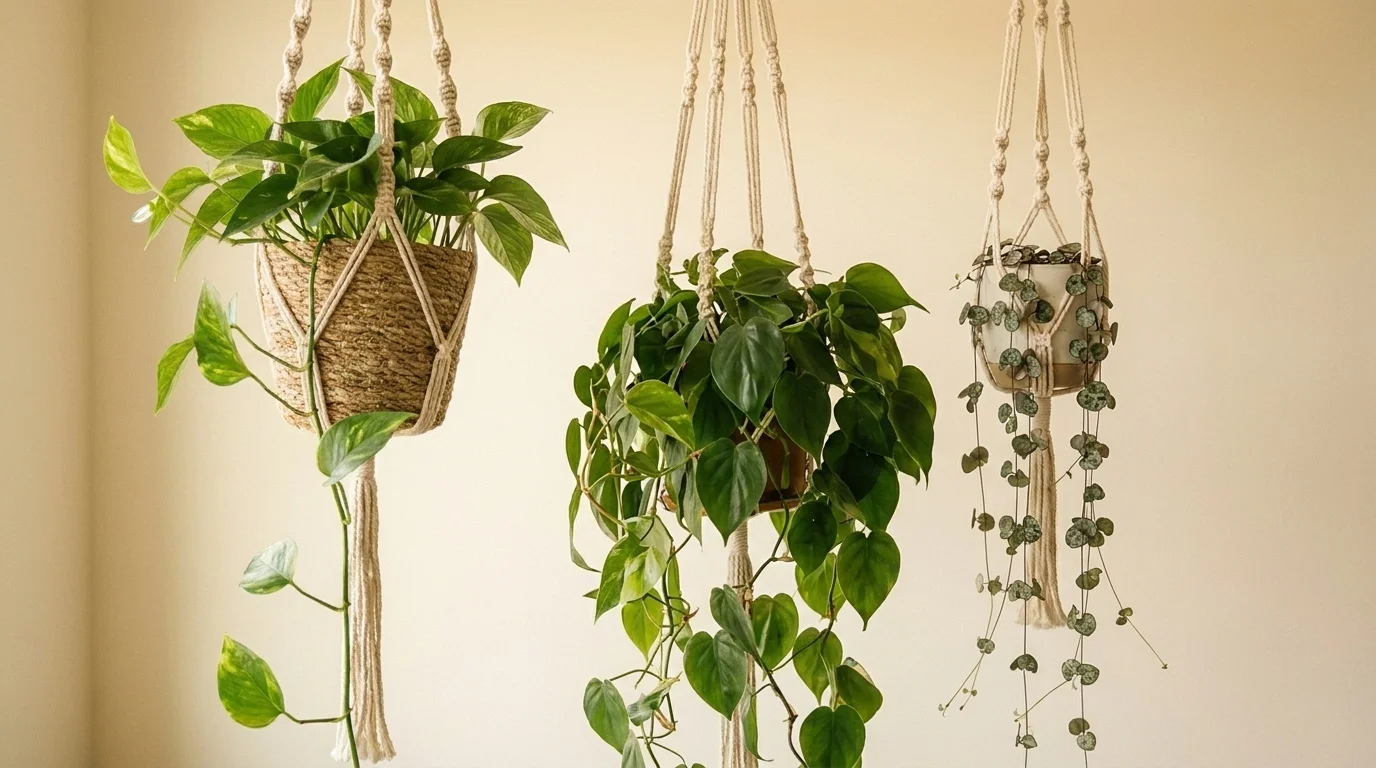
One macramé hanger is an ornament; three at staggered heights in a single corner become a cascade — the eye reads a garden, not a lone pot.
The classic, and still the best entry point — a knotted cotton hanger costs little, needs one hook, and asks nothing of the wall itself. The trick is to stop treating one as an ornament and hang three, at staggered heights in a single corner, so the eye reads a cascade rather than a lone pot.
Ceiling-hook trailing corner
A dead ceiling corner is wasted vertical space. One well-anchored hook and a trailing pothos or philodendron will, given a season, pour a curtain of green down the join of two walls — the cheapest way to soften a hard architectural edge.
Not every room gets direct sun, and you do not need it. Set your hangers back from the window, out of the glare but inside the light, and low-light trailers — pothos, heartleaf philodendron, the humble spider plant — will thrive where a fussier plant would sulk. This is the display for the north-facing room everyone writes off.
Trailing succulent wall
The newer idea most legacy fern-and-pothos lists miss: trailing succulents, hung in a loose cluster, for a wall of texture that forgives a forgotten watering. They have become a genuine indoor trend, and if you ask me, forgiving a forgotten watering has a good deal to do with it.
Hanging propagation station
Half display, half nursery. A row of clear glass vessels, each holding a cutting rooting in water, becomes living décor while it works — and it is how a single pothos quietly becomes the six you hang everywhere else. Nothing bought that you did not already have.
Outdoor, Balcony & Railing Hanging Garden Ideas
Outdoors, and especially on a balcony, the constraint sharpens: you are gardening on borrowed edges — a rail, a bracket, a bit of fence — because the floor is either taken or not yours to dig. That constraint is the whole design brief.
Classic overflowing hanging baskets
The front-porch staple, and it earns the cliché. A basket packed with trailing annuals will spill over its own rim by midsummer until the container disappears entirely. Pick varieties that cascade, plant them thick, and let them do the one thing they are built for.
Railing planters for a balcony
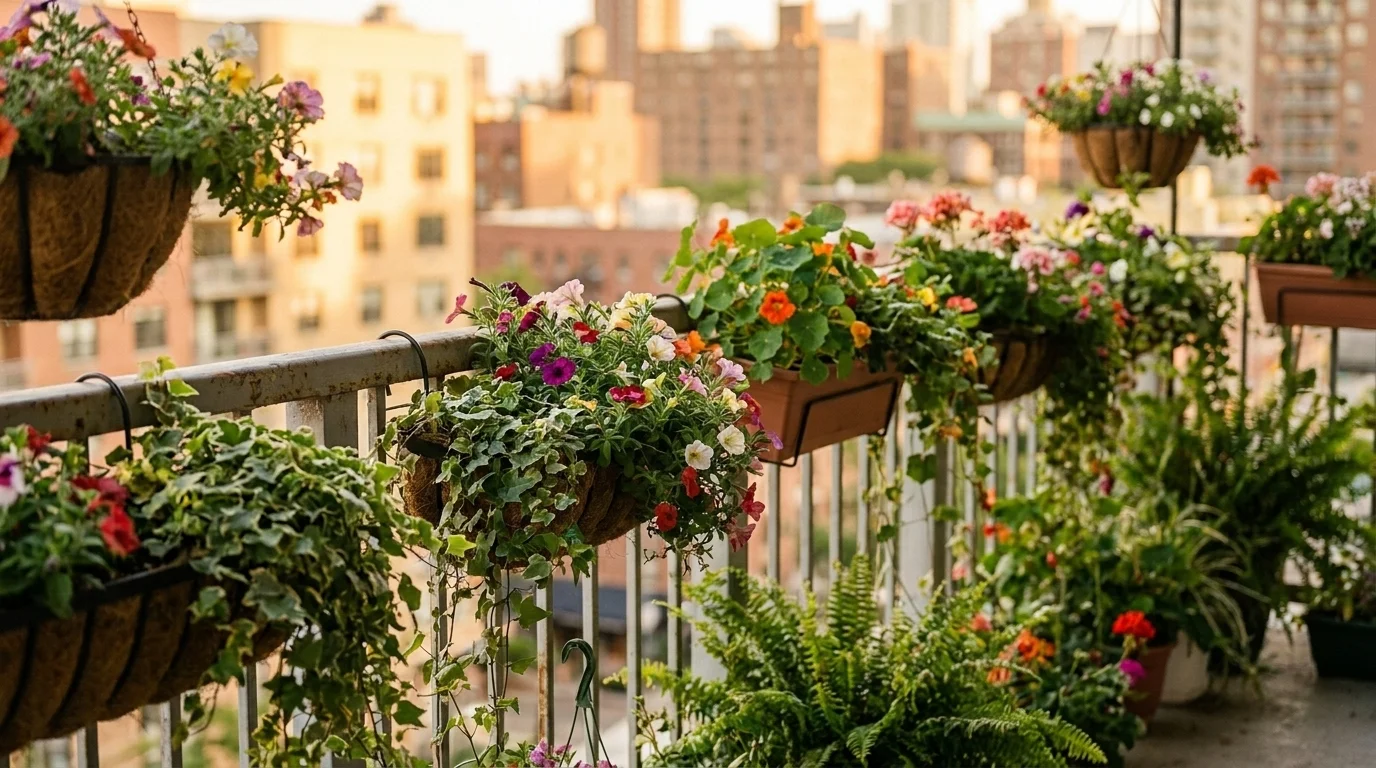
The balcony grower's single most useful move: planters that saddle or clamp onto the rail itself, so you garden along the edge without surrendering a centimetre of the standing room you already ration. On a small balcony, floor space is the scarce resource — the rail is the frontier.
Balcony privacy wall of greenery
Stack hanging pots at descending heights across one side and you have built a living screen — privacy from the neighbouring balcony that also happens to be a garden. It is the rare piece of screening that improves the air on both sides of it.
Fence-mounted pots & tiered basket columns
A blank fence is a vertical bed waiting to be claimed. Mount a grid of pots across it, or hang a tiered column of baskets from a single sturdy hook, and you get real layered planting from a footprint of almost nothing.
Low-maintenance sun picks
For the sunny rail belonging to someone who forgets to water — and that is most of us, some weeks — reach for drought-tolerant trailers: sun-hardy trailing annuals, herbs, and trailing succulents that shrug off a missed day. Match the plant to your habits, not to an ideal version of yourself.
Loading image...
On a small balcony the floor is the scarce resource, so the rail becomes the frontier — garden along the edge and keep every centimetre of standing room.
Vertical & Living Wall Ideas
The wall is the most ambitious surface, and the most rewarding — a full vertical garden reads less like a collection of pots and more like a single green object. Here the "hanging garden" and the "vertical garden" become the same thing.
Pocket & felt wall planters
Modular fabric pockets, hung in a grid, are the simplest route to a genuine green wall — each pocket a small planting bed, the whole panel a curtain of foliage. They mount to a wall or fence and scale to whatever space you are willing to give them.
Pallet or reclaimed-wood wall
An upcycled pallet, stood against a fence and planted through its slats, is a vertical bed for the price of a bit of salvage and an afternoon. If you want the structure without the wall, the same instinct scales up into proper vertical structures and trellises that carry climbers as well as trailers.
Modular gravity-fed towers
The idea that went mainstream: stacking towers — the GreenStalk-style systems — that fit more than 30 plants into a two-foot-by-two-foot footprint and water the whole column from the top by gravity. For a productive vertical garden in the smallest possible plan area, this is the current benchmark.
Full living green wall
The aspirational end — a wall greened edge to edge, framed in 2026 coverage as "living art" that adds movement to a flat surface through cascading vines. It asks for more plumbing and patience than a row of baskets, but even a single planted panel gestures at the effect.
Gutter garden
Lengths of rain guttering, mounted in rows up a wall, make shallow horizontal beds ideal for lettuces and other shallow-rooted greens — a flat-pack green wall for anyone who would rather build than buy.
DIY & Upcycled Hanging Garden Ideas
This is the section I like best, because it answers the land question with almost no money. You do not need a garden centre; you need a look around the recycling. Every idea here starts with something on its way to landfill.
Plastic-bottle tower
Cut and stack plastic bottles into a hanging column and you have a vertical planter that cost you nothing but the bottles you were binning anyway. It is crude, it is effective, and it is the purest expression of growing with what you have.
Repurposed shoe-organizer pockets
A hanging fabric shoe organiser is, if you squint, a ready-made pocket wall — each pouch a planting cell for herbs or small trailers. Hang it on a fence or a balcony wall and skip the specialist product entirely.
Driftwood / reclaimed-wood air-plant mount
Air plants need no soil at all, which frees you to mount them on a piece of driftwood or salvaged timber and hang the whole thing as sculpture. It is the lowest-maintenance living object in the house.
Hanging terrarium globes
Glass orbs of moss and small succulents, suspended at eye level, are a jeweller's version of the hanging garden — tiny, self-contained, and quietly mesmerising in a window.
Mason-jar wall rail
Clamp a row of jars to a mounted board and you have a herb rail for the kitchen wall — leftover jars, a length of timber, and a handful of screws. The whole thing reads as deliberate once it is up.
Edible Hanging & Vertical Gardens
Here I am back on home ground, because this is what a hanging garden is for, as far as I am concerned — not only to be looked at, but to be picked from. Lifting food off the soil and up to hand height is one of the oldest small-space moves there is.
Strawberry towers & hanging bags
Strawberries were made for this. Grown in a hanging bag or a stacked tower, the fruit dangles clear of the ground, out of reach of slugs and easy to pick — a berry patch for people with no patch.
Herb baskets by the door
A basket of basil, thyme, and trailing rosemary hung within arm's reach of the kitchen door is the most-used garden most people will ever own. The measure of it is not the harvest weight; it is how often you actually walk out and cut something.
Hanging lettuce & salad greens
Shallow-rooted, quick, and lifted safely above the pests that would otherwise find them, salad greens in a hanging trough or gutter give you cut-and-come-again leaves from a strip of wall.
What Are the Best Plants for a Hanging Garden?
The best hanging plants are trailers matched to your conditions — pothos and heartleaf philodendron for shade indoors, drought-tolerant trailers for a sunny balcony. Choose for the light you have, not the light you wish you had, and the plant does the rest.
Plant
Best for
Light
Why it hangs well
Pothos
Indoor, low light
Low to bright indirect
Trails for metres from one pot; nearly unkillable
Heartleaf philodendron
Indoor, low light
Low to bright indirect
Soft, fast vines that fill a corner
Spider plant
Indoor, low light
Low to bright indirect
Arching stems drip baby plantlets; pet-safe
Grape ivy
Indoor, low light
Low to medium indirect
A tolerant climber-trailer for a shaded room
English ivy
Indoor, low light
Low to bright indirect
Dense green curtain (keep clear of pets)
Trailing annuals
Outdoor / balcony sun
Full sun
A season-long spill of flower over the rim
Trailing succulents
Balcony / bright indoor
Bright, some direct
Drought-tolerant and sculptural; forgives a missed watering
Trailing herbs
Balcony / doorway sun
Full sun
Edible, fragrant, and picked at eye level
Best indoor hanging plants for low light
For rooms away from direct sun, the reliable five are pothos, heartleaf philodendron, spider plant, grape ivy, and English ivy. All of them trail, all of them tolerate the low, indirect light of an interior wall, and none of them will punish you for the occasional lapse.
One honest caution before any of these goes up in a home with a cat, a dog, or a small child. Pothos, heartleaf philodendron, and English ivy are all listed as toxic to cats and dogs by the ASPCA — the spider plant on that same list is one of the safe ones. Hanging carries a quiet safety dividend here: a basket at head height is one a curious puppy or a toddler cannot reach. But a fallen leaf or a low-trailing stem is still within reach, so check the ASPCA's list before you bring anything new indoors, and if you are unsure, choose the spider plant. The broader houseplant care basics are worth a read before you commit.
Best low-maintenance outdoor & balcony hanging plants
Outside, and on the balcony rail, the brief is resilience. Sun-tolerant trailing annuals for colour, trailing herbs for use, and drought-tolerant trailing succulents for the weeks you are away — these are the plants that survive real life rather than an idealised watering schedule.
How Do You Design and Mount a Hanging Garden?
Design it by choosing a structure sturdy enough for the loaded weight, fixing the containers securely so they cannot fall, then grouping plants by their light and watering needs. This is the unglamorous half nobody photographs, and it is the half that decides whether the whole thing survives the first windy fortnight.
Loading image...
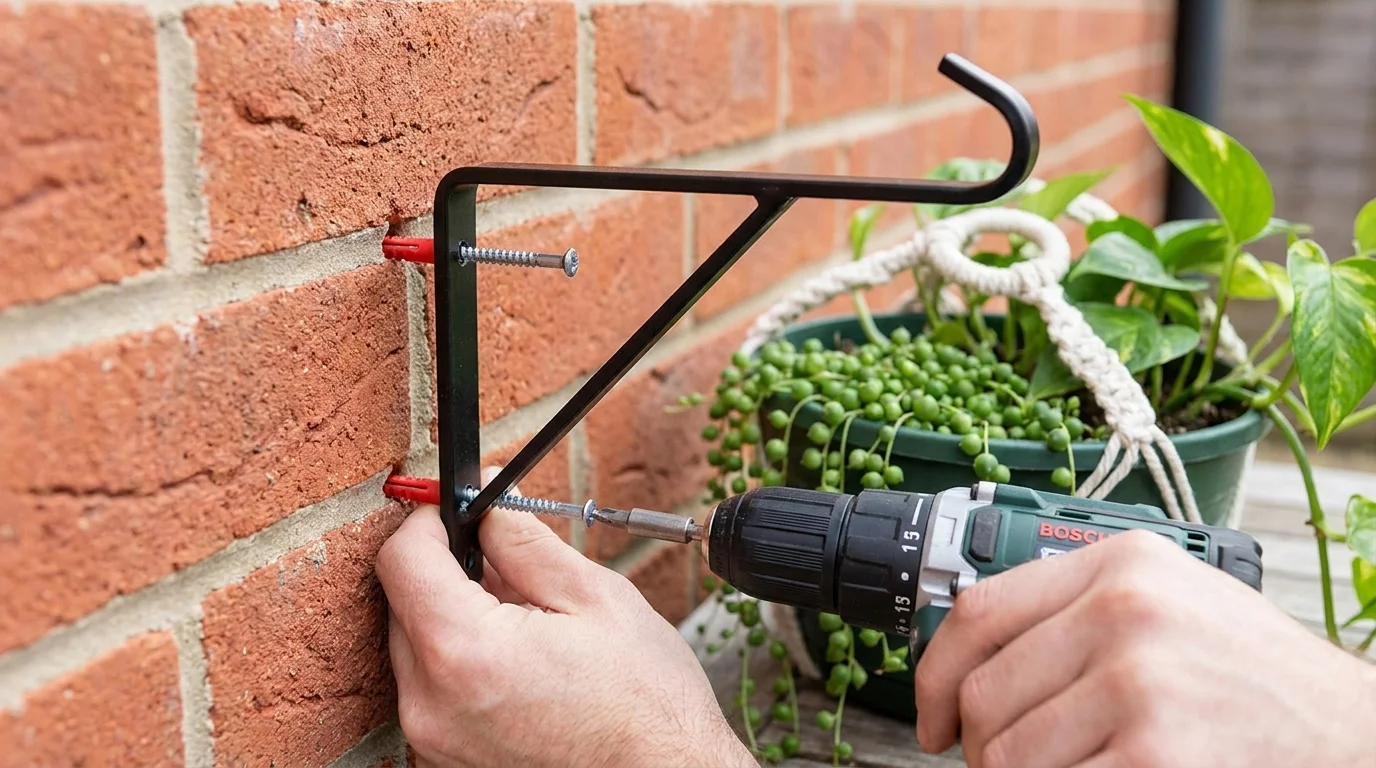
A hanging garden is heavier than it looks, and heavier the moment you water it — anchor into something that holds and rate the fixing for the wet weight, not the empty one.
Make it secure — weight & mounting
A hanging garden is heavier than it looks, and it gets heavier the moment you water it. The advice from Garden Design's Janet Loughrey is worth taking verbatim: "Insure that walls, fencing, vertical planters, or other structures are sturdy enough to support the weight," and "affix planting containers securely so they don't become detached or fall." In plain terms — anchor into something that will hold, use fixings rated well above the wet weight, and give every container a drainage hole so it is not also holding a reservoir of rain. Count the real load, not the empty one.
Avoid the #1 mistake — shallow watering
The commonest way to lose a hanging garden is to water it badly, and the usual instruction — "water when dry" — is dangerously vague for a hanging container, because moisture stratifies top to bottom and the surface lies to you. The care writers who actually diagnose this are blunt about the fix: probe at least two inches deep before you decide, and check near the basket's inner wire rim, where the roots concentrate and the drying starts. A hanging basket dries faster than anything at ground level; treat it accordingly, and water for where the roots are, not for what the top inch is telling you.
Start With One
Strip away the marble and the myth and a hanging garden is a plain, hopeful piece of work: an idea that suits your space, a plant matched to your light, and a fixing that holds. Get those three right and the rest is watering. You do not need a wall of them to begin — the whole thing starts with one. A single macramé hanger in a low-lit corner, or one railing planter of trailing herbs by the door, mounted properly so it stays where you put it, and you have joined a very old tradition of people making a garden out of the space they were given rather than the space they wished for. That, in the end, is what hanging gardens have always been. Pick one idea from this list of hanging garden ideas, hang it this weekend, and come back to VerdeNook's houseplant and container guides when you are ready for the second.
Frequently Asked Questions
What are the best plants for an indoor hanging garden?
Low-light trailers like pothos, heartleaf philodendron, spider plant, grape ivy, and English ivy thrive away from direct sun and cascade well.
What are common hanging or vertical garden mistakes?
Sporadic surface-only watering — probe at least 2 inches deep and check the basket's inner rim, since hanging containers dry fast and stratify moisture.
What plants work for a balcony or railing hanging garden?
Low-maintenance sun-tolerant picks in railing planters and hanging baskets — trailing annuals, herbs, and drought-tolerant trailing succulents.
Are hanging gardens the same as the Hanging Gardens of Babylon?
No — the ancient wonder was a legendary terraced garden; a modern hanging garden is a practical vertical display of potted or trailing plants for homes and balconies.
United Greens: The Story of Two Neighbors Transforming Their Fence Line into a Lush Edible Garden
Join
Loading...
Our Green Community!
Loading...
VerdeNook is more than just a source of gardening wisdom; it’s a platform for sharing, learning, and growing together. We invite you to join our community, share your stories, and spread the joy of gardening. Let’s sow the seeds for a greener, healthier, and more sustainable future, one garden at a time.