A trellis is one of the most buildable things in the garden — the internet just decided it is a $350 purchase. Pick a shape and build it instead.
Every search for a garden trellis ends the same way: a wall of storefronts quoting $300 arches and $500 obelisks, as if the only way to grow vertical is to swipe a card. It's one of the most buildable structures in the whole garden, and the internet has quietly decided it's a luxury purchase.
Let me push back on that. A trellis is just a frame of crossed supports a climbing plant can grab — and you can bend one from a single cattle panel for about $50, or zip-tie one from concrete remesh for under $20, in an afternoon. This guide runs the three things no ranking page puts in one place: a scannable gallery of shapes worth stealing, the actual build steps for the arch and the budget panel, and a straight wood-vs-metal cost table so you can choose instead of guess. Ideas first, then the build, then the decision.
Garden Trellis Ideas to Steal for Your Backyard
The good news for anyone building rather than buying: trellises have become the most versatile design object in the garden. The 2026 framing is that they're "stepping beyond simple plant supports and becoming statement pieces that shape the entire backyard aesthetic," from sculptural wood to modern metal grids (TheCoolist). That's the inspiration layer — and it's exactly where most articles stop.
Loading image...
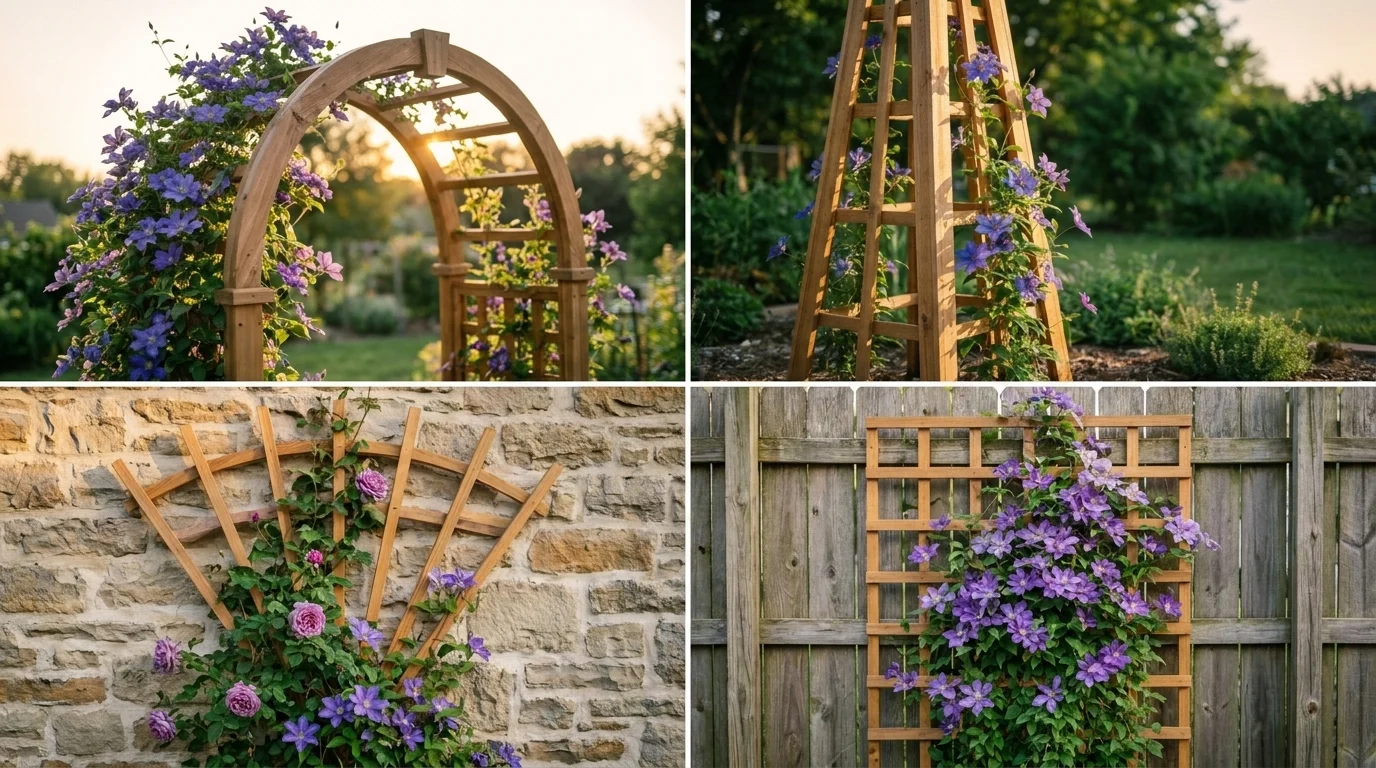
Trellises have quietly become the garden's most versatile design object — steal whichever shape fits your space, then build it for a fraction of the store price.
Before we go deeper, here's the shape vocabulary, because "trellis" covers a lot of ground. Steal whichever fits your space:
Arch — a curved frame you walk through; the sculptural focal point, and the one we build below.
Obelisk — a four-sided tapering tower for a single showpiece climber or a pot.
Fan — ribs spreading from a base, classic against a wall for roses or clematis.
Flat panel / lattice — the workhorse; a grid you lean, mount, or frame.
A-frame — two panels leaned together like a tent, brilliant straddling a vegetable bed.
Tepee / cage — stakes or a ring lashed at the top (Seed Savers Exchange); my own go-to for beans and peas.
Wall-mounted panel — the small-space and urban pick, going vertical where there's no ground to spare.
Freestanding panel — the same climbing surface, staked into a bed or a large pot, no drilling required.
That last pair matters if you rent. A wall-mounted panel means screws into masonry; a freestanding one gives you the same surface with nothing to patch when you leave.
But a gallery is where the incumbents give up — pretty photos, no help. A trellis still has to be built, matched to your plants, and chosen on cost, which is the rest of this guide. Want more projects in this vein? The DIY Gardening category is full of them.
The Garden Trellis Arch — A Statement You Can Build Yourself
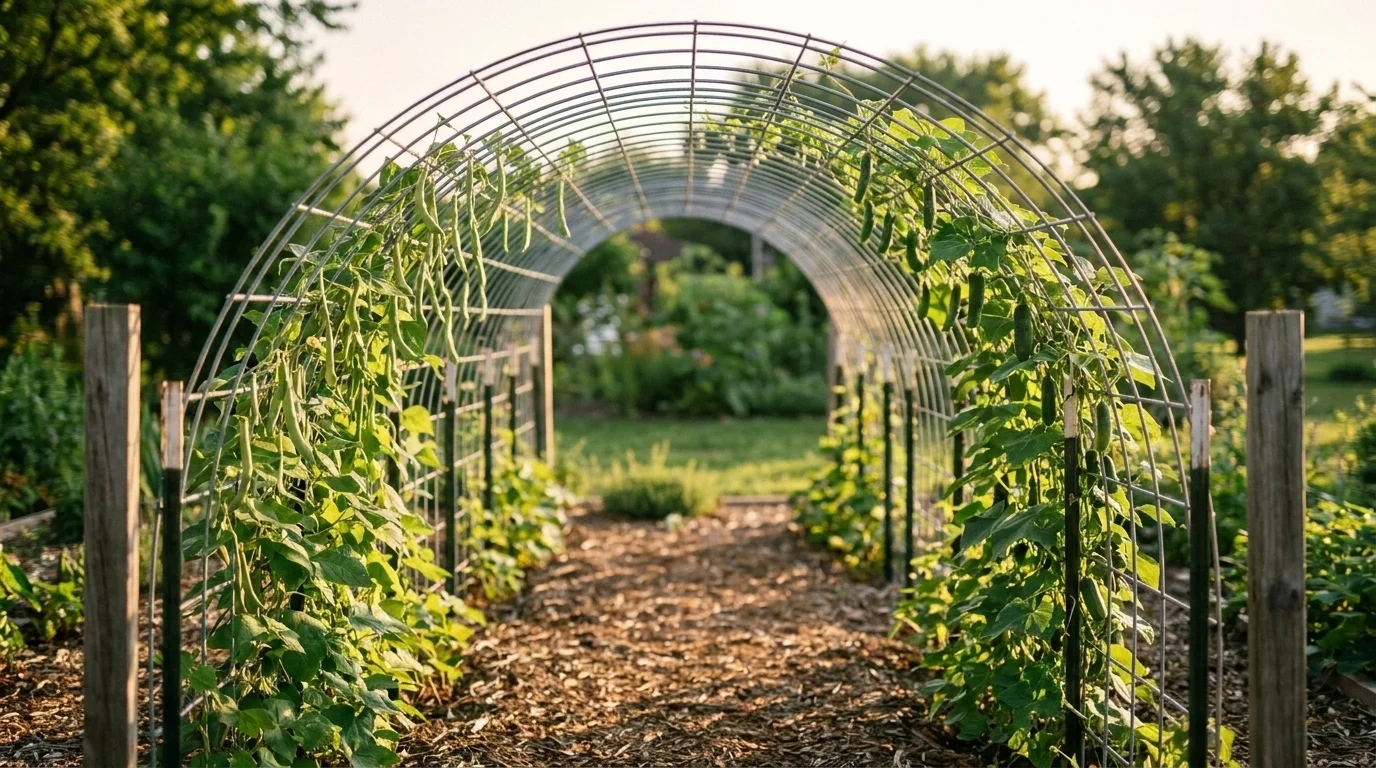
A garden trellis arch is a curved frame you walk through; one bent 16-foot cattle panel makes one for about $50 that lasts years. It's the biggest, most sculptural thing you can add to a garden for the least money — and it's the build the retail results price at $299 to $349.
Why an arch over anything else? To my eye it does three jobs at once: it's a focal point you move through rather than just look at, it frames a path or a gateway between garden zones, and it turns a single footprint into vertical growing space by sending vines up and over instead of sprawling sideways. In the 2026 "statement piece" framing, nothing else earns its footprint like it.
The store-bought version is real, and fine if you don't want to build — Vego Garden's arch runs $349, Gardener's Supply's "Jardin" rose arch $299.99 (Barrier Boss, 2026). But the DIY version costs a sixth of that and is arguably sturdier, because a galvanized cattle panel is farm-grade steel meant to hold livestock.
One caution before you start, and it's a real one. As Jessica Walliser of Savvy Gardening puts it, "Cattle panels are very stiff and will only arch and flex so much." A 16-foot (about 5 m) panel wants to spring back straight — wrangle it with a second pair of hands, keep your face clear of the ends, and don't force the curve tighter than it gives.
Materials, about $50: one 16-foot cattle panel, four 6-foot T-posts, and 24 UV-resistant zip ties (Savvy Gardening).
Site it in full sun — 8 or more hours a day, since you'll be growing heavy croppers up it.
Drive the T-posts in two facing rows, the rows about 5 feet (1.5 m) apart, two posts per side, hammered a foot or so into firm ground.
Arch the panel. Stand one 16-foot end at the base of the first row, then walk the far end toward the second row so the panel bows into a curve, and seat it inside the posts.
Zip-tie the panel to every post it touches, top and bottom — this is what stops the whole thing sailing off in the first real gust.
Plant 4 to 5 vines, or 15 to 20 bean seeds, per side at the base, and train the first growth onto the steel.
That's a Saturday, one panel, and a structure that will outlast the arch someone paid six times as much for.
Loading image...
One bent 16-foot cattle panel, about $50, and a Saturday — and you get an arch sturdier than the $349 kit, because it is farm-grade steel built to hold livestock.
Wood vs. Metal Trellises: Cost and Durability
Wood trellises look natural but rot in 3 to 5 years; galvanized panel and powder-coated steel or aluminum last far longer for a similar cost. That single trade-off is the decision no product listing makes for you.
Wood — cedar, or bamboo lashed into a lattice — is the warm, natural look, and it's the friendliest material to cut and screw together yourself. The catch is lifespan: untreated wood in contact with soil and weather rots in 3 to 5 years (Barrier Boss, 2026). For plenty of gardeners that's a fair trade for the aesthetic and the low entry cost — just know you're signing up to rebuild it.
Metal lasts. Galvanized cattle panel is the budget-and-brawn end: farm steel that shrugs off weather for years. Powder-coated steel and aluminum are the lightweight, low-stress-mounting option the 2026 trend lists keep naming, because a thin aluminum panel weighs almost nothing and won't rust. And for a heavy perennial — an established climbing rose, a wisteria that will one day try to pull a wall down — heavy-duty wrought iron is the one built to carry the load.
Here's the whole decision on real 2026 numbers:
Trellis
Typical cost
Lifespan
Best for
Remesh panel (DIY)
Under $20 (~$7/sheet + ~$2/stake)
Years — galvanized steel
The cheapest flat trellis
Cattle-panel arch (DIY)
~$50
Years — galvanized steel
Budget + heavy vegetables
Wood panel (cedar / bamboo)
DIY; framed panel ~$40–$60
Rots in 3–5 years untreated
A warm, natural look
Store-bought metal arch kit
$299–$349
Years
Non-builders who'll pay for finished
Read it top to bottom and the pattern is the one running through this whole guide: the cheapest options are DIY galvanized steel, the natural material is the one you replace on a timer, and the priciest line is the one someone else assembled. Choose on how you weigh look against labour — because budget and durability both point the same way.
The cheapest garden trellis is a concrete "remesh" panel zip-tied to two stakes — about $7 for the sheet and $2 a stake, under $20 all in. Everything above that line is a matter of taste, not necessity.
This is the section retailers can't serve, because there's nothing to add to cart. As Deanna Talerico of Homestead and Chill puts it, a trellis is a "great space-saver" that lets you "'get vertical' – which can be especially useful when growing space is limited." That isn't a slogan to me — it's the entire reason I grow the way I do on 42 square feet. Going up is how small spaces win.
The Under-$20 Remesh Panel Trellis
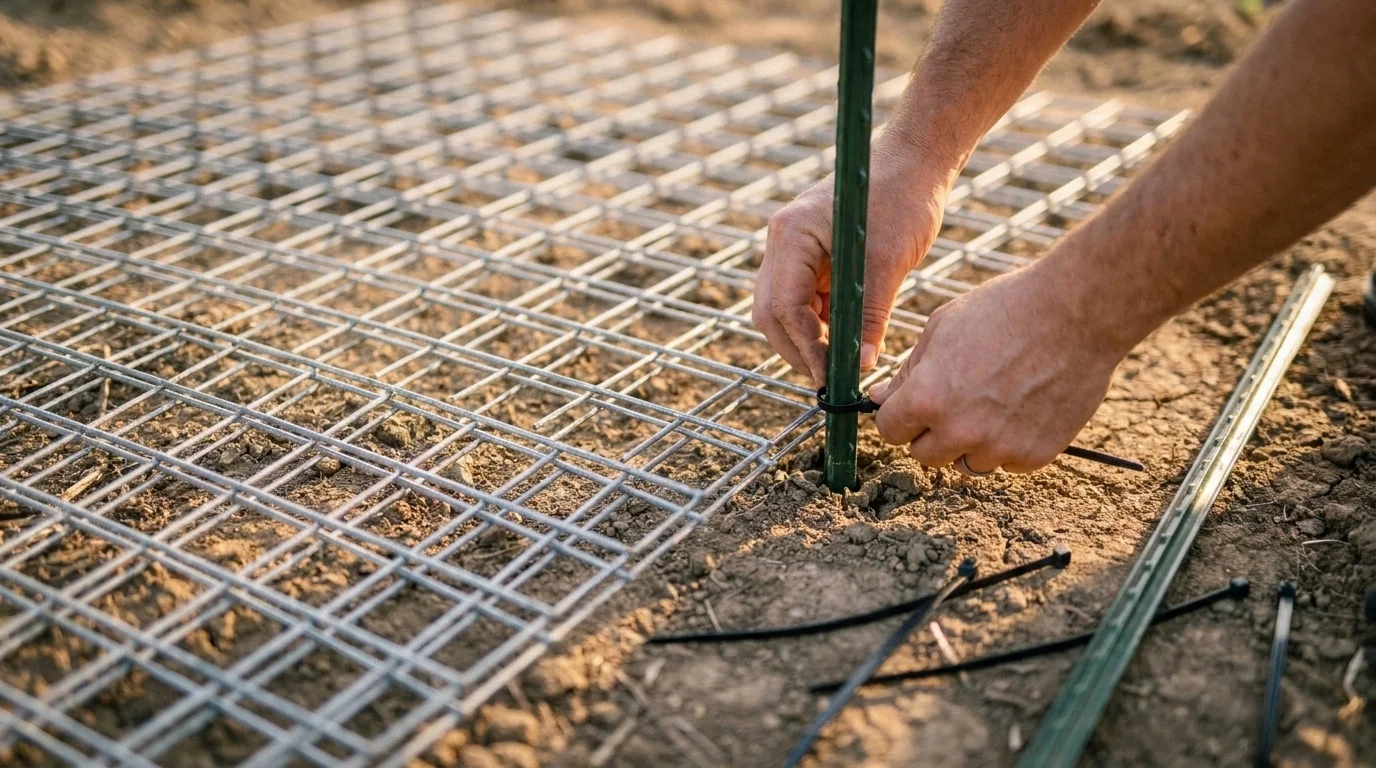
Concrete reinforcing mesh — "remesh," sold in flat sheets in the concrete aisle — is a rigid galvanized grid that makes a superb flat trellis for almost nothing. Stand a sheet on edge, zip-tie or wire it to two driven stakes or T-posts, and you're done: about $7 for the panel, $2 a stake, under $20 total (Homestead and Chill). Want it to look less agricultural? Screwing a simple cedar frame around it lifts the build to roughly $40 to $60 — still a fraction of a store panel, and now it reads as furniture rather than farm salvage.
Loading image...
The cheapest trellis there is: a concrete remesh sheet, two stakes and a fistful of zip ties, under $20 all in. Everything above that line is taste, not necessity.
A DIY Trellis for Potted Plants
For a container — a balcony pot, a raised-bed corner — you don't need steel at all. Three or four bamboo canes pushed in and tied at the top into a tepee, or a spiral of jute twine run between a couple of stakes, is all a pea, a bean, or a morning glory has ever asked of me. It costs a few dollars, packs away flat at the end of the season, and puts zero holes in anything you'd have to answer for at a rental inspection.
And if even that feels like a purchase, repurpose. An old ladder, a wooden pallet stood on end, a length of leftover fencing, a tomato cage, or jute twine strung between two posts all work — anything rigid a climber can grab is a trellis.
Choosing a Trellis for Climbing Plants and Vegetables
The right trellis is the one matched to what's climbing it, because a support that's wrong for the plant either buckles under it or disappears beneath it.
Match the structure to the plant's weight and habit. Light annual vines — peas, morning glory, nasturtium — grab almost anything; a twine grid or a thin panel is plenty. Heavy perennials — mature climbing roses, wisteria, trumpet vine — need wrought iron or a heavy-duty steel panel that won't bend under years of woody growth. Vegetables sit in between and lean heavy: cucumbers, pole beans, and squash pile on weight fast, which is exactly why the cattle-panel arch earns its keep in a food garden — plant 4 to 5 vines or 15 to 20 bean seeds a side and it carries the whole crop (Savvy Gardening).
Placement changes the rules. A potted indoor climber needs almost nothing — a small stake or a hoop to lean on. Outdoors is where people underbuild, and I've paid for it: my balcony catches a cross-wind off the lake that has dismantled two trellises a calmer yard would never have troubled. A mature vine in leaf is a sail. Anchor an outdoor trellis like you mean it — posts driven deep, panels tied to every support — before the wind and the weight of a full-grown plant test it for you.
Two climbers deserve a guide of their own rather than a line here: cucumbers, which want a dedicated arch or A-frame, and climbing roses, which want a fan or wrought iron to carry their canes. Both are their own project — look for those in the DIY Gardening guides as they land.
2026 Garden Trellis Trends to Watch
Five looks are defining the 2026 garden trellis, and they all point the same way — toward the trellis as a design object, not just a plant prop (Leafy Haven Home):
Wall-mounted panels for small and urban spaces, squeezing a growing surface out of a bare wall.
Powder-coated aluminum — lightweight, rust-proof, and easy on whatever it's fixed to.
Painted, colourful trellises used as deliberate splashes of colour rather than hidden behind the foliage.
Reclaimed and weathered wood, leaning into character instead of buying new.
Geometric steel grids standing as sculptural focal points in their own right.
Notice the through-line: every one treats the trellis as a "statement piece that shapes the entire backyard aesthetic" (TheCoolist). Whether you build or buy, the structure is meant to be seen now — so pick a shape and a finish you'd want in the frame even before the vine covers it.
The Bottom Line
You don't need a $350 kit to grow vertical. With a weekend, one 16-foot cattle panel, and about $50, you can raise a garden trellis arch that outlasts a store-bought kit and sends your vines up instead of out — or spend under $20 on a remesh panel and get climbing this season either way.
Pick one shape from the gallery, grab the matching build — the arch or the budget panel — and put it up while the growing's good. Then come back to the DIY Gardening category for the next project, and check the cucumber-trellis and climbing-roses guides once you know exactly what you're sending up it.
Frequently Asked Questions
What is a garden trellis called?
A trellis is also called a lattice, espalier, or trellis panel; in its arched form it's a garden arch or arbor — all frameworks of crossed supports that climbing plants grip.
What is the cheapest way to make a trellis?
A concrete "remesh" panel zip-tied to two stakes costs under $20; a bent 16-foot cattle-panel arch runs about $50 and lasts for years — versus $299–$349 for a store-bought metal kit.
What can I use instead of a trellis?
Repurpose an old ladder, a wooden pallet, a metal fence or cattle panel, or a tomato cage — or simply string jute twine between two posts. Anything rigid a climber can grab will do.
Is a wood or metal garden trellis better?
Wood (cedar, bamboo) looks natural but usually needs replacing in 3–5 years; galvanized cattle panel and powder-coated steel or aluminum last far longer for a similar or DIY-cheaper cost.
How do you install a garden trellis?
Anchor it firmly — sink posts or T-posts at least a foot deep, or screw a wall-mounted panel into studs or masonry — so wind and the weight of a mature vine can't topple it.
VerdeNook is more than just a source of gardening wisdom; it’s a platform for sharing, learning, and growing together. We invite you to join our community, share your stories, and spread the joy of gardening. Let’s sow the seeds for a greener, healthier, and more sustainable future, one garden at a time.