A community garden's quiet return is this: a dozen people who did not know each other in March, arguing about tomatoes by July — neighbours you actually know.
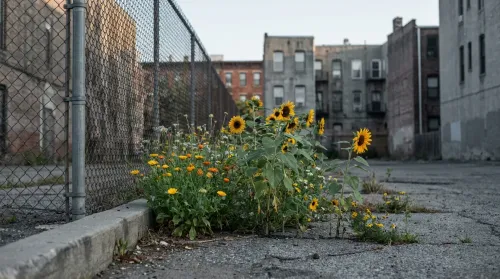
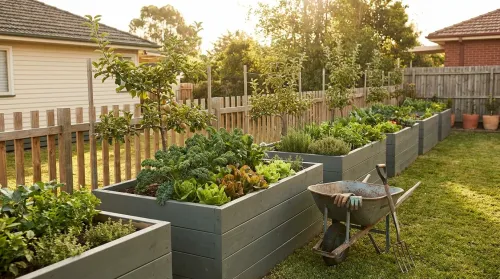
There is a fenced lot on a city block somewhere near you that used to be empty — broken asphalt, a chain-link fence, the kind of ground a neighborhood learns to stop seeing. On a lot like that, a single season is enough to change everything. Rows of raised beds appear, then a water tank, then a hand-painted sign, and by midsummer a dozen people who did not know each other in March are arguing, in the best-humoured way, about tomatoes. That is what community gardens do: they turn shared, unused ground into fresh food, a reason to be outdoors, and — almost as a by-product — a set of neighbors you actually know.
This guide covers the whole of it: what a community garden is, how they work, the real benefits, and how to start or join one. But it also tells you what the cheerful versions leave out. The food payoff is real, and it is uneven — recent research shows it does not reach everyone equally — and the difference between a plot that works and one that disappoints is knowing that going in. So we will take the promise seriously, and the fine print just as seriously.
What Is a Community Garden?
A community garden is a single piece of land gardened collectively by a group of neighbors, usually divided into individual or shared plots that members tend themselves. That is the whole idea in one sentence, and the three words carrying the weight are shared, collective, and plots.
Loading image...
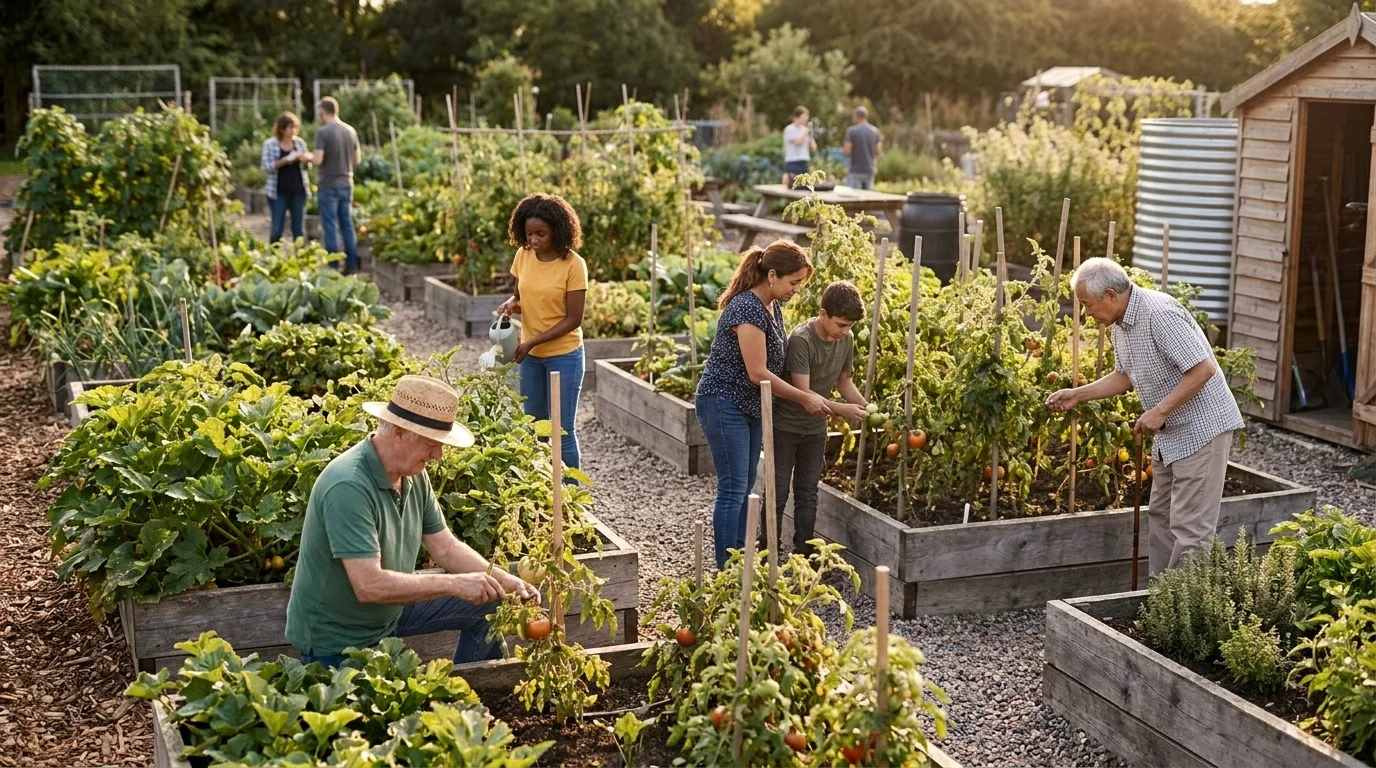
Shared ground held in common, worked as individual beds — the middle path between a private backyard and a farm, and a vacant lot turned back into food.
It helps to say what it is not. It is not a private backyard garden, where one household owns the ground and makes every decision. And it is not a farm, where the point is production for sale. A community garden sits between the two: the land is held in common — often a vacant lot, a strip of park edge, a schoolyard, or a piece of church ground — while the growing happens on individually worked beds, governed by rules the members set together. None of this is new. The wartime victory gardens of the 1940s and the community-garden revival that swept North American cities in the 1970s are the same instinct wearing different clothes: when land is short and food matters, people grow it together.
The scale is larger than most people assume. The American Community Gardening Association estimates there are roughly 18,000 community gardens across the United States and Canada, with about 2,100 linked directly through its own network. That is a movement, not a novelty — which is why it is worth understanding properly before you go looking for a plot. If you want the wider lane, VerdeNook's Community Gardening coverage runs alongside this guide.
Do Community Gardens Really Deliver on Food Security?
Yes — but unevenly. Community gardens produce substantial food, yet a 2024 study found the benefit skews toward gardeners with more time and higher incomes.
Start with why the question matters. In 2023, more than one in ten US households were food insecure, and roughly 23 million people lived in communities without easy access to affordable, nutritious food — the backdrop, as Green America notes citing USDA figures, that keeps interest in community gardens durable rather than faddish. The movement has heard it. The American Community Gardening Association themed its 2026 national conference, held in Denver, "Pathway to Food Security" — which is a movement saying out loud that it wants to be food infrastructure, not just amenity.
So do the gardens deliver? They grow real food. In a 2024 Sustainability Science study of 18 community gardens on California's Central Coast, 38 percent of gardeners estimated harvesting one to five pounds of produce a week at peak, and another 26 percent put their haul at six to ten pounds. That is not a token basket of herbs; that is a genuine contribution to a household's table.
Here is the part no other guide on the first page of Google will tell you, and it is worth sitting with. The same study found that food security was higher for gardeners who had more time and higher incomes, and lower for those with larger families or lower incomes. Read that twice. The people who most need the food are not reliably the ones harvesting the most of it. This is the honest complication at the centre of community gardening, and it is a question of labour hours and access before it is a question of soil. A plot rewards the time you can give it, and time is exactly what a person working two jobs and raising three children has least of. "Food security requires addressing not just immediate hunger but also the systemic issues that cause it," Erin Meyer of Basil's Harvest told Green America, and the uneven harvest is one of those issues in miniature.
None of that is an argument against community gardens; it is an argument for running them with your eyes open. A garden that wants its food to reach the households that need it has to design for that, not assume it will happen. Three things help. Income-based plot fees or scholarships lower the door for the people a flat fee quietly excludes. Choosing high-yield, low-effort crops — beans, greens, zucchini, the vegetables that forgive a missed week — puts the most food within reach of the gardener with the least time, where a bed of fussy heirloom tomatoes rewards the retiree and not the night-shift nurse. And a communal bed, worked and harvested collectively and sent home with whoever needs it, moves output toward need instead of leaving it to fall where time and money already sit. The food benefit is real. Whether it lands fairly is a decision the garden makes.
Loading image...
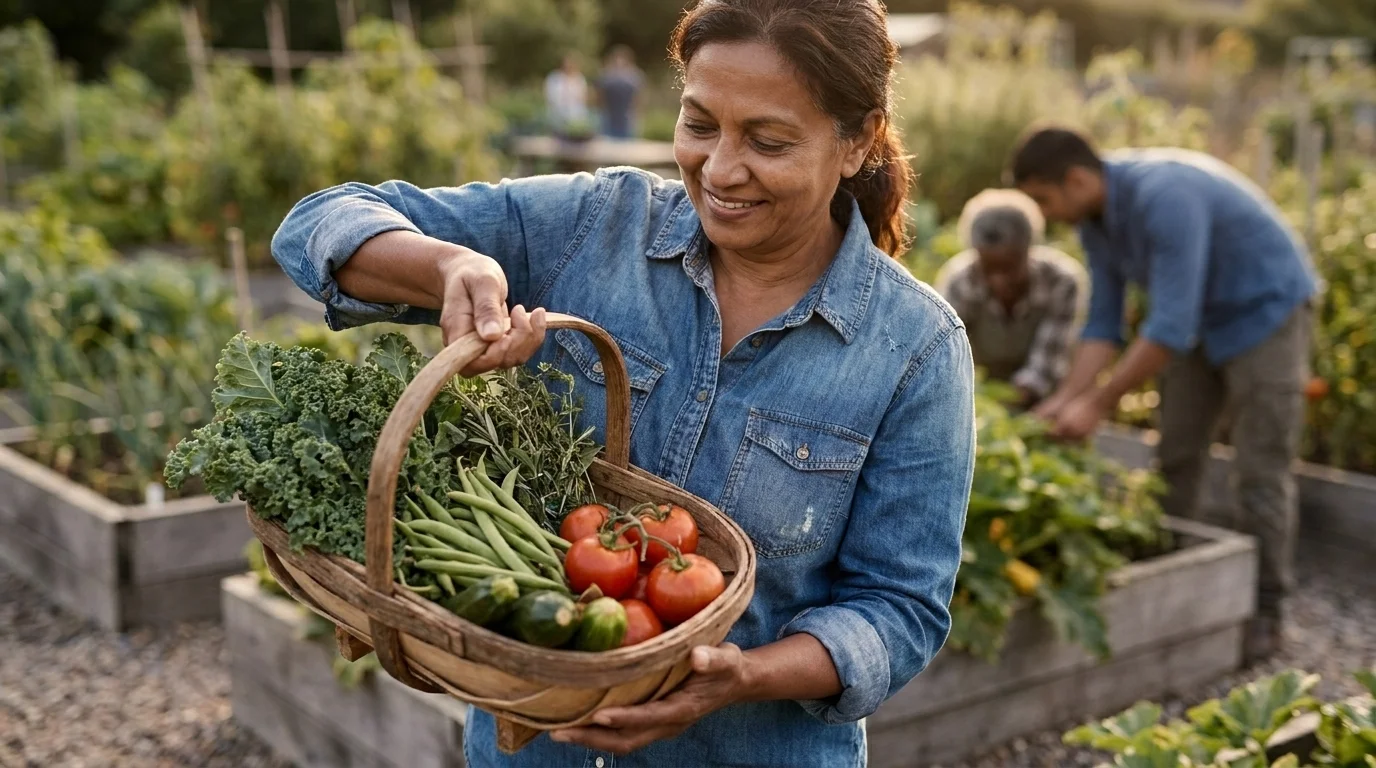
A plot grows real food — often one to ten pounds a week at peak — but the harvest skews to whoever has the time, which is exactly what the least-served household lacks.
How Do Community Gardens Work?
Members apply for a plot, usually pay a small seasonal fee, and follow shared rules on watering and maintenance, coordinated by a volunteer committee. The machinery is simpler than it looks, and it is roughly the same wherever the garden stands.
The land is divided into plots — a raised bed, or a marked section of ground, assigned to one gardener or household — and, very often, one or two shared beds worked by everyone. You get your plot by applying: some gardens sign you up the same week, others keep a waitlist that can run a season or more, and nearly all ask you to sign a plot agreement setting out what you are committing to.
Underneath sits the least visible and most important part: governance. A volunteer coordinator or a steering committee keeps the thing running — organising work days, chasing the water bill, settling the small disputes that shared ground always generates. On the plot I help coordinate behind a train line in Melbourne's inner north, a Saturday roster can draw a retired electrician, a night-shift nurse, and a pair of exchange students to the same bed of compost, and it holds together not because anyone is in charge but because enough people show up. The modest dues most gardens charge are not really a fee for the land; they are the pooled money that pays for water, seed, and the shared tools — the practical machinery of a commons. What a plot actually costs, and how to get one, comes a little further down.
Community gardens offer fresh produce, physical activity, better mental health, stronger neighbor ties, and greener, cooler urban space — though, as we have seen, the food benefit is not equal for everyone. Here is the taxonomy, sorted into the four kinds of return a plot pays.
Health Benefits
The physical case is straightforward: gardening is real, sustained, low-impact exercise, and a plot puts fresh vegetables within arm's reach of the people eating them. There is some evidence the effect goes further — community gardeners tend to show lower obesity rates, and one study cited in the encyclopedic literature reported that 17 percent of overweight or obese children improved their BMI over seven weeks of gardening. Read that as an association worth noting rather than proof of cause; a garden is one part of a life, not a treatment. Still, the direction is consistent, and it costs nothing to test on yourself.
Social & Community Benefits
This is the return that surprises people. A shared plot manufactures the weak ties a modern city quietly strips away — the nod across the beds, the swapped seedling, the older gardener showing a beginner how to stake a bean. It pulls people out of isolation and puts them to work beside neighbors they would otherwise never meet. "Climate Victory Gardens strengthen communities both literally and figuratively," as Emma Kriss of Green America puts it, and the phrase earns its keep: the soil improves, and so does the street.
Environmental Benefits
A community garden is a working piece of green infrastructure. It offers forage and habitat for pollinators, absorbs stormwater that would otherwise sheet off hard ground, and cools the block in the way any planted lot cools the air around it. Every square metre given over to beds is a square metre taken back from mown lawn or bare asphalt — a small, real dent in a city's heat and runoff.
Economic Benefits
The grocery savings are genuine, if easy to overstate: a productive plot offsets a meaningful share of a household's summer produce bill. There is a wider return, too — green, tended lots tend to lift the sense and value of the space around them, which is part of why municipalities support them. The commercial interest is not imaginary; it is not the reason most people garden.
An Honest Note on the Drawbacks
None of this comes free of friction. A plot is a standing time commitment, waitlists can be long, urban soil can carry contamination that has to be tested for (more on that below), and any shared space eventually produces a disagreement about water, weeds, or whose zucchini has colonised the path. And underneath it all sits the uneven food benefit from the section above — the reason to go in clear-eyed rather than starry-eyed. These are manageable problems, not disqualifying ones, but a guide that hid them would be doing you no favours.
How Do You Start a Community Garden?
Gauge neighbor interest, form a planning group, secure land and a water source, test the soil, set rules, then divide the space into plots. That is the arc; here it is as a sequence you can actually follow.
7 Steps to Start a Community Garden
Gauge interest. Before anything else, find out whether the neighbors will show up — a garden needs a dozen committed people more than it needs a perfect site. Knock on doors, post in the local group, hold one meeting.
Form a core group. Turn the interested into a small planning committee that will carry the boring, essential work: land, water, rules, money.
Find and secure land. Look at vacant lots, park edges, school grounds, and church land, then get permission in writing. This is the step that decides everything — a garden is only ever as secure as its tenure.
Confirm a water source. No reliable water, no garden. Check what is on the site and what it will cost to connect before you commit.
Test the soil. On a former industrial or urban-fill lot especially, have the soil tested for heavy metals such as lead before anyone grows food in it. Your local cooperative extension service or a certified soil lab can do this, and the US EPA's guidance on gardening in urban soils walks through the risks. If results come back elevated, do not improvise around them — grow in raised beds filled with clean imported soil, and keep root crops out of any ground you are unsure of.
Agree on rules and plot fees. Decide how plots are assigned, what the dues are, and what members owe each other. Write it down while everyone is still friendly.
Divide the plots and plant. Mark the beds, assign them, and get the first seeds in. The garden is real the day someone waters it.
Starting With No Money
A thin budget is a sourcing problem, not a wall. Parks departments and schools sometimes offer land for little or nothing; local businesses and nurseries sponsor gardens for the goodwill; small grants exist for exactly this. Soil, lumber, and tools can be donated or shared through a tool library rather than bought new. What the garden always needs, and what no grant supplies, is the labour hours — which is why step one is people, not funding.
How Do You Join a Community Garden and Get a Plot?
Search your city parks department or a local garden council, apply or join the waitlist, and pay any seasonal plot fee to be assigned a bed. Joining is far easier than starting, and it is where most people should begin.
Finding one near you is a local errand, and deliberately so — this is a national guide, not a directory, and the "garden near me" search is best answered by the people who run the local programs. Start with your city or county parks department, look for a regional community garden council or coalition, and check the American Community Gardening Association's directory for a garden in its network. One of those three will point you to the plots within reach.
What it costs varies, and I will not invent a number the sources do not support: most gardens charge a modest seasonal or annual fee that covers water and shared supplies, some are free, and some offer income-based scholarships precisely to widen access. Ask about that last option if the fee is a barrier — the sign-up form does not always mention it. For your fee you typically get a defined bed, access to water, a shared tool store, and a communal compost heap, along with the standing invitation to the work days that keep it all going.
What Are the Rules of a Community Garden?
Most gardens set rules on watering, weeding your plot, chemical and pesticide limits, shared-tool care, work-day participation, and keeping paths and communal areas tidy. Think of the rulebook not as bureaucracy but as the social contract that keeps shared ground functioning.
The common expectations are few and sensible. Keep your own plot weeded and harvested, because a neglected bed seeds weeds into everyone else's. Stay within the garden's chemical norms, which are usually organic or low-input by agreement. Conserve water, since you are drawing on a shared and metered supply. Respect any quiet hours and the garden's policy on pets and children.
The etiquette is even simpler, and it is mostly about not being the person everyone talks about. Do not harvest from a plot that is not yours. Show up for your share of the work days. And if you are going away, tell someone, so your tomatoes do not die of thirst while a whole garden watches and grumbles. Shared ground works on the same currency everywhere — showing up, and not taking more than you give.
Community Garden Layout & Design Ideas
A good layout makes a shared garden legible and generous: clear beds, clear paths, and a few communal features everyone benefits from. Keep it to the essentials rather than over-designing.
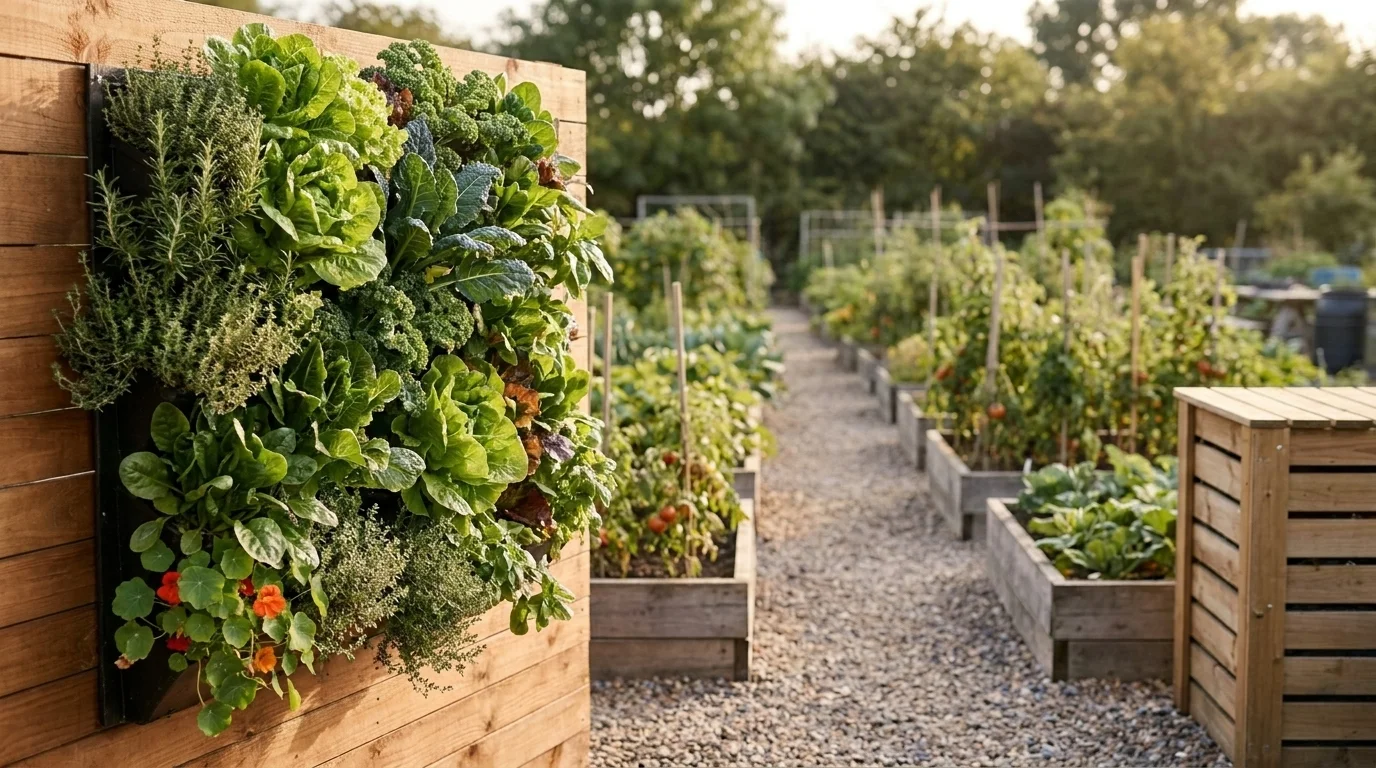
Raised beds and marked paths. Defined beds and wide, firm paths keep the garden accessible to older and less mobile gardeners and stop the whole thing dissolving into a muddy scramble.
2026 design trends. Newer gardens are leaning into vertical growing and living walls to squeeze more from small plots, choosing climate-adaptive plants that shrug off heat and drought, and favouring low-input, soil-first methods over heavy fertilising.
Shared features. A pollinator strip, a communal herb bed, a compost station, a children's plot, and a bench in some shade turn a grid of beds into a place people actually linger.
Loading image...
Keep a shared garden legible and generous: clear beds, clear paths, and vertical growing to wring more food from a small plot without crowding anyone out.
The Bottom Line
Community gardens are shared ground that pays you back in food, in exercise, in neighbors — as long as you go in clear-eyed about the uneven food benefit and design your plot to actually reach the people who need it. That honesty is not a caveat; it is the point. You do not need land of your own, and you do not need expertise. A season's commitment and a willingness to show up on the work days is the whole entry fee.
So make this the season you find the empty lot behind the fence — or the plot already waiting at the end of a waitlist. Search your city parks department or a local garden council for a bed this spring, or gather a few neighbors and start one where nothing grows now. Then come back to VerdeNook's Community Gardening coverage for the next step. The lot has been empty long enough.
Frequently Asked Questions
Are community gardens free?
Most charge a modest seasonal or annual plot fee to cover water and shared supplies, though some are free and a growing number offer income-based scholarships to widen access.
What are the disadvantages of community gardens?
The main ones are a standing time commitment, long plot waitlists, the need to test urban soil for contamination, occasional shared-space conflict, and — per 2024 research — a food benefit that skews toward higher-time, higher-income gardeners.
What can you grow in a community garden?
Common vegetables, herbs, and flowers. High-yield, low-effort crops like beans, greens, and zucchini are smartest for a shared plot you only visit a few times a week.
How many community gardens are there in the US?
The American Community Gardening Association estimates roughly 18,000 community gardens across the US and Canada, with about 2,100 linked directly through its own network.
Do you need experience to join a community garden?
No. Beginners are welcome, and more experienced neighbors typically mentor newcomers on soil, watering, and what grows well locally.
United Greens: The Story of Two Neighbors Transforming Their Fence Line into a Lush Edible Garden
Join
Loading...
Our Green Community!
Loading...
VerdeNook is more than just a source of gardening wisdom; it’s a platform for sharing, learning, and growing together. We invite you to join our community, share your stories, and spread the joy of gardening. Let’s sow the seeds for a greener, healthier, and more sustainable future, one garden at a time.