An annual is a plant that bets everything on one season of seed and colour, then dies — which is why the tray, and the replanting, come round every spring.
Walk into any garden centre in May and the busiest bench is the one stacked with trays of colour sold by the dozen — and most of what is on it will be dead by the first hard frost. These are annual plants, and despite that short life they are nothing like the niche purchase they sound. In the 2025 State of Annuals grower survey, 69 percent of all flowering and foliar garden plants sold were annuals, against 31 percent perennials — which makes annuals the majority of what gardeners actually carry home, not the throwaway option. The confusion is understandable: shoppers love the colour but are rarely sure what they are buying, whether it will come back, or how it differs from the perennial on the next bench along. This guide settles all three. I will define what an annual plant actually is, set annuals honestly against perennials and biennials, answer the question everyone asks — do they come back? — and hand you a curated shortlist of the best annual flowers, vegetables, and herbs, organised by where and how you will grow them.
What Is an Annual Plant?
An annual plant completes its entire life cycle within a single growing season: it germinates, grows, flowers, sets seed, and dies, all inside one year. To have it again the next year you must sow or plant it afresh — the original does not return.
Strip the botany back to its essentials and an annual is a plant that has made a particular bet. Rather than building the thick roots, crowns, or woody stems a perennial uses to survive winter and return, an annual pours almost everything it has into flowers and then seed, races through one season, and dies. The annual habit is best understood as a life-history strategy — a way of persisting as seed rather than as standing tissue — not as a plant that has somehow failed to last. Read it that way and the group turns out to be far larger and more important than the bedding bench suggests.
Annuals make up only about 6 percent of all plant species and roughly 15 percent of herbaceous plants, yet they cover close to 70 percent of the world's croplands and account for around 80 percent of what humans eat — the figures come from the botanical literature summarised in Wikipedia's Annual plant entry. Wheat, rice, and maize are annuals; the same strategy that fills a hanging basket also fills the grain silo. And it is a strategy the plant kingdom keeps reinventing: the annual life cycle has evolved independently in more than 120 separate plant families, which is about as strong a signal as botany offers that it works. For the gardener, though, the practical consequence is the one the label never prints — buy an annual and you are buying a single season of performance, after which the plant is spent. That one fact is the foundation of the plant care basics that follow, and it leads straight to the question every shopper eventually asks.
Loading image...
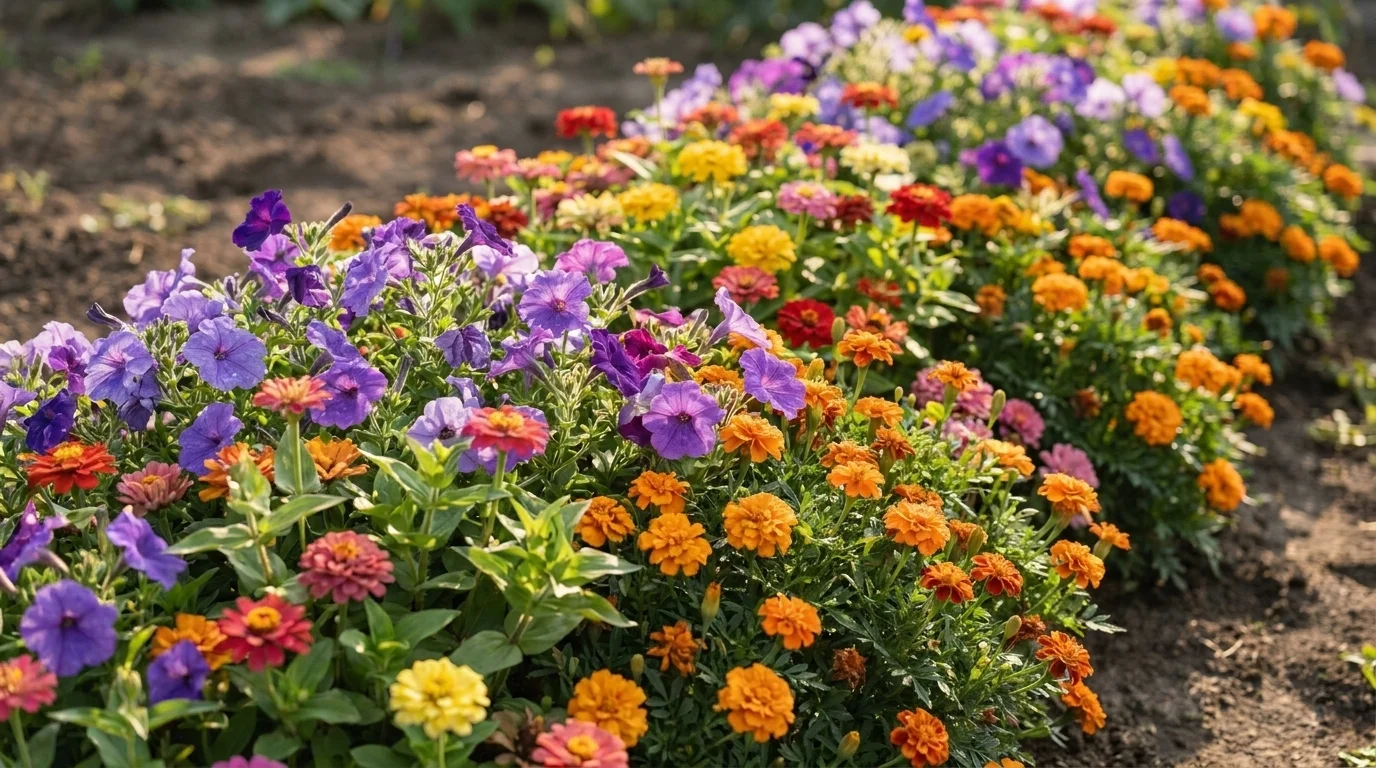
All this colour is the annual's whole strategy: pour everything into flowers and seed in one fast season, then die — season-long colour is the pay-off.
Annual vs. Perennial vs. Biennial: How They Really Differ
Annuals live one season and must be replanted; perennials regrow from the same roots for years; biennials spend their first year as leaves, then flower, seed, and die in their second.
The three groups are really three different answers to the same problem — how to get from one growing season to the next — and each invests its resources somewhere different. An annual invests in seed and lets the parent die. A perennial invests in persistent underground structure — roots, a crown, a bulb, sometimes wood — so the same individual can shut down over winter and start again from stored reserves in spring; a well-sited Geranium or peony can do this for a decade or more. A biennial takes the slow road: in year one it builds a rosette of leaves and a food store in the root, overwinters, and only in year two does it bolt, flower, set seed, and finish. Foxglove (Digitalis purpurea) and many carrots left in the ground are classic biennials.
The trade-off gardeners are really weighing sits underneath all this. Annuals give you season-long colour and the freedom to plant something different next year; perennials cost less over time and give you permanence, but at the price of that yearly reinvention. Neither is better — they are tools for different jobs. One warning, though, that sets up the next section: a good number of plants sold as "annuals" in cold climates are not true annuals at all. They are tender perennials that would live for years somewhere warmer, and it is only your winter that turns them into a one-season plant.
Annual vs. Perennial vs. Biennial — At a Glance
Lifespan
Replanting
When it flowers
Example plants
Annual
One growing season
Every year
The same season it is sown
Marigold, zinnia, cosmos, tomato, basil
Perennial
Several years
Not needed — returns from its roots
Year after year, usually from the second season on
Peony, hardy Geranium, rosemary, thyme
Biennial
Two growing seasons
Every two years (or self-sown)
In its second year only
Foxglove, honesty, parsley, first-year carrot left in
See VerdeNook's wider plant care basics for how perennial plants earn their keep alongside the annuals here.
Do Annual Plants Come Back Every Year?
A true annual does not come back — it dies after one season. But some self-seed and reappear from their own dropped seed, and a few plants sold as annuals are really tender perennials that only the frost kills.
The honest answer, then, is no: buy a true annual and it is gone by winter. What confuses people is that some beds do seem to refill themselves, and the explanation is worth getting right, because it is not the plant returning.
Self-Seeding (Reseeding) Annuals
Cosmos (Cosmos bipinnatus), calendula (Calendula officinalis), and larkspur (Consolida ajacis) are all annuals that scatter ripe seed freely before they die. Left undisturbed, that seed sits in the top centimetre or two of soil over winter and germinates the following spring, so the bed appears to "come back." But what you are seeing is a fresh generation grown from the seed bank, not the original plant waking up — the parent is long dead. The distinction matters in practice: self-sown seedlings turn up where the seed happened to fall, not where you first planted, and a season of tidy autumn clearing or deep hoeing removes the seed and breaks the cycle. If you want the effect, leave the spent plants standing until they have shed, and hoe shallowly rather than deeply next spring. A useful check the following May: look for the seedlings' first true leaves on the soil surface, not for regrowth from the old stems — the seed bank keeps the promise the plant cannot.
Tender Perennials Grown as Annuals
A second group muddies the water further. Petunia (Petunia ×hybrida), the bedding "geranium" — which is botanically a Pelargonium (Pelargonium ×hortorum), not a true Geranium at all — coleus (Coleus scutellarioides), and wax begonia (Begonia semperflorens) are all perennials in a frost-free climate. Where winters stay mild they persist for years; where the ground freezes, the cold kills them, and gardeners simply treat them as annuals, replacing them each spring. The "annual" label here describes your climate, not the plant's biology. The practical rule follows directly: to guarantee the same plant next year, either choose a genuine perennial, or lift your tender perennials and overwinter them somewhere frost-free — a cool, bright windowsill will hold many of them until spring.
Best Annual Flowers to Grow (Curated Examples)
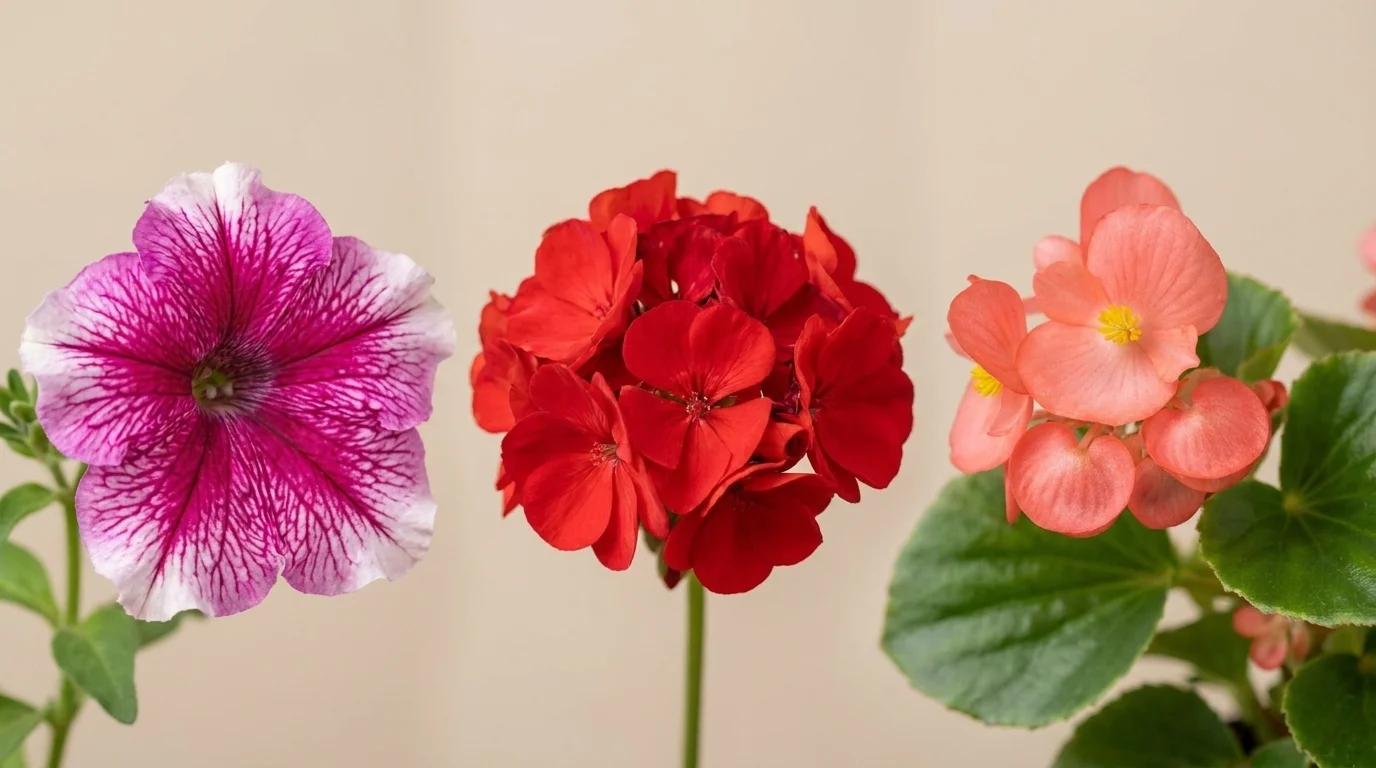
Start with what the market itself has already voted for. In the 2025 State of Annuals survey, petunia was the runaway leader — cited by about a third of growers as their top-selling annual — with the bedding geranium (Pelargonium) and begonia rounding out the top three. That is a fair place for a beginner to begin, because a plant does not become a bestseller by being difficult.
Beyond that trio, these are the annual flowers I would point a new gardener toward, each earning its place for a specific reason:
Marigold (Tagetes) — tough, quick from seed, and long-flowering; the reliable workhorse of a sunny bed.
Zinnia (Zinnia elegans) — heat-loving, brilliantly coloured, and one of the best annuals for cutting.
Cosmos (Cosmos bipinnatus) — airy and generous on poor soil; over-feed it and you get leaves instead of flowers.
Snapdragon (Antirrhinum majus) — cooler-season colour that keeps going where summers are mild.
Sweet alyssum (Lobularia maritima) — a low, honey-scented carpet that knits the front of a border together.
Impatiens (Impatiens walleriana) — the dependable answer for colour in shade, where most annuals sulk.
That is a curated shortlist, not the whole field — annual flowers are a vast subject in their own right, with hundreds more worth growing. For the fuller treatment, follow VerdeNook's annual flowers guides in Plant Care rather than trying to make one list carry all of it.
Loading image...
The market has already voted: petunia, bedding geranium and begonia lead every survey — and a plant does not become a bestseller by being difficult to grow.
Annuals Aren't Only Flowers: Annual Vegetables & Herbs
No — many kitchen-garden staples are annuals too. Tomatoes, lettuce, and beans, along with herbs such as basil and cilantro, all finish their entire life cycle in a single season.
This is the half of the answer most guides leave out, and it is the half I know best: I spent seven years trialling heritage vegetable varieties across a range of soils, and the overwhelming majority of what we grew was annual. Reframing annuals as food, not just bedding colour, is also the honest botanical picture — remember that annuals are most of the world's croplands.
Annual Vegetables
Tomato (Solanum lycopersicum), lettuce (Lactuca sativa), spinach (Spinacia oleracea), bean (Phaseolus vulgaris), and cucumber (Cucumis sativus) are all annuals in the practical, garden sense: you sow them in spring, harvest through summer, and clear them before winter. What makes them annuals is the speed of the cycle — most of the common kitchen-garden crops run from sown seed to harvest in a single season, roughly 90 to 120 days for the familiar ones, with no intention of surviving the cold. The gardener's mistake to avoid is treating them as if they might overwinter; they will not, and the bed is better cleared and composted than left to a hard frost.
Annual Herbs
The same split runs through the herb bed, and it catches people out. Basil (Ocimum basilicum), cilantro or coriander (Coriandrum sativum), and dill (Anethum graveolens) are annuals — they run to seed and die within the season, which is why your basil collapses at the first cold night while the rosemary beside it shrugs. Rosemary (Salvia rosmarinus), by contrast, along with thyme (Thymus vulgaris), is a woody perennial that persists for years. Knowing which is which tells you where to plant them: annual herbs where you can replace them each spring, perennial herbs in a permanent spot you are not going to disturb.
Loading image...
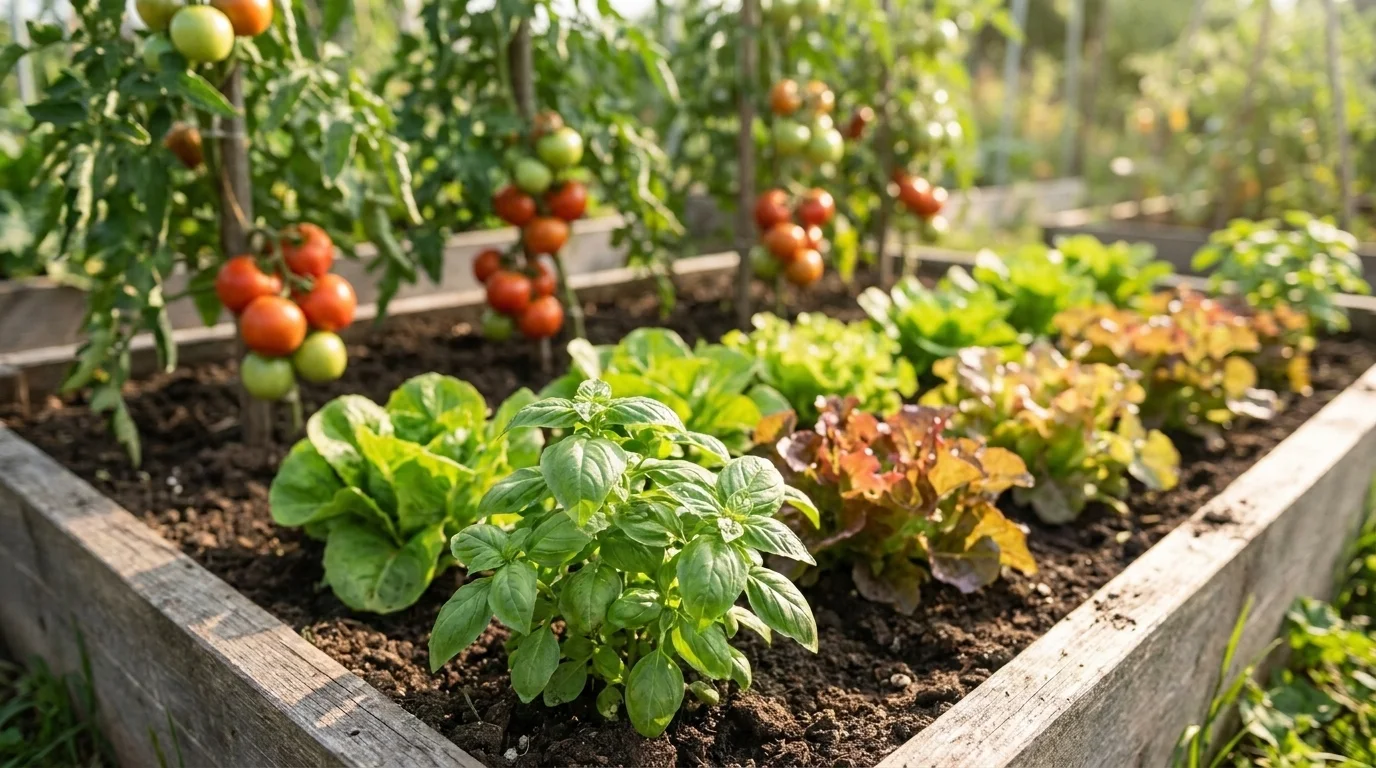
Annuals are not only bedding colour — tomatoes, lettuce and basil run the same one-season cycle, which is why the annual habit fills most of the world's croplands.
Best Annuals by Condition: Shade, Full Sun & Pots
Which annual to plant is mostly a question of where it will stand. The same season-long colour comes from very different plants depending on light and root room, so match the plant to the spot rather than the other way round. The picks below are well-established garden choices for each condition.
Best Annuals for Shade
Shade is where most annuals disappoint, so the shortlist is genuinely useful: impatiens (Impatiens walleriana) for reliable colour in low light, wax begonia (Begonia semperflorens) for the same in a slightly brighter spot, coleus (Coleus scutellarioides) grown for its foliage rather than flowers, and lobelia (Lobelia erinus) for a cool blue trailing edge. None of these want full midday sun; give them the north side of the house or dappled light under a tree.
Best Annuals for Full Sun
An open, sunny bed is where annuals are at their most exuberant: zinnia (Zinnia elegans), marigold (Tagetes), petunia (Petunia ×hybrida), the bedding geranium (Pelargonium), and — for height and structure — the sunflower (Helianthus annuus). These want the heat and will flower hardest in full sun; in shade they stretch, flop, and sulk.
Best Annuals for Pots & Containers
Containers reward plants that flower long and trail or mound rather than reach: petunia and calibrachoa (Calibrachoa) for cascading colour, and sweet potato vine (Ipomoea batatas) for a spilling, chartreuse or near-black foil. A well-known container convention is worth borrowing — a "thriller" for height, "fillers" to bulk out the middle, and a "spiller" to trail over the rim — and annuals happen to supply all three roles cheaply and for a single season. See VerdeNook's container gardening guidance in Plant Care for the potting and watering side of that.
How to Use Annuals in Your Garden
Once you know what annuals are, the uses follow naturally, and they are the reason the group earns its place every year. Annuals give season-long colour in borders; they fill the gaps between perennials while those are still bulking up; they carry containers and hanging baskets through the summer; and they throw quick colour into a brand-new bed that has nothing else in it yet. Because they last one season and no more, they are also the low-risk way to experiment — a colour scheme you can commit to for a summer without committing to for a decade.
There is a current wrinkle worth a line: garden writers noted for 2026 that patio culture is "moving beyond just a few annuals," with shrubs and perennials increasingly grown in containers alongside them for a more layered, permanent look. Take it as an invitation, not a rule — annuals still do the fast, generous work no shrub can. And they are not locked to a single date: while spring is the classic time to plant, annuals can be started right through the growing window, so a bed can be refreshed whenever it needs it.
The Bottom Line
Annual plants are the season's workhorses: one full cycle — germinate, flower, set seed, done — and then a fresh start the following year. You now know what that means, how annuals genuinely differ from perennials and biennials, why a self-seeding bed is a new generation rather than the same plant returning, and which flowers, vegetables, and herbs are worth the space. If you are starting from scratch, plant an easy trio — petunia, marigold, and zinnia — or sow a short row of an annual vegetable, and let one season teach you the rhythm. Then explore the rest of VerdeNook's Plant Care library for what comes next. A closing check, in case you ever wonder whether an annual has truly finished: look for the seed. Once a plant has set and ripened it, its work is done and no feeding will call it back — but let that seed fall, and next spring the bed may surprise you.
Frequently Asked Questions
What are annual plants?
Plants that complete their entire life cycle — germinate, grow, flower, set seed, and die — within a single growing season, and must be replanted the next year.
Do annual plants come back every year?
True annuals don't; they die after one season. Some self-seed and reappear from dropped seed, and a few plants sold as annuals are actually tender perennials grown as annuals in cold climates.
What is the difference between annual and perennial plants?
Annuals live one season and must be replanted; perennials regrow from the same roots for several years.
What are examples of annual plants?
Flowers like marigolds, petunias, and zinnias; vegetables like tomatoes, lettuce, and beans; herbs like basil, cilantro, and dill.
Are annual plants only flowers?
No — many popular vegetables and culinary herbs are annuals too, alongside the familiar bedding flowers.
VerdeNook is more than just a source of gardening wisdom; it’s a platform for sharing, learning, and growing together. We invite you to join our community, share your stories, and spread the joy of gardening. Let’s sow the seeds for a greener, healthier, and more sustainable future, one garden at a time.