DIY Greenhouse Gardening: Tips for Year-Round Harvests and Plant Propagation
Share this article:
A greenhouse is not a different kind of gardening; it's gardening with a thicker roof and a bigger heating bill. The difference is arithmetic.
The 2026 Greenhouse Grower Outlook Study reports that Gen Y outspent Gen X on gardening in 2025 (61.1 per cent versus 43.0 per cent) and that a record 64 per cent of all surveyed gardeners plan to expand their plots in 2026 — which means a lot of first-year greenhouses are about to be bought, built, and quietly underused.
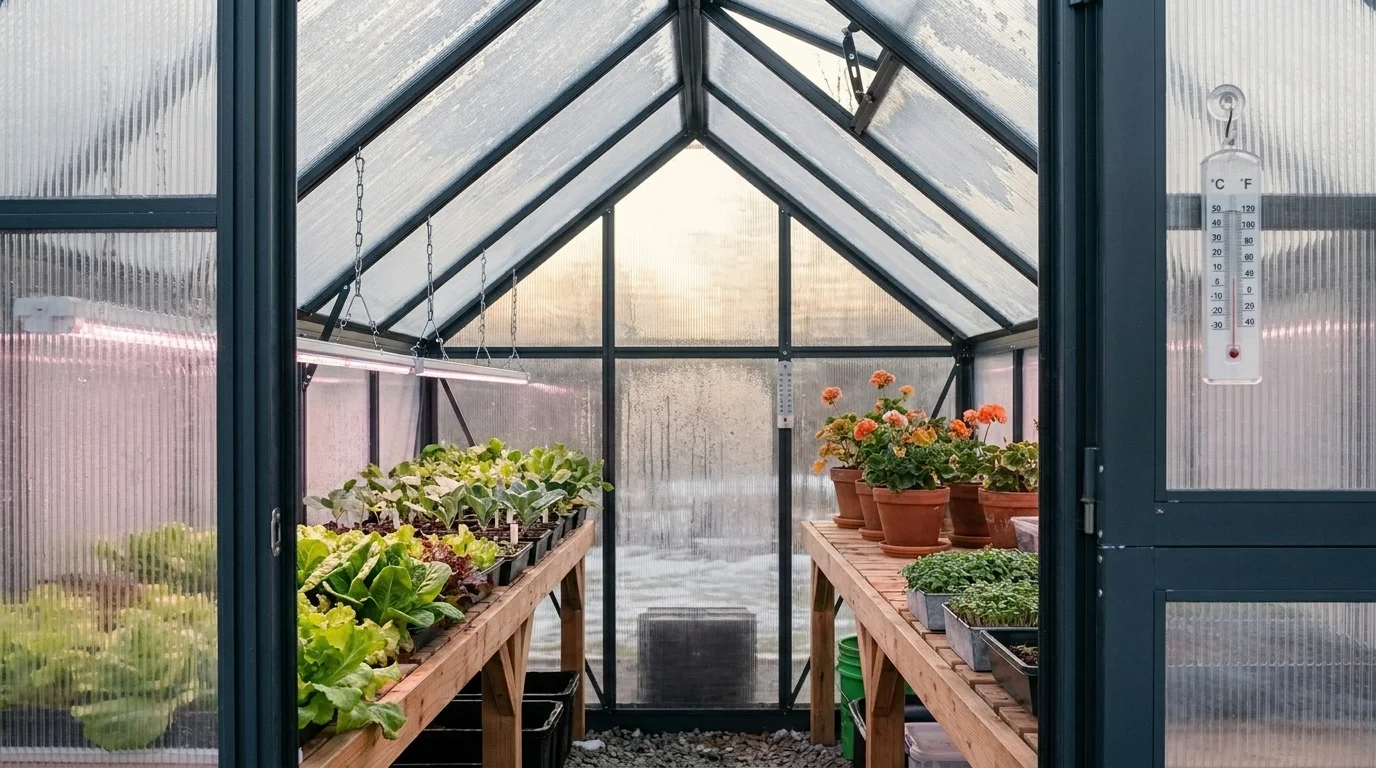
This is a guide for the people doing that. Greenhouse gardening is not a different kind of gardening; it is gardening with a thicker roof and a bigger heating bill. Done well, it adds twelve to twenty weeks to your growing season, gives you space to start every seedling for the outdoor beds, and lets you eat homegrown lettuce in January in zones where January is otherwise a dead month. Done badly, it is a ten-by-twelve box that gets too hot in July, too cold in February, and quietly grows whitefly while you are at work.
The difference between those two outcomes is mostly arithmetic. We will go through the arithmetic.
Should you build it or buy it?
Most beginner advice skips this question because it assumes the reader has already answered it. They usually have not. Here is a frank version of the decision:
Factor
Build (DIY)
Buy (kit)
Footprint
8×10 to 20×30+ ft easily; size to your site
Standard kits run 6×4 to 14×20 ft
Material cost (8×12 frame + glazing)
$400–$900 for hoop/PVC; $1,500–$3,000 for a wood-and-polycarb build
$1,200–$5,000+ for hobby-grade kits; $8,000+ for English-style
Build time
1–3 weekends DIY; longer with a permit involved
1–2 days assembly with a helper
Skill required
Basic carpentry + drainage planning
Cordless drill and the patience to read instructions
Code / permits
More likely to need them; depends on size and your municipality
Often pre-sized to fall under permit thresholds
Resale / portability
Custom build adds limited home value; can't move it
Kits hold value; smaller ones can be relocated
The lazy rule of thumb that has held up across the urban growers I've worked with in Toronto: if your budget is under $1,500 and you have one full weekend, build a hoop house. If your budget is over $1,500 and your time is the binding constraint, buy a kit. Anything custom and architectural — the Hartley Botanic, the English glasshouse, the lean-to on the south wall — is a separate conversation and a separate kind of money.
If you are renting, none of the above applies. A 4×6 ft "mini-greenhouse" with a PVC frame and a clear cover is a renter-safe option that doesn't drill into anything, costs $80–$200, and gives you four shelves of seed-starting space on a balcony. It will not get you year-round tomatoes. It will get you a head start on a real garden by six to eight weeks.
Greenhouse setup: size, location, substrate
A useful sizing rule from Eartheasy's beginner guide: plan on 20–25 square feet of growing space per person if vegetable self-sufficiency is the goal. A two-person household runs 40–50 sq ft of bench plus walking space, which an 8×10 or 8×12 frame covers comfortably with room left for one large container.
Site the structure with the long axis running east–west so the longest broadside catches winter sun. South-facing is the default in the northern hemisphere; if you have to compromise, south-east beats south-west because the morning sun warms the soil before midday and the canopy holds the heat better than glass does. Avoid frost pockets at the bottom of slopes, and avoid walls that throw a shadow across the structure between 10 a.m. and 2 p.m. — those are your highest-PPFD hours in winter and they are not negotiable.
For substrate inside the greenhouse — whether you are growing in raised beds, large containers, or directly in soil — the most reliable starter mix is 60 per cent loam topsoil, 30 per cent finished compost, and 10 per cent bark mulch or coconut coir, finished to a pH of 5.8 to 6.5 (Eartheasy). A cheap pH meter from the seed shop is $15 and pays for itself in the first season; most greenhouse failures I've watched are downstream of soil pH that nobody bothered to check.
Loading image...
Below ten hours of daylight, cool-hardies stop growing no matter how warm you keep them. Plant to mature size before the line, then harvest sparingly.
Implication for an 8×12 (96 sq ft) greenhouse held at 65°F
3–4
$6–12
$575–$1,150 / year
5–6
$3–7
$290–$670 / year
7–8
$1.50–$4
$145–$385 / year
9–10
$0.75–$3
$70–$290 / year
If you do not need tender-plant temperatures, do not pay for them. Holding the greenhouse at 36°F instead of 65°F can cut heating costs by 70–85 per cent in cold zones — the difference between a hobby and a financial decision.
Most beginner advice talks about heat. The real winter ceiling is light. At around 40° latitude (roughly Boulder, New York, Madrid, Beijing) the day drops below ten hours of daylight from mid-November to early February. Below that threshold, most cool-hardy greenhouse crops slow to near-zero growth regardless of how warm you keep them (Ceres Greenhouse Year-Round Calendar).
Practically, that means three things. First, plant cool-hardy crops in late summer so they're at near-mature size before the 10-hour line is crossed — the greenhouse becomes a holding pen rather than a growth chamber for the deep-winter weeks. Second, supplement with LED grow lights on a 14-hour timer if you want active growth in December and January. Third, harvest sparingly during the dark weeks; the plants are not replacing what you take.
The further north you live, the wider this window. At 50° latitude (Edmonton, London, Berlin), the under-10-hour window stretches from late October to mid-February — closer to four months than two.
Ventilation
The single most common greenhouse failure in summer is overheating. A 10×12 structure can climb from 75°F to 110°F in an hour on a sunny day with the door closed. Two roof vents and one wall vent, opened automatically by a wax-cylinder vent opener ($25–$60), solve the problem cheaply. A small thermostatically controlled fan in the gable extends the working range. If you are within $100 of your build budget, spend it on the auto-vent opener before anything else.
What to grow — start with how you actually cook
Beginner advice traditionally tells you to grow "what grows easily in a greenhouse," which produces a row of tomatoes, a row of basil, and a glassy regret in September when you realise you cook with neither. The 2026 framing has shifted toward kitchen-first crop selection — what you would actually pull out of the fridge twice a week (Seeds 'n Such 2026 Trends).
A workable starter mix that pays for itself in season one:
Cool-hardy leaf crops: lettuce ('Buttercrunch', 'Salanova'), spinach, mizuna, mâche. Sprout in 5–7 days, tolerate cool nights, cut-and-come-again for months.
One warm-season anchor: a single indeterminate tomato ('Sungold', 'Cherokee Purple') or a Hungarian wax pepper. Grown vertically, one plant produces 8–15 lb across the season.
Continuous herbs: basil, parsley, coriander (in succession — it bolts hard at 75°F+), thyme, mint (in a container; never in the soil).
One experiment: a melon, a hot pepper, an eggplant, or a tropical you have always wanted to try. Year-one greenhouses run two productive crops and one beautiful failure. Plan for the failure.
Skip in year one: cucumbers (humidity-hungry and disease-prone), citrus (needs tender-plant heat), and any annual that requires more than 12 hours of daylight to set flowers.
Year-round crop calendar by USDA zone
The single most useful asset on a beginner greenhouse wall is a calendar that tells you what to sow when. None of the top-five SERP competitors publishes one segmented by zone. Below is a three-zone × four-season grid you can copy onto a card by the door:
Season
Zones 3–5 (cold)
Zones 6–7 (temperate)
Zones 8–10 (warm)
Spring (Mar–May)
Start tomatoes, peppers, brassicas indoors; harden off late May
Set out tomatoes, peppers, eggplant; sow heat-lovers
Summer (Jun–Aug)
Tomatoes, peppers, basil, cucumbers; succession lettuce in shade
Full warm-season production; succession greens early/late summer
Shade-cool the greenhouse; switch to heat-tolerant okra, peppers
Autumn (Sep–Nov)
Cool-hardy greens (spinach, kale, mâche) sown by Aug for Sep–Dec
Sow cool-hardies in Sep; pull warm crops by mid-Oct
Restart cool-season crops; herbs through winter
Winter (Dec–Feb)
Holding mode: mature cool-hardies, no active growth Dec–Feb
Slow growth under unheated cover; harvest sparingly
Full cool-season production: lettuce, broccoli, peas
Add LED supplemental lighting in zones 3–5 if you want any growth during the under-10-hour window. In zones 8–10, the limiting factor is summer heat, not winter cold — your greenhouse mostly works as a year-round nursery, with a "summer break" through July and August.
Watering, feeding, and substrate care
Greenhouse plants are easier to overwater than to underwater. The greenhouse traps humidity, slows evaporation, and the temptation to "give them a drink" because they look thirsty in the morning is usually wrong — they are transpiring, not dehydrated.
The reliable test: push your index finger into the substrate up to the second knuckle. If the soil at that depth is cool and slightly damp, do not water. If it is dry, water until you see a trickle from the drainage hole.
Feed organically: a weekly seaweed or fish-emulsion drench at half the bottle's recommended strength, plus a top-dress of compost in spring and mid-summer. The 60/30/10 substrate above provides a long-term reservoir; the liquid feed handles the short-term draw. Skip granular synthetic fertilisers in a greenhouse — concentrations build up in the substrate faster than they would outdoors, and salt burn is a common rookie failure.
Plant propagation cheat sheet
The greenhouse is also where you propagate next year's stock. The headline numbers, distilled from multiple cooperative-extension references (notably NC State Extension's Plant Propagation Handbook):
Method
Typical success rate
Conditions
Timing
Best for
Seed
50–95% (varies by species + age)
75–80°F soil; fresh seed; sterile mix
Any season; matches plant cycle
Most annuals + vegetables
Cutting
87–96% with hormone + 70–100% RH
Mist or covered tray; rooting hormone; bottom heat 70°F
Soft cuttings in spring; semi-hardwood in summer; hardwood in autumn
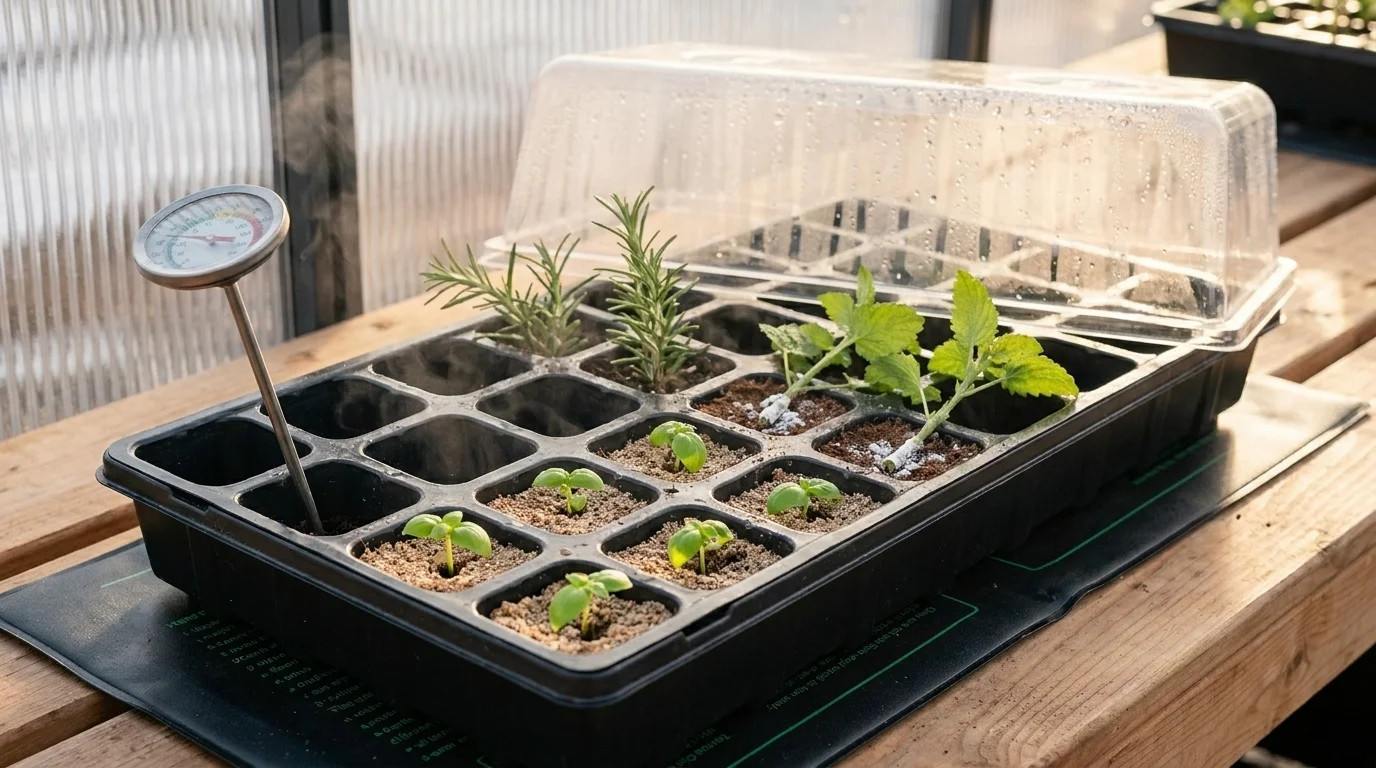
Rooting hormone (a powder or gel from any garden shop, $6–$10 a tub) boosts cutting success by 1.88–2.29 times over untreated, and cuts rooting time by 25–47 per cent. For most beginners that is the single highest-return $10 in the greenhouse.
For seed, fast-sprouters (lettuce, radish, basil) germinate in 5–7 days at 75°F; slow-sprouters (parsley, peppers, eggplant) take 14–21+ days. If a tray of peppers shows nothing on day 10, do not panic; do not re-sow. Wait.
Loading image...
Rooting hormone boosts cutting success by roughly two times and cuts rooting time in half. The single highest-return ten dollars in the greenhouse.
Greenhouse pest ID and IPM treatment
Greenhouse pests reproduce faster than outdoor pests because the structure that protects your plants also protects them. A single female whitefly lays up to 250 eggs on the underside of a leaf (UKY Entomology) — by the time you notice the adults, the next generation is already on the bench.
Tiny white flying insects rise in clouds when leaves are disturbed
Encarsia formosa parasitoid wasp
Yellow sticky cards; release Encarsia at first sign
Aphid
Soft-bodied clusters on new growth; sticky honeydew below
Lacewing larvae + ladybird beetles
Knock off with water spray; release predators
Fungus gnat
Tiny black flies running on substrate surface; larvae chew root hairs
Steinernema feltiae nematode
Let top inch of substrate dry between waterings; sticky cards
Spider mite
Stippled, dull leaves; fine webbing on undersides; needs 20× hand lens
Phytoseiulus persimilis predatory mite
Raise humidity above 60%; release predator
Powdery mildew
White powdery patches on leaf upper surface
(Not biological — cultural + fungicide)
Improve airflow; sulfur or potassium-bicarbonate spray
Reach for a broad-spectrum spray only after the biological options have failed. In a closed greenhouse, broad-spectrum insecticides destroy the predator populations that were your one durable defence — you end up sterilising the structure and then becoming the only pest control.
What you will actually spend, and what to do this weekend
A frank starting budget for a first-year 8×12 greenhouse:
Structure (kit or DIY hoop house): $1,200–$2,500
Auto-vent opener (2 vents): $60–$120
Min/max thermometer + soil thermometer: $30
Substrate mix for two raised beds (≈30 cu ft total): $80–$150
Year-one total: roughly $1,650–$3,310, plus your time
That is what a sub-suburban backyard greenhouse actually costs in 2026. A renter-safe balcony mini-greenhouse runs $80–$200 all-in and still produces real lettuce.
This weekend, before you build or buy anything: stand in the proposed spot at 10 a.m., noon, and 2 p.m., and time the direct sun. Anything under four hours of winter direct sun is a greenhouse site that will fight you. Anything over six hours is gold. Choose the site first; the structure follows.
For vegetable self-sufficiency, plan on 20-25 square feet of growing space per person — so a two-person household runs 40-50 sq ft. An 8×10 or 8×12 covers most first-year beginners and gives room to experiment without overcommitting to heat costs.
Do I really need to heat my greenhouse year-round?
Not always. A frost-free greenhouse (kept above 36°F / 2°C) covers most cool-hardy crops like lettuce, kale, and spinach through winter. Tender plants — citrus, peppers, fuchsias — need a 45°F (7°C) minimum, which is where heating costs jump. Expect $3-7 per sq ft per year in USDA zones 5-6, and $6-12 in zones 3-4.
What grows best in a greenhouse for a complete beginner?
Start with one cool-hardy group (lettuce, spinach, kale, radishes — sprout in 5-7 days, forgiving of temperature swings) and one warm-season anchor (a single indeterminate tomato or pepper). Skip melons, eggplant, and citrus in year one; they're not difficult, but they punish small mistakes more than greens will.
How often should I water plants in a greenhouse?
Seedlings usually need daily watering; established plants typically every two to three days. Let the top inch of soil dry between waterings — overwatering causes more beginner losses (root rot, fungus gnats) than underwatering does. The reliable test is to push your finger in to the second knuckle: if it's cool and slightly damp, do not water.
What is the 10-hour daylight rule?
At roughly 40° latitude, daylight drops below ten hours from mid-November to early February — and below that threshold most cool-hardy greenhouse crops slow to near-zero growth, regardless of how warm you keep them. Plant cool-hardies to near-mature size before the line is crossed, supplement with LED grow lights on a 14-hour timer if you want active winter growth, and harvest sparingly during the dark weeks.
How do I know which greenhouse pest I'm dealing with?
Sticky-yellow cards catch flying adults (whitefly, fungus gnat, thrips). Stippled, dull leaves with fine webbing on undersides means spider mites — you'll need a 20× hand lens to confirm. Soft-bodied clusters on new growth are aphids. Match the pest to its biological control rather than reaching for a broad-spectrum spray: Encarsia formosa for whitefly, Phytoseiulus for spider mites, lacewings for aphids, Steinernema nematodes for fungus gnats.
VerdeNook is more than just a source of gardening wisdom; it’s a platform for sharing, learning, and growing together. We invite you to join our community, share your stories, and spread the joy of gardening. Let’s sow the seeds for a greener, healthier, and more sustainable future, one garden at a time.