Urban Rooftop Gardening Innovations: Maximizing Green Spaces in the Concrete Jungle
Share this article:
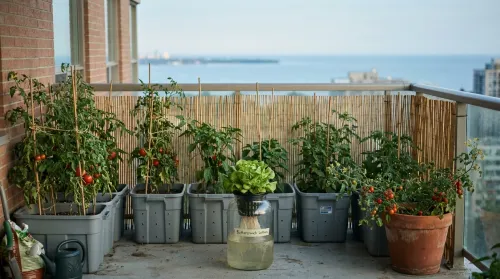
Twenty-one pounds of food from a sixth-floor north-east balcony that catches a lake cross-wind — rooftop growing works as a discipline, not as a beauty shot.
A rooftop garden is a deliberate growing space — containers, raised beds, or a built-up soil profile — installed on a roof, terrace, or balcony. To start one, first confirm the roof's load capacity (most modern flat roofs handle 20-30 lb/sq ft of live load), pick a system that fits the limit (containers and modular boxes for most homes; built-up media only with engineering sign-off), map sun and wind exposure across the season, and choose plants that match both the container depth and the conditions. Expect $10-15 per sq ft for a DIY container setup, $25-40 for mid-tier modular systems, and $50+ for engineered intensive installations.
Before you build: the 6-point pre-flight checklist
The single biggest cause of rooftop-garden disappointment is starting before answering these six questions. Walking the checklist takes a Saturday morning and saves a season of dead plants.
Pre-flight item
What to confirm
Practical thresholds
1. Load capacity
The roof's structural live-load rating per square foot
Most modern flat roofs handle 20-30 lb/sq ft; pre-war NYC buildings often capped at ~35 lb/sq ft; intensive systems exceed 50 lb/sq ft saturated; consult a structural engineer for any built-up system
2. Drainage path
Where the water goes after a heavy rain
The roof must drain freely with the new system in place; never block a scupper or roof drain with a planter
3. Sun hours
Hours of direct sun across the growing season, mapped by zone of the roof
Edibles need 6+ hours direct; leafy greens and herbs tolerate 4-5; map at solstice for the conservative number
Rooftops are typically 2× windier than ground level; locate plantings on the leeward side or build windbreaks
5. Water access
A reliable water source for daily watering in summer
A spigot within hose-reach is the gold standard; rain-barrel-only systems work only for low-water-demand plantings
6. Building approval
Landlord, HOA, co-op board, structural engineer sign-off, fire code
Always required for built-up systems; often required for any installation in multi-family buildings
Each row is a hard prerequisite. Skipping the load-capacity check is the one that hurts the most, because the consequences range from a buckling deck to a structural failure. The structural engineer's sign-off costs $300-$800 for a typical residential inspection and is the cheapest insurance in the entire build.
Three structural decisions drive everything else: the container system, the growing medium, and the irrigation strategy. Each has a 2026-current best answer that the conventional rooftop-gardening article tends to skip.
Container systems: from upcycled to modular
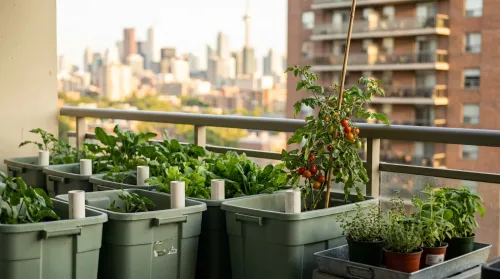
The cheapest path is upcycled containers — five-gallon plastic buckets ($2-$4 each at hardware stores), fabric grow bags ($8-$20 each), or the classic apartment-balcony self-watering bucket built from two nested totes (about $14 in parts; the better build I outlined in my overwatering article takes a Saturday afternoon and zero holes in the wall). This is the right tier for first-year rooftop growers who want to learn what their roof actually does before committing capital.
The 2026 dominant residential default has shifted toward pre-engineered modular box systems with waterproofing, root barrier, drainage layer, and irrigation pre-integrated. These typically run $25-$40 per square foot installed for a complete system. Companies like Rooflite, Sopraflor, and several European modular-box manufacturers now produce homeowner-scale kits in standard footprints. The advantage over upcycled containers is real — the waterproofing protects the building, the drainage layer prevents waterlogging, and the irrigation reduces labour during peak summer.
The practical rule for residential growers: a 6-inch container of engineered lightweight mix, saturated, weighs about 27-30 lb/sq ft. That fits within most modern roof load tolerances. A 12-inch container or built-up bed of the same media, saturated, exceeds it. Match container depth to your roof's structural rating, not to the plant's ideal root depth.
Smart watering and irrigation
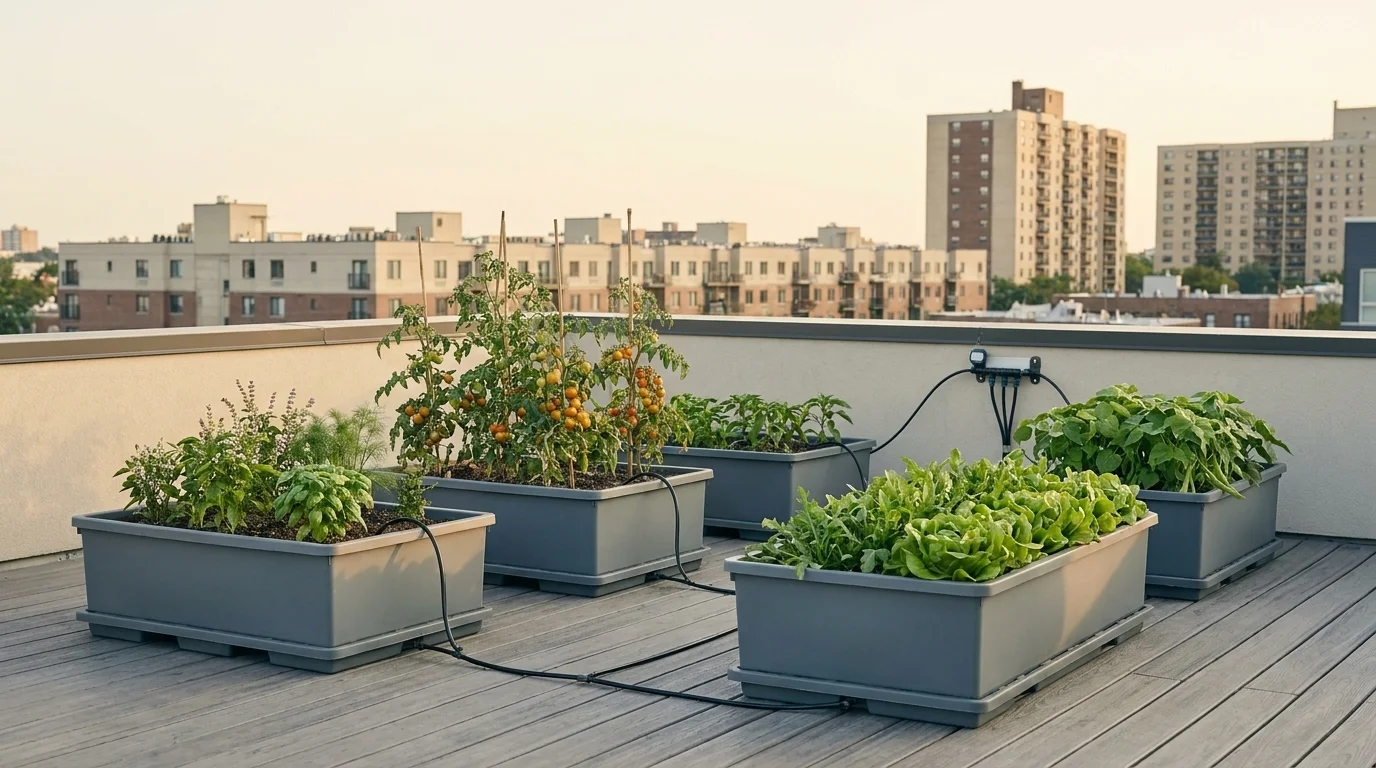
Daily watering is the rooftop-garden labour cost that breaks most growers in July. A drip-irrigation system on a timer eliminates it. A residential rooftop drip-irrigation install with a manifold, a timer, and a half-inch poly-tubing distribution network runs $1,000-$2,000 for a 200-400 sq ft setup, per Garden Design. A Rachio 3 smart controller ($230, often eligible for $50-$150 utility rebates depending on the state) adds weather-aware automation on top.
For under $100, the budget version works fine: a Y-splitter from your water source, a battery-powered hose timer ($30-$50), and a $40 starter drip kit from a hardware store. The water savings against hand-watering are real — most published manufacturer figures show 20-50% reductions, which on a heavily planted rooftop in July is materially less labour and materially less water-bill cost.
Hydroponic systems are a separate category. A non-circulating Kratky setup (a five-gallon reservoir with a net pot and a lid, nutrient solution, and no pump) grows lettuce and herbs on a rooftop with zero electricity. The roof load is essentially the weight of the water reservoir — under 50 lb for a 5-gallon system. This is the cheapest credible rooftop food-growing setup in the entire toolkit, and it works without any of the structural complications of soil-based systems.
Loading image...
Mid-tier modular systems run $25-$40 per sq ft installed — waterproofing, drainage layer, and irrigation pre-integrated. The Tier-1 DIY tier runs a third of that.
Small space gardening: making 40 square feet seriously productive
The phrase "rooftop garden" tends to call to mind a Brooklyn Grange-scale installation, but the working unit for most urban growers is a 40 to 200-square-foot patio, balcony, or terrace. The discipline at that scale is small space gardening — the practice of treating limited area as a feature rather than a consolation prize. Three principles do almost all the work:
Pick crops by yield per square foot. Cherry tomatoes ($40-100 of grocery-equivalent value per plant), basil ($50 of cut basil per plant at retail), and cut-and-come-again salad mix ($15-25 per sq ft over three cuttings) dominate the math. Avoid space-greedy crops with low per-square-foot return: corn, large winter squashes, melons.
Grow vertically. A pole bean or cherry-tomato plant trellised against a wall produces 6-10 pounds of food in the same horizontal footprint as a 4-foot row of bush beans. Pole varieties are the small-space grower's default.
Use containers that match plant depth requirements. Most edibles need 6-12 inches of root depth; herbs need 4-6; shallow-rooted greens and microgreens work in 3-inch trays. Right-sizing containers to plant depth saves both weight and money.
A 40-square-foot rooftop, properly planted, comfortably produces 50-80 pounds of food across a Northern Hemisphere growing season. That is the 4.5 kg per square metre per year benchmark the industry data quotes, slightly above-average for a competent first-year grower with engineered media and drip irrigation.
Plant selection: what grows on a rooftop
The named-plant table the rooftop-gardening SERP keeps avoiding. Eight to ten species cover most rooftop applications, sorted by minimum container depth, sun requirement, and wind tolerance.
Plant
Min container depth
Sun
Wind tolerance
Notes
'Patio' or 'Cherry Cascade' tomato (compact)
12 in (30 cm)
6+ hrs direct
Moderate
Stake or cage; cherry varieties outproduce slicers per sq ft
'Provider' bush bean
6-8 in (15-20 cm)
6+ hrs direct
Moderate-high
Self-supporting; no trellis needed; succession-plant for continuous harvest
'Buttercrunch' or 'Black Seeded Simpson' lettuce
4-6 in (10-15 cm)
4-6 hrs
Low-moderate
Cut-and-come-again harvest; shaded spots in heat
Basil (Genovese)
6-8 in (15-20 cm)
6+ hrs direct
Moderate
One plant produces ~1 lb of cut basil over a season ($50 retail)
Thyme, oregano, sage, rosemary
4-6 in (10-15 cm)
6+ hrs direct
High
Drought-tolerant; ideal for hot, exposed rooftops
Mint (contained!)
6-8 in (15-20 cm)
4-6 hrs
Moderate
Always in its own pot — it will take over otherwise
'Tom Thumb' or 'Mascotte' bush pepper
8-10 in (20-25 cm)
6+ hrs direct
Moderate
Compact varieties only; full-size peppers need more space than rooftops usually offer
Sedum (mixed, 'Angelina', 'Autumn Joy')
3-4 in (8-10 cm)
Full sun
Very high
Native pollinator-friendly succulent; ultra-extensive systems
Lavender (Lavandula angustifolia)
8-10 in (20-25 cm)
Full sun
High
Pollinator anchor; needs excellent drainage
Native pollinator perennials (region-dependent)
8-12 in (20-30 cm)
6+ hrs
Varies
Black-eyed Susan, coneflower, yarrow — bridges the 2026 native-plant trend
Native plants for rooftops
Native species are the dominant 2026 garden trend, and rooftops are a surprisingly good site for them. Sedums are the easiest entry — shallow-rooted, drought-tolerant, the canonical green-roof plant family. In the eastern US, native pollinator perennials like black-eyed Susan (Rudbeckia hirta), purple coneflower (Echinacea purpurea), and yarrow (Achillea millefolium) tolerate rooftop conditions with proper container depth and drainage. In the West, California poppy (Eschscholzia californica) and yarrow do the same work. The pollinator value is real — rooftop gardens at scale measurably support urban bee populations, and the solar-canopy interception of native plantings reaches up to 87%, which directly mitigates the heat-island effect that motivates many rooftop gardens in the first place.
Wind strategy (beyond "it's windy")
The conventional wisdom on rooftops says wind is a problem and then moves on. The conventional wisdom is correct about the first part and unhelpful about the second. Rooftops are typically twice as windy as ground level, more in coastal or high-rise contexts. Three tactical responses do most of the mitigation:
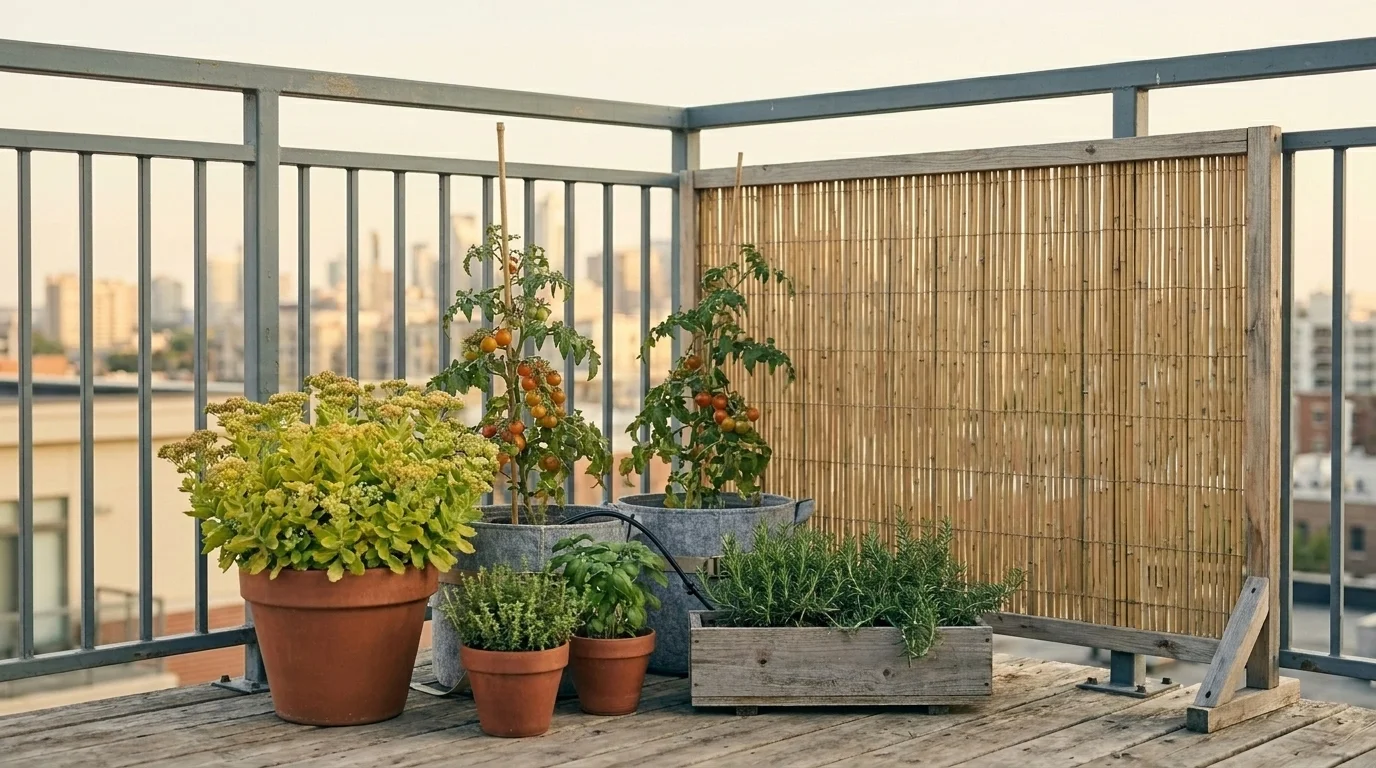
Windbreak placement. A bamboo screen, a low trellis, or a row of taller perennials on the prevailing-wind edge reduces gust velocity by 50-70% in the lee. Place windbreaks at right angles to the dominant wind direction, not parallel.
Container weighting and strapping. A 5-gallon plastic container with one tomato plant on a windy rooftop is, structurally, a sail. Anchoring containers with quick-release straps to a perimeter rail or weighting their bases with a sandbag prevents the spectacular failure mode where the entire planter goes over the edge in a summer storm.
Plant form selection. Avoid top-heavy plants with large leaves (full-size cabbages, large-leaf tomato varieties) on exposed corners. Favor low-growing, small-leaf forms (bush beans, thyme, sedums, ornamental grasses) on the windward edge and reserve taller plantings for the lee. Ornamental grasses are particularly forgiving — they bend rather than break, and they screen wind for the plantings behind them.
Loading image...
A bamboo screen on the prevailing-wind edge cuts gust velocity by 50-70% in the lee — the cheapest rooftop-survival tactic in the entire wind-strategy toolkit.
Cost ranges: the tiers nobody publishes
What does a rooftop garden actually cost? The published gardening literature avoids this question because the answer ranges from a few hundred dollars for a balcony-bucket experiment to tens of thousands for an architect-led intensive install. Three working tiers cover the spread.
A 200-square-foot Tier-1 DIY setup at $10-$15 per square foot works out to a couple of thousand dollars in materials over the first year — three to four containers per square metre, the cheap drip kit, a starter set of plants. The same footprint at Tier 2 runs several thousand dollars installed, with the drip-irrigation install accounting for $1,000-$2,000 of that according to Garden Design. Tier 3 is rarely justified for residential applications and typically requires architectural-firm involvement; the structural engineering alone runs several thousand dollars before any plants are bought.
For most apartment and home rooftop growers, Tier 1 in year one and a partial migration toward Tier 2 in years two and three is the sane progression.
Building approval: the conversation you cannot skip
This is the section the gardening literature avoids and the apartment-dweller reader needs first. Three approvals matter:
The landlord, HOA, or co-op board. Multi-family buildings almost always require written approval before installation. Many have explicit rules about container materials, edge clearances, and what gets installed on a shared roof.
The structural engineer. Required for any built-up system; recommended even for a Tier-1 container setup if your roof is decades old or you do not know its rated load capacity. The $300-$800 inspection fee is the cheapest line item in the build.
The honest summary: most apartment and condo rooftops can host a garden legally; almost none of them can host a garden without paperwork.
The benefits that justify the work
The case for a rooftop garden does not rest on the spreadsheet. It rests on a measurable combination of environmental and quality-of-life impacts that have grown more documented since the early 2020s.
Rooftop gardens versus green roofs — a distinction worth making once: a rooftop garden is a deliberate productive or ornamental growing space, typically in containers or modular systems, that the owner interacts with daily. A green roof is an engineered vegetated roof system (typically extensive sedum monoculture) designed for stormwater retention, heat-island reduction, and roof-membrane longevity rather than for active gardening. The two overlap technically; they are different products commercially. This guide covers the first; commercial green-roof installation is a separate industry with its own contractors and design firms.
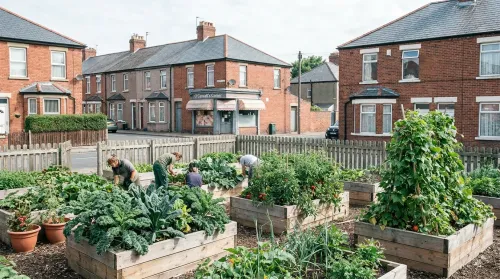
The community version is the third leg of the same conversation. If your building cannot host a rooftop garden — load too low, approvals not forthcoming, or the structural engineer says no — find a community rooftop garden in your neighbourhood. Cities like New York, Toronto, Singapore, and Paris now run formal urban-agriculture networks linking apartment-dwellers to shared rooftop sites. Brooklyn Grange has been operating rooftop farms in New York since 2010; Lufa Farms has done the same in Montreal at industrial scale. The presence of these examples is the strongest evidence that rooftop growing works as a discipline; the absence of them in your own neighbourhood is often more a matter of organising than of agronomy.
The cheapest rooftop garden that pays back this season
If you take one thing from this guide: skip the modular kit, the engineered media, and the structural intensive install in year one. Get the structural engineer's sign-off ($300-$800), buy three to five upcycled containers ($30-$80), build the $14 self-watering tote, install a $40 drip kit on a $40 hose timer, and plant a cherry tomato, a basil, a 4-foot strip of cut-and-come-again lettuce, and a sedum pot for the windy edge. Total build: under $300 in materials, one Saturday afternoon, zero holes in anything you own. By the time the second harvest of basil comes off in July, you will know whether your roof can sustain the discipline — and if it can, the year-two build at modular tier becomes a real conversation. The conventional wisdom on rooftops is that they are inhospitable. The data, the engineering, and twenty-one pounds of food from a north-facing balcony all say otherwise.
Most modern flat roofs handle 20 to 30 lb per square foot of live load. Pre-war buildings often cap closer to 35 lb/sq ft. Shallow extensive sedum systems add about 4.8 to 6 lb/sq ft per inch of saturated media; intensive built-up gardens can exceed 50 lb/sq ft saturated. Always confirm capacity with a structural engineer ($300 to $800 for a residential inspection) before installing anything beyond a few containers.
Do I need permission to start a rooftop garden?
Almost always, in multi-family buildings. Landlord, HOA, or co-op board approval is typically required; a structural engineer's sign-off is essential for any built-up system; and many cities have building or fire codes that affect rooftop installations (NYC, for example, caps wood decking at 20% of the total roof surface). Call the local building department before you start.
What vegetables grow best on a rooftop?
Compact, wind- and heat-tolerant varieties: 'Patio' or 'Cherry Cascade' tomatoes, 'Provider' bush beans, 'Buttercrunch' lettuce, 'Tom Thumb' or 'Mascotte' bush peppers, kale, basil, thyme, mint, and oregano. Avoid tall, top-heavy plants on exposed corners — they catch wind and break. Cherry tomatoes and basil have the highest dollar-per-square-foot return at 2026 grocery prices.
How much sun does a rooftop garden need?
At least 6 hours of direct sun for most edibles; herbs and leafy greens tolerate 4 to 5. Rooftops typically receive more sun than ground gardens, but heat and wind become the larger constraints. Map sun hours at the summer solstice for the conservative number, since shadowing patterns change across the season.
What is the difference between a rooftop garden and a green roof?
A rooftop garden is a deliberate productive or ornamental growing space — containers, raised beds, or modular boxes — that the owner interacts with daily. A green roof is an engineered vegetated roof system, typically planted with shallow-rooted sedums in a thin substrate, designed for stormwater retention, heat-island reduction, and roof-membrane longevity rather than active gardening. The two overlap technically but are different products commercially.
What containers work best for a rooftop garden?
Fabric grow bags ($8 to $20 each) are the lightest and most forgiving. Five-gallon plastic buckets ($2 to $4) are the budget standard. Pre-engineered modular boxes with integrated drainage and irrigation are the 2026 default for permanent installs ($25 to $40 per square foot installed). Match container depth to plant root requirements: 4 to 6 inches for lettuces and herbs, 8 to 10 for peppers and bush beans, 12 inches for tomatoes.
How much does a rooftop garden cost?
DIY container setups run about $10 to $15 per square foot in materials (upcycled buckets, basic drip kit, soil mix). Mid-tier modular box systems with drip irrigation cost $25 to $40 per square foot installed. Engineered intensive built-up systems for commercial-scale installations run $50 to $100 or more per square foot and require structural engineering. A 200-square-foot DIY rooftop garden typically costs $2,000 to $3,000 in year one.
What is the best lightweight soil for a rooftop garden?
Engineered green-roof media (Rooflite-class and similar) weighs about 54 lb/cu ft dry and 86 lb/cu ft saturated — roughly half the weight of native topsoil at 100 to 125 lb/cu ft saturated. A perlite + peat-moss blend at around 40 lb/cu ft saturated is the most accessible DIY equivalent. For 3 inches of engineered media in a planter, expect roughly 13.5 lb/sq ft dry and 21.5 lb/sq ft saturated.
How do you handle wind on a rooftop garden?
Rooftops are typically twice as windy as ground level. Install a windbreak (bamboo screen, low trellis, or row of taller perennials) at right angles to the prevailing wind direction to reduce gust velocity by 50 to 70% in the lee. Anchor containers with quick-release straps to a perimeter rail or weight bases with sandbags. Favor low, small-leaved plants (thyme, sedums, ornamental grasses) on exposed edges; reserve top-heavy plants for the protected lee.
The Changing Landscape of Urban Gardening: Predictions for the Future
Join
Loading...
Our Green Community!
Loading...
VerdeNook is more than just a source of gardening wisdom; it’s a platform for sharing, learning, and growing together. We invite you to join our community, share your stories, and spread the joy of gardening. Let’s sow the seeds for a greener, healthier, and more sustainable future, one garden at a time.