The Changing Landscape of Urban Gardening: Predictions for the Future
Share this article:
Twenty-one pounds of leafy greens, herbs, and bush beans from three hours and twenty minutes of June sun. The reasonable standard needs a second look.
My balcony faces north-east, gets exactly three hours twenty minutes of direct sun in June, and catches a cross-wind off the lake that has dismantled two trellises and one cocky pepper plant. This is, by any reasonable standard, a bad place to grow food. It is also where I have harvested twenty-one pounds of leafy greens, herbs, and bush beans in a single season — which means the reasonable standard needs a second look, and which is the practical premise of the rest of this article. Urban gardening in 2026 is not a watered-down version of suburban gardening; it is its own discipline, with its own constraints (wind, weight limits, drainage, three hours of sun), its own toolkit (sub-irrigated planters, vertical stacks, dwarf cultivars, smart-watering kits), and its own honest yields that the conventional gardening press still tends to underestimate.
The Royal Horticultural Society's 2026 Gardening Predictions confirm what most urban growers already see at the till: potted-herb sales are up 10% and houseplant sales 15% year-on-year, with houseplants now outselling traditional bedding plants for the first time. RHS Chief Horticulturist Guy Barter ties the move directly to cost-of-living pressure driving home food production (RHS — 2026 Gardening Predictions). The next sections are a working guide for the urban gardener building into that demand — by space type (balcony, rooftop, vertical, tabletop), by rental status, and by the small set of smart-watering and hydroponic kits that actually earn the money you spend on them.
Balcony gardens
Balcony gardening is the urban discipline most people start with, and the one most likely to be ruined by trying to recreate a back-garden border in a 1.2 × 4 m strip. The constraints are real and the conventional wisdom is mostly wrong about how to handle them.
Light. Most urban balconies get three to six hours of direct sun, depending on aspect and what is built across the street. The conventional wisdom says full-sun vegetables need eight hours; the working reality is that leafy greens, herbs, salad onions, bush beans, dwarf tomatoes, and most chillies will produce real harvests on five to six hours of decent light, and salad greens are happy with three. The map of what to grow follows the light, not the other way around — measure your direct sun on a clear day in June before you buy seeds.
Wind. Balcony cross-winds at any altitude above the third floor will desiccate plants twice as fast as ground-level gardens. The gardendesign.com balcony guide notes that high-wind balconies need watering twice a day in summer — which is realistic and almost never mentioned in beginner content (Garden Design — Balcony Garden). Three responses that work: use larger containers (which hold moisture longer), choose wind-tolerant plants (herbs over salad leaves, dwarf brassicas over peas), and add a low windbreak — a knee-high row of pots along the railing reduces gusts at plant level without blocking the gardener.
Weight. Pots filled with damp soil are heavy. A 40 cm terracotta pot full of wet potting mix weighs around 30 kg; a long trough at 60 cm full weighs 40 kg or more. Most balconies are rated for at least 250 kg per square metre of distributed load, but check your building's spec before you build a six-pot SIP rig. Distribute the load along the railing edge rather than the centre, and avoid stacking heavy pots.
Containers. The two formats that actually work for the time-pressed urban gardener: sub-irrigated planters (SIPs) and self-watering troughs. A SIP holds a water reservoir at the bottom, a wick draws moisture up to the soil column, and the plant draws on the reservoir between waterings — a tomato plant in a properly-built SIP will survive a seventy-two-hour heatwave without you. A small DIY SIP runs around £15 in materials (a pair of 30-litre storage totes, a length of half-inch PVC, a Saturday afternoon); a commercial 60 cm self-watering trough runs £35-£60 and is the right buy for renters who don't want to build.
The four-pot starter setup that actually works, for a south- or west-facing balcony of any size: one 60 cm trough planted with cut-and-come-again salad and basil; one 40 cm SIP holding a dwarf tomato; a 30 cm pot of mixed herbs (rosemary, thyme, mint in a separate pot because mint runs); and one 25 cm hanging basket of compact strawberries or trailing cherry tomatoes. Total build cost: £70-£120 with new kit, less if you reuse containers. Year-one expected yield: £150-£300 of produce at supermarket prices — the math is real.
Rooftop gardens
A rooftop offers more space than a balcony and three to four times the wind and direct sun load. The structural constraints are different, the plant choices are different, and most balcony advice doesn't transfer cleanly.
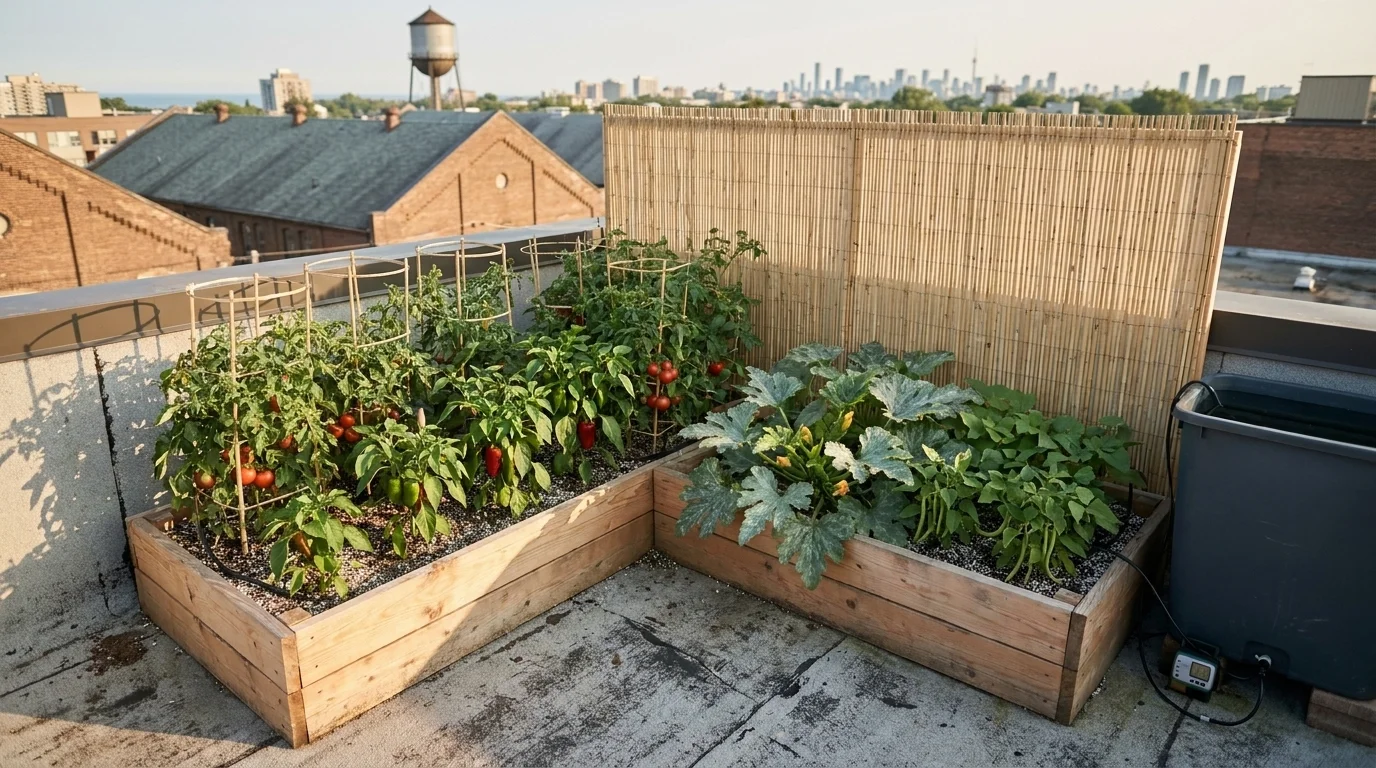
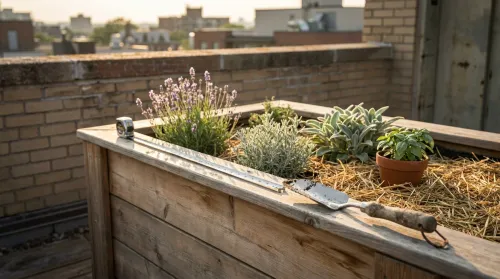
Weight limits matter more, not less. Rooftops are typically rated for 60-100 kg per square metre live load — much less than a balcony per square metre because the spans are longer. A 250 L raised bed full of wet soil weighs roughly 500 kg over its footprint, which means raised-bed builds on rooftops should be sited over structural beams (talk to your building manager) and use peat-free, perlite-heavy potting mixes — a perlite-and-peat-moss mix weighs about 40 lb/cu ft fully watered against 100-125 lb/cu ft for standard soil, a 60%+ reduction the Perlite Institute recommends specifically for roof gardens.
Wind exposure runs higher. A typical urban rooftop catches the local prevailing wind plus whatever is funnelled off neighbouring buildings. Wind-pruning (browned, wind-burned leaf edges) is the most common rooftop problem; pleached trees, trellised peas, and tall sunflowers tend to be the casualties. A 1.2-1.5 m solid or semi-solid wind screen at the windward edge of the bed transforms what survives. The wind also speeds evaporation — a rooftop bed without drip irrigation can lose its moisture by mid-afternoon on any hot day.
Sun gives back what wind takes. The compensation for the wind is light: most rooftops get genuine full sun, which opens the door to crops a balcony cannot grow (full-size tomatoes, peppers, aubergines, courgettes, beans, summer squash, melons in the right climate). Pair high-light crops with the wind screen and the rooftop becomes the most productive urban gardening surface available.
Water access is the single biggest practical question. Most rooftops don't have a tap. The realistic options: a 200 L rainwater catchment off a downpipe (where roof drainage allows), a daily-trip-with-watering-can routine (sustainable for a small bed, brutal for a large one), or a battery-powered drip system fed from a refillable cistern. A drip system on a £40 battery timer with a 100 L reservoir will water a 5 m² rooftop bed for a week with one fill.
The right rooftop build is bigger than balcony but smaller than most beginners think — a 3 × 2 m raised bed is enough to produce serious vegetables for a household, and is easier to manage than a sprawling collection of containers.
Loading image...
A 3 × 2 m rooftop bed produces serious vegetables for a household. Wind screen, perlite-lightened mix, and a drip kit on a £40 timer do most of the work.
Vertical gardening is the small-footprint method that produces the most genuinely useful yield-per-square-metre for an urban grower. The technique stacks growing space vertically — wall planters, rotating tiered towers, modular pocket systems, or hydroponic verticals — to multiply the planting area without multiplying the floor footprint. The published yield numbers are striking: vertical hydroponic systems can return up to 70-80× the yield per square foot of traditional in-ground plots, with consumer-system productivity gains around 300% per square foot (Hydroponic Update — Vertical Garden Strategies 2025).
Three categories of vertical that actually work for an urban gardener:
Soil-based stackable tower planters (e.g. GreenStalk, Mr Stacky) — 3 to 5 tiers, 1 m tall, footprint around one square foot. Hold 20-30 plants. Good for strawberries, salad greens, herbs, compact peppers, and some flowers. Limited by soil depth per tier — not for tap-root crops (carrots, beets, full-size tomatoes). Price: £80-£200 for a domestic unit.
Modular pocket / pouch systems — fabric or felt hanging pocket assemblies that mount on a wall or fence. The viral shoe-organiser version works as a one-season project; commercial pouch planters (£40-£100) last longer. Good for herbs and salad greens; mediocre for anything else because the soil dries fast.
Vertical hydroponic towers (e.g. Lettuce Grow Farmstand, Tower Garden, Click & Grow vertical units) — soil-free systems that recirculate nutrient solution past the roots. Highest yield-per-square-foot of any consumer system. Best for salad greens, herbs, strawberries; not designed for heavy fruiting crops. Price: £400-£900 for the system, plus £25-£50/month in nutrient solution and replacement pods.
Two practical decisions before buying any vertical system. First, where does the water go? A tower placed on a balcony tile floor will drip; a tower placed on a wooden deck will rot the deck. A drip tray (or a tile or a £20 IKEA shoe mat) under the unit solves it for £5-£20. Second, where does the sun come from? A south-facing tower will produce three times the yield of an east-facing one over a season; orient the tower so the sun moves across all sides if you can rotate it weekly (which most rotating models are designed for).
The simplest vertical that genuinely works on a small balcony, all-in for under £100: a single GreenStalk-style 5-tier soil-stacker on the railing, planted with strawberries on tier 1, salad greens on tiers 2-3, herbs on tier 4, and an early-spring radish-and-spring-onion mix on tier 5. Year-one expected yield: roughly equivalent to a 4 × 4 ft raised bed in the floor space of a single foot square.
Tabletop edibles
The Royal Horticultural Society named tabletop vegetables their #1 trend for 2026: dwarf cultivars specifically bred for balcony, patio, and windowsill scale — table-top chillies, compact aubergines, hanging-basket cucumbers, and 50 cm grape vines that produce a real crop in a single 30 cm pot (RHS — 2026 Gardening Predictions). The trend matters because it puts crops that used to need 2 m of border space into a container a renter can carry up two flights of stairs.
A working set of tabletop-scale cultivars for an urban gardener:
Tomatoes — 'Tumbling Tom' (hanging basket, heavy yield, 25 cm pot), 'Red Robin' (true dwarf at 25 cm tall), and the RHS-recommended blight-resistant 'Buffalosun' or 'Burlesque' for variable summers.
Chillies — most chilli varieties are functionally tabletop in a 25-30 cm pot; 'Apache' and 'Numex Twilight' are the easiest first picks.
Aubergines — 'Ophelia' and 'Hansel' are bred for container scale; both will fruit reliably in a 30 cm pot with full sun.
Cucumbers — 'Mini Munch' and 'Patio Snacker' are bred for hanging baskets or 30 cm pots; expect 20+ small cucumbers per plant.
Peppers — 'Sweet Sunshine' and 'Lunchbox' work on a balcony given six hours of sun.
Strawberries — 'Mara des Bois' and 'Marshmello' in hanging baskets or stacking towers; both fruit June to October on continuous-flowering varieties.
50 cm grape vines — RHS-flagged 2026 trend; 'Suffolk Red' and 'Boskoop Glory' are the best-known dwarf rootstocks for container culture.
Herbs as tabletop ground cover — golden marjoram, creeping thyme, and prostrate rosemary fill the negative space between fruiting plants and feed pollinators while doing it.
The compounding benefit of tabletop scale is that the plants are small enough to move. A renter who plans to move within two years can put the entire tabletop garden in a removal van without losing a season; a balcony gardener with full-sized tomato vines cannot.
The single biggest practical constraint for most urban gardeners is the tenancy. The conventional gardening press tends to assume permanent installations; the rental reality requires the opposite — modular, lightweight, no-drill mounting, packs-down-when-you-move. The 2026 RHS Chelsea Flower Show converged on exactly this idiom: "A Little Garden of Shared Knowledge" won Gold and Best Balcony Garden, and "The Transient Garden" specifically showcased modular, lightweight, two-person-portable balcony setups designed for movers and renters (Homes & Gardens — RHS Chelsea 2026 balcony gardens). The trend is overdue.
The renter-safe rules I work from on my own Toronto balcony, after eight years of moving and rebuilding:
No drilling into walls or floors. Use freestanding planters, railing planters (the over-rail hook style that does not need screws), modular folding arches, and tension-rod systems that wedge between balcony floor and ceiling.
Weight aware, removable. Every container should be liftable by two people when full. A 60 cm trough on a balcony floor is fine; a built-in raised bed bolted to the deck is a tenancy violation waiting to happen.
Modular vertical that breaks down. Stackable tower planters (GreenStalk, Mr Stacky) unstack flat for moving. Modular wall pocket systems unhook from their rail. Hanging baskets come off the bracket.
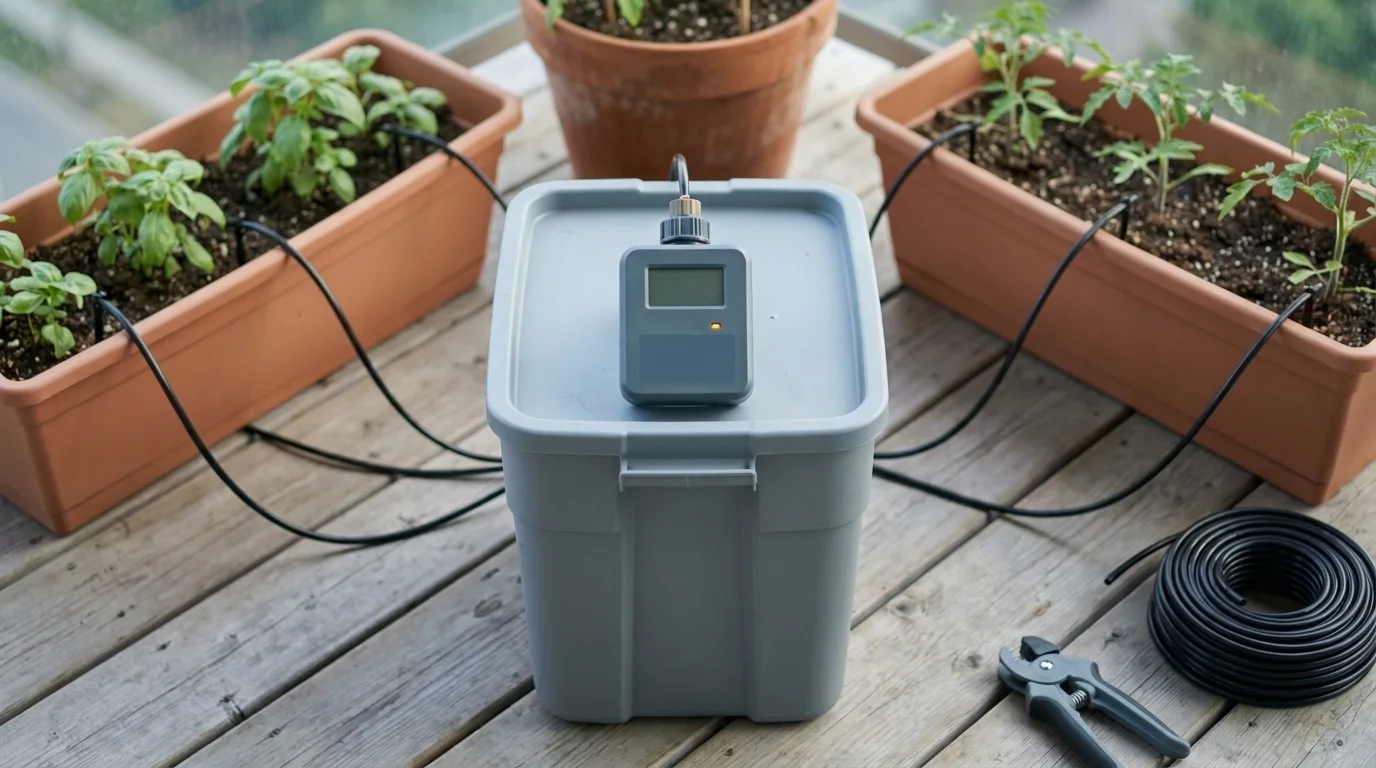
Drip-irrigation that doesn't require plumbing. A battery-powered drip kit fed from a refillable 25 L water container (£45 all-in) waters a balcony for three to five days at a time, requires no plumbing, and packs into a moving box.
Decorative coverings that aren't permanent. Bamboo screening zip-tied to railings, removable trellis panels, freestanding privacy planters — all renter-safe, all gone when you go.
Total build for a working renter-friendly first-balcony setup: £100-£200 in materials, an afternoon to assemble, zero holes in the wall, and the entire installation will fit in two boxes and the back seat of a small car when the lease ends.
Loading image...
A £45 battery drip kit on a 25 L refillable reservoir runs a balcony for three to five days. No plumbing, no holes in the wall, packs into a moving box.
Climate-resilient cultivars for containers
The 2025 UK summer was dry, and the gardening press has updated its container-vegetable recommendations accordingly. The Royal Horticultural Society's 2026 retail data shows a 14% sales uplift for resilient tomato cultivars like 'Shirley' and 'Sungold', and active recommendation of newer blight-resistant varieties — 'Buffalosun', 'Burlesque', 'Nagina' — over legacy favourites for unpredictable weather (RHS — 2026 Gardening Predictions). For a balcony or rooftop gardener without the buffer of in-ground roots, climate-resilient cultivar choice is the single most useful decision of the season.
Container-resilient picks worth knowing for 2026:
Blight-resistant tomatoes: 'Buffalosun', 'Burlesque', 'Nagina' — RHS-recommended for variable summers. 'Mountain Magic' is also worth knowing for the same reason.
Drought-tolerant herbs: Mediterranean herbs (rosemary, thyme, sage, oregano) handle dry containers better than basil and parsley; plant them in free-draining gritty mixes rather than rich compost.
Heat-tolerant salads: 'Salad Bowl', 'Lollo Rossa', and other loose-leaf lettuces handle warmer summer balconies better than crisphead varieties; mizuna and rocket bolt fast in heat so plant them only in early spring or autumn.
Wind-tolerant flowers for pollinator support: Lavandula angustifolia, Salvia nemorosa 'Caradonna', Origanum vulgare — all RHS Plants-for-Pollinators-listed and all drought-tolerant.
The general rule: choose plants that match the worst day your balcony will see, not the average. A balcony plant that survives a 35°C July afternoon with a dry reservoir will thrive in the cooler weeks; a plant chosen for the average conditions will die in the heatwave.
Smart watering and modular hydroponics
The smart-garden category split through 2024 into two genuinely useful tools and a long tail of marketing. The two worth knowing for an urban gardener:
Smart watering kits — a tap-mounted timer (Rachio, Eve Aqua, Hozelock automatic) with optional soil-moisture sensors that override the schedule when rain or wet soil makes irrigation unnecessary. Domestic kits run £40-£150. The RHS has flagged AI-enabled water butts as moving toward consumer release in 2026 — useful to track, not yet mainstream (RHS — 2026 Gardening Predictions). The single biggest practical benefit is removing the hand-watering decision from a gardener's daily schedule in summer, which is the most-skipped task on hot days and the most common cause of plant loss.
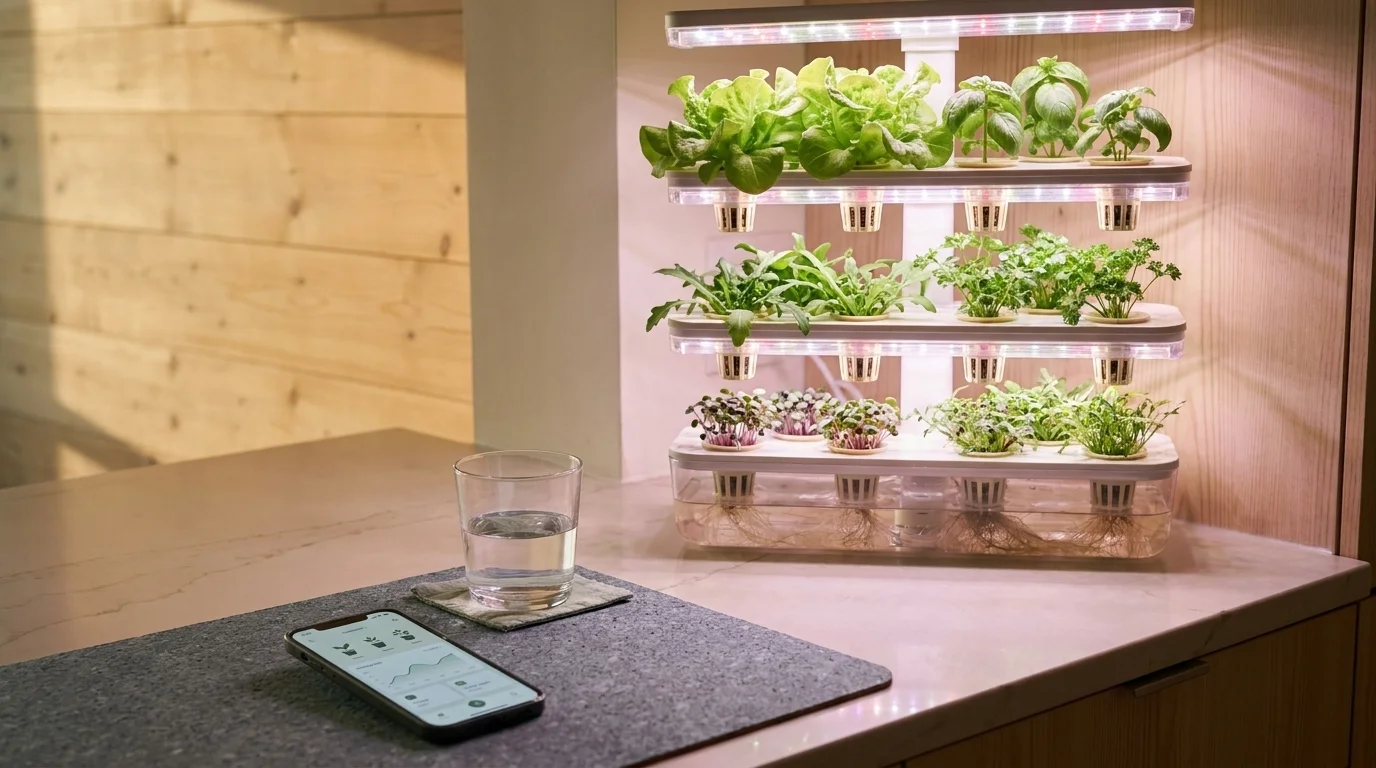
Modular consumer hydroponics — countertop and multi-tier systems with WiFi pumps, full-spectrum LED lighting (typically 36 W per tier), and companion apps. Price tiers:
£100-£200: AeroGarden Bounty Basic, Click & Grow Smart Garden 3 — 3-pod countertop units for herbs and salads.
£200-£400: LetPot Pro, iDOO 12-pod — multi-tier mid-range; serious herb-and-salad production for a household.
£400-£900: Gardyn, Lettuce Grow Farmstand, vertical hydroponic towers — high-output 24+ pod systems with companion apps.
What the published 70-80× yield-per-square-foot figure for vertical hydroponics actually means for a home gardener: a £400 unit on a kitchen counter or in a spare room will produce enough leafy greens and herbs to supply a household's weekly salad and cooking needs all year, with about 30 minutes of weekly maintenance. The break-even on the unit cost runs roughly 12-18 months at supermarket-equivalent prices for organic-quality produce.
A short word on community
The collective end of urban gardening — community gardens, allotment co-ops, school-and-workplace plots — deserves its own article, and gets it elsewhere on Verdenook. The short summary here: most UK and US cities have multi-year waiting lists for council allotment plots (get on the list now, before you're sure you want one), and most also have informal community-garden networks and seed swaps that an urban gardener with even a balcony can usefully join. The peer learning is genuinely useful and reduces the loneliness that solo-balcony gardening sometimes produces; the social media side of finding these networks lives in our companion article on garden influencers, hashtags, and online communities.
What's actually coming next
The forward-looking coda the original framing of this article wanted to write is worth keeping, briefly, anchored in 2026 reality rather than 2018 speculation. Three things to track as an urban gardener.
Modular consumer hydroponics will get cheaper and better. The global gardening market is projected to reach roughly USD 157 billion by 2030, with vertical-system share growing fastest (Hydroponic Update). The £400 unit of 2026 will be the £200 unit of 2028, and the £200 unit will perform like the £400 of today. Worth holding off a year if you can; worth buying now if your kitchen counter is empty and your supermarket salad bill is high.
AI-assisted watering will move from gimmick to standard. The RHS-flagged trial of AI water butts is a small move in a larger trend toward systems that use rainfall forecasts, soil-moisture readings, and learned-plant-preference patterns to schedule irrigation more intelligently than a fixed timer. The early units will be expensive and quirky; the second-generation units in three to five years will probably be the right buy.
The cultivar pipeline is responding to climate. The 2025 dry-summer-resistant tomato list is a leading indicator; expect blight-resistant, drought-tolerant, heat-tolerant cultivars to dominate seed catalogues over the next decade, with traditional favourites quietly slipping out of the mainstream. The gardener who tracks the RHS Plants for Pollinators updates and the major UK seed-house catalogue listings each February will be one to two years ahead of the curve on what is worth planting.
Loading image...
A £400 multi-tier unit on the counter supplies a household's weekly salad and cooking herbs. Break-even at supermarket-organic prices: twelve to eighteen months.
The honest closing: my balcony, on its eight-and-counting season, currently holds nine sub-irrigated planters, a Kratky lettuce station in a repurposed pickle jar, and a single stubbornly productive cherry tomato that has been there for three seasons and defies every published rule about full-sun requirements. Total build cost across the whole installation, accumulated over years: somewhere under £400. Year-on-year produce yield: somewhere around 20-30 pounds of leafy greens, herbs, and bush vegetables. The math is straightforward; the constraints are real; the harvest is real too. Pick the space you have, choose the method that suits it, and start with one tier — a balcony, a window box, a single hydroponic kit on the counter. The rest of the urban-gardening discipline will come together a season at a time. By next April, the tomato that you weren't sure would survive will, and you'll have a better answer to "is this worth doing" than any article will ever give you.
What's the best way to start an urban garden on a small balcony?
Measure your direct sun on a clear June day before buying seeds, then choose three to four containers sized to your weight limit. Start with low-maintenance herbs (basil, mint, thyme) and add a dwarf tomato in a sub-irrigated planter once the herbs are settled. A 60 cm trough, a 40 cm SIP, and a 30 cm herb pot is a working starter setup for £70–£120, with expected first-year produce value of £150–£300.
Can you grow vegetables on a rooftop or balcony in the UK climate?
Yes. UK balconies suit lettuces, herbs, dwarf tomatoes, chillies, and compact aubergines through the growing season. Choose climate-resilient cultivars — the RHS recommends blight-resistant tomatoes like 'Buffalosun', 'Burlesque', and 'Nagina' after the dry 2025 summer. The 2026 trend is tabletop vegetables: dwarf chillies, compact aubergines, hanging-basket cucumbers, and 50 cm dwarf grape vines bred specifically for container scale.
How much does a vertical garden or hydroponic system cost to set up?
Entry-level modular vertical planters (GreenStalk, Mr Stacky) start around £80–£200 for a 3–5 tier soil-based unit. Consumer hydroponic kits range £100–£200 for a 3-pod AeroGarden or Click & Grow countertop, £200–£400 for a 12-pod LetPot Pro or iDOO, and £400–£900 for a Gardyn or Lettuce Grow Farmstand. Vertical hydroponic systems can return up to 70–80 times the yield per square foot of traditional in-ground beds.
What plants and setups work best for renters who can't drill into walls?
Use freestanding planters, railing planters (over-rail hook style), modular folding arches, tension-rod systems, and stackable tower planters that unstack flat for moving. The 2026 RHS Chelsea Flower Show specifically showcased modular, two-person-portable balcony setups designed for renters. Battery-powered drip-irrigation kits fed from a refillable 25 L reservoir work without plumbing. Total renter-friendly first-balcony build: £100–£200, no holes in the wall.
How often do I need to water a balcony garden in summer?
High-wind balconies need watering twice a day in summer — desiccation runs roughly double the rate of ground-level gardens. Three practical responses: use larger containers (which hold moisture longer), choose wind-tolerant plants (Mediterranean herbs over salad leaves), and install a sub-irrigated planter or a battery-timer drip kit so the routine doesn't depend on a daily decision. A properly built SIP will hold a tomato plant through a 72-hour heatwave without you.
Nurturing Inclusive Landscapes: Collaborative Efforts for Accessible Gardens in Public Spaces
Join
Loading...
Our Green Community!
Loading...
VerdeNook is more than just a source of gardening wisdom; it’s a platform for sharing, learning, and growing together. We invite you to join our community, share your stories, and spread the joy of gardening. Let’s sow the seeds for a greener, healthier, and more sustainable future, one garden at a time.