Unleashing the Healing Power of Nature: Creating a Therapeutic Garden Space
Share this article:
A healing garden does not need a designer to do the work. Three pine boards in the right corner, plants close enough to brush, audible water — the rest is patience.
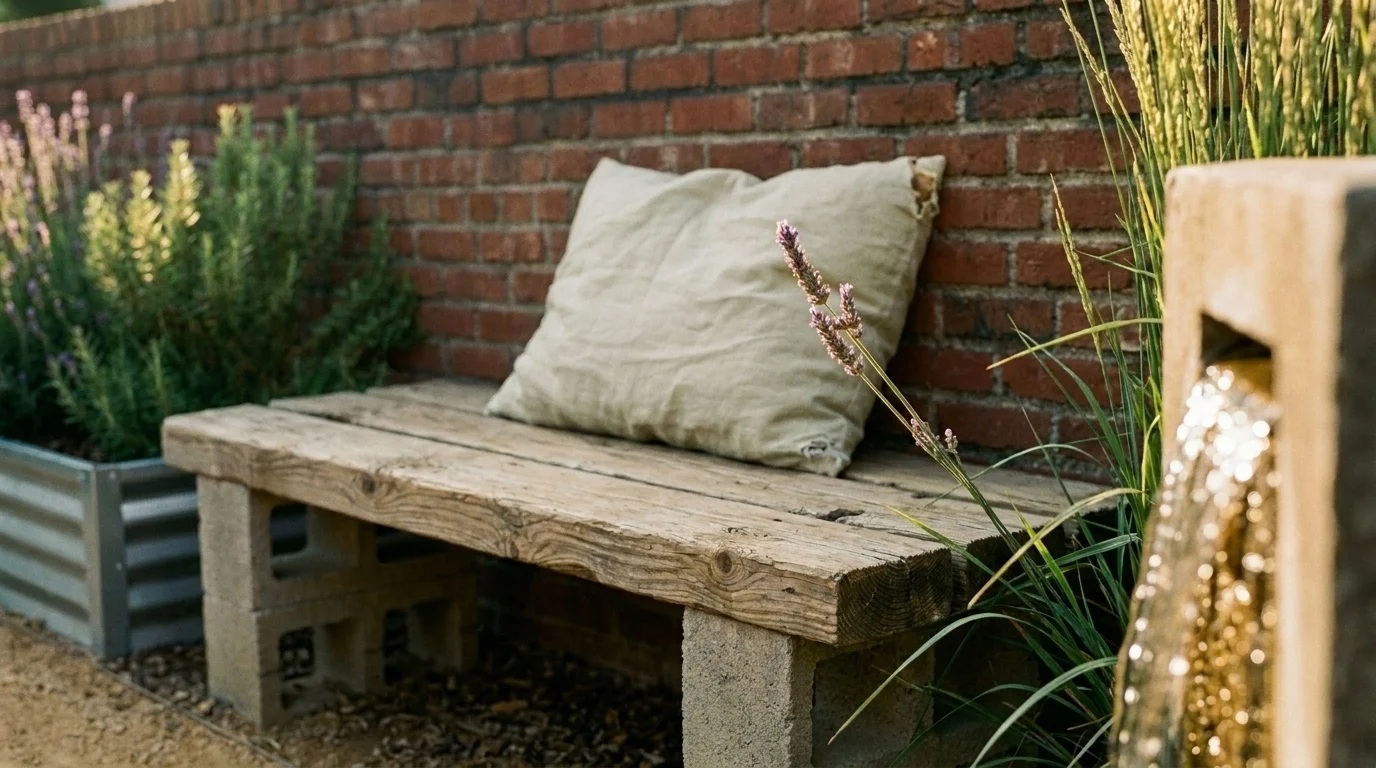
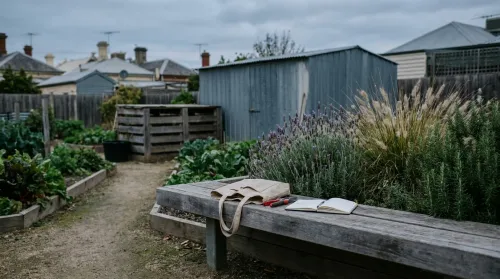
The community plot I help run sits on a strip of council land behind a train line in Brunswick, and the bench at the eastern corner — three pine boards on cinder blocks, donated by a woman whose late husband had built the original — is the most used object in the garden. People walk past the carrots, past the espaliered apple, past the herb spiral, and they sit. Nothing about the bench was designed; it accumulated. And yet it has become the closest thing the plot has to what the literature calls a healing garden — a place where the presence of plants does measurable work on the people in their orbit. A nurse coming off a night shift sat there for forty minutes one morning before she felt able to drive home. A retired carpenter sits there most Saturdays and watches the bees in the borage.
A growing body of evidence backs up what the bench knows. The summary of the field in Scientific American puts it bluntly: as little as three to five minutes of nature viewing measurably reduces anger, anxiety, and pain (Scientific American). The garden behind the train line did not need a designer to do that work, but if you are setting out to build a healing garden on purpose — at home, in a hospital courtyard, behind a hospice — there is now a serious literature to draw on. This is a guide to using it.
What is a healing garden?
The vocabulary is unhelpfully crowded. Healing garden, therapeutic garden, sensory garden, meditation garden, enabling garden, restorative garden — every one of those terms is in active use, often interchangeably, and the result is a SERP full of confusion. The American Horticultural Therapy Association has tried to settle the taxonomy, and it is worth borrowing.
Term
What it is
Where you find it
Healing garden
The umbrella term: a plant-dominated environment designed to benefit most users. No specific clinical program required.
Hospitals, hospices, senior living, schools, private homes
Therapeutic garden
A subcategory of healing garden: purposefully designed to support a specific treatment program (occupational, physical, or horticultural therapy) and tailored to defined user goals.
Rehabilitation centres, psychiatric wards, dementia care wards
Sensory garden
A design approach (rather than a separate type): plant layering specifically chosen for touch, smell, sight, sound, and taste.
Children's hospitals, special-education schools, residential homes
Enabling garden
A therapeutic garden tuned to a particular access challenge — raised beds, vertical planting, wheelchair turnarounds.
Care homes, rehabilitation outpatient programmes
Meditation garden
A design style emphasising contemplation: water, simple planting, framed views. Often informally called a healing garden by users.
Private homes, retreat centres, monasteries
All therapeutic gardens are healing gardens; not all healing gardens are therapeutic. The shorthand for everything in this article will be healing garden, because it is the umbrella the others sit under, and because it is the term most home gardeners actually use (AHTA; Wikipedia).
The practice is older than the vocabulary. Garden spaces used in the care of the sick are documented in healthcare contexts at least to the fifth century AD, with horticultural precedents going back to roughly 2000 BC in Mesopotamia. What is new is not the idea — it is the evidence.
Why it works
Roger Ulrich's 1984 study is the foundational citation, and any honest article in this field has to begin there. Ulrich compared two cohorts of surgical patients in a Pennsylvania hospital: half had a window view onto a stand of deciduous trees, half looked at a brick wall. The cohort with the tree view had shorter post-operative stays, required fewer doses of strong analgesics, generated fewer negative comments from nurses, and recorded lower scores on a post-surgical complications scale (summary via Wikipedia, Therapeutic garden; Scientific American). Forty years later, that single comparison still underwrites the field.
The newer literature is more granular. A 2023 systematic review published in Frontiers in Public Health derived a working set of design guidelines for hospital healing gardens after surveying the available evidence (PMC10722422); a companion review in Frontiers in Psychology the same year, on hospital green spaces as sensory-therapeutic environments, found that visual and olfactory stimuli drove the strongest psychological-restoration responses, and that high plant diversity combined with natural sound and complex aromas produced the greatest combined psychological and physiological effect (PMC10705765; see also PMC10621031 for the literature-review-and-working-definition paper).
The home-scale implication is plain enough: a few aromatic plants, audible water or wind-moved grasses, and enough species diversity to give the eye somewhere to land. None of that is exotic. Most of it is already happening in the better-kept allotment plots in any city.
Loading image...
A seat with its back to a wall and a view forward is the prospect-and-refuge pattern human bodies appear to find restorative across cultures.
Therapeutic garden design principles
The two design moves that show up across every credible design-guideline paper are prospect and refuge — a seat with its back protected and a clear view forward — and Universal Design, the seven-principle framework (equitable use, flexibility, simple/intuitive, perceptible information, tolerance for error, low physical effort, size and space for approach and use) that has quietly replaced the older "accessibility" vocabulary in serious therapeutic-garden practice. Universal Design is not a checklist about disability; it is a checklist about whether the garden is usable by an eight-year-old, an eighty-year-old, a wheelchair user, and someone with a stroller, all in the same week. If it passes those four tests, it will pass most others.
Paths. A minimum of 5 ft (60 in) for any path expected to handle wheelchair turnaround and side-by-side passage. The ADA single-direction minimum is 3 ft (36 in) — usable for narrow service paths, but not the main loop. Surface matters as much as width: compacted decomposed granite, brushed concrete, or stabilised pavers are firm and quiet underfoot; loose pea gravel is a Universal Design failure.
Beds. Raised beds 24–36 in high allow seated and wheelchair-using gardeners to work without leaning; lower beds suit children and standing adults.
Seating. Place seats with their backs to a wall, a hedge, or a planted screen, with the view outward — the prospect-and-refuge pattern that human bodies appear to find restorative across cultures. The community plot's bench is an unintentional textbook example.
Water. A water element that registers somewhere in the 40–60 dB range at the seating position will mask street noise without dominating conversation. Wallace J. Nichols' Blue Mind research is the popular-press anchor for why audible water consistently produces the response it does; the design point is that the water has to be loud enough to hear, not loud enough to perform.
The article you are reading sits inside a category of gardening writing that loves the word sanctuary. I would gently set that word aside. The bench behind the train line is not a sanctuary. It is a serviceable object placed in a useful spot by accident, and the principles above mostly amount to making that kind of accident more likely.
A practical distinction: therapeutic horticulture vs horticultural therapy
It is worth saying this clearly, because the two phrases are constantly conflated. Horticultural therapy (HT) is a clinical discipline: a formal, goal-directed treatment programme delivered by a registered horticultural therapist (HTR) with measurable patient outcomes. Therapeutic horticulture (TH) is what almost everyone reading this article actually practises — facilitated wellness activity in a garden, with no clinical goals required and no credentials needed (NC Botanical Garden).
If your interest is in the clinical side — for a school, hospital, or aged-care setting — the American Horticultural Therapy Association maintains a directory of HTR practitioners. If your interest is in the bench behind the train line, what you are doing already is enough.
Healing garden plants by sense
The single most useful thing a home gardener can do, once the bench and the path are in place, is plant for more than one sense. The table below is consolidated from the plant lists in Penn State Extension, SDSU Extension, and Kew's sensory-garden guide. Choose two or three from each column, biased toward what is native and seasonal where you garden.
Sense
Plant (common name)
Botanical name
Hardiness
Role
Touch
Lamb's ear
Stachys byzantina
USDA 4–8
Silvery, felted leaves; deeply tactile
Touch
Wooly thyme
Thymus pseudolanuginosus
USDA 4–8
Soft mat over a path edge
Touch
Yarrow
Achillea millefolium
USDA 3–9
Fern-like fingertip texture
Smell
English lavender
Lavandula angustifolia
USDA 5–9
Long-season fragrance; brushable
Smell
Rosemary
Salvia rosmarinus
USDA 7–10
Aromatic, evergreen, hardy in milder climates
Smell
Catmint
Nepeta mussinii
USDA 3–8
Sustained scent and a magnet for pollinators
Smell
German chamomile
Matricaria chamomilla
Annual / USDA 4–9
Apple-and-honey scent in midsummer
Smell
Lemon balm
Melissa officinalis
USDA 3–7
Crushed leaves give a sharp citrus lift
Sight
Purple coneflower
Echinacea purpurea
USDA 3–8
Strong vertical structure and a long bloom
Sight
Delphinium
Delphinium elatum (and hybrids)
USDA 3–7
Spires of blue — uncommon in the planted world
Sight
Sunflower
Helianthus annuus
Annual
Scale; satisfies the eye's hunt for a focal point
Sound
Feather reed grass
Calamagrostis × acutiflora
USDA 4–9
Carries even slight wind audibly
Sound
Bamboo (clumping)
Fargesia spp.
USDA 5–9
Rattle in stronger gusts
Sound
Rattlesnake master
Eryngium yuccifolium
USDA 3–8
Dry seed-head rattle from late summer
Taste
Strawberry (alpine)
Fragaria vesca
USDA 4–9
Edible, low, child-height
Taste
Mint (in containers!)
Mentha spp.
USDA 3–8
Edible; never plant in open ground
Taste
Culinary herbs
Petroselinum, Origanum, Salvia
mostly USDA 4–10
Daily-use sensory engagement
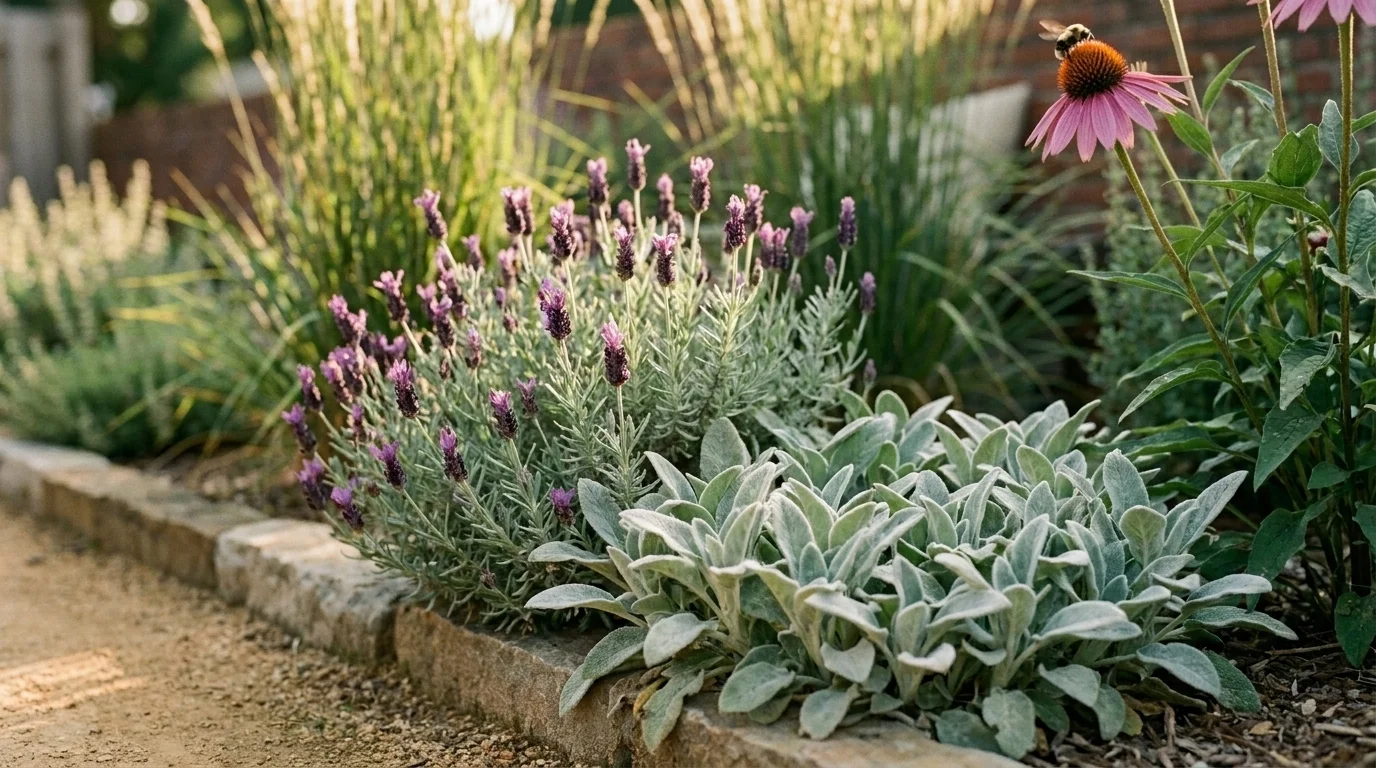
Plant in groups rather than single specimens — three to five of any one variety, repeated through the bed, reads to the eye as intentional rather than busy. A high-plant-diversity bed (somewhere north of ten species in a single sensory zone) is what the 2023 Frontiers in Psychology paper specifically identified as producing the strongest psychological response. The instinct of the inexperienced gardener is to keep adding kinds; the instinct of the experienced one is usually to remove them. In a healing garden, lean back toward the inexperienced instinct.
Loading image...
Plant for more than one sense. High species diversity in a sensory bed produces the strongest measured psychological response in the literature.
Healing garden at home: balcony and container adaptations
Most writing about healing gardens silently assumes a backyard, which silently assumes a particular kind of housing tenure, which is — to put it gently — an uneven assumption to make in any Australian, British, or North American city in 2026. The community plot behind the train line exists because the council still owns that strip of land. Most of the people who use it do not own the ground they live on, and would not be able to dig a sensory bed at home if they wanted to.
The Universal Design principles scale down. A five-container balcony arrangement is enough to honour the same logic:
Aromatic. One trough or large pot of English lavender plus a second of rosemary. Both will overwinter outside in most zones from USDA 5 upward.
Tactile. A shallow planter of lamb's ear or wooly thyme, positioned where a hand can fall on it from the seat. (Yes, the seat is part of the design — a single, comfortable chair counts.)
Auditory. One ornamental grass — a clumping Calamagrostis is fine in a 16-litre pot for several seasons — placed where any movement of air reaches it.
Edible. Strawberries in a hanging container at hand height, or any combination of culinary herbs you actually use. Eaten leaves are sensory engagement.
Water. A small recirculating tabletop fountain plugged in for the hour you are out there. The 40–60 dB range is easily achievable with the smallest commercial unit.
That arrangement is a healing garden. It is not less of one because it fits on a third-floor balcony in Carlton or in Camden, and the design literature would say the same.
Hospital case studies and what to take from them
The international exemplar is Khoo Teck Puat Hospital in Singapore — designed as a garden first and a hospital second, with planting woven through the building rather than added as a courtyard (discussed in research Section 4). At home scale, the takeaway is not the building scale; it is the principle. The garden is not somewhere you visit during a hard day. The garden is the route the day passes through. If the only way to reach the bench is to cross the planted ground — to brush past the lavender, to walk under the apple — the garden does its work whether or not you sit down.
A note about land
The case for a healing garden does not rest on the literature, which is good, because most people will not read the literature. It rests on the bench. It rests on the fact that the nurse who sat on those three pine boards for forty minutes the morning I am thinking of would have struggled to find any other place in the city, on her budget and on her timetable, that could have done the same work. The literature can tell us why. The bench tells us that.
If you are designing one at home, design it for that nurse. If you do not have a home to design it in — and a great many of the people who would most benefit do not — the case still holds, and the work then is to argue for the council plot, the laneway garden, the school yard, the strip behind the train line. A healing garden is not the same as a private sanctuary, and the politics of that difference matter. The bench, eventually, has to be available to whoever needs it.
What is the difference between a healing garden and a therapeutic garden?
According to the American Horticultural Therapy Association, a healing garden is a plant-dominated environment designed to benefit most users — typically found in hospitals, hospices, and senior living. A therapeutic garden is a subcategory: a garden purposefully designed to support a specific treatment program (occupational therapy, physical therapy, horticultural therapy) and tailored to defined user goals. All therapeutic gardens are healing gardens; not all healing gardens are therapeutic.
What plants should I include in a therapeutic garden?
Layer plants by sense. Touch: lamb's ear (Stachys byzantina), wooly thyme (Thymus pseudolanuginosus), yarrow (Achillea millefolium). Smell: lavender (Lavandula angustifolia), rosemary (Salvia rosmarinus), catmint (Nepeta mussinii), chamomile, lemon balm. Sight: purple coneflower (Echinacea purpurea), delphinium, ornamental grasses, sunflowers. Sound: feather reed grass (Calamagrostis × acutiflora), bamboo, rattlesnake master. Taste: strawberry, mint (in containers only), culinary herbs. Choose native and seasonal varieties suited to your USDA zone for low maintenance and biodiversity.
How wide should paths be in a therapeutic garden?
Five feet (60 inches) is the preferred minimum for wheelchair accessibility, allowing turnaround and side-by-side passage. The ADA single-direction minimum is 3 feet (36 inches). Path surfaces must be firm, smooth, and free of loose gravel — compacted decomposed granite, brushed concrete, or stabilised pavers all work; loose pea gravel is a Universal Design failure.
Can I build a healing garden on a balcony or in containers?
Yes. A five-container arrangement replicates the principles at apartment scale: one aromatic planter (lavender plus rosemary), one tactile container (lamb's ear or wooly thyme), one ornamental grass for movement and sound, one edible (strawberries or culinary herbs), and a small tabletop fountain for audible water. Add a comfortable single seat — the Universal Design framework scales down to a third-floor balcony without losing its substance.
Is there scientific evidence that healing gardens work?
Yes. Roger Ulrich's 1984 study showed that surgical patients with a window view of trees had shorter hospital stays, lower analgesic use, and fewer post-surgical complications than patients viewing a brick wall. More recent 2023 systematic reviews in Frontiers in Public Health and Frontiers in Psychology confirm that hospital healing gardens promote measurable psychological and physiological restoration, with visual and olfactory stimuli driving the strongest response and high plant diversity combined with natural sound producing the greatest combined effect.
The Healing Garden: How to Cultivate Plants for Mental Health and Well-being
Join
Loading...
Our Green Community!
Loading...
VerdeNook is more than just a source of gardening wisdom; it’s a platform for sharing, learning, and growing together. We invite you to join our community, share your stories, and spread the joy of gardening. Let’s sow the seeds for a greener, healthier, and more sustainable future, one garden at a time.