The Influence of Gardening on Behavior Change: Empowering Positive Lifestyle Choices and Attitudes Through Horticulture
Share this article:
Ten to thirty minutes is the threshold at which measurable mood and cortisol changes begin; the carrots are part of it, but the plot is most of it.
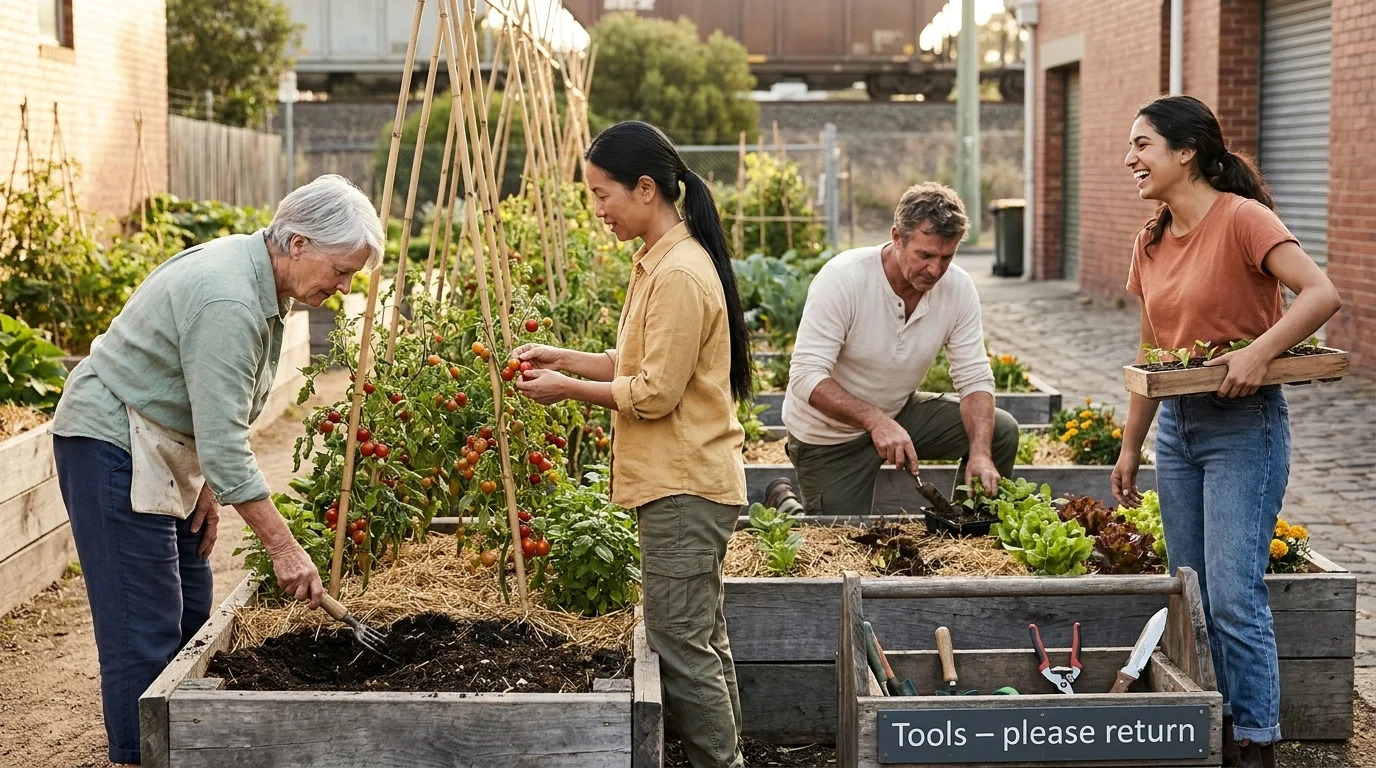
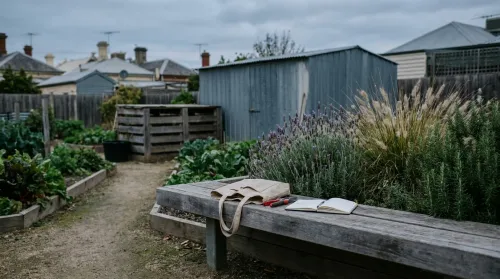
The community plot I help coordinate sits on a strip of council land behind a train line in Brunswick, and on the Saturday morning I am thinking of, there were nine of us there before the heat came up — a retired nurse, two women from the Vietnamese grocer on Sydney Road, an exchange student from Argentina, and the rest of us somewhere in between. None of us would have said, in that moment, that we were there for the mental health benefits of gardening. We were there for the carrots, the company, and the patch of council land that had finally been turned in October. But the carrots are not the whole story.
A 2024 umbrella review in BMC Public Health pooled forty systematic reviews of gardening's effects on well-being and found a standardised effect size of 0.55 in favour of the gardening group — a moderate-to-large signal, statistically significant at p < 0.001, with the honest caveat that heterogeneity between studies was high. A 2026 cohort study from the University of Florida found that daily gardeners had forty-three per cent lower odds of poor health — defined as anxiety, health limitations, or both — than non-gardeners. These are the kinds of numbers that, until quite recently, the public-facing literature was reluctant to put behind the more lyrical claims. The numbers are now strong enough to start with.
This is the argument I want to make, by accretion: that gardening's mental-health benefits are real, more specific than the listicles suggest, and most interesting where they spill into the broader pattern of how a person comes to live differently. The carrots are part of it. The plot is part of it. The behaviour change is part of it. None of them, on its own, is the whole story.
What 2024-2026 research actually shows
The headline number from the 2024 umbrella review is a well-being effect size of 0.55, with a 95% confidence interval of 0.23 to 0.87 and a p-value below 0.001. For a non-statistician, what that translates to is a moderate-to-large benefit, robust enough to clear a high evidentiary bar. What the same review also said, and what the consumer summaries usually omit, is that heterogeneity across the included studies was very high (I² of 88.5%) and that seventy-one per cent of the underlying reviews were rated as critically low in methodological quality. The authors recommended caution against drawing direct clinical conclusions. Both halves of that sentence belong in the same paragraph.
The 2026 UF cohort number — forty-three per cent lower odds of poor health for daily gardeners — has the inverse strength and weakness: it is a large effect from a large sample, but it is observational, which means daily gardeners are not a randomly assigned group. People who garden every day differ from people who don't in ways the study cannot fully account for.
The strongest randomised evidence is the 2023 CAPS community-gardening trial of 291 participants, which found statistically significant reductions in perceived stress and anxiety in the gardening group compared with controls. The community-plot setting matters here; the social element is doing work that a solitary windowsill basil pot does not, and the literature is finally honest about that.
The most useful thing to take from the 2024-2026 wave is that ten to thirty minutes of gardening activity is the threshold at which measurable mood and cortisol changes begin to appear. You do not need to garden for two hours to receive the benefit. A short, regular session is more useful than a long irregular one — which is, not coincidentally, the same answer the habit-formation literature gives for almost every other behaviour.
Loading image...
A 2024 umbrella review found a moderate-to-large well-being effect — 0.55 standardised, p < 0.001 — pulled mostly from people in action and maintenance.
Horticultural therapy: what it actually is
The term I keep coming back to is horticultural therapy, partly because I have watched it do the work it claims to do and partly because the term has more history behind it than the consumer wellness industry usually acknowledges. The modern discipline traces directly to the post-war rehabilitation programmes for veterans of the First and Second World Wars — the gardens of the Friends Hospital in Philadelphia, the work at the Rusk Institute in New York, the convalescent allotments attached to British military hospitals. The pamphlet I keep on my desk, the 1943 Dig for Victory leaflet from the Australian Department of Agriculture, sits next to a copy of the 2023 systematic review of horticultural therapy for dementia, and I find the proximity instructive: the case for the garden as a rehabilitative space is, by now, eighty years older than most articles on the topic let on.
Horticultural therapy as currently practised in North America is a credentialed clinical discipline. The American Horticultural Therapy Association (AHTA) reports that fifty-nine per cent of its members hold an accredited certificate and fifty-three per cent hold a Master's degree or higher. Professional registration requires a four-hundred-and-eighty-hour supervised internship, which is not the kind of training a wellness blog talks about when it equates "garden therapy" with "spending more time outside".
A note on credentialing, because it is changing. Through the first half of 2026, the AHTA credential a practitioner carried was the HTR — Horticultural Therapist, Registered. From October 2026, the HT-BC (Board Certified) credential begins testing, and the HTR designation retires around July of the same year. If you are looking for a qualified therapist in your area in the second half of 2026 or later, the HT-BC is the credential to look for; through the transition, both will be in circulation.
How gardening moves you through the Stages of Change
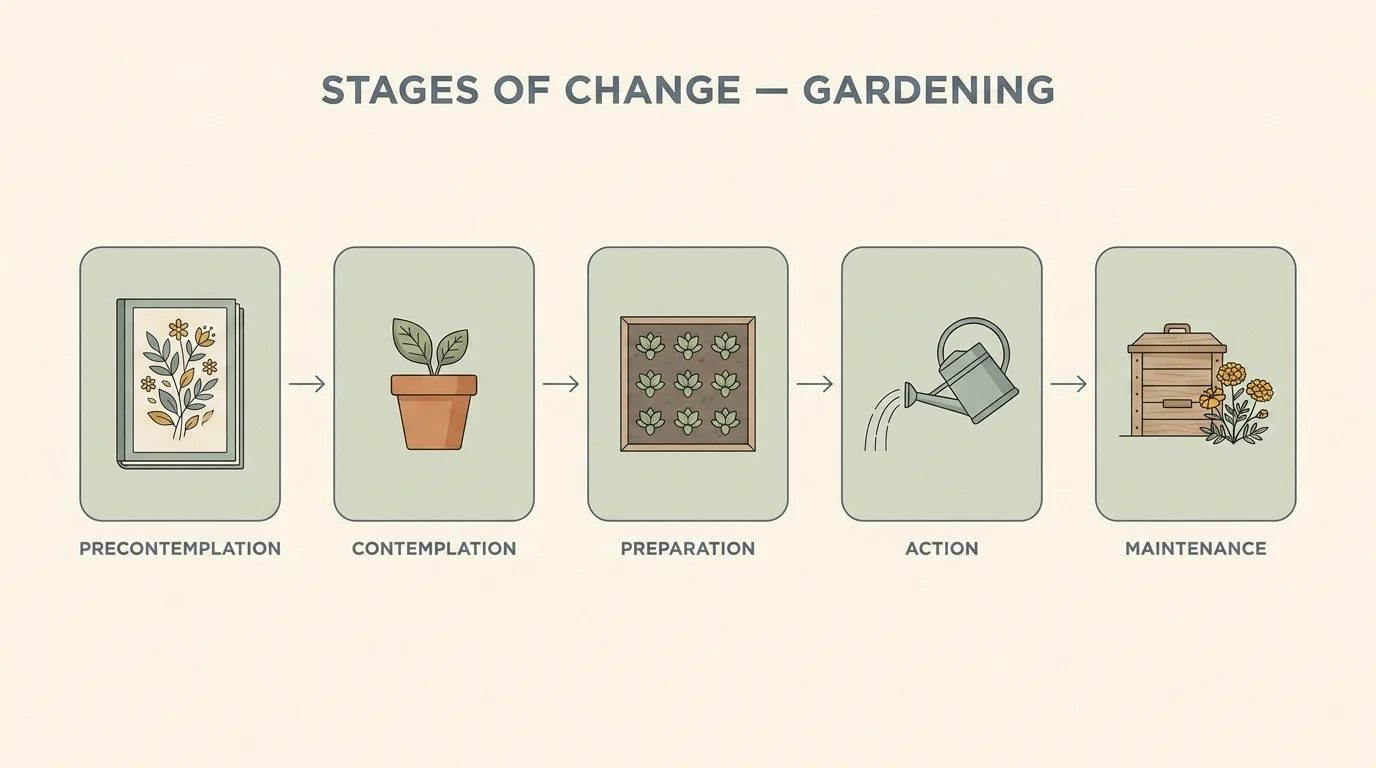
The most useful behaviour-change framework I have read against the gardening literature is the Transtheoretical Model — the Stages of Change developed by Prochaska and DiClemente in the late 1970s and applied more recently to pro-environmental behaviour by a 2022 Frontiers in Psychology review. The model proposes that any meaningful behaviour change moves through five stages — precontemplation, contemplation, preparation, action, and maintenance — and that interventions work best when they are matched to the stage the person is actually in. Almost nobody writing about the mental-health benefits of gardening uses this frame, and it is a missed opportunity, because gardening maps onto it almost too neatly.
Precontemplation — the person is not yet thinking about gardening. The intervention that matters is a small, low-cost exposure: a community plot working bee they walk past; a neighbour offering a packet of basil seed; an Instagram reel that registers but is not yet acted on.
Contemplation — the person is thinking about it but not doing it. The intervention is a single low-stakes commitment: buy one potted herb, choose one bed at a community plot, attend one workshop. The literature is clear that this is the stage where most well-intentioned campaigns fail by demanding too much.
Preparation — the person buys the seed, lays out the bed, signs up for the plot. This is where decisions accumulate that lock in the next stage.
Action — the daily-watering, weekly-weeding stage; the cortisol and mood effects in the 2024 umbrella review apply most strongly here. Brennan's law of community plots applies: in the first three weeks, people show up because they said they would. From the fourth week, they show up because they want to.
Maintenance — the stage at which gardening becomes part of how someone lives rather than something they do. This is where the keystone-habit literature engages, and where the spillover into composting, water conservation, and reduced food miles becomes legible.
The reason this matters for the mental-health argument is that the moderate-to-large benefit sizes in the 2024 review are pulled mostly from people in action and maintenance — the carrots-and-cortisol crowd — and the consumer-facing intervention that actually helps a precontemplative reader is not a study citation but a working-bee invitation. The Stages of Change framework is what lets an honest article hold both of those truths at once.
Loading image...
Almost nobody writing about gardening uses the Stages of Change frame; it is the move that lets an honest article hold cortisol numbers and working-bee invites at once.
Conditions: what the evidence supports — and what it does not
The literature is more granular than the listicles, and the article most worth reading is the one that names that granularity honestly.
Depression
The strongest randomised signal is the 2023 CAPS community-gardening trial, which found significant reductions in perceived stress and anxiety in the gardening arm. For depressive symptoms specifically, the observational and quasi-experimental literature is consistent — daily and regular gardeners report fewer symptoms — but I would not be honest if I said the evidence base supports gardening as a replacement for professional care in clinical depression. It is best framed as a complement to existing treatment, not an alternative to it.
Anxiety
The same 2023 CAPS trial reported significant anxiety reductions, and the 2024 umbrella review's well-being effect size of 0.55 is driven in part by anxiety subscale improvements. The mechanism the literature most frequently names is attention restoration — the soft fascination of repetitive, low-stakes tasks like weeding that allows the directed-attention system to recover.
Stress and cortisol
The ten-to-thirty-minute threshold appears here more often than anywhere else. Multiple studies through 2025 and 2026 — summarised by the Virginia Master Gardener evidence-based update — find measurable cortisol reductions after short sessions of contact with plants and soil, with effects more reliable when the activity involves physical task completion (planting out, harvesting) than passive observation.
Dementia
The honest part of the dementia conversation requires care. A 2023 systematic review of horticultural therapy in dementia patients found consistent improvements in agitation level and engagement time, but no conclusive evidence of benefit to cognitive function itself. That is a real and useful finding — agitation is one of the hardest things a dementia carer faces, and a meaningful reduction in it is not a small thing — but it is not the same as the claim that gardening slows cognitive decline.
ADHD
The evidence for gardening's effect on attention regulation in ADHD is thinner. The repeated citation in consumer pieces (Faber Taylor & Kuo, American Journal of Public Health) is from observational work on green-space exposure rather than gardening specifically. The honest position is that the broader green-space literature suggests a likely benefit; the specifically gardening literature in ADHD remains sparse.
A note on M. vaccae
The most-cited mechanistic claim in this whole space is that the soil bacterium Mycobacterium vaccae acts on serotonin-producing brain cells. The original 2007 work by Christopher Lowry's lab at the University of Bristol found exactly that, and subsequent rodent studies have replicated cognitive and stress-related effects. Direct causal evidence in humans, however, remains limited. The honest framing is that soil contact is a plausible contributor to the mood signal, not a proven cure for depression. The consumer pieces that call it "nature's antidepressant" are over-claiming on a body of work that the lead researcher has been clear about.
Design a therapeutic garden at home
You do not need a community plot or a credentialed therapist to start. What you do need is a small set of choices made deliberately. The table below is a working starting point I have used with people who walked into our Brunswick plot precontemplative and walked out, three months later, growing herbs on a balcony.
Goal
Plant or activity
Why it works
Sensory grounding, sleep adjacency
Lavender, chamomile, lemon balm
Aromatic herbs engage olfactory and tactile systems at low task demand
Cognitive engagement
Basil, parsley, mint (frequent harvest)
Repeated short interactions reinforce daily routine and reward
Reduces fall risk, allows seated work, sustains visual engagement
Social connection
Community plot or shared bed
The 2023 CAPS RCT's anxiety reductions are strongest in community settings
The activity column matters as much as the plant column. Sowing seeds engages future-orientation and patience. Pruning is a small repeated act of decision-making — what to cut, what to leave — that practices a cognitive skill many anxious gardeners arrive having lost. Harvesting closes the loop on the reward system. Soil-handling is the M. vaccae contact, framed as plausibly useful rather than miraculously curative. Watering is the daily-repetition behaviour that builds the habit infrastructure the Stages-of-Change model depends on.
Gardening as a keystone habit for sustainable living
The phrase I find most useful for what comes after the mental-health benefits is keystone habit — a small recurring practice that, once established, catalyses a cluster of adjacent behaviours that the person did not necessarily intend to take on. In the literature on pro-environmental behaviour change, gardening is one of the most reliably documented keystone habits: people who establish a regular gardening practice are statistically more likely to begin composting, conserve water, reduce food miles, and spend more time outdoors. The 2022 Frontiers review on Transtheoretical-Model applications to pro-environmental behaviour calls this spillover effect explicitly.
I count the hours of our community plot honestly, the way I have always counted them: a Saturday morning's roster works out to about thirty dollars an hour of labour per person if you were pricing it like the nurse on her night shift, and the carrots that come out the other end do not, on their own, repay it. What repays it is the part that does not appear on the receipt — the slow accumulation of a different way of buying, throwing out, and walking past a neighbour's compost bin. The mental-health benefit and the sustainable-living benefit are not two arguments. They are two faces of the same one.
For the reader who has read this far, the practical move is small. Pick one gardening behaviour to begin this week — a single herb in a windowsill pot, a Saturday morning at a local community plot, ten minutes weeding a bed you have been ignoring. The 2024 umbrella review's effect size is downstream of that single behaviour, repeated. So is, eventually, the composting bucket on the kitchen counter and the changed habit at the supermarket. The garden is small. The change it begins is not.
Loading image...
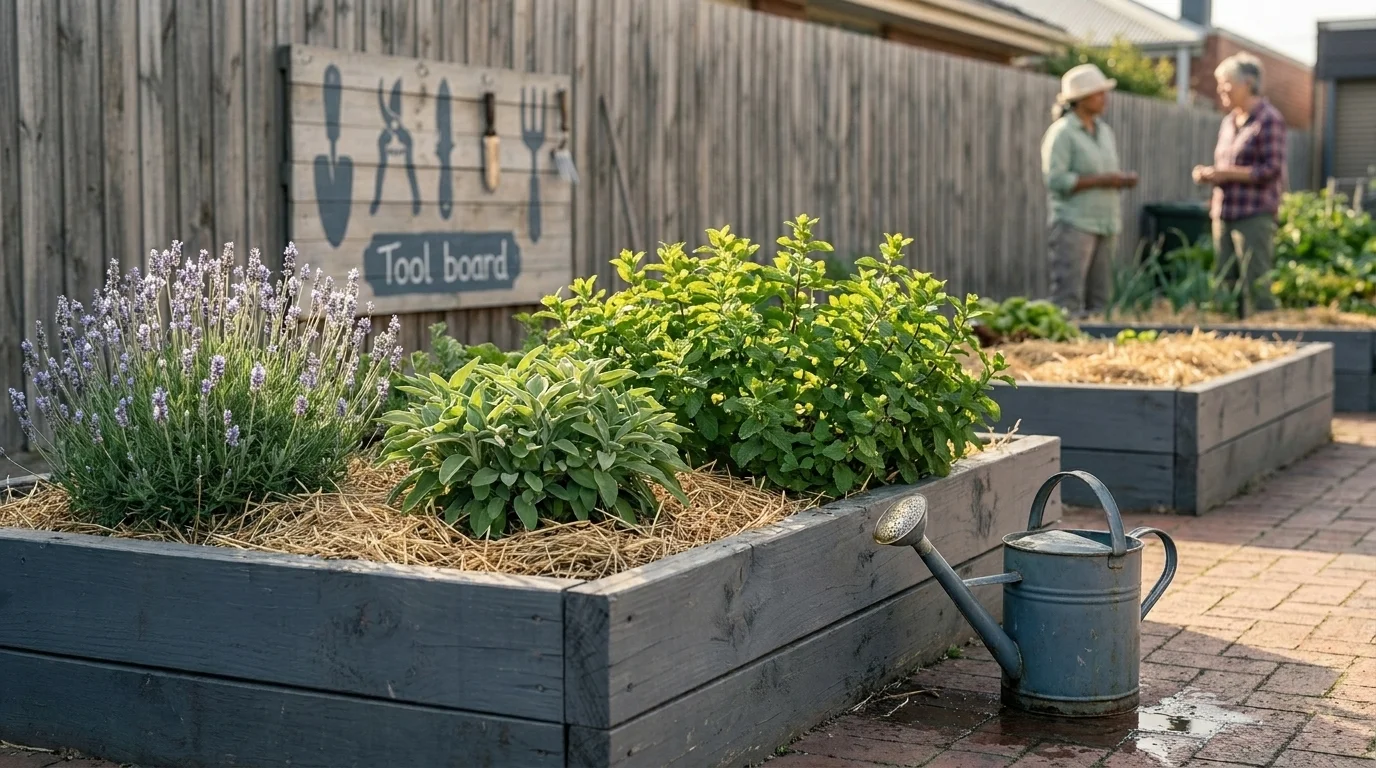
Pick one gardening behaviour this week — a single herb pot, ten minutes weeding a bed. The change is downstream of the single behaviour, repeated.
What are the evidence-backed mental health benefits of gardening?
A 2024 umbrella review pooling forty systematic reviews found gardening produced a moderate-to-large well-being effect (standardised effect size 0.55, 95% confidence interval 0.23 to 0.87, p < 0.001), with the honest caveat that heterogeneity between studies was high. A 2026 cohort study from the University of Florida found daily gardeners had forty-three per cent lower odds of poor health — defined as anxiety, health limitations, or both — than non-gardeners. Benefits include reduced stress and cortisol, improved mood, fewer symptoms of depression and anxiety, and stronger social connection, with measurable mood and cortisol changes appearing in as little as ten to thirty minutes of activity.
Can gardening help with depression?
The strongest randomised signal comes from a 2023 community-gardening trial of 291 participants, which found significant reductions in perceived stress and anxiety in the gardening group. For depressive symptoms specifically, observational and quasi-experimental studies are consistent that regular gardeners report fewer symptoms, but the evidence base does not support gardening as a replacement for professional care in clinical depression. It is best framed as a complement to existing treatment, not an alternative to it.
What is horticultural therapy and how does it differ from gardening as a hobby?
Horticultural therapy is a credentialed clinical discipline in which a trained therapist uses plant-based activities to achieve specific therapeutic goals — emotional, cognitive, social, or physical. The American Horticultural Therapy Association reports fifty-nine per cent of its members hold an accredited certificate and that Professional Registration requires a four-hundred-and-eighty-hour supervised internship. Through the first half of 2026, the credential is HTR (Horticultural Therapist, Registered); the new HT-BC (Board Certified) credential begins testing in October 2026 and will become the standard going forward.
How long do I need to garden to see mental health benefits?
Research summarised across recent extension-service updates suggests measurable mood and cortisol changes can occur in ten to thirty minutes of gardening activity. Consistency matters more than duration — daily gardeners show stronger effects in cohort studies than occasional ones. A short, regular session is more useful than a long irregular one, which matches what the habit-formation literature finds for almost every other behaviour.
Is it true that soil contains a natural antidepressant?
A 2007 study at the University of Bristol found that mice exposed to the soil bacterium Mycobacterium vaccae showed antidepressant-like behavioural changes via serotonin-producing brain cells, and subsequent rodent studies replicated cognitive and stress-related effects. Direct causal evidence in humans, however, remains limited. The honest framing is that soil contact is a plausible contributor to gardening's mood benefits, not a proven cure for depression — the consumer claims that call it 'nature's antidepressant' are over-claiming on a body of work the lead researcher has been clear about.
The Healing Garden: How to Cultivate Plants for Mental Health and Well-being
Join
Loading...
Our Green Community!
Loading...
VerdeNook is more than just a source of gardening wisdom; it’s a platform for sharing, learning, and growing together. We invite you to join our community, share your stories, and spread the joy of gardening. Let’s sow the seeds for a greener, healthier, and more sustainable future, one garden at a time.