Revolutionizing Traditional Gardening with Smart Technology and Gadgets
Share this article:
The smartest gardening tool is still the one at the end of your wrist. The dashboards are useful — but every reading is calibrated against a thumb-press first.
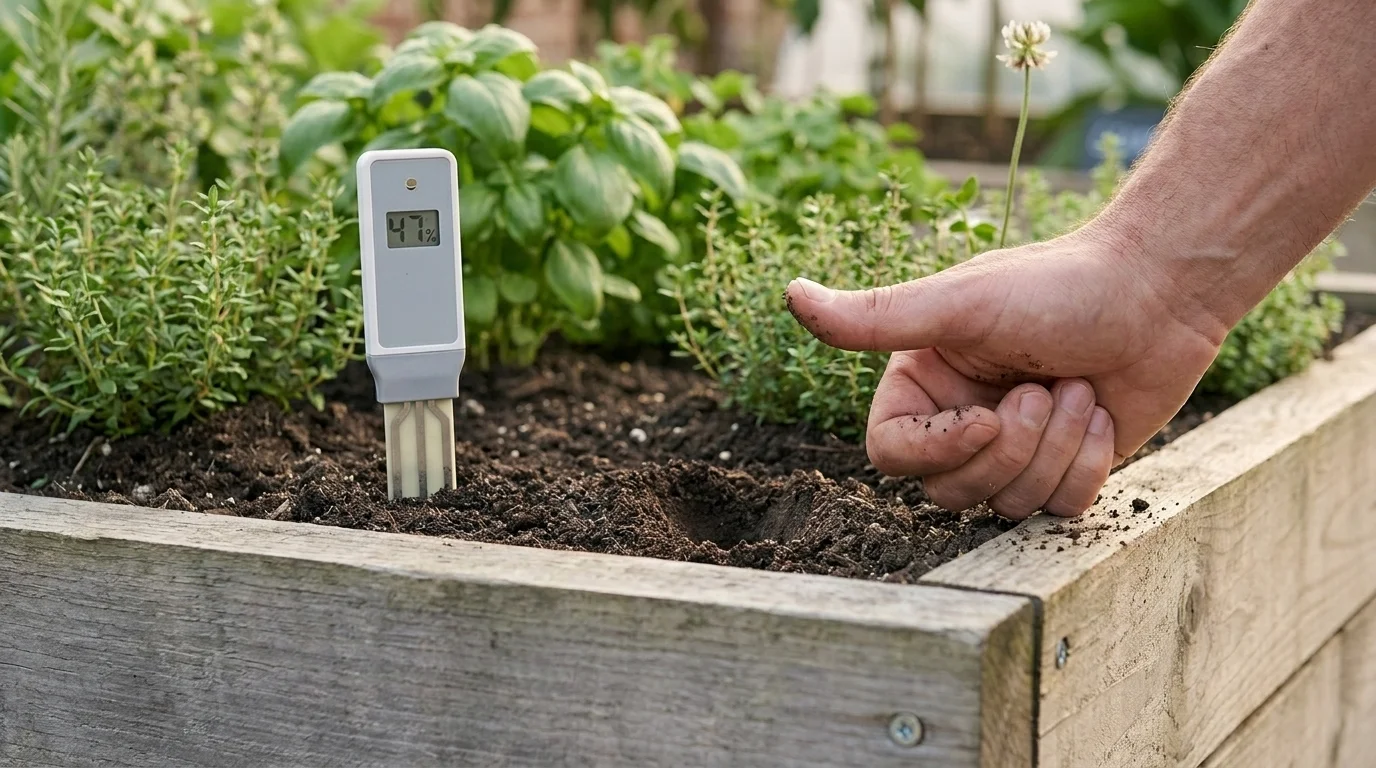
A capacitive soil-moisture sensor is reading 47 per cent in a raised bed of clay loam that, by the evidence of a thumb pressed three centimetres into the surface, is visibly bone-dry. The plant — a wilting Lavandula angustifolia — is telling one story, the £40 sensor is telling another, and the marketing copy on the box told a third when you bought it. Three things changed in smart gardening between 2023 and 2026: robotic mowers ditched the boundary wire, AI assistants moved into countertop appliances, and the EPA quantified, in gallons per home per year, what "smart irrigation" actually saves. Before you buy a £200 soil-moisture sensor or a £2,500 wire-free mower, you need to know whether the device is measuring what your roots need — and whether the marketing claims have been tested by anyone other than the company selling them.
This is not a roundup. It is an evaluation: which categories of smart gardening technology have measurable evidence behind them, which still rely on glossy product copy, and which are genuinely useful for the home gardener who measures things.
Loading image...
Press a thumb into the bed; if the print holds sharp edges, you are below field capacity. The probe says 47%; the thumb has been correct longer than the firmware has shipped.
Smart irrigation: the one category where the savings are quantified
Of every category covered here, smart irrigation is the only one with peer-reviewed, government-quantified outcomes. The U.S. Environmental Protection Agency's WaterSense programme reports that weather-based irrigation controllers save the average American home approximately 7,600 gallons per year compared to a clock-based timer, with national potential of 220 billion gallons and $2.5 billion in water bills annually if every automatic-sprinkler home installed one.
The figure carries weight because the certification is not self-awarded. To carry the WaterSense label, a controller must demonstrate at least a twenty per cent reduction in outdoor water use under the Smart Water Application Technologies (SWAT) protocol — a testing methodology developed in partnership with University of Florida research and codified as the ANSI/ASABE S627 consensus standard. This is the rare case where a marketing term ("smart") corresponds to an enforceable benchmark.
Three families of smart irrigation system dominate the consumer market in 2026:
Weather-based controllers (Rachio 3, Rainbird ST8I-WIFI, Orbit B-hyve) pull local evapotranspiration data from internet weather services and adjust schedules accordingly. These are the systems the WaterSense label was designed for, and the 7,600-gallon figure applies primarily to them.
Soil-moisture-based controllers add probes in the root zone and water only when soil drops below a configured threshold. In published trials these can reach thirty to fifty per cent reductions when properly calibrated, though calibration is rarely properly done.
Hose-tap controllers (Orbit B-hyve hose-tap, Eve Aqua) attach to a single outdoor tap and run via wifi or Bluetooth. Useful for a small bed or a balcony; not certified to the same standard as zone controllers.
A WaterSense-labelled controller costs £120–£250 installed in the UK. At typical residential water rates, the 7,600-gallon (~28,800-litre) annual saving translates to a payback of roughly two to eight years before any utility rebate — and several water companies in drought-stressed regions offer £30–£150 rebates that compress the payback further. Check your supplier's rebate page before you buy.
One-line diagnostic: if your sprinkler runs in the rain, you do not have smart irrigation; you have a timer. The simplest test of whether a controller deserves the label is whether it skipped today's run.
Smart soil sensors: do they actually work?
This is where the gap between marketing and measurement is widest. The consumer plant sensor that pings your phone with a moisture percentage is, almost without exception, a capacitive sensor — a pair of electrodes coated in a non-conductive layer that measure the dielectric constant of the surrounding medium and infer water content from it.
A 2025 review in Frontiers in Plant Science of smart sensors and IoT in precision agriculture and a parallel review in MDPI Agronomy of soil moisture sensing technologies put the achievable accuracy of consumer-grade capacitive sensors at roughly ±3 per cent at 0.1 per cent resolution across the 0–100 per cent volumetric water content range. That is genuinely useful — provided the sensor has been calibrated against the soil it is sitting in.
The catch is that calibration is soil-specific. A sensor calibrated at the factory against a standard sandy loam will read several percentage points differently in heavy clay, in coir-based potting mix, or in a peat-reduced compost. Capacitive sensors also measure volumetric water content — the proportion of the soil volume that is water — but plants do not pull water out of soil based on volume; they pull it based on matric potential, the suction force the soil holds water with. The same volumetric reading can mean "moist" in sandy loam and "drought stress" in clay, because clay grips water more tightly. A laboratory tensiometer, which measures matric potential directly, costs ten times more than a consumer plant sensor for a reason.
What does this mean in practice?
A capacitive sensor is a useful trend indicator, not an absolute moisture truth. If it reads 30 per cent on Monday and 22 per cent on Friday, you have lost roughly eight points of water — useful information regardless of calibration.
Treat the absolute number with scepticism, especially in clay-heavy soils or any container medium that is not a sandy loam.
For an indoor pot, a capacitive sensor genuinely helps an inattentive gardener avoid overwatering — the leading killer of houseplants, by a margin no other category comes close to.
For a raised bed of clay or any heavily organic mix, recalibrate at season start by saturating the soil, allowing it to drain to field capacity (twenty-four hours), and recording the sensor's reading as your "fully watered" reference.
Ultrasonic and motion-activated electronic pest deterrents marketed alongside plant sensors deserve separate scepticism. There is no published peer-reviewed evidence that ultrasonic deterrents repel rodents, deer, or rabbits at any usable distance; they are a category where marketing leads measurement by a wide margin.
Verdict: capacitive plant sensor — buy for indoor pots, £15–£40 range; treat as trend, not truth, outdoors. Ultrasonic pest deterrent — skip.
Loading image...
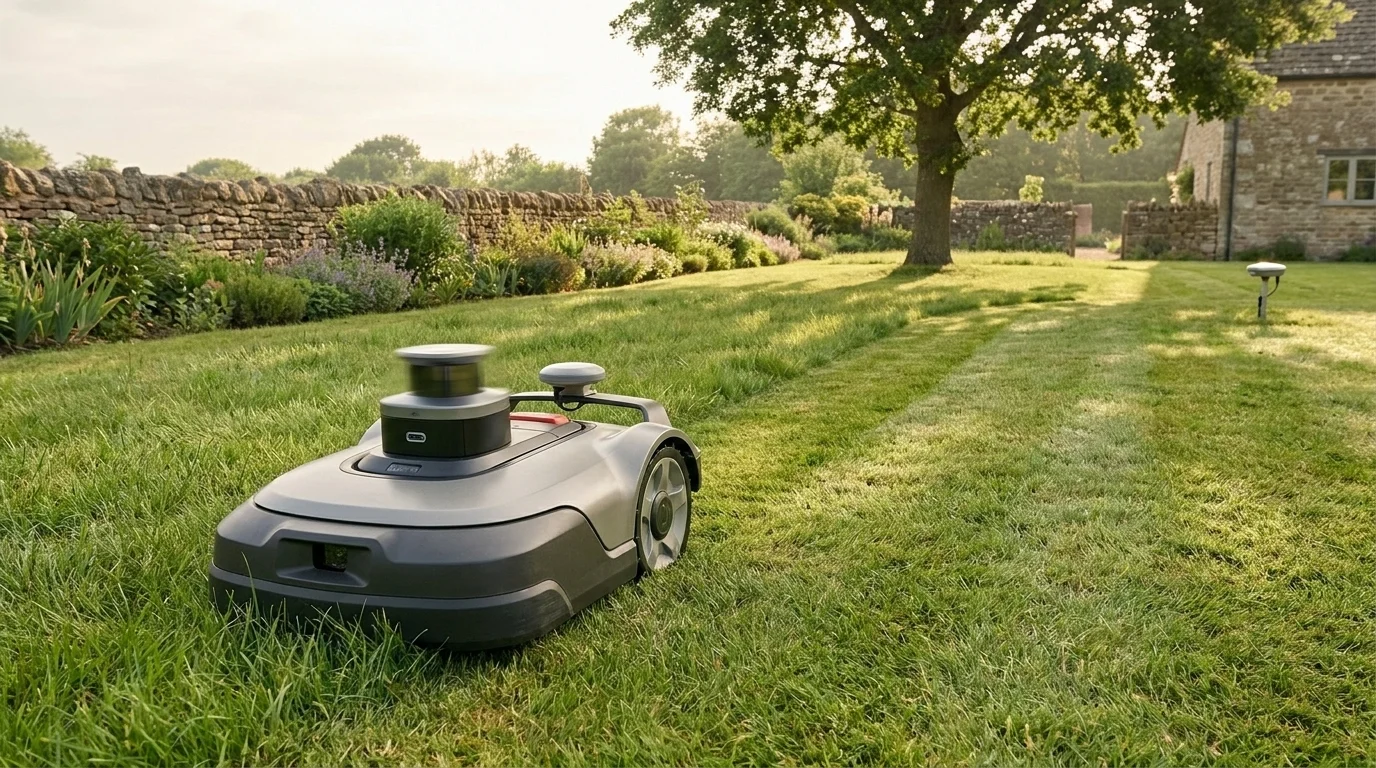
LiDAR plus RTK is the 2026 generation, and the named failure mode is the moment the canopy closes overhead. Trial it under your own oak before you trust the route plan.
Robotic lawn mowers: what changed when the wire came off
In December 2023, when the original version of this article was written, "robotic lawn mower" meant a boundary-wire model — a Husqvarna Automower 430X or a Worx Landroid that followed a buried perimeter cable around the lawn, bumped into obstacles, and reversed away. By April 2026, the category has shifted underneath itself.
Three changes matter:
RTK-GPS replaced the boundary wire as the default. Husqvarna's EPOS line uses Real-Time Kinematic GPS for centimetre-level positioning against a base station — no buried cable required. Segway Navimow and Mammotion follow the same pattern. The buyer no longer commits a weekend to trenching wire around the perimeter.
Slope and area limits widened sharply. The Mammotion LUBA 2 AWD 3000HX handles slopes up to eighty per cent (38°) and covers 1.5 acres on a single deployment — three times the area of a typical 2023 boundary-wire model.
What none of the manufacturers will tell you in the brochure is the new failure modes the wire came with attached. RTK-GPS requires line-of-sight to satellites; under heavy tree canopy, the position fix degrades and the mower drifts. The base-station correction signal is wifi-dependent; if your home wifi drops, so does the centimetre-level positioning, and the mower falls back to dead-reckoning. Wire-free mowers are also more attractive to thieves than buried-wire models, because they can be picked up and walked away with — several insurance schedules now require a GPS anti-theft tracker as a condition of cover.
Verdict by lot size and condition:
Under 0.1 acre, flat lawn: a corded electric mower or a manual reel mower is faster and cheaper than any robotic option. Skip.
0.1 to 0.25 acre, simple shape: an entry-level boundary-wire mower (£700–£1,200) still earns its keep. Buy if you want the time back.
0.25 acre and up, irregular shape, slopes under 35°, clear sky-view: a 2026 RTK-GPS or LiDAR model (£1,500–£3,500) is the genuine upgrade. Buy.
Heavy tree canopy or unreliable wifi: stick with boundary-wire. Wait for the next-generation visual-SLAM models that don't depend on satellite fix.
App-controlled gardening: useful, until the wifi or the subscription drops
The smartphone app is now standard across every category covered here. The category-defining question is no longer "can I control my garden from my phone" — yes, you can — but "what happens when the cloud service goes away?"
Most consumer smart-gardening platforms route through the manufacturer's cloud server rather than communicating directly with the device on the local network. This has three consequences. First, every action — opening a valve, reading a sensor, scheduling a mow — depends on the manufacturer's servers being online and the home wifi being connected. Second, the platform can change the terms of service after purchase: Gardyn's Kelby AI assistant requires a continuing $30-per-month plant subscription to retain full functionality, a fact rarely surfaced at the point of sale. Third, a discontinued product can become a brick: when AeroGarden's parent company shut down operations in late 2024, app users lost cloud features overnight (the line relaunched in spring 2025, but the gap was instructive).
Before you buy any cloud-dependent smart-gardening device, ask three questions: does the device function on the local network if the manufacturer's cloud is offline; is any feature gated behind a subscription, and what does that subscription cost over five years; and what happens to your data if the company is acquired or wound up?
Hydroponic and aeroponic systems: the indoor category just rebooted
The result is a 2026 market with three serious contenders:
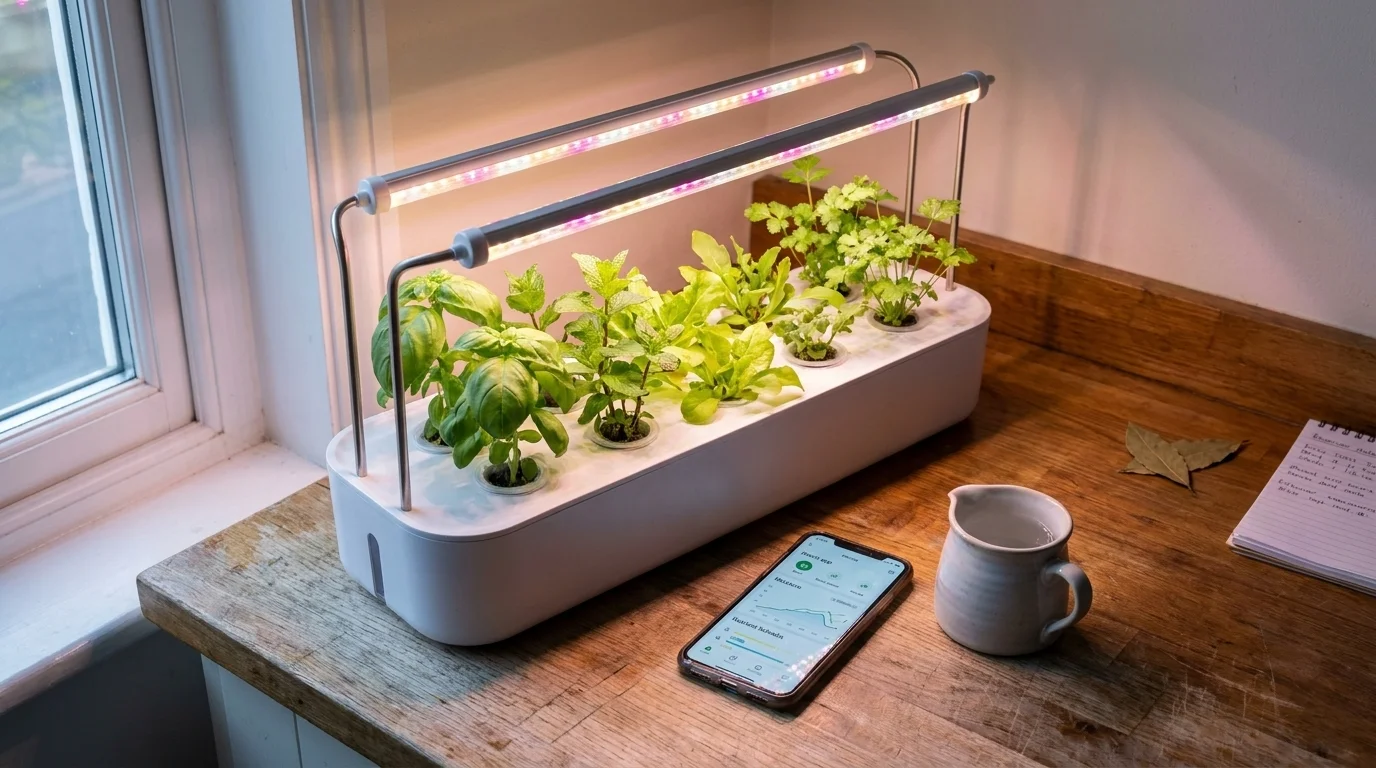
Click & Grow (Estonian-designed, capsule-based growing pods, £80–£180 range) — the lowest-friction entry point; the capsule system removes most user error.
AeroGarden Harvest (relaunched 2025, £100–£200 range) — the rehabilitated incumbent; works, but the cloud-dependency questions in the previous section apply with full force.
Gardyn (vertical floor-standing unit, £700–£900, plus the Kelby AI subscription noted above) — genuinely capable for thirty plants in a footprint smaller than an armchair, with the largest ongoing cost.
For raised-bed outdoor growers and allotment holders, none of these are particularly relevant — they are an indoor-only category. For a renter with a kitchen counter and no outdoor light, the cheap end (Click & Grow Smart Garden 3 at around £100) is a perfectly reasonable way to grow basil twelve months a year.
Artificial intelligence in gardening: the category where evaluation matters most
AI in the garden divides cleanly into two applications: plant identification and recommendation engines. Both have grown faster in marketing claims than in independent evaluation.
The plant-identification market is dominated by four apps: PictureThis, PlantSnap, PlantIn, and Pl@ntNet. PictureThis claims "99 per cent accuracy" in its marketing materials. An independent 2025 head-to-head test by HousePlant Authority put the actual measured accuracy at PlantIn 100 per cent, PlantSnap 93.75 per cent, and PictureThis 87.5 per cent on a controlled set of common ornamentals — with PictureThis's marketing claim not corroborated by the independent test. Pl@ntNet, which is a citizen-science project run by a consortium of French research institutes, was not in the head-to-head but remains the application of choice if you want a botanically rigorous identification with the option to contribute observations to a scientific dataset.
Recommendation engines are a newer and shakier category. Gardyn's Kelby and a wave of similar in-appliance assistants offer continuous monitoring with voice and app feedback. The accuracy of their recommendations has not, to date, been independently benchmarked against trial data; treat them as a useful nudge ("your basil hasn't been topped up for four days") rather than a horticultural authority.
Verdict: plant ID app — buy the free version, prefer Pl@ntNet for taxonomic verification and PlantIn for breadth; ignore the "99 per cent" marketing claim. Recommendation AI — wait, the independent evaluation isn't there yet.
Loading image...
The countertop unit succeeds where the lawn-mower fails: a controlled environment is a closed system, and the firmware does not have to interpret a passing cloud or an oak shadow.
Smart gardening for beginners: a working setup under £200
Most "best smart gardening" articles are written by affiliate sites and assume a budget that exceeds the cost of a small greenhouse. A complete beginner kit fits comfortably under £200:
Indoor herb production: Click & Grow Smart Garden 3 (£90) or AeroGarden Harvest (£120). Either grows basil, mint, parsley, and salad leaves for twelve months without a learning curve.
Outdoor irrigation: an Orbit B-hyve hose-tap controller (~£50). Single-tap, weather-aware, no buried cable. Pairs with a single drip line through a vegetable bed.
One soil sensor for your largest pot or bed: an Ecowitt or Xiaomi-style capacitive sensor (~£20). Use it as a trend indicator, not a truth source.
Total at the high end: roughly £190. If you find yourself genuinely using all three after a season, scale up; if one of them sits on a shelf, you have learned something useful about your gardening style at a cost lower than a single visit to the garden centre.
When smart gardening is the wrong choice
Every commerce page in this category has a flat-positive bias. There are several common situations in which smart gardening is the wrong investment, and a horticultural scientist owes the reader an honest list:
No reliable home wifi. Most consumer platforms are cloud-dependent; without a continuous connection, sensors stop reporting, schedules don't sync, and AI features fall back to defaults.
Heavy tree canopy over the area you want to mow with an RTK-GPS robotic mower. The satellite fix degrades under foliage, the mower drifts, and you spend more time rescuing it than reclaiming.
Cold-winter climates without indoor storage for outdoor electronics. Freeze-thaw cycles destroy battery cells and crack housings; budget for taking everything indoors from October to March.
Heavy clay soil if you intend to rely on capacitive sensor readings for irrigation decisions without recalibrating; the readings will mislead you.
A subscription you have not budgeted for. Gardyn's Kelby plant subscription (~$30/month) is the most prominent example, but it is not the only one. Read the post-purchase pricing page before you click buy.
A garden under 0.1 acre on a flat lawn. Manual or corded options are genuinely faster and cheaper.
Smart gardening rewards the gardener who has already built the basic discipline of observation. It is a poor substitute for the discipline; it is a useful amplifier of it.
A final diagnostic, in keeping with the way I close every article: tomorrow morning, before you reach for an app, press a thumb three centimetres into the soil of whatever you are about to water. If the print holds sharp edges and the soil holds together when you lift a pinch, you are below field capacity and the plant wants water. If the print smears and water beads on the surface, the soil is at or above field capacity and a sensor reading of "dry" is the sensor's problem, not the plant's. The smartest gardening tool is still the one at the end of your wrist.
Yes. WaterSense weather-based controllers save the average U.S. home approximately 7,600 gallons per year — a minimum 20% reduction validated under the ANSI/ASABE S627 consensus standard. Soil-moisture-based controllers can reach 30-50% in published trials when properly calibrated.
Are robotic lawn mowers worth it for a small yard?
Below 0.1 acre, a push reel or corded electric mower is faster and cheaper than any robotic option. Robotic mowers earn their cost on lots above 0.25 acre, on slopes under 35°, with reliable wifi or RTK satellite sky-view, and where the buyer values reclaimed time over the £1,200-£3,500 upfront cost.
Do plant sensors work in clay soil?
Capacitive sensors achieve approximately ±3% accuracy at 0.1% resolution — but only after soil-specific calibration. In clay, heavy potting mix, or any medium that is not the sandy loam the factory calibrated against, absolute readings drift. Treat the number as a trend indicator and recalibrate at season start.
What is the cheapest way to start smart gardening?
Under £200 covers a Click & Grow Smart Garden 3 (~£90) or AeroGarden Harvest (~£120) for indoor herbs, an Orbit B-hyve hose-tap timer (~£50) for outdoor irrigation, and a basic capacitive soil sensor (~£20). Skip the all-in-one premium platforms until you have tested whether the workflow fits your gardening habits.
When is smart gardening the wrong choice?
When your home has no reliable wifi (most platforms are cloud-dependent), when heavy tree canopy blocks RTK sky-view for wire-free mowers, in cold-winter climates without indoor winter storage for outdoor electronics, or when the manufacturer locks core features behind a subscription you have not budgeted for over the device's lifetime.
Water-Wise Gardening: Sustainable Landscaping and Irrigation Techniques
Join
Loading...
Our Green Community!
Loading...
VerdeNook is more than just a source of gardening wisdom; it’s a platform for sharing, learning, and growing together. We invite you to join our community, share your stories, and spread the joy of gardening. Let’s sow the seeds for a greener, healthier, and more sustainable future, one garden at a time.