The primrose is the first real colour of the year — and keeping it is less about surviving winter than getting it through a dry summer in cool, moist shade.
There is a fortnight in early spring — here in the Cotswolds it falls somewhere in the second half of March — when the garden is still mostly bare soil and bones, and then, low against the cold ground, the primroses open. A rosette of crinkled leaves, and above it a scatter of pale five-petalled flowers on stems no longer than a finger; nothing showy, and everything hopeful. The name tells you why we love it: from the Latin primus, "first." The primrose flower is the first real colour of the year.
I have grown primroses in the shade under an old apple and crammed them into pots by the door for as long as I have had a garden, and the question I am asked about them is almost never about colour. It is "why didn't mine come back?" The answer surprises people, because it is not the cold. This is the whole of the primrose (Primula): what it is, how to keep it returning, which kinds and colours to choose, when it blooms, and what it has long been taken to mean — and, along the way, why it is not the evening primrose, which is a different plant altogether.
What Is a Primrose? Meet the Primula Genus
A primrose is a flowering plant in the genus Primula, in the family Primulaceae — and if you want the measure of that genus, it holds more than 425 species (Harvest to Table), from the pale wild primrose of a hedge-bank to the candelabra primulas that stand knee-high in a bog. That is an unusually wide family to gather under one common name, and it is worth saying the botanical name aloud early, because Primula is the thread that connects a supermarket pot of polyanthus to a connoisseur's auricula.
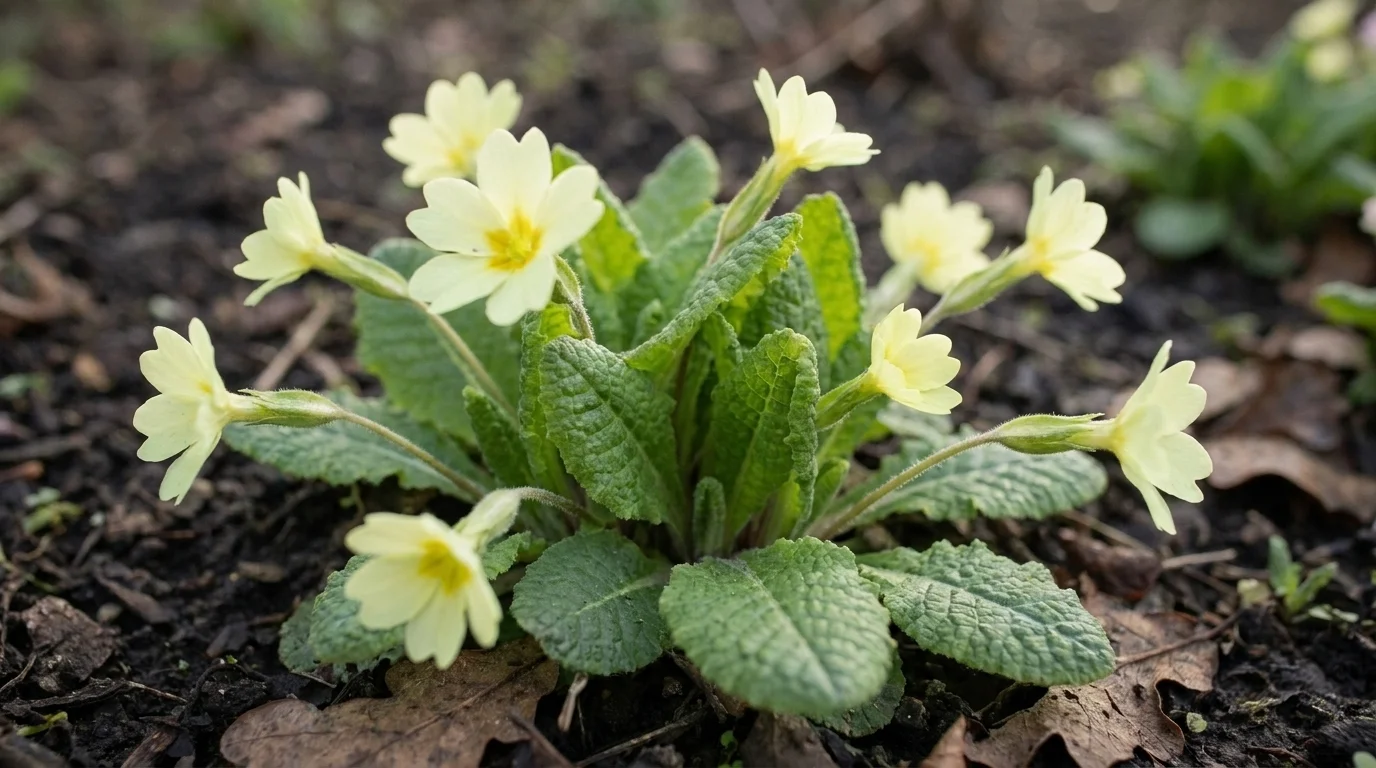
What they share is a habit. Most primroses grow as a low rosette of textured, slightly puckered leaves, and from the centre they send up five-petalled flowers — often notched at the tip, sometimes so deeply that each petal looks like two — either singly on short stems or clustered in a head. They are built low and early, before the border has any height to compete with them; they are, in the truest sense, ground-floor plants. The name comes from the Latin primus, "first," for the oldest reason in the garden: they open before almost anything else. What that "first" has come to mean is a story I will keep for the end.
Loading image...
Built low and early, before the border has any height to compete with — a ground-floor plant whose name, from the Latin primus, simply means first.
Primrose vs. Evening Primrose: Not the Same Plant
Two plants carry the word primrose, and they are not related. The garden primrose is Primula (family Primulaceae), the low spring rosette described above. The evening primrose is Oenothera — an unrelated plant whose flowers open in the evening and whose seeds are pressed for oil. If a plant opens its flowers at dusk, it is an evening primrose and belongs to a different genus entirely; nothing in this guide about growing, colour, or meaning applies to it.
Do Primroses Come Back Every Year? Why Drought — Not Cold — Decides
Yes — most primroses are perennials, hardy in USDA zones 3 to 8; but they come back only where summers stay cool and the soil never dries out. That second clause is the whole answer, and it is the one the plant label leaves off.
Here is the counter-intuitive part, and it is worth quoting the person who put it most plainly. "Drought, far more than cold, is the enemy where all primroses are concerned," wrote Sydney Eddison in Fine Gardening — and once you have heard it, you cannot un-hear it. The primrose that failed to return was almost never killed by winter. It was lost the previous July, to a spell of dry, baking soil it had no way to survive. Cold it can take; a parched summer it cannot.
So the rule I would give an American gardener is a decision, not a hope. In cool-summer regions across zones 3 to 8 — where the ground stays reliably moist and the heat never sits — treat the primrose as a true perennial, and it will return for years; Garden Design puts its lifespan at up to about five years in those conditions. In hot, dry-summer regions, stop fighting the plant's nature: treat it as a spring annual, enjoy it as the first colour of the year, and let it go when the heat arrives. Neither choice is wrong. They are simply two different gardens, and both are correct.
The practical consequence is almost the opposite of what most people do. If your primroses keep vanishing, the fix is shade and water in summer — not fleece and cloches in winter.
Do Primroses Like Sun or Shade? Everyday Primrose Care
Primroses prefer partial or dappled shade; they will take full sun only where summers are cool, and they always want soil that stays moist and humus-rich through the season. Get those two things right — light and, above all, water — and the rest is detail.
Light first, because it is the thing people fret about most and it matters least. Dappled or afternoon shade is ideal: the light you get under a deciduous tree that leafs out after the primroses have flowered, or on the cool side of a wall. Full sun is only safe where the summer stays gentle. But light is the junior partner here. Water is the senior one.
Aim for about an inch of water a week in dry spells (Garden Design, Fine Gardening), and think of the goal as consistently moist — never a swamp, never a drought. This is the same truth as the last section, pointed at your watering can: the plant's whole constitution is built for damp woodland edges and cool ground, and it reads dry soil as an emergency. Rich, humus-heavy, free-draining soil holds that moisture without turning sour, and a light feed through the growing season keeps the display coming.
For spacing and scale, primroses run roughly 5 to 18 inches tall and want 6 to 12 inches between them, depending on the kind (Garden Design). Whatever you plant, lay a one-to-two-inch mulch around them: it is the single most useful thing you can do, because it keeps the roots cool and the moisture in — which is to say it quietly solves the exact problem that kills them.
Common Primrose Problems & Pests
Most primrose trouble traces back to heat and dry stress; a cool, evenly watered plant is largely left alone. The pests worth knowing are slugs and snails, which graze the young leaves and flowers; aphids on the soft new growth; and spider mites, which turn up precisely when a plant is hot and dry. In damp, crowded conditions a fungal leaf spot can mark the foliage. Space the plants for air, keep them evenly watered, and clear fallen debris, and you have removed most of the causes before they start.
Primrose Varieties and Colors
The genus's range is its glory, and you can choose primroses almost the way you would choose paint. A handful of kinds do most of the work in gardens:
English primrose (Primula vulgaris) — the wild species, pale yellow, low and quietly perfect; the one most people picture, and the plant behind most "English primrose" seed.
Cowslip (Primula veris) — nodding clusters of deeper yellow on taller stems, at home in grass and meadow plantings.
Polyanthus — the bold, many-flowered hybrids that fill spring pots and bedding in every colour there is.
Auricula (Primula auricula) — the connoisseur's primrose, with smooth grey-green leaves and flowers so precisely marked that eighteenth-century florists built little tiered "theatres" simply to display them. The twentieth century mostly forgot them; the eighteenth century was right.
Drumstick primrose (Primula denticulata) — early spherical heads of lilac, purple, or white on straight stems, like small allium drums.
Japanese primrose (Primula sieboldii) — delicate, scalloped flowers for cool woodland shade.
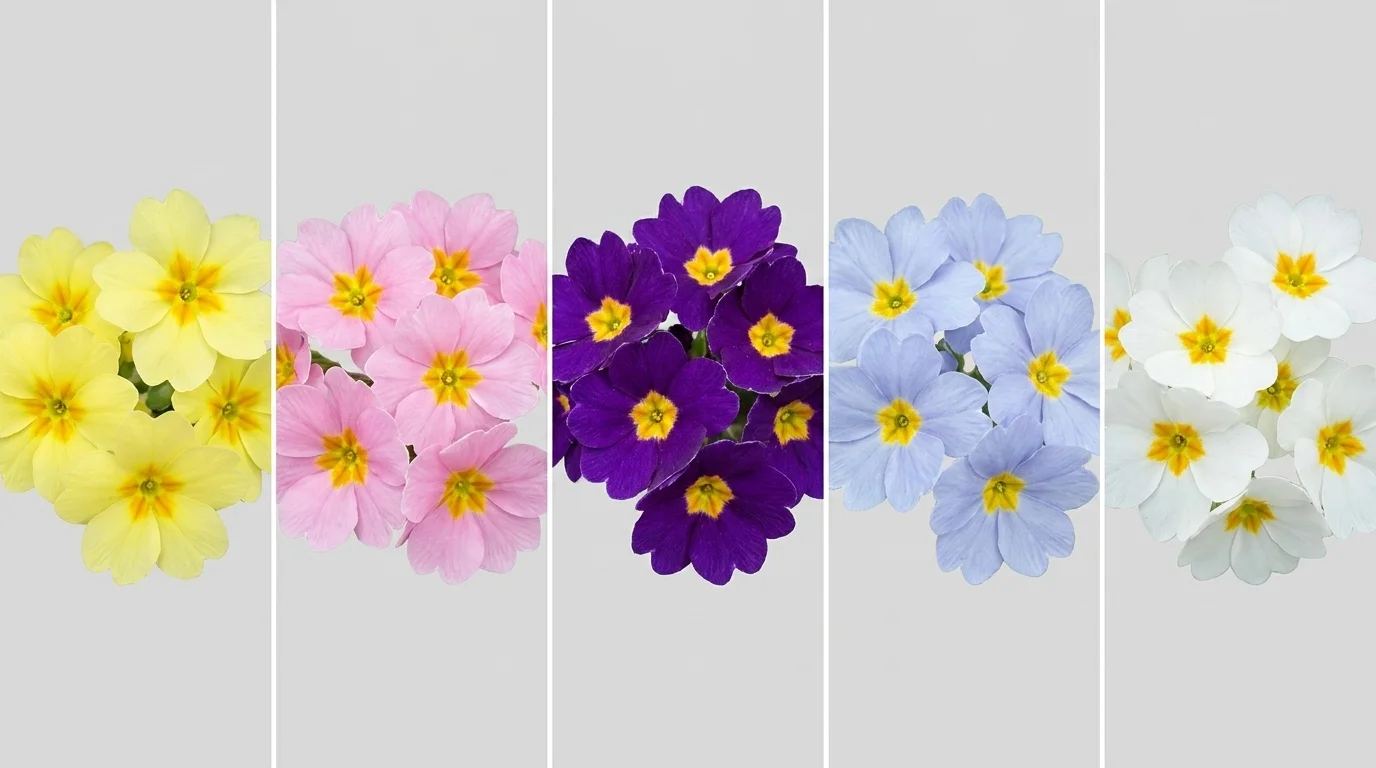
The colour range is the part no other early perennial can match: yellow, pink, purple, blue, white, and red, across the wild species and the hybrids alike. Choose colour with a second thought, too, because the primrose has long carried meaning by its colour — yellow for happiness most of all, though the full account comes below. And choose by site as much as by shade: auriculas earn a raised pot or an alpine trough where you can look them in the face; Primula florindae will take a genuinely damp, shaded spot most plants refuse; polyanthus give you bold, immediate border colour for the price of a tray.
Loading image...
No other early perennial offers this colour range — yellow, pink, purple, blue, white and red — so choose the shade with a second thought; the primrose means by it.
How to Grow Primroses from Seed (and by Division)
There are three ways to come by more primroses, and they suit three different kinds of patience.
From seed is the cheapest and the slowest. Primrose seed germinates reliably only after a cold spell — about three to four weeks of chilling (Garden Design) — which is the plant insisting on the winter it evolved to expect. You can sow in autumn and let the weather do the chilling for spring germination, or give fresh seed three or four weeks in the refrigerator first. Sow on the surface and barely cover it, because the light helps it germinate; keep it cool and evenly moist; and then be patient, because it comes up unevenly and in its own time.
Division is quicker and, to my mind, the most satisfying. Lift an established clump in spring or autumn, tease it apart into rooted pieces, and replant them at once; you both multiply your stock and rejuvenate a tired crown that had begun to flower less. Do it every few years and one plant becomes a drift.
The third way is simply to buy plants already in flower. A tray of potted primroses in earliest spring gives you instant, certain colour at the moment the garden most needs it — the honest choice when you want the effect this year rather than next.
Growing Primroses in Containers
Primroses are among the best plants for an early pot, provided you remember what they want: a cool, bright position out of hard sun, and a rich potting mix kept reliably moist. Water before the surface dries rather than after; a pot dries far faster than open ground, and a primrose has no tolerance for it. As the weather warms, move the container into shade to stretch the display, and afterwards treat the plant by its zone — lifted into the garden in cool-summer regions, or enjoyed as the season's first flourish and let go where the summers bake.
When Do Primroses Bloom?
Primroses bloom in early spring — often from March into early summer, and as early as late winter in mild regions. They are, as Garden Design puts it, "one of the first perennials to bloom in spring — sometimes as early as March," which is exactly the point of them.
There is more range than that headline suggests, because the genus is large. In a mild winter the wild primrose may open in February and carry on for weeks; a few species, Primula florindae among them, hold their bloom into summer, long after the early kinds have finished. Plant a spread of primroses rather than a single kind and you can stretch the first colour of the year across a remarkably long window.
To make any one plant last, do two small things: deadhead the spent flowers so the plant keeps producing rather than setting seed, and keep the soil moist, because a dry primrose stops early. The season is generous to begin with; a little attention makes it more so.
What Does the Primrose Flower Symbolize?
The primrose has long stood for youth, renewal, and young love; its very name means "first," and each colour carries its own note — yellow for happiness, pink for affection, white for innocence. For a plant that flowers before almost anything else, the meaning rather writes itself.
The root of it is that word again: from the Latin primus, "first" (Bloom & Wild). To people watching for any sign that winter was loosening, the first flower of the year naturally became a symbol of new beginnings, of youth, of the fresh start the season promised. From there the colours took on their own shades of meaning — yellow for happiness above all, pink for grace and affection, white for innocence (and, in older custom, for mourning), red for young love.
There is a layer of folklore under all this that is worth a light touch and no more. The Victorians tied the primrose firmly to young love; older country lore set it at the threshold between our world and the fairies'; and in Britain the nineteenth of April is still kept as Primrose Day. None of it is the reason to grow the plant — but if you are choosing a colour to give, or to plant for someone, it is pleasant to know the flower is, quietly, already saying something. A guide that told you how to keep a primrose alive and nothing of what it has meant would be leaving out half the reason people plant it at all.
Designing With Primroses: Containers and Companions
This is the part I think about most, because a primrose is not a specimen to be admired on its own; it is a first layer, the thing that carries a border or a pot while the taller plants are still underground. The 2026 trend guides are calling for "bold and abundant" cottage planting and early-season colour (PHS), and the primrose is the natural opening move — low, generous, and early enough to matter.
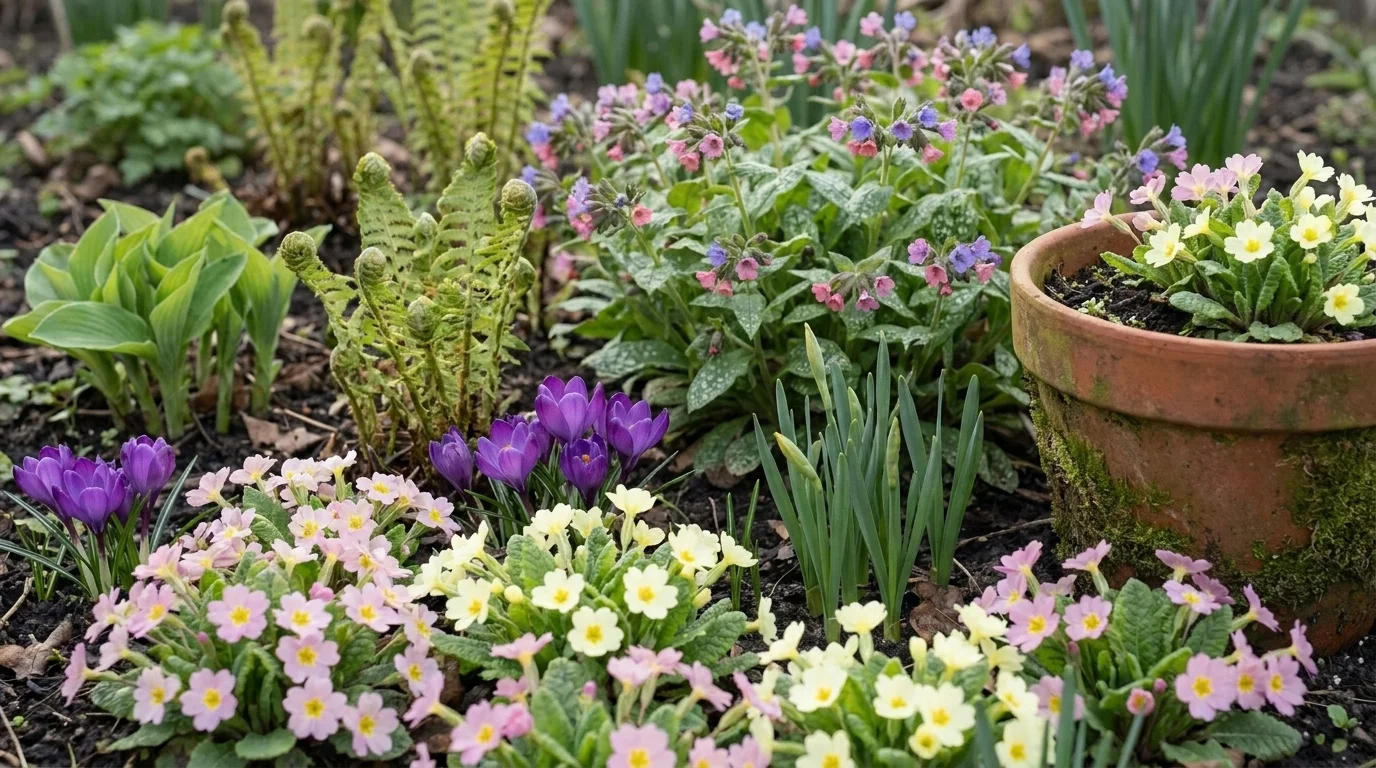
Give it the right neighbours. Primroses sit beautifully with the other plants of early spring and cool shade: crocus and daffodil for the weeks they overlap, then ferns, hosta, astilbe, bleeding heart, and lungwort to take over the ground as the primroses fade and the season lifts (Garden Design, HGTV). In a container, layer them over early bulbs so the pot reads as a small, complete spring in itself. Think of it across time, as a border always should be read: the primrose holds the picture in March, then hands it on.
Loading image...
A primrose is a first layer, not a specimen — it holds the border in March, then hands the picture on as the crocus, ferns and hostas rise behind it.
A closing note on use, because two things are always asked. The early flowers are genuinely valuable to emerging pollinators, feeding bees at a moment when little else is open. And the flowers of the common primrose, Primula vulgaris, are edible — a delicate garnish for a spring plate — but treat that as a claim to verify rather than to assume: confirm the species with certainty first (the North Carolina State Extension plant toolbox is a reliable place to check), handle primroses with a little care because some kinds, notably Primula obconica, can irritate the skin, and never, under any circumstances, substitute an evening primrose in their place. Grow the plant for the first colour of the year; anything else is a bonus, and one to take slowly.
The First Colour of the Year
Strip everything else away and the primrose flower is a simple promise kept early: the first real colour of the year, low against cold ground, in more shades than any other spring perennial offers. Keeping it is less about surviving winter than about getting through summer — cool shade, steady water, and an honest decision about your zone, a returning perennial where summers stay kind and a cheerful spring annual where they do not.
So make the decision, then make the border. Choose a kind and a colour that suit your site and your zone, get plants or seed into the ground this spring, and mulch to hold the moisture that keeps them coming back. Then come and read the rest of VerdeNook's Flower Gardening guides for the plants that take up the story where the primrose leaves off — because a border, like a year, is best planned one season at a time.
Frequently Asked Questions
Is a primrose the same as an evening primrose?
No — the garden primrose is Primula (family Primulaceae); evening primrose is Oenothera, an unrelated plant with edible seeds and oil and flowers that open in the evening.
How long do primroses live?
Up to about five years where summers stay cool and moisture is steady; in hot, dry-summer regions they are best treated as spring annuals.
How often should you water primroses?
Roughly 1 inch of water per week, keeping the soil consistently moist but never soggy — drought, far more than cold, is a primrose's real enemy.
Can you grow primroses indoors?
Yes — potted primroses make cheerful cool-season houseplants; keep them bright and cool rather than hot, then move them outdoors once they finish blooming.
Are primrose flowers edible?
Common primrose (Primula vulgaris) flowers are edible as a delicate garnish when you are certain of the species; handle primroses with care, as some kinds can irritate the skin, and never substitute an evening primrose.
VerdeNook is more than just a source of gardening wisdom; it’s a platform for sharing, learning, and growing together. We invite you to join our community, share your stories, and spread the joy of gardening. Let’s sow the seeds for a greener, healthier, and more sustainable future, one garden at a time.