Save the photograph if you like, but the bed is buildable only once you know the recipe underneath — the cultivars, the spacing, and the weeks each is in flower.
Most flower bed ideas arrive as photographs: a border caught at its best hour, dew still on it, not one instruction attached. You fall for the picture, save it to a folder, and then stand in your own garden with no idea what is actually planted in the thing you fell for.
This is a gallery you can build rather than only admire. Below are thirty-eight numbered flower bed ideas, grouped by where the bed goes and how you want it to feel — and, the part the pretty pictures leave out, a compact plant recipe for each: the actual cultivars, the hardiness zones, the sun, the spacing, and the weeks each will be in flower. Threaded through all of them is a simple way to keep colour coming from the first thaw to the first frost. Whether you are cutting your first bed or refreshing one that has gone tired, the broader lane is the same; good flower garden ideas are really just good plant choices, arranged in time as much as in space. I garden a walled acre in the Cotswolds, on clay, and I will tell you where a scheme needs adapting to your own ground rather than pretend a plant is easy everywhere.
The Plant-Recipe System That Makes Every Idea Buildable
Every idea below carries the same small card, and it is worth thirty seconds to learn to read it. A recipe names three to five cultivars, a USDA hardiness range, the sun the bed wants, how far apart to set the plants, and the window each is in bloom. Treat the zones as a starting point, not a verdict — a plant content in zone 5's cold may sulk in zone 9's heat — and the honest answer to "will this work for me" is always "read your own conditions first."
Two principles hold the whole gallery together. The first is the oldest rule in border design and the one beginners break most often: plant in drifts, in odd numbers — threes, fives, sevens — never in ones and twos. Creative Vegetable Gardener calls the mistake the "onesies," the habit of buying one or two of everything on each trip to the nursery until "a garden of singles and doubles will most likely look cluttered and jumbled." Five of one catmint reads as a considered gesture; one each of five different plants reads as a waiting room. Massing is what turns a shopping list into a composition.
The second principle is time. A border in June is a different garden from the same border in late August, and both are meant to be correct; the trick the photographs never show is sequencing the bloom so the bed is never bare. I keep to three phases — early risers in April and May, heat-seekers through June and July, autumn closers from August to the frosts — and I lean on plants that bridge them. A drift of Geranium 'Rozanne' is my usual hinge: Gardeners' Yards rightly calls it famous for "blooming almost continuously from June until the first frost," which means a single plant carries two of my three phases on its own. Learn the table below and every recipe in this guide slots into it; the plant-by-plant portraits behind them live in the flower gardening archive.
One honest word before you plant. Several of the loveliest early-border plants — hellebores, and later foxgloves — are toxic to pets and children if any part is eaten. If a dog, a cat, or a small child roams the bed, check a plant against the ASPCA's toxic and non-toxic plant database before you choose it, and if something is nibbled, ring your vet or poison control rather than wait. A beautiful bed and a safe one are not in tension; they only ask that you know what you are planting.
How Do You Design a Flower Bed Layout?
Layer by height — tall plants at the back, mid-height through the middle, low plants at the front — and set everything in odd-numbered drifts of three to five. That is the whole method in one sentence; here is what each part asks of you.
Layer by height
Tall at the back, mid-height in the middle, low at the front, so nothing hides behind anything else and the bed reads like a shallow amphitheatre tilted toward you. In an island bed seen from all sides, the tall plants go to the centre instead and everything steps down to the edges. Think in three tiers — knee, waist, shoulder — and place each recipe's plants by their mature height, not the height they are in the pot. The commonest beginner error is planting for what looks balanced on the day; a border is a four-dimensional thing, and the fourth dimension is the season in which the back row finally overtops the front.
The 70/30 rule
A dependable ratio, often credited to the designer Piet Oudolf, keeps a bed from collapsing into a two-week firework and then nothing: give roughly seventy per cent of the bed to structural, come-back-every-year perennials — the bones — and about thirty per cent to seasonal annuals and fillers for the colour that changes with your mood and the year. The bones are what hold the composition in March and November, when the fireworks are asleep; the thirty per cent is where you get to play. Most tired borders I am called to rescue have the ratio backwards — all fireworks, no bones — and they look wonderful for a fortnight and lost for the other fifty weeks.
Color as mood
Colour is the lever most people reach for last and should reach for first. As Proven Winners puts it, "color can be used to set the mood for your garden spaces, just like how you use paint to set the tone for your indoor rooms." Cool tones — the blues and violets, with their silver-green foliage — recede, read calm, and make a small bed feel larger; warm tones — orange, red, hot yellow — advance, warm the space, and pull the eye close. And the same source is right that "foliage makes a great anchor": a bed built only on flowers flickers, while a bed built on leaf shape and colour holds together even between blooms.
Front-Yard, Backyard & Curb-Appeal Flower Bed Ideas
Loading image...
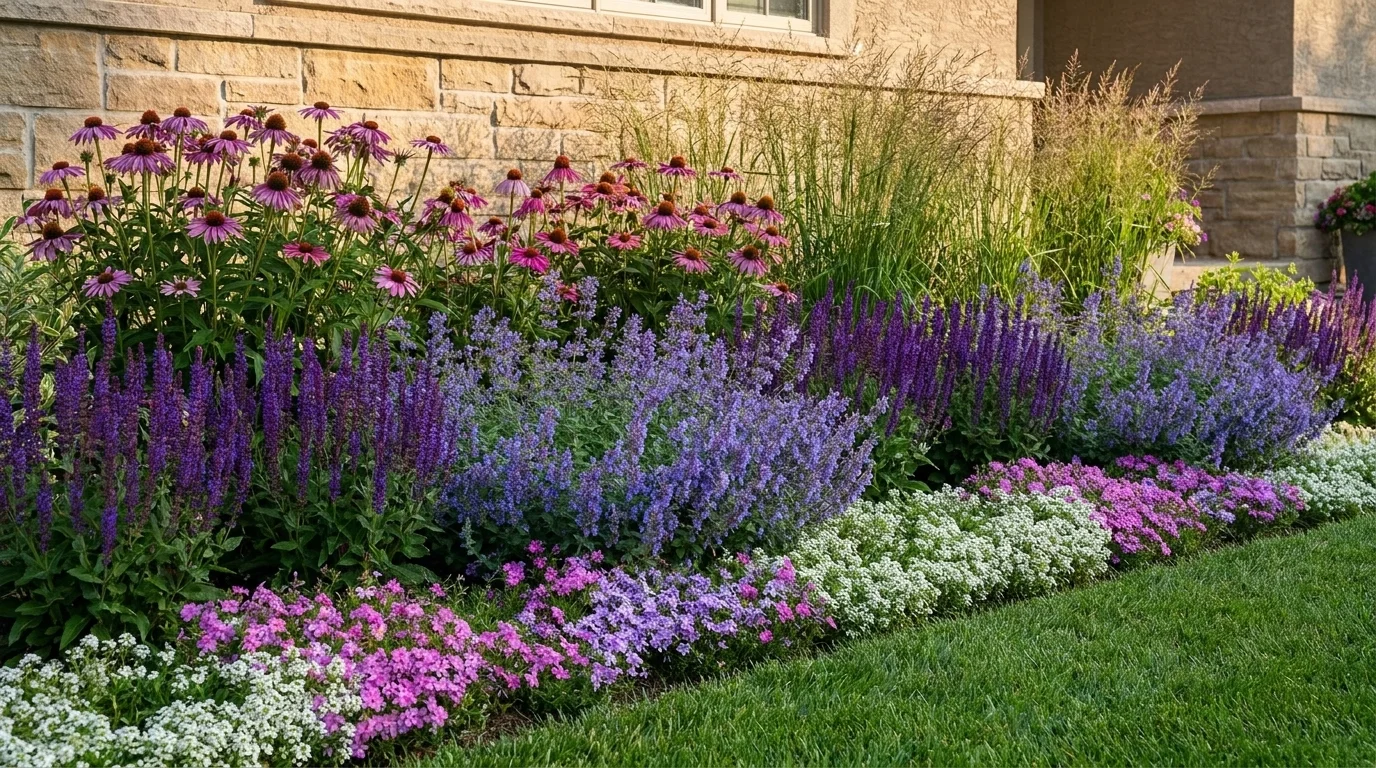
The bed you see every day is the one to give real structure — layer it tall-to-low so nothing hides, and it earns its keep in March as much as July.
Here the gallery begins. The front of a house is the bed you see most and tend least, which is exactly backwards; because it is on view every day of the year, it wants all-season structure more than any bed on the property. These seven run from the formal to the frankly wild.
1. The foundation border along the house. A long, low bed hugging the wall, read from the pavement and the front step both. Give it evergreen bones so it is never bare in the months the house needs it most.
Recipe — clipped box (Buxus sempervirens) for structure, Nepeta racemosa 'Walker's Low', Geranium 'Rozanne', tulips for April · zones 5–8 · full sun · 18 in apart · April–October.
2. The mailbox or lamppost bed. A small anchored planting at the post turns a piece of hardware into a full stop at the end of the path. Keep it to one strong drift so it reads from the street.
Recipe — Salvia nemorosa 'Caradonna', Coreopsis 'Moonbeam', a skirt of creeping phlox · zones 4–9 · full sun · 12–15 in · May–September.
3. The curved front-walk border. Lay a garden hose along the path and shift it until the curve pleases you, then plant to it; a curve leads the eye to the door far better than a ruled line.
Recipe — Lavandula 'Hidcote', Nepeta, Alchemilla mollis frothing over the edge · zones 5–9 · full sun · 15 in · June–August.
4. The tree-surround ring bed. A ring of shade planting around a trunk furnishes the hardest spot in the front garden. Keep soil and mulch well back from the trunk flare; a buried trunk rots.
Recipe — Hosta, Heuchera, Astrantia major, spring bulbs beneath · zones 4–8 · part to full shade · 12–18 in · April–September.
5. The symmetrical entry pair. Two matched beds flanking the door, planted as mirror images, give a formal welcome for very little cleverness; repetition does the work.
Recipe — clipped box domes, a repeated drift of Salvia 'Caradonna', white cosmos for summer height · zones 5–9 · full sun · evenly spaced, formal.
6. The private backyard sitting border. Behind the house, plant for the chair you will actually sit in: scent at shoulder height, and flowers you can read from six feet away in the evening light.
Recipe — Rosa 'Madame Hardy', lavender beneath, Verbena bonariensis hovering through it · zones 5–9 · full sun · fragrant · June–September.
7. The pollinator corner. Let one corner go a little loose for the bees and butterflies; a working wildlife bed is not untidy, it is generous.
Recipe — Echinacea purpurea, Rudbeckia, Monarda, late asters · zones 3–8 · full sun · 18 in · June–October.
Raised Bed & Container Flower Bed Ideas
Raise a bed and you choose your own soil, save your knees, and draw the hard architectural line the eye likes. Container clusters do the same for a patio or a rented yard you cannot dig.
8. The timber or stone raised border. The edge is also the retaining wall, which is why a board that would rot in five years earns its place here anyway — it is doing two jobs. Fill with a free-draining loam-and-compost mix.
Recipe — Salvia, Achillea 'Moonshine', Sedum for the autumn end · zones 3–9 · full sun · 15 in · June–October.
9. Tiered, stepped beds on a slope. A flight of shallow raised beds turns an awkward bank into a staircase of colour, each step a shelf you can reach without climbing.
Recipe — trailing rosemary and alyssum at the front lip, upright grasses at the back · zones 6–9 · full sun.
10. The corrugated-metal bed. The galvanised bed is the modern look of the moment; treat it as a cutting garden and sow in succession so there is always something to bring indoors.
Recipe — cosmos, zinnia, dahlia, sown in waves · zones 3–10 as annuals · full sun · June–October.
11. The no-dig, layered bed. The gentlest way to make a bed on top of lawn, and the one the answer engines keep citing: smother the grass with cardboard, layer compost and organic matter over it, and plant straight into the top. No digging, no broken back, and the worms do the cultivation for you.
Recipe — forgiving first-year perennials — Geranium 'Rozanne', Nepeta, Rudbeckia · zones 4–8 · full sun · 15 in.
12. The grouped container cluster. For renters and patios: mass an odd number of pots as one movable bed, tallest at the back, and you have a border you can take with you when the lease ends.
Recipe — pelargoniums, salvia, trailing verbena · zones 9–11 or as annuals · full sun · June–October.
Flower Bed Border & Edging Ideas
An edge is the frame around the picture; it is also, honestly, the difference between a bed that looks tended and one that looks like it is losing a slow argument with the lawn. Two of these are planted edges; three are hard materials that buy back your trimming time.
13. A low living edge. A soft, spilling front line of one plant, repeated the length of the bed, is the most forgiving edge there is and the one I reach for most.
Recipe — Nepeta 'Walker's Low' or sweet alyssum, in a continuous ribbon · zones 4–8 · full sun · 12 in · May–September.
14. A brick or stone mowing strip. A single course of brick set flush with the lawn lets a mower wheel ride the edge, so you skip the string trimmer entirely — a hard edge cuts your maintenance more than any plant can.
15. Steel edging for clean modern lines. A thin steel strip reads almost invisibly and holds a crisp line for decades; it is the quiet choice, which is usually the right one.
16. A gravel mow-strip. A narrow band of gravel between lawn and bed catches creeping grass and drains beautifully — cheap, and quietly effective.
17. A repeating ribbon of one edging plant. Repetition is the most underused tool in border design: run a single plant the whole length of the bed and the eye reads rhythm where a mixed edge reads noise.
Recipe — Alchemilla mollis or Stachys byzantina, one plant repeated · zones 3–8 · full sun to part shade.
Rock, Gravel & Rocks-Instead-of-Mulch Flower Bed Ideas
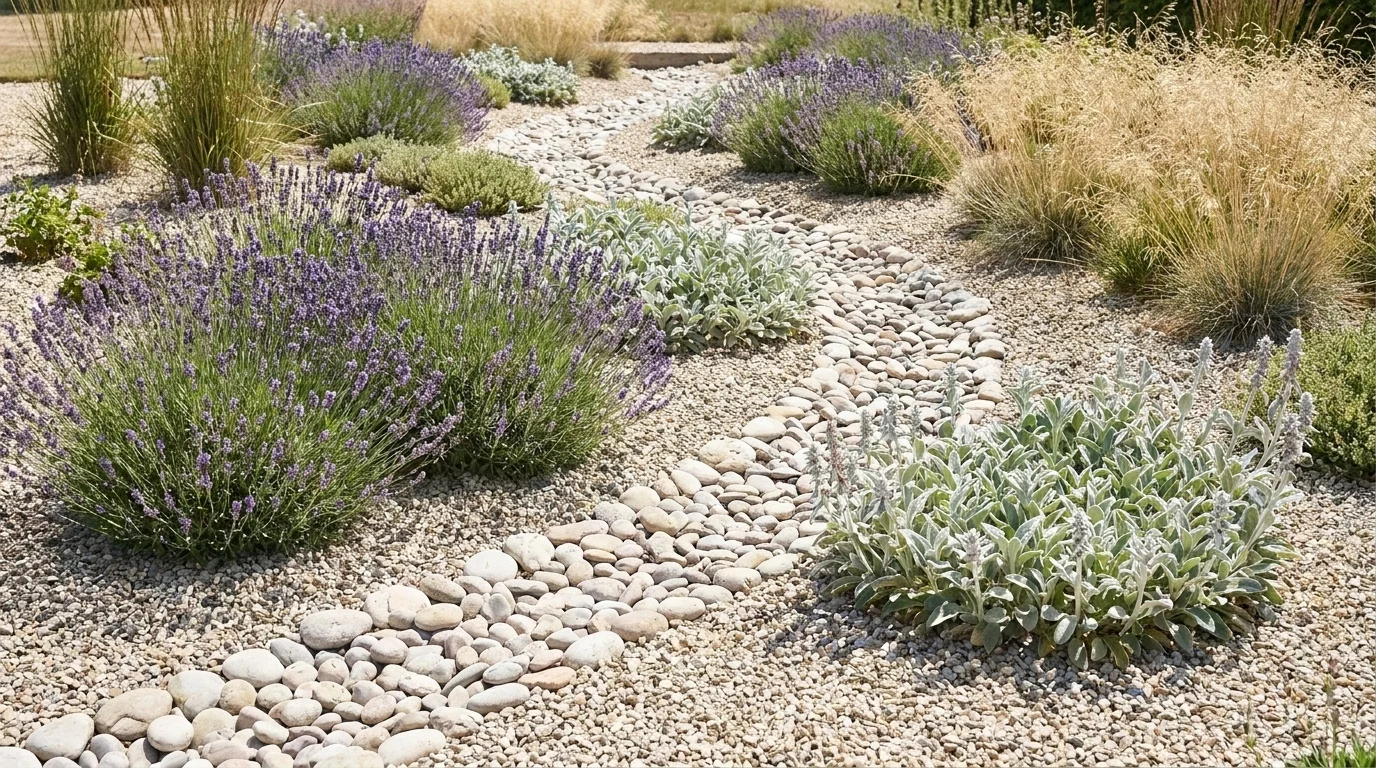
The rock bed is the section the general galleries skip, which is a pity, because gravel and stone do something no bark mulch can: they hold heat, drain hard, and never rot down into the soil. That last point is the honest catch — rocks instead of mulch means you never feed the ground beneath them, so this is a bed for lean-soil, full-sun plants that resent rich living and easy water, and a slow death for the moisture-loving border perennials elsewhere in this guide. Choose the plants to the stone, not the stone to the plants.
18. A river-rock dry-creek bed. A sinuous run of smooth stone through the planting reads as a streambed and, in a downpour, actually behaves like one; it is drainage disguised as design.
Loading image...
Rock mulch never rots down to feed the soil, so a gravel bed only works for lean-soil sun-lovers — choose the plants to the stone, never the other way.
19. A gravel garden. Beth Chatto's gravel garden is the reference point here, and the principle travels — sharp drainage plus drought-tolerant plants equals a bed that thrives on a little neglect.
Recipe — Lavandula, Verbena bonariensis, Stipa tenuissima, Sedum · zones 5–9 · full sun · lean, sharp-drained soil · June–October.
20. A boulder-accent bed. Three or five large stones — odd numbers again — set as though they surfaced there give a bed year-round bones that never need deadheading. Bury each stone a third of its depth so it looks anchored, not dropped.
21. Rock mulch over low-water perennials. A skin of pea gravel or crushed stone around drought-lovers keeps their crowns dry and their roots cool.
Recipe — Delosperma, Sempervivum, Sedum · zones 5–9 · full sun · 10–12 in · June–September.
22. A rock-edged dry strip. A lean, stone-edged band along a hot fence or drive, planted to things that want exactly those conditions, turns the worst soil on the property into the easiest bed.
Recipe — Gaillardia, Achillea, blue fescue and other low grasses · zones 3–9 · full sun · 12 in · June–September.
Small-Space, Simple & Beginner Flower Bed Ideas
A small bed is not a lesser bed; it is a discipline. With less room you must resist the onesies harder than anyone — a few kinds, more of each — because a small bed crowded with singletons has nowhere to hide. Everything here is deliberately short on choices.
23. The single-colour corner. Pick one colour family and work it in varied shades and leaf textures; one restraint makes a beginner's bed look designed rather than accumulated.
Recipe — the blues — Salvia 'Caradonna', Nepeta, Geranium 'Rozanne' · zones 4–8 · full sun · 15 in · May–October.
24. The three-plant starter trio. The smallest real bed there is: one tall plant for the eye, one mounding plant for the middle, one low plant to spill. Three drifts, nothing more.
Recipe — Echinacea for height, Nepeta for the mound, creeping phlox to spill · zones 3–8 · full sun · 15 in.
25. The narrow side-yard strip. The mean band between house and fence is usually written off; plant it vertically — tall and slim at the back, low at the front — and it becomes a green corridor.
Recipe — foxglove (Digitalis) or Verbena bonariensis at the back, Alchemilla at the front · zones 4–9 · part sun · April–July. (See the toxicity note above if pets or children pass through.)
26. The kidney-shaped island bed. A simple curved island in the lawn, seen from every side, is the friendliest shape for a first bed; plant tall to the centre and step down all round.
Recipe — a central drift of ornamental grass, ringed by Rudbeckia and hardy geranium · zones 4–9 · full sun.
27. The window-box-style ground bed. A long shallow ribbon under a front window, planted as you would a window box — low, dense, seasonal — reads neat from indoors and out.
Recipe — sweet alyssum, low salvia, dwarf marigold, refreshed each season · zones 3–10 as annuals · full sun.
28. The one-weekend smother-and-plant bed. No-dig at its simplest: cardboard, a bag of compost, and a dozen plants on a Saturday. The least intimidating way to make a first bed and be planting it by lunch; the fuller portrait of each plant is in the flower gardening archive.
Recipe — Geranium 'Rozanne', Nepeta, Sedum — three drifts of four · zones 4–8 · full sun.
Low-Maintenance & Perennial Flower Bed Ideas
Low maintenance is mostly a planting decision made once, at the start. Lean on the seventy per cent — the structural perennials that return on their own — choose plants native or well-suited to your region so they resist the local pests and, once established, largely feed and water themselves, and you buy yourself years of quiet. These are the beds I design for people who love a garden but not a chore.
29. The regional-native border. Plant what evolved where you live and the bed asks for almost nothing; natives shrug off local pests and, once their roots are down, the watering can stays in the shed.
Recipe — Echinacea purpurea, Rudbeckia, Monarda, Baptisia · zones 3–9 · full sun · 18 in · June–October.
30. The plant-it-and-leave-it drought bed. Silver foliage and Mediterranean shrubs that thrive on being ignored; the more you fuss over them, the worse they do.
Recipe — lavender, Achillea, Perovskia (Russian sage), Sedum · zones 5–9 · full sun · 18 in · June–September.
31. The all-perennial four-season bed. Built entirely from come-back plants, staged across the bloom table above so something is always in flower and nothing is ever replanted.
Recipe — hellebores for spring, Geranium 'Rozanne' for summer, asters and Sedum for autumn · zones 4–8 · full sun to part shade · February–October.
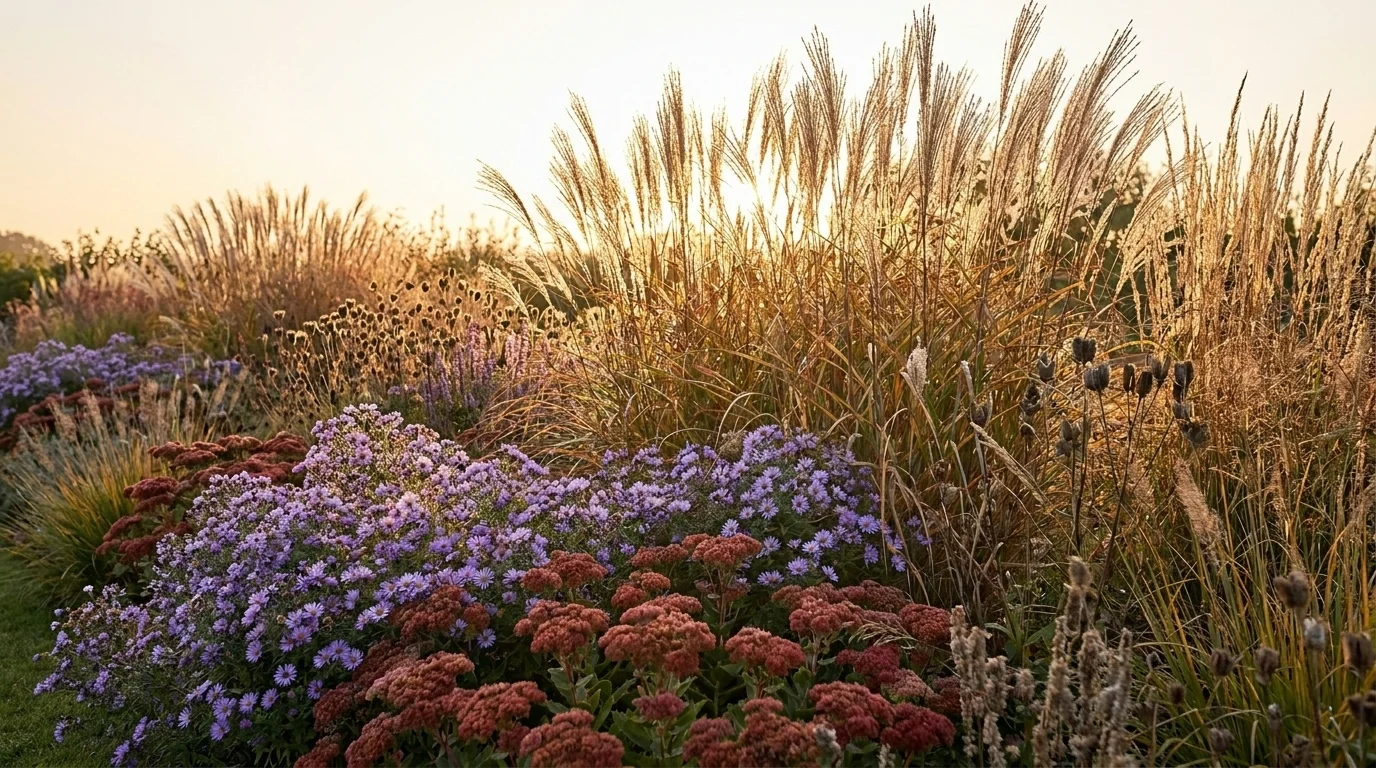
32. The ornamental-grass motion bed. The current fashion, and a right one: grasses are grown now for movement as much as colour — the "rhythmic movement" the 2026 trend writers keep naming — a bed that sways and catches the low autumn light.
Recipe — Panicum 'Heavy Metal', Pennisetum, threaded with late asters · zones 4–9 · full sun · 24 in · August–October.
33. The groundcover carpet. A low weave of spreading plants leaves no bare soil for weeds to colonise; the bed mulches itself.
Recipe — creeping phlox, Ajuga, hardy geranium · zones 3–9 · sun to part shade.
34. The pollinator meadow strip. A long loose band of perennials left largely to their own devices; cut once in late winter and otherwise leave it for the bees.
Recipe — Echinacea, Rudbeckia, Monarda, aster, grasses · zones 3–8 · full sun · June–October.
2026 Style Trends — Monochromatic & Bold-Color Flower Bed Ideas
Two moods dominate the 2026 beds, and they pull in opposite directions: monochrome cohesion on one side, bold playful contrast on the other. Both are worth knowing; neither is new.
35. The single-colour bed. House Digest calls the one-colour bed a headline 2026 idea, and it is a lovely one — a single colour family in varied shades, textures, and forms reads richer than a scattered rainbow. It is also old: it is the idea behind Vita Sackville-West's White Garden at Sissinghurst, which has been quietly instructing designers ever since.
Recipe (white) — Rosa 'Madame Hardy', white Nepeta, Japanese anemone, Astrantia 'Shaggy' · zones 4–8 · full sun to part shade · June–October.
36. The cool-tone calm bed. Blues and violets to make a small space read larger and a busy household read quieter; the colour does the same work indoors paint does.
Recipe — Salvia 'Caradonna', Nepeta, Geranium 'Rozanne', Perovskia · zones 4–9 · full sun · May–October.
37. The bold contrast bed. The other 2026 pole: hot, high-energy colour set deliberately against its complement, the border as a played chord rather than a held note.
Recipe — dahlias, Rudbeckia, purple Salvia, orange Verbena · zones 3–10 · full sun · July–October.
38. The minimalist grass-and-one-bloom bed. The most modern look of all: a mass of a single grass, interrupted by one repeated flower and nothing else. Restraint reads as confidence.
Recipe — Miscanthus sinensis with a single repeated Echinacea or Allium · zones 5–9 · full sun · July–October.
Loading image...
This is what bloom sequencing buys: a bed that still holds colour and movement in late October, glowing where a firework border went bare in July.
The Recipe Underneath the Photograph
The best flower bed ideas are not the photographs you save but the recipe underneath them — the plants, the spacing, the weeks each is in flower. So do not build all thirty-eight. Choose the one that fits your yard, your zone, and your patience; plant it in generous odd-numbered drifts; sequence its bloom across the three phases; and build that one bed well before you start a second. Plant it this season and it will have grown into itself by next spring's peak, which is the whole reward of gardening in time as well as in space. When you are ready for the plant-by-plant detail behind any of these recipes, the flower gardening archive is where the individual portraits live.
Frequently Asked Questions
What is the 70/30 rule in gardening?
Fill about 70% of the bed with dependable structural perennials — the bones — and about 30% with seasonal annuals and fillers for changing color. The ratio is often credited to designer Piet Oudolf, and it keeps a bed reading well across the whole year rather than for just a fortnight.
How do you make a flower bed for beginners?
Pick a sunny, well-drained spot, smother or no-dig the existing grass, amend the soil, then plant in height layers — tall at the back, mid-height in the middle, low at the front — using a small palette of proven low-maintenance plants set in odd-numbered drifts of three to five.
What are the best low-maintenance flower bed ideas?
Plant regional native perennials and drought-tolerant plants in drifts — they need less water and care and resist local pests once established. A gravel or rock-mulched bed of lean-soil, full-sun plants like lavender, sedum and ornamental grasses is among the lowest-effort of all.
How do you keep a flower bed blooming all season?
Use bloom sequencing: pair spring risers (hellebores, creeping phlox), summer heat-seekers (catmint, Geranium 'Rozanne', coneflower) and autumn closers (sedum, asters, ornamental grasses) so something is always in flower from the first thaw to the first frost.
VerdeNook is more than just a source of gardening wisdom; it’s a platform for sharing, learning, and growing together. We invite you to join our community, share your stories, and spread the joy of gardening. Let’s sow the seeds for a greener, healthier, and more sustainable future, one garden at a time.