Nurturing the Muse: Integrating Fine Art Principles into Your Vegetable Plot
Share this article:
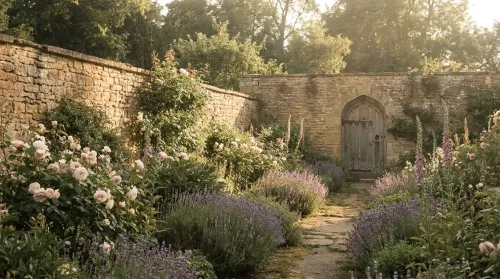
Choose one or two edimentals and repeat them; place a focal point off-centre. That rhythm is the difference between a colourful veg patch and a composed edible landscape.
For most of the twentieth century we kept the vegetables out the back, behind a screen, as though productivity were something to apologise for. That line is dissolving, and the proof arrived with an award: in 2026, Kale 'Rubybor' became the first All-America Selections winner in nearly a hundred years to be honoured as both an edible and an ornamental — a deep-purple, compact kale the judges called a showstopper. The practice of designing a garden that feeds you and pleases the eye in equal measure is called edible landscaping, and the plants that do both jobs at once have a name now too: edimentals. What follows is how to compose with them — to treat the vegetable plot as a painter treats a canvas, which is to say with colour, rhythm, proportion, and a clear idea of where the eye should rest.
For structure and form — the bones of any planting — the globe artichoke is unmatched among vegetables, holding its grey-green architectural foliage and, if you let one flower, a blue thistle bloom worthy of any border. A blueberry hedge gives you spring blossom, summer fruit, and a genuine autumn fire in the foliage. And for the deliberate blur between food and ornament, edible flowers do the work no purely decorative plant can: nasturtium spilling over an edge, calendula threaded through the beds, both edible, both magnets for the predatory insects that keep aphids honest. You need not commit the whole garden at once; an edible landscape can be anywhere from one to a hundred per cent edible, and the most sensible way to begin is to swap a few ornamentals and watch what happens.
Loading image...
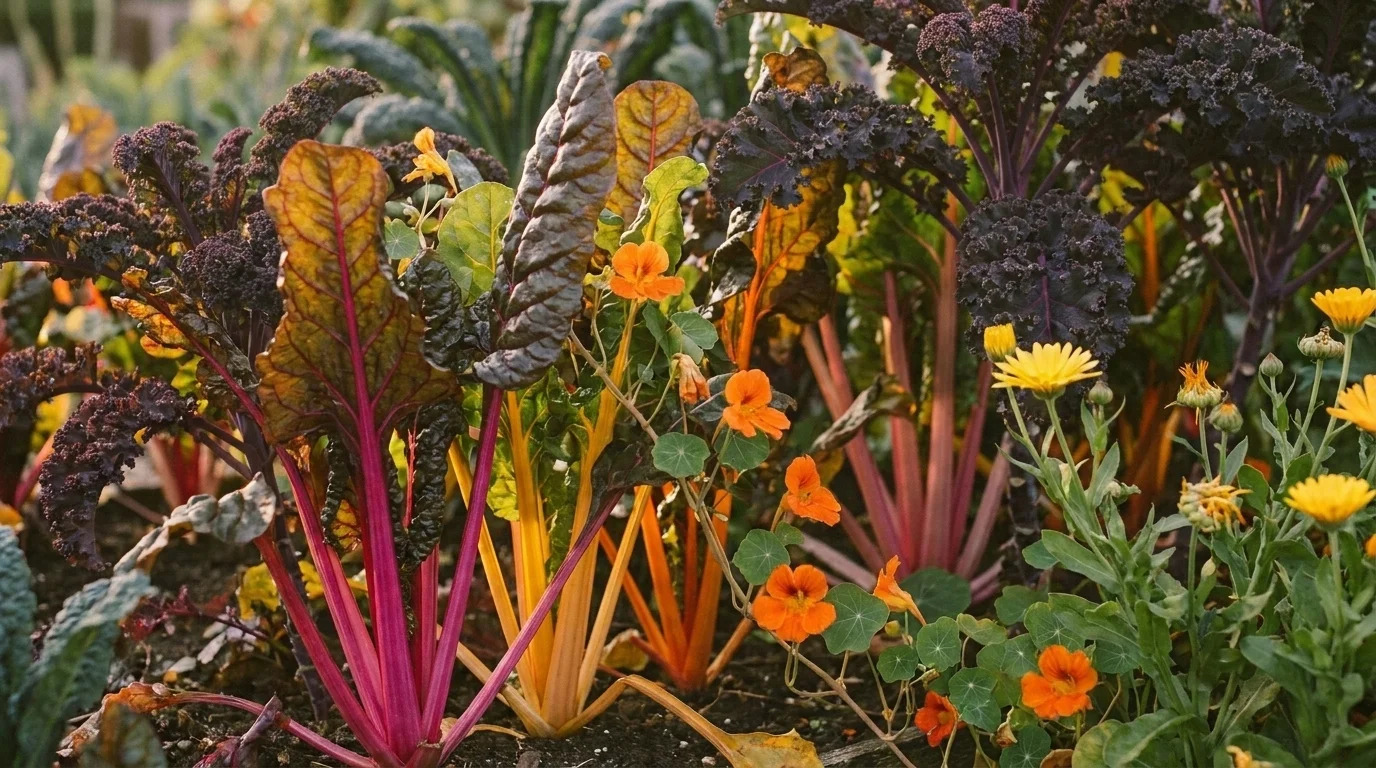
The showiest edibles aren't the difficult ones — chard stems hold colour from June to frost. Swap a few ornamentals for edimentals and watch what happens.
Composition: colour, rhythm, and the focal point
The Impressionists understood that colour reads at a distance as a single shimmering field, and a vegetable bed planted for beauty works the same way. Set warm against cool — the magenta of a chard stem beside the blue-grey of an artichoke leaf — and the bed gains the luminosity a Monet border has at twenty paces. But colour alone is restless; what steadies a composition is rhythm. A single dramatic plant is an accident; the same plant repeated down a bed becomes a deliberate beat, the eye carried from one to the next the way a brushstroke is carried across a canvas. Choose one or two edimentals — the chard, say, and the runner bean on its support — and repeat them, rather than planting one of everything.
Then give the eye somewhere to rest. Every composition needs a focal point, and in an edible bed it is usually the plant with the strongest form: the artichoke, a standard gooseberry, a wigwam of beans rising above the lower planting. Place it deliberately, not in the dead centre but off to one side where the rhythm leads toward it. This is the difference between a vegetable patch that happens to be colourful and an edible landscape that has been composed.
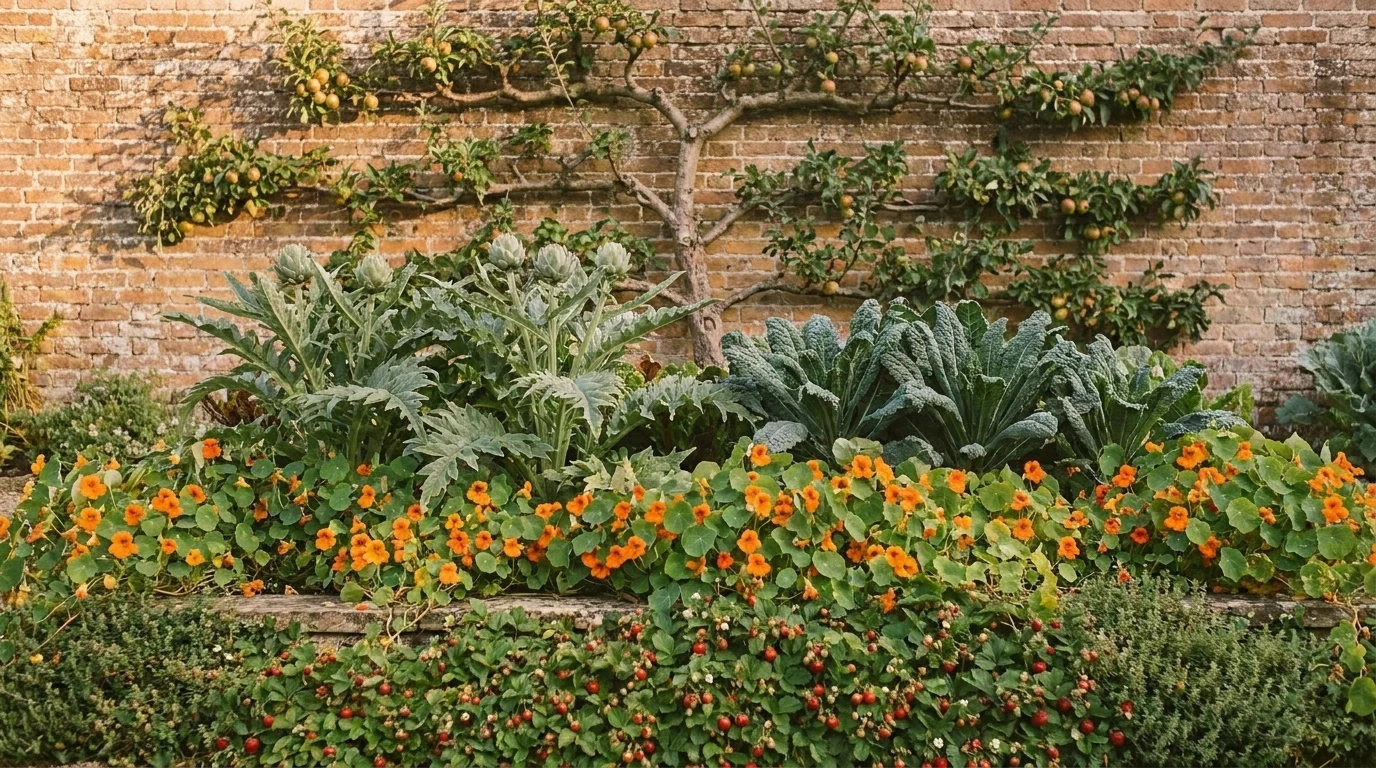
A border is never a single plane, and neither is a good edible landscape. The most useful structural idea to borrow from ornamental design is layering — building the planting in vertical tiers so that every level of the eye finds something. Start with an overstory: a small fruit tree, an espaliered apple, or a wigwam of climbing beans for the tallest layer. Beneath it sits the mid-layer — the artichoke, a blueberry, taller brassicas like 'Rubybor'. Then the flowering layer that does the ornamental and the ecological work at once: nasturtium, calendula, flowering herbs. And finally a groundcover layer — trailing thyme, alpine strawberries, low lettuces — that covers bare soil, suppresses weeds and keeps the composition reading as full rather than gappy. Planted in these four tiers, even a small bed acquires the depth and abundance that a single-height row of vegetables never will.
Loading image...
Build in four tiers — overstory, mid-layer, flowers, groundcover — and even a small bed gains the depth and abundance a single-height row of veg never will.
The potager: still life made real
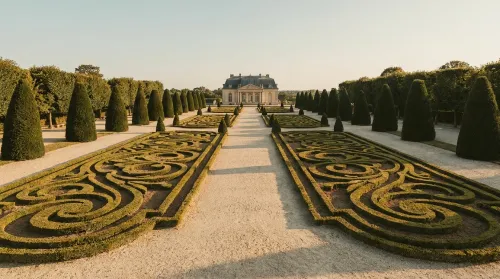
The French had a word for the beautiful kitchen garden long before we needed one: the potager, a plot where vegetables, herbs and flowers are arranged in formal, decorative beds rather than utilitarian rows. It is the still-life painting made three-dimensional and edible — and it is enjoying a serious revival, with designers like Christian Douglas, whose 2025 book The Food Forward Garden blends classical design principles with edible, regenerative planting, bringing it back into prestige design.
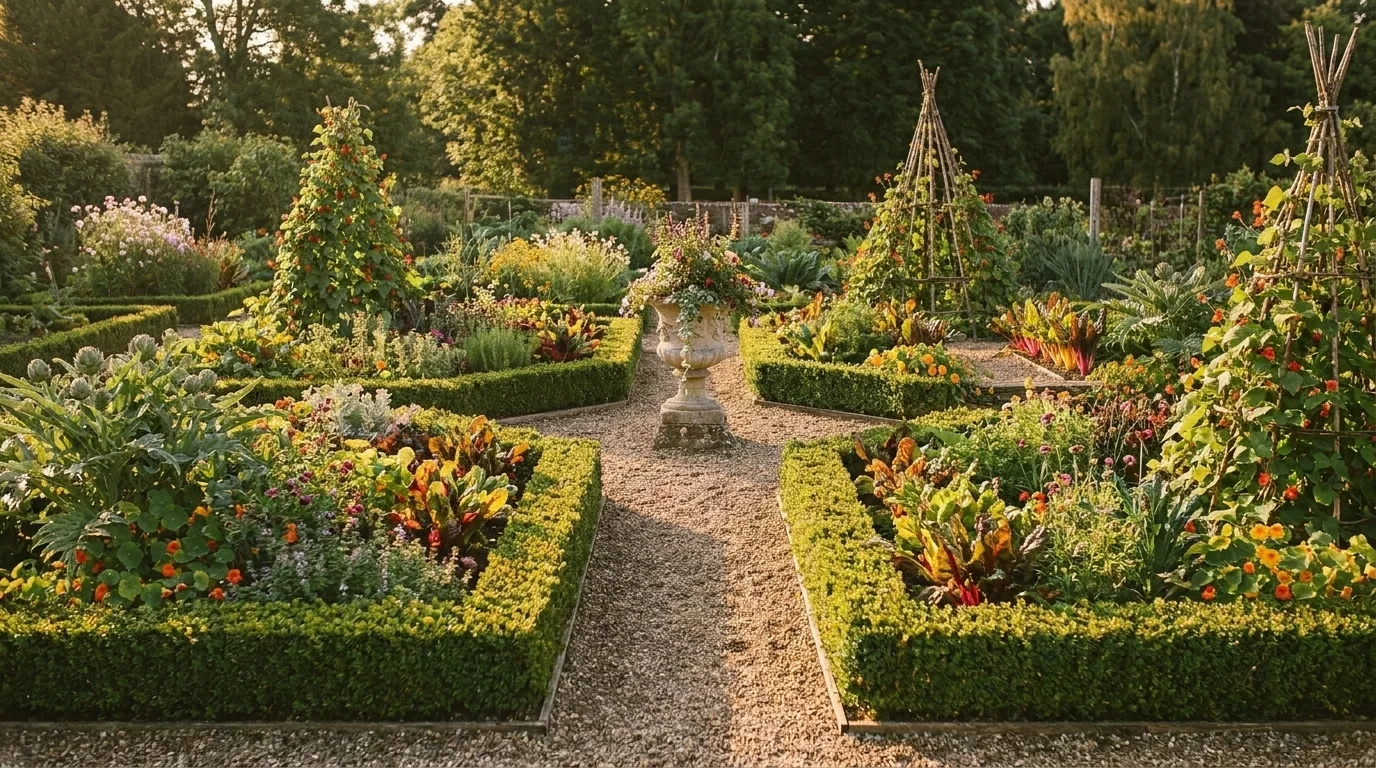
To build one, borrow the discipline of the parterre: divide the space geometrically — four beds around a central feature is the classic plan — and edge each bed with something low and tidy, clipped box if you want the traditional look, or a productive edging of parsley or alpine strawberry if you would rather every inch earned its keep. Within the beds, compose as you would a still life: a structural plant for weight, companion flowers for colour and pest control, mixed plantings rather than monocultural blocks. The formality of the frame is what lets the abundance inside it read as deliberate rather than chaotic. A potager is the proof that structure and productivity are not opposites; the structure is what makes the productivity beautiful.
Loading image...
The formality of the frame is what lets the abundance inside read as deliberate, not chaotic — structure is what makes the productivity beautiful.
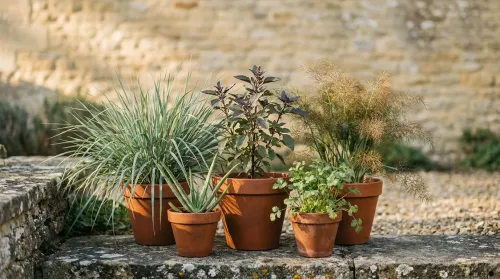
In containers, the same composition rules apply at a smaller scale. A strawberry tower is a living column; a herb spiral packs rosemary, thyme and basil into a sculptural mound that doubles as ornamental edging; a single large pot of 'Bright Lights' chard underplanted with trailing nasturtium is a complete composition in itself. The container garden is not a lesser version of the real thing — it is the still life reduced to its essential objects, which is its own discipline.
The line I began with — the screen that used to hide the vegetables — was never really about tidiness. It was about a belief that food and beauty belonged to different parts of the garden. Plant a single bed of edimentals, compose it with colour and rhythm and a focal point, and watch that belief quietly fall apart. The border in June is a different garden from the same border in late August, and both are correct; an edible landscape adds a fifth season to that calendar — the harvest — and loses none of the beauty for it.
What is edible landscaping (and what are "edimentals")?
Edible landscaping integrates food-producing plants — vegetables, herbs, berries, edible flowers — into ornamental garden design so the space is both beautiful and productive. "Edimentals" are the plants that do both jobs at once, like Bright Lights Swiss chard, scarlet runner beans, or award-winning Kale 'Rubybor'. You can make a landscape anywhere from 1% to 100% edible.
What are the best edible plants for a beautiful landscape?
Showy, low-fuss edimentals: Bright Lights Swiss chard (neon stems), scarlet runner beans (red blooms, hummingbird magnet), Kale 'Rubybor' (deep purple, an award-winning ornamental), purple and two-tone heirloom tomatoes, globe artichoke (architectural form, blue thistle bloom), nasturtium and calendula (edible flowers), and a blueberry hedge for structure and fall color.
How do I use the golden ratio or Fibonacci sequence in my garden layout?
Plant in Fibonacci-number groups (1, 3, 5, 8) rather than even rows, and scale heights by the golden ratio (≈1.618) — for example a 6-ft fruit tree, three 4-ft shrubs, and eight 2.5-ft perennials. The eye reads these proportions as naturally harmonious.
Can I do edible landscaping in a front yard or in containers?
Yes. Espalier or cordon-trained apple/pear, columnar fruit (apple, dwarf fig, peach 'Sweet Sensation'), strawberry towers, and herb spirals all suit front yards and patios, giving you an ornamental, productive display in a small footprint.
How do I add bold texture and form to a beautiful vegetable garden?
Use architectural edibles as focal points and repeat them for rhythm: globe artichoke for sculptural grey-green form, Bright Lights chard for vivid contrast, and a wigwam of scarlet runner beans for height. Set warm colours against cool — magenta chard stems beside blue-grey artichoke leaves — and let one strong plant anchor the composition off-centre.
How does a potager bring classical design into an edible landscape?
A potager is the ornamental kitchen garden — vegetables, herbs and flowers arranged in formal, decorative beds rather than utilitarian rows. Borrow the parterre's discipline: divide the space geometrically (often four beds around a central feature), edge each bed with something low and tidy like clipped box or parsley, and compose mixed plantings inside the frame. The structure is what makes the abundance read as deliberate.
How do I arrange edibles for both beauty and a good harvest?
Compose in layers — an overstory of fruit trees or climbing beans, a mid-layer of artichoke and kale, a flowering layer of nasturtium and calendula, and a groundcover of thyme or alpine strawberries. Mix edible flowers among the vegetables for colour and natural pest control, and repeat a few key plants rather than planting one of everything.
Blossoms Across Borders: How Cultural Heritage Shapes Our Gardens
Join
Loading...
Our Green Community!
Loading...
VerdeNook is more than just a source of gardening wisdom; it’s a platform for sharing, learning, and growing together. We invite you to join our community, share your stories, and spread the joy of gardening. Let’s sow the seeds for a greener, healthier, and more sustainable future, one garden at a time.