The viral plant does not exist — but the real one behind the name does: a hardy blue-grey hosta that returns every spring and keeps its colour in shade.
The video is genuinely arresting. A hosta the colour of a bruised midnight sky, its heart-shaped leaves lit from the inside by an electric blue no living leaf actually holds, and a voice-over promising it will thrive indoors, shrug off snow, and ask almost nothing of you. You half-reach for the seeds. Stop there.
I want to tell you plainly whether the midnight blue heart plant is real or fake, because the entire first page of search results is trying to sell it to you rather than explain it. The short version is this: the plant in that advertisement does not exist, but the name has been pinned to one that very much does — an ordinary, genuinely lovely blue-grey hosta. What follows is the honest account. What the real plant is, the leaf chemistry that makes it blue, how to grow it, and how to buy it without funding a scammer.
Is the Midnight Blue Heart Plant Real or Fake?
As sold online, the midnight blue heart plant is fake — an AI-generated fantasy. The honest plant behind the name is a naturally blue-grey hosta, Hosta 'Blue Heart'.
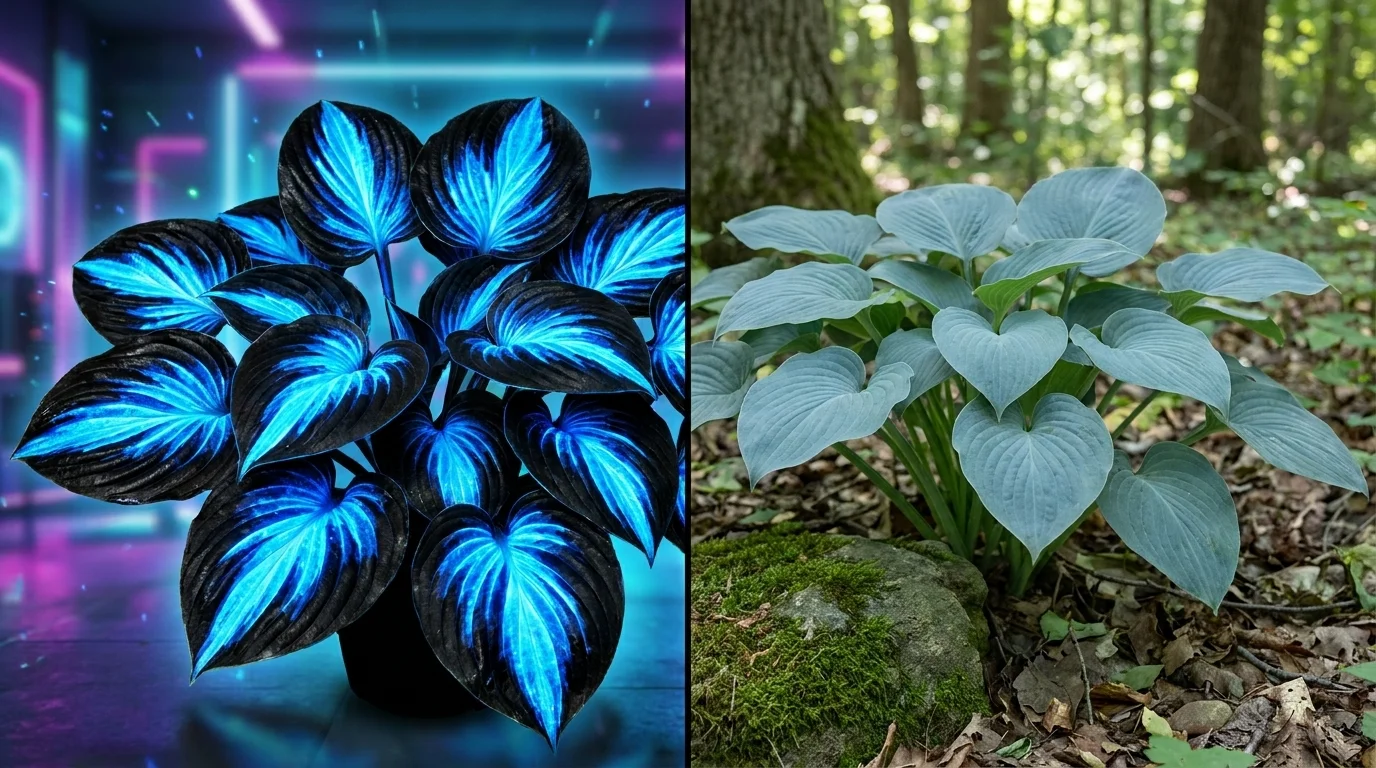
The verdict divides cleanly in two, and holding both halves at once is the whole trick to reading these listings. The jet-black, glowing-blue version in the viral reels and seed listings is not real: foliage of that colour does not occur in the genus. What you are looking at is an edited or AI-generated image, and Google's own AI Overview — the box sitting above every one of those product pages — says as much, warning that the pictures are "heavily edited" and that seeds "treated with artificial wax... washes away in the rain." A leaf cannot be dyed from the inside by a coating on the outside of a seed. That claim alone should end the transaction.
The other half is the reassuring part. There is a real, heart-shaped, faintly blue hosta at the bottom of all this. The AI Overview names it correctly: "While true midnight blue does not exist, varieties like Hosta sieboldiana 'Blue Heart' or 'Blue Mouse Ears' produce beautiful, textured, heart-shaped leaves with a natural powdery blue-gray tint." That is your anchor for everything below — a clump-forming, shade-loving perennial whose blue is soft, grey-cast, and entirely genuine. The rest of this guide follows the sensible order: why the scam exists, what the real plant is doing to look blue, how to grow it, and how to buy it. If you want a broader tour first, VerdeNook's shade-loving foliage plants guides are the place to start.
Loading image...
Hold both halves at once: the jet-black glowing version is an AI fabrication, and the soft blue-grey hosta beside it is the genuine, ordinary plant it borrows credibility from.
The AI Seed Scam Behind the "Midnight Blue Heart"
The reason this query exists at all is a piece of very recent news, and no page-one competitor connects the two. The "midnight blue heart" plant is a byproduct of the 2025–2026 wave of AI-generated fake-seed scams. The investigation was broken by 404 Media; Futurism named "midnight blue heart" explicitly in December 2025; and by July 2026 Malwarebytes confirmed the listings were still live. This is not folklore passed around a forum — it is documented, dated, and traceable.
It is also on the record with the people best placed to judge it. Bill Hegeman, co-president of the Genesee Valley Hosta Society, assessed the midnight-blue-heart seed ads for Futurism in three words: "Definitely all fake." Set that against the scam's own voice-over — "a rare black and blue hosta that looks like it came from another planet" — and you have the debunk in a single line. When a plant is described as extraterrestrial, that is not marketing hyperbole. It is an admission.
The mechanism is worth understanding, because it explains the sheer volume. Scammers have moved from Photoshop to text-to-image AI tools — Midjourney, DALL·E, Stable Diffusion — which, as Malwarebytes puts it, let a seller "spin up a store, generate an entire catalog of impossible products, and disappear." The economics are deliberate too. Those listings run roughly $3 to $63, and that low price is the point: Malwarebytes, citing Gallup, notes that 23% of fraud incidents involve losses under $100, precisely the band people do not bother to report. I will not give you a count of how many listings or victims exist, because no source publishes one and the sellers churn too fast to measure. The honest answer is that it is widespread and unquantified, which is worse, not better.
How to spot an AI plant fake
The National Garden Bureau, the horticulture industry's own body, published a dedicated "AI Plant Scams" guide in July 2025 with a red-flag checklist. Compressed, the tells are these:
Impossible colours. Jet-black, neon, or rainbow foliage that no species in that genus produces.
Do-everything claims. A plant said to grow indoors, survive snow, need little water, and glow — all at once. Real plants make trade-offs; fantasy ones do not.
Sold as seeds, not divisions. Named cultivars are propagated vegetatively, so seeds of a specific "variety" are a structural impossibility (more on this below).
No Latin name. A real listing gives you a binomial you can verify; a fake one hides behind a marketing phrase.
Churn-and-disappear sellers. New store, no history, a catalogue of exotic impossibilities, and a checkout that outlives the shop.
As the Bureau puts it, "The online plant community is built on trust... Your best defense, however, is awareness." Awareness, here, is mostly a matter of asking for the Latin name and watching the listing fail to supply one.
What It Really Is: The Blue Hosta (Hosta 'Blue Heart')
Strip away the fantasy and the plant underneath is a well-documented perennial. Hosta sieboldiana 'Blue Heart' is a clump-forming, shade-loving herbaceous perennial in the family Asparagaceae, grown for heart-shaped, blue-green foliage and carrying nodding, funnel- or bell-shaped flowers in early summer. That is not a nursery's sales copy; it is the Royal Horticultural Society's own plant record. The plant is real, it is hardy, and it comes back every year — three facts the seed listings quietly borrow to lend themselves credibility.
You will also see the softer name "midnight blue hosta" used, and it is worth knowing what it signals. It is the semi-legitimate halfway house of the fantasy name — dropping the impossible "black" while keeping the "midnight" glamour — and it still points back to an ordinary blue hosta, not a darker one that does not exist. Treat "midnight blue hosta" and "blue hosta" as the same real plant wearing different amounts of make-up.
Why blue hostas look blue: the glaucous bloom
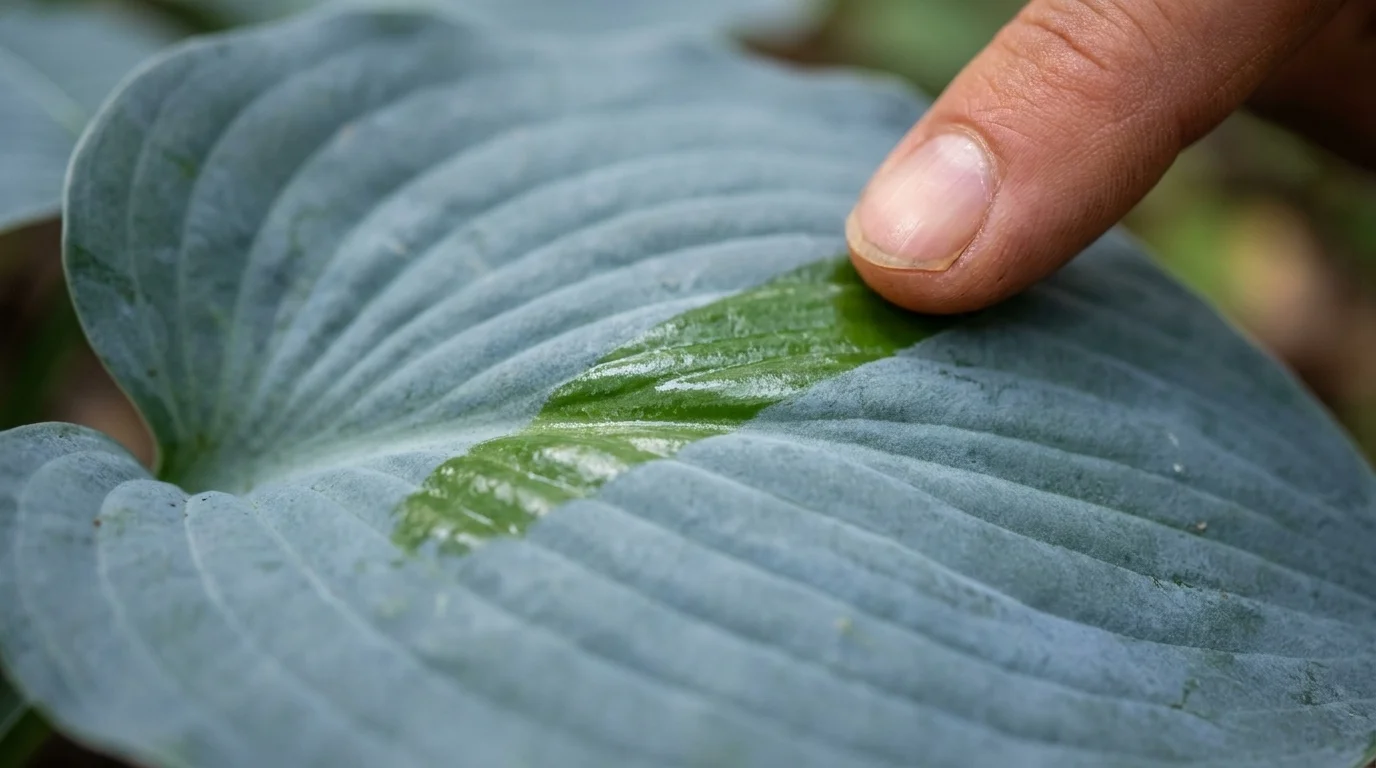
Here is the mechanism, and it is the fact that resolves the whole argument. The blue of a blue hosta is not pigment. It is a powdery layer of wax on the leaf surface — a glaucous bloom — that reflects light with a cool, blue-grey cast while the chlorophyll sits green beneath it. You can prove this to yourself in a second: draw a fingertip across a blue hosta leaf and you leave a clean green stripe where the wax has come away. The blue was never in the leaf; it was on it.
That single mechanism explains two things at once. It tells you why the fantasy version is impossible — a wax coating on a seed cannot install blue pigment that the plant does not make — and it tells you why the care instructions below are non-negotiable. Strong sun melts the wax away, so a blue hosta baked in full sun simply turns green for the rest of the season. Gardeners who have wondered whether the blue is real have answered it the slow way: one widely shared time-lapse followed a "blue" hosta for 222 days and watched it come true to colour — in shade. The blue is real. It is also conditional, and the condition is shade.
Loading image...
The blue is wax, not pigment — a glaucous bloom on the surface. Rub a stripe clear and the green shows through, which is exactly why full sun melts a blue hosta back to green.
How to Care for a Real Blue Hosta
None of what follows is difficult. It is simply specific, and the specificity all traces back to that layer of wax you just rubbed off with a finger.
Light and placement
Light shade to full shade — this is the single most important rule, because direct sun melts the blue bloom to green. A blue hosta in a sunny border is not a dead plant; it is a green plant that used to be blue. If you must give it some morning sun, pair it with afternoon shade, but the honest target is dappled woodland light for the whole day. When people report that their "blue" hosta "turned green," this is almost always the cause, and it is not a disease to be treated — it is a placement to be corrected.
Watering and soil
Water at the roots, not over the leaves, and give it a moist, well-drained, humus-rich soil. Overhead watering does two small harms: it abrades the glaucous bloom you are trying to preserve, and it leaves the leaf surfaces damp, which is an open invitation to slugs and snails — the one genuine nuisance in a hosta's life. As for the ground itself, hostas are woodland-floor plants, and they want what a woodland floor provides: a friable, moisture-retentive soil with plenty of organic matter to hold water without going stagnant. If your border dries hard and pale in summer, work in leaf mould or garden compost before you plant; the roots want cool and damp, not wet.
Hardiness and the indoor myth
A real blue hosta is a fully hardy herbaceous perennial — in US terms, roughly USDA zones 3 to 9 — and it will not live as a year-round indoor houseplant. This is where the marketing pitch collapses on its own logic. The scam claims the plant both survives snow and thrives indoors forever. The tell is not that a hosta cannot take snow; it can, and that hardiness is exactly what makes it a dependable perennial. The tell is that a hosta needs the cold. It requires a proper winter dormancy to return, so a plant kept perpetually warm on a windowsill has been denied the one thing it cannot do without. "Grows indoors year-round" and "hardy outdoor perennial" are not two features. They are a contradiction. Grow it outdoors, in shade, and let it die back in autumn without alarm — that dormancy is the plant working, not failing. Containers are fine, provided they sit in the shade and are not brought inside to over-winter warm.
How to Buy the Real Plant — and Skip the Seed Scam
The most useful rule in this entire guide is also the one that dismantles the scam at its root: hostas do not grow true from seed. A named cultivar such as 'Blue Heart' is a single genetic individual, and it can only be reproduced faithfully by division — lifting an established clump and splitting it. Seed from that plant will not come true; it will give you a grab-bag of seedlings, none of them the named plant. So a listing selling "'Midnight Blue Heart' seeds" is selling something that cannot exist even before we reach the question of colour. Buy divisions or potted plants. Never buy the seeds.
Beyond that, the buy-real checklist is short and echoes what both the National Garden Bureau and Malwarebytes advise:
Insist on the Latin name — a real seller gives you Hosta sieboldiana 'Blue Heart' or a named cultivar; a fake one gives you adjectives.
Buy from established nurseries and seed companies with a trading history, not a store that appeared last week.
Be wary of impossible colours and of marketplace grids of near-identical exotic SKUs.
Pay with a method that carries fraud protection, so a small loss is a recoverable one.
Real blue, heart-shaped alternatives
If what drew you to the advert was the blue, heart-shaped leaf, three real plants deliver it honestly:
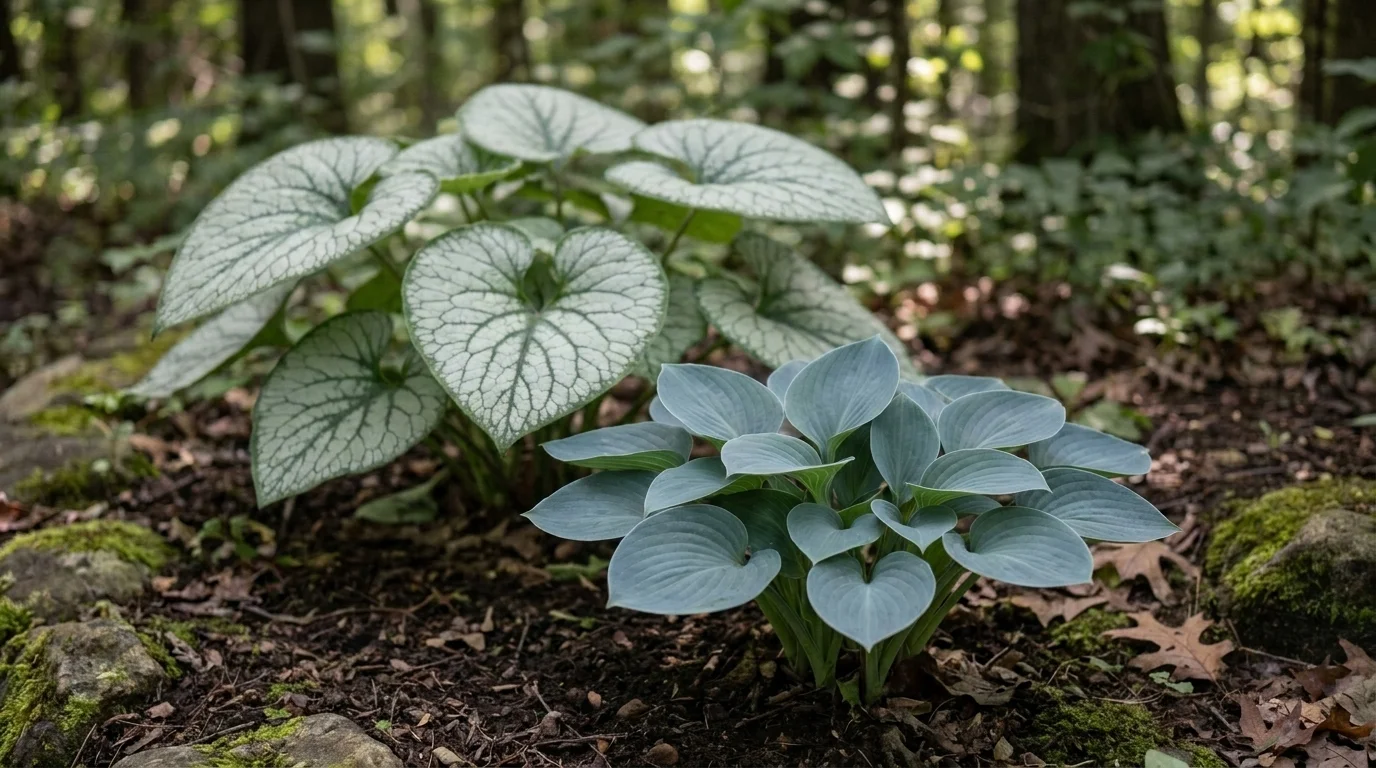
Hosta 'Blue Mouse Ears' — thick, rounded-to-heart-shaped leaves in a genuine soft blue, and the closest legitimate substitute for the look the scam is imitating. Small, tidy, and widely sold as real divisions.
Brunnera macrophylla 'Queen of Hearts' — Siberian bugloss, with silver-washed, heart-shaped foliage for shade. Not a hosta, but it hits the same note in the same conditions.
Bleeding heart (Dicentra) — if it was the literal heart motif you fell for, this is the plant that carries it, in the flower rather than the leaf.
Loading image...
If it was the blue heart-shaped leaf you fell for, these two deliver it honestly — and they will outlast the scammer's shopfront by decades.
The Honest Takeaway
The impossible midnight blue heart plant is not real, and now you know precisely why: no hosta makes black or neon-blue pigment, and a coating of wax on a seed cannot invent one. What is real is quieter and better — a hardy, heart-shaped blue hosta that returns every spring, holds its cool grey-blue in shade, and asks only for a damp, shady corner and protection from slugs. If the advert disappointed you, a genuine 'Blue Heart', a 'Blue Mouse Ears', or a Brunnera will give you the look you fell for and outlast the scammer's shopfront by decades.
So skip the viral seed listing, buy a named division from a real nursery, and browse VerdeNook's Plant Care guides for the shade-loving foliage that rewards it. And if you are ever unsure which plant is in front of you, use the test that costs nothing: draw a thumb across a blue hosta leaf in the shade. If a stripe of green appears where the blue was, you are holding the real thing — and no wax-treated seed in a padded envelope will ever pass it.
Frequently Asked Questions
Is Midnight Blue Heart a perennial?
The real blue hosta behind the name is a hardy herbaceous perennial that returns each spring; the fantasy "midnight blue" version sold as seeds isn't a real plant at all.
Do midnight blue hostas come back every year?
Yes — genuine blue hostas are cold-hardy perennials that die back in winter and re-emerge each spring in most US zones.
Why do blue hostas look blue?
A powdery wax coating (glaucous bloom) reflects light blue; it rubs off and melts in strong sun, leaving green — so plant in shade to keep the blue.
Are midnight blue heart hosta seeds a scam?
Yes — hostas don't grow true from seed, and these listings use AI images and wax-treated seeds. Buy named nursery divisions or potted plants instead.
What are the downsides of hostas?
They're slug and snail magnets, need shade (sun scorches the leaves), die back in winter, and can be nibbled by deer — but they're otherwise low-maintenance shade perennials.
VerdeNook is more than just a source of gardening wisdom; it’s a platform for sharing, learning, and growing together. We invite you to join our community, share your stories, and spread the joy of gardening. Let’s sow the seeds for a greener, healthier, and more sustainable future, one garden at a time.