The Therapeutic Benefits of Aromatic Herb Gardens: Cultivating Wellness and Tranquility at Home
Share this article:
The first bee on the lavender in the Hudson Valley every June is a long-tongued miner — not a honeybee. The garden is a pollinator strategy disguised as wellness.
The first bee on the lavender in my Hudson Valley garden every June is not a honeybee — it is a long-tongued Anthophora miner, working a Lavandula angustifolia I planted three seasons ago because the regional ecotype seed I ordered came from a New York nursery, not an Illinois mail-order house. The pollinators know the difference; so does my nervous system when I walk past the plant in late afternoon. A medicinal herb garden is not really an aromatherapy project. It is a layered planting that delivers nectar to the insects that hold the food web together, a harvest of compounds with documented effects on the human nervous system, and a sensory architecture you can walk through on the worst day of the week. This guide is about how to plant one — what goes in, how it goes in, when it goes in, and what to do with the harvest. The wellness payoff is real, and recent neuroscience finally explains why; the rest of the work is gardening.
Quick answer: the 5 must-have herbs for a medicinal herb garden
Lavender (Lavandula angustifolia), chamomile (Roman or German), lemon balm, peppermint, and tulsi (holy basil) — five hardy aromatic herbs that thrive in full sun, tolerate beginner mistakes, and deliver the strongest combination of pollinator value, harvest yield, and documented wellness use in their first season. Plant them at your last frost date in well-drained soil. Five is enough for a 4×4 bed; you can scale up from there.
How aromatic compounds reach your nervous system
A short detour through the mechanism, because the conventional gardening writing on this topic stops at "lavender smells calming" and the conventional wellness writing skips the gardening entirely. What is happening when you walk past a lavender hedge is not metaphor.
The honest summary is this: scent and infusion are two delivery routes for compounds that interact with measurable receptor and microbial systems. You are not imagining the effect. The garden is the supply.
The 15 medicinal herbs to plant
Every other medicinal-herb-garden article on the internet either gives you the wellness use of these plants or the growing data — never both in the same place. Here is the table that should have existed five years ago. USDA zones, sun, mature height, harvest window, and the reported therapeutic use, with the scent profile as a planning aid.
Roman and German chamomile are both useful and serve different roles — Roman is perennial in zones 4–9 and tolerates light shade; German is the larger annual that produces the more aromatic flower. If your bed is small, pick one. Tulsi, ashwagandha, and rosemary are treated as annuals in cold zones; the others overwinter as perennials in their stated range. The harvest window in the Harvest column is the scent-peak window — when the essential-oil concentration in the plant tissue is highest — not the longest possible harvest period. Cutting earlier or later still works; the oil yield drops.
Loading image...
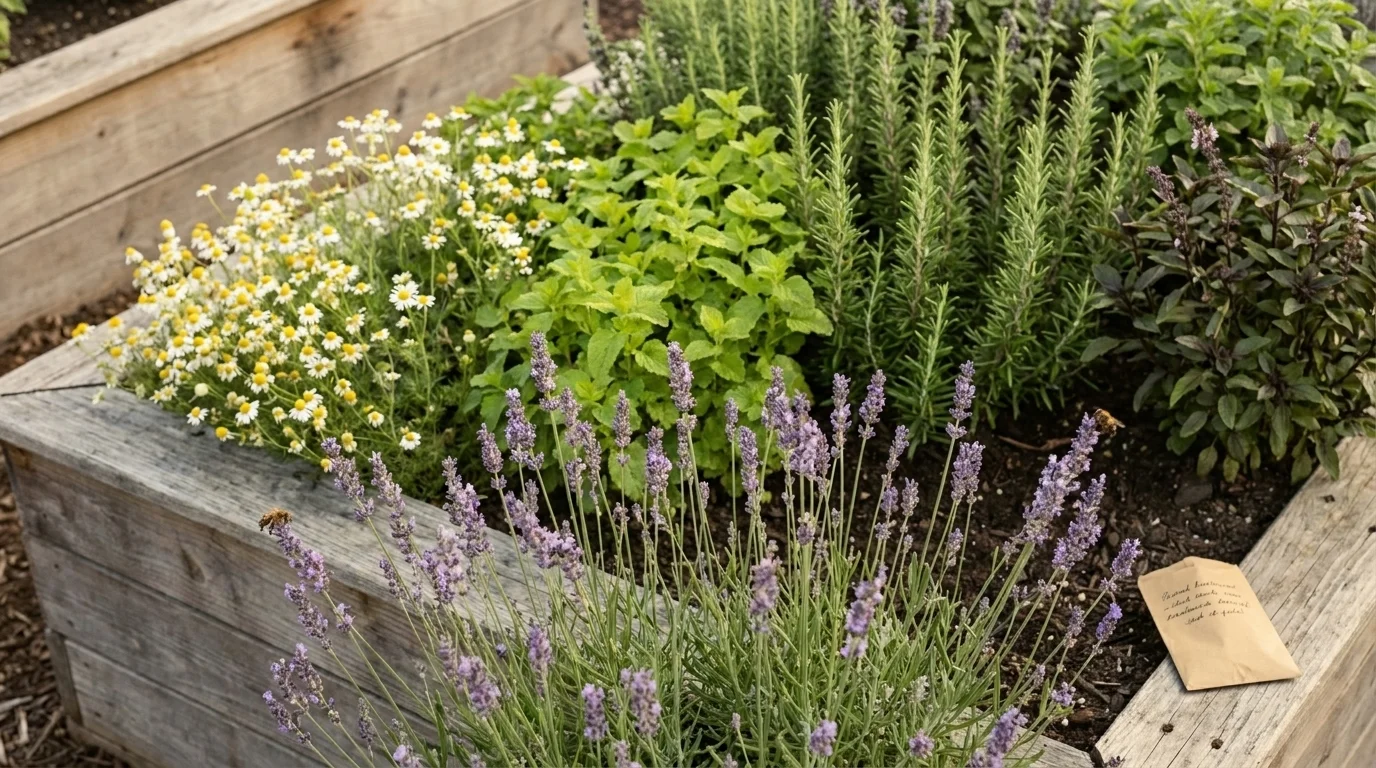
Five herbs in a 4×8 bed cover the bee-friendly bloom window from June to September — and feed the long-tongued miners no zinnia mix ever will.
Lavender: the cornerstone of an aromatic garden
Lavender deserves a section to itself, because every other article in this SERP names "lavender" without distinguishing the three commonly sold species, and the differences matter for both scent intensity and winter survival.
French lavender (Lavandula dentata) is the toothed-leaf, longer-blooming, less-hardy species — zones 8 through 11. Higher camphor content means a more medicinal, less perfumey scent. Beautiful in southern gardens, dies in zone 5.
Spanish lavender (Lavandula stoechas) is the flag-topped lavender with the showy bracts — zones 8 through 9, again the higher camphor content. Best as an ornamental in mild climates; not the lavender to dry for sleep sachets.
For the highest essential-oil concentration, harvest English lavender mid-morning, after the dew has dried but before mid-day heat, with the lowest two or three buds on each stem just starting to open. Cut long stems, bundle them in 25-stem bunches, secure with a rubber band (which tightens as the stems dry, instead of falling slack like twine), and hang upside down in a dark, dry, ventilated space for two to three weeks. The dark matters — light bleaches the bud color and degrades the linalool. The ventilation matters more — a humid, still spot is how a bunch of lavender goes moldy in week two.
Plant English lavender in deeply drained soil at the south edge of a bed, where it gets the most sun and the least competition for root space. Lavender hates wet feet more than it hates anything else; a slope, a raised bed, or a grit-amended planting hole is the difference between a plant that lives ten years and one that rots in its third winter.
Bergamot mint (Mentha citrata) is the easiest at-home stand-in for citrus bergamot (Citrus bergamia, which needs a frost-free climate to fruit). Zones 5–9, full sun to part shade, vigorous mint-family grower. The citrusy lift is real even if the bergamot orange is impractical.
Roses — old-garden roses like Rosa damascena (damask rose) and R. centifolia are the species used in attar; zones 4–9 depending on cultivar. Plant for petals to dry; the modern hybrid teas are bred for show, not for scent. Harvest petals in early morning at full bloom.
Chamomile — both Roman and German are in the table above; both are used in the published trials.
Clary sage (Salvia sclarea) — zones 4–8, full sun, biennial. Strong, slightly musky scent; the source of the most-cited menstrual-cycle support data in the MDPI review.
Ylang-ylang (Cananga odorata) is the tropical exception — a tree, zones 10 and warmer. If you live in zone 10 or are willing to overwinter a small specimen indoors, grow it; if not, the home aromatic garden delivers five of the six and the substitute mint for the sixth.
A short note on the women's-mental-health framing the MDPI review uses: the studies are not claiming aromatherapy is a substitute for clinical care during hormonally sensitive life stages. They are documenting that aromatherapy is increasingly being formally evaluated as a complement — and that the evidence is strongest for the six oils above. The garden gives you the inputs; the use is yours to integrate, with whatever clinical guidance you already have.
Calming herbs you can grow at home
The Mayo Clinic and the VA own the top of the "calming herbs" search results, and you should read what they have to say if your interest is medical. The garden answer is shorter and complementary: which calming herbs are actually plantable in zones 5 through 9, harvestable in a normal home garden, and supported by published research.
Lavender — first, again, for the reasons above.
Chamomile — Roman or German; the most-studied sleep-and-relaxation herb in the entire materia medica.
Lemon balm — Melissa officinalis; bright lemon scent, vigorous grower, dries beautifully for tea. Bin it if you don't want it spreading; the roots are mint-family persistent.
Passionflower — Passiflora incarnata; the perennial native vine with the alien-flower architecture. Aerial parts (leaves and flowers) used in published anxiolytic trials. Zone 6 hardy with mulch.
Tulsi / Holy basil — Ocimum tenuiflorum; the adaptogen with the strongest available evidence base for stress modulation. Annual in most of the US; sow seeds indoors six weeks before last frost.
Valerian (Valeriana officinalis) — zones 4–9, the strongest sedative of the list; an acquired smell (some people find the root unpleasant), but the clinical data for sleep support is the most robust of any garden-grown herb.
California poppy (Eschscholzia californica) — zones 6–10, mild anxiolytic via the aerial parts. Self-seeds; effectively perennial in mild climates.
Mayo Clinic and the VA make the medical case for these. The garden makes them yours to harvest, dry, infuse, and live with — which is a different relationship to the same plants than buying a tincture, and worth the bed space if you have it.
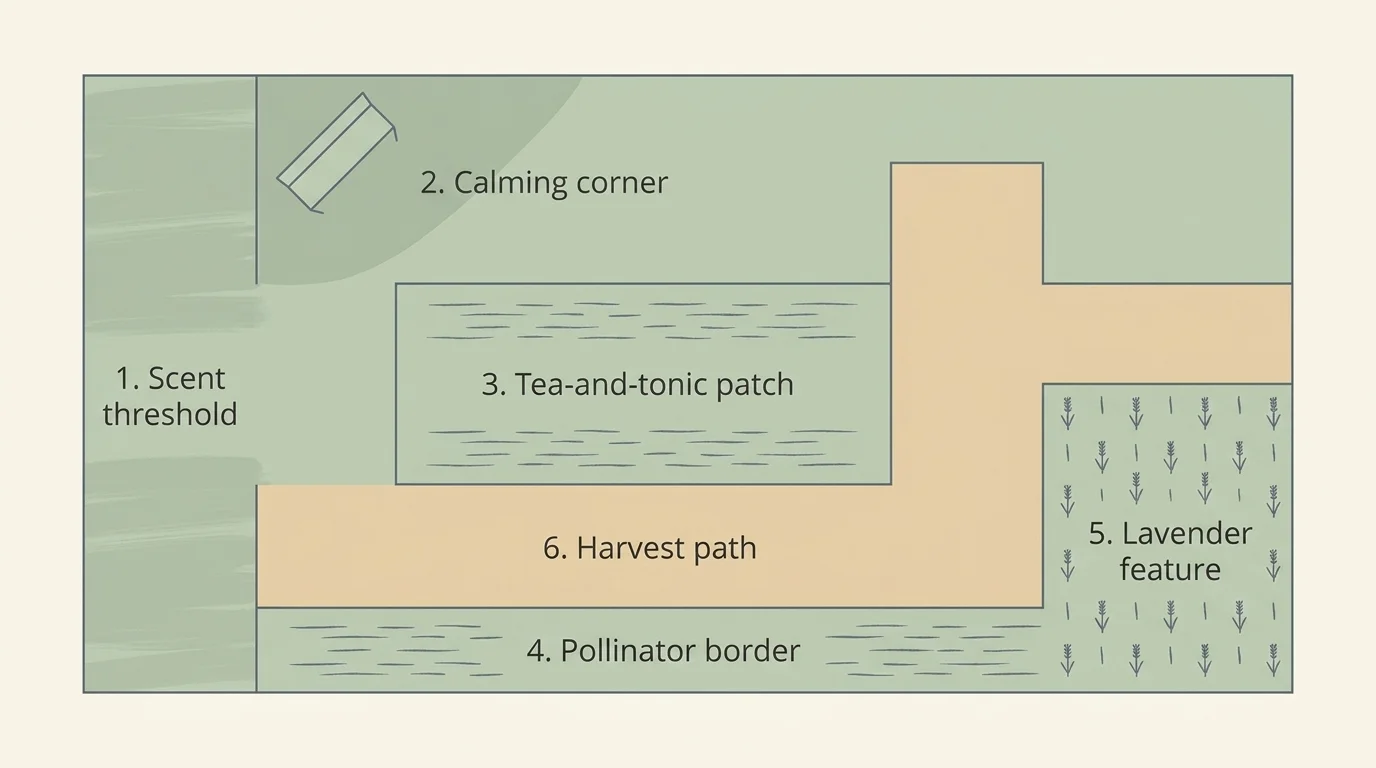
Scent threshold — the first plants you brush past at the entry. Low, brushable, persistent scent. Thyme, oregano, low rosemary, and creeping mint between paving stones. Walking through releases the volatile oils; this is the layer that announces what the garden is.
Calming corner — a sheltered, partly shaded section with chamomile, lemon balm, valerian. A bench or stool here is the part nobody designs deliberately and everyone uses constantly.
Tea-and-tonic patch — the harvest-heavy section. Tulsi, lemon balm, peppermint, German chamomile in a 1 × 2 m / 4 × 6 ft block. Pick weekly. This is the part of the garden that earns its keep daily.
Pollinator border — the long edge along the bed's south or west side. Wild bergamot, hyssop, oregano, lavender, calendula. Aromatic herbs are the canonical pollinator-garden plants in temperate zones; this layer attracts the bees and beneficial insects that the rest of the garden depends on.
Lavender feature — a single deliberate planting of English lavender, large enough to read as a feature (three to five plants), in the sunniest, best-drained spot. Often the visual focal point as much as the scent anchor.
Harvest path — a working corridor wide enough to walk down with a basket, between the tea-and-tonic patch and the pollinator border. Functional, not decorative.
The point of organizing this way is that scent is delivered in layers across the time the body spends in the garden — the threshold layer registers in the first thirty seconds, the calming corner over five minutes of sitting, the pollinator border on the walk back. A pile-of-everything herb bed delivers a single dense smell once and then stops working. A layered sensory garden keeps producing.
Loading image...
Pile-of-everything herb beds deliver one dense smell, then stop working. A layered sensory garden keeps releasing scent across the time a body walks through it.
A pollinator note
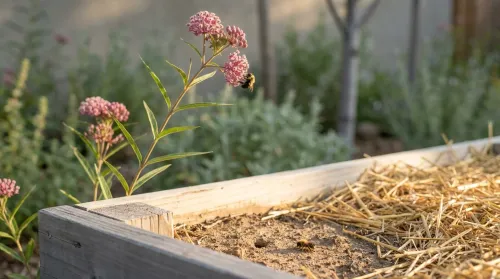
Aromatic herbs are not separate from the food web. Lavender, thyme, oregano, hyssop, and lemon balm are the canonical pollinator-garden plants in the temperate Northeast — they bloom across an extended summer window that covers honeybees, native bumble bees, long-tongued miners, and the parasitic wasps that suppress aphids and caterpillars on the rest of the garden. A medicinal-herb-garden is, almost by accident, one of the highest-value insectary plantings a home gardener can install. Leave the lavender flower spikes on the plant a few days longer than aesthetic timing would suggest, and watch which bees show up. The Anthophora mining bees and the long-tongued Bombus species are the ones that find their way to it first, and they are also the ones with the steepest population decline curves over the past decade.
From garden to ritual
The bridge between "the herb is growing" and "the herb is doing the thing for me" is harvest plus a small set of post-harvest steps. The wellness sites talk about essential oils as bought products; the gardening sites stop at the harvest. Here is the part both camps skip.
Harvest at the scent peak. Pick lavender just as the lowest buds open; cut chamomile flowers when they are fully open but before they fade; harvest lemon balm, peppermint, and tulsi leaves before the plant flowers (post-flowering, leaf oil concentration drops). Mid-morning, after dew, before noon.
Dry in the dark, with airflow. Hang upside down in 25-stem bundles in a dark, dry, ventilated space — closet, attic, spare room. Two to three weeks. If you can smell the herb from the doorway, the drying is going well; if the air smells musty, ventilation is inadequate and you will lose the batch.
Infusions at a 1:1 ratio. One tablespoon of dried herb per one cup of just-off-boiling water for tea-strength infusions; cover the cup while it steeps (the lid catches the volatile oils that would otherwise leave with the steam); five to ten minutes for leaves, ten to fifteen for flowers, fifteen to twenty for roots. This is the route the microbiome work addresses — the flavonoids go in through the digestive tract, get metabolized by the gut microbes, and produce calming metabolites circulating in the bloodstream within an hour.
Sachets and the lavender pillow. Two tablespoons of dried lavender buds in a small muslin bag, slipped inside a pillowcase. The scent persists for three to four months; refresh with fresh buds in the fall. Old buds compost.
This is the practical loop — plant, grow, harvest, dry, use — and it is the part the wellness market sells as a finished product. The garden makes it the slowest part of the slow part of the year, and that is most of the point.
A practical close
If you have one bed and one season, plant five herbs at last frost: English lavender ('Munstead' or 'Hidcote'), Roman chamomile, lemon balm, tulsi from seed started six weeks ago, and either peppermint (in a contained pot) or wild bergamot. By the time the wild bergamot flowers in mid-July, your first lavender will be ready to cut for sachets and the chamomile will be on its third pick. The food web shows up on its own; the nervous system does too. The garden does not need you to commit to a spiritual framework to deliver what it delivers — it just needs the plants in the ground at the right time, the harvest at the scent peak, and the cup of chamomile at the right hour. The rest takes care of itself.
Aromatic herbs with the strongest current evidence for calming the nervous system are lavender (Lavandula angustifolia), chamomile, lemon balm, passionflower, and tulsi (holy basil). Recent reviews show these compounds bind to GABA receptors and may modulate gut microbiota linked to mood regulation. They are well suited to a home aromatic herb garden — though for clinical anxiety, consult a qualified healthcare provider.
What is the easiest aromatic herb for beginners to grow?
Start with chamomile, lemon balm, lavender, peppermint, and tulsi (holy basil) — five hardy aromatic herbs that thrive in full sun, tolerate beginner mistakes, and produce usable harvests in their first season. Plant around your last frost date in well-drained soil. A 4x4 raised bed comfortably fits all five.
Can I grow medicinal herbs indoors?
Yes — most aromatic herbs grow well indoors with 6 to 8 hours of bright light from a sunny south-facing window or a grow light. Lavender, rosemary, thyme, and mint adapt well to containers; lemon balm and tulsi prefer larger pots. Indoor herbs need consistent watering and good airflow to avoid mildew.
When should I harvest lavender for the strongest scent?
Harvest English lavender (Lavandula angustifolia) just as the lower flower buds open — typically late June through mid-July depending on your zone. Cut in mid-morning after dew has evaporated but before peak sun, when essential-oil concentration is highest. Bundle 25 stems with a rubber band and hang upside down in a dark, dry, ventilated space for 2 to 3 weeks.
How does aromatherapy actually work?
Aromatic compounds like linalool (in lavender) bind directly to GABA-A receptors in the brain, the same receptor system that regulates the body's quieting response. A 2024 mechanistic review documents three concurrent pathways: upregulation of serotonin and GABA, downregulation of glutamate, and modulation of intracellular signalling. A 2025 review adds a second route — flavonoids from chamomile, passionflower, and lemon balm act through gut-microbiome modulation when taken as teas.
Which lavender variety should I grow?
English lavender (Lavandula angustifolia) is the cold-hardy choice for USDA zones 5 to 9 with the strongest documented anxiolytic profile — 'Munstead' and 'Hidcote' are the most reliable cultivars. French lavender (L. dentata) and Spanish lavender (L. stoechas) are zones 8 to 11 only and have higher camphor content, which makes them more medicinal-smelling and less floral. For drying and sachets, grow English.
What is the difference between Roman and German chamomile?
Roman chamomile (Chamaemelum nobile) is a low perennial groundcover hardy in zones 4 to 9, growing 15 to 25 cm tall. German chamomile (Matricaria recutita) is a taller annual reaching 30 to 60 cm with more aromatic flowers — it is the chamomile used in most published clinical studies. Both produce apple-scented flowers and steep into similar tea. If you have space for only one, grow German chamomile in summer and re-sow each spring.
Exotic Plant Adventures: Growing and Caring for Unique and Unusual Plants
Join
Loading...
Our Green Community!
Loading...
VerdeNook is more than just a source of gardening wisdom; it’s a platform for sharing, learning, and growing together. We invite you to join our community, share your stories, and spread the joy of gardening. Let’s sow the seeds for a greener, healthier, and more sustainable future, one garden at a time.