The Chemistry of Composting: How Science Transforms Scraps into Soil Superfood
Share this article:
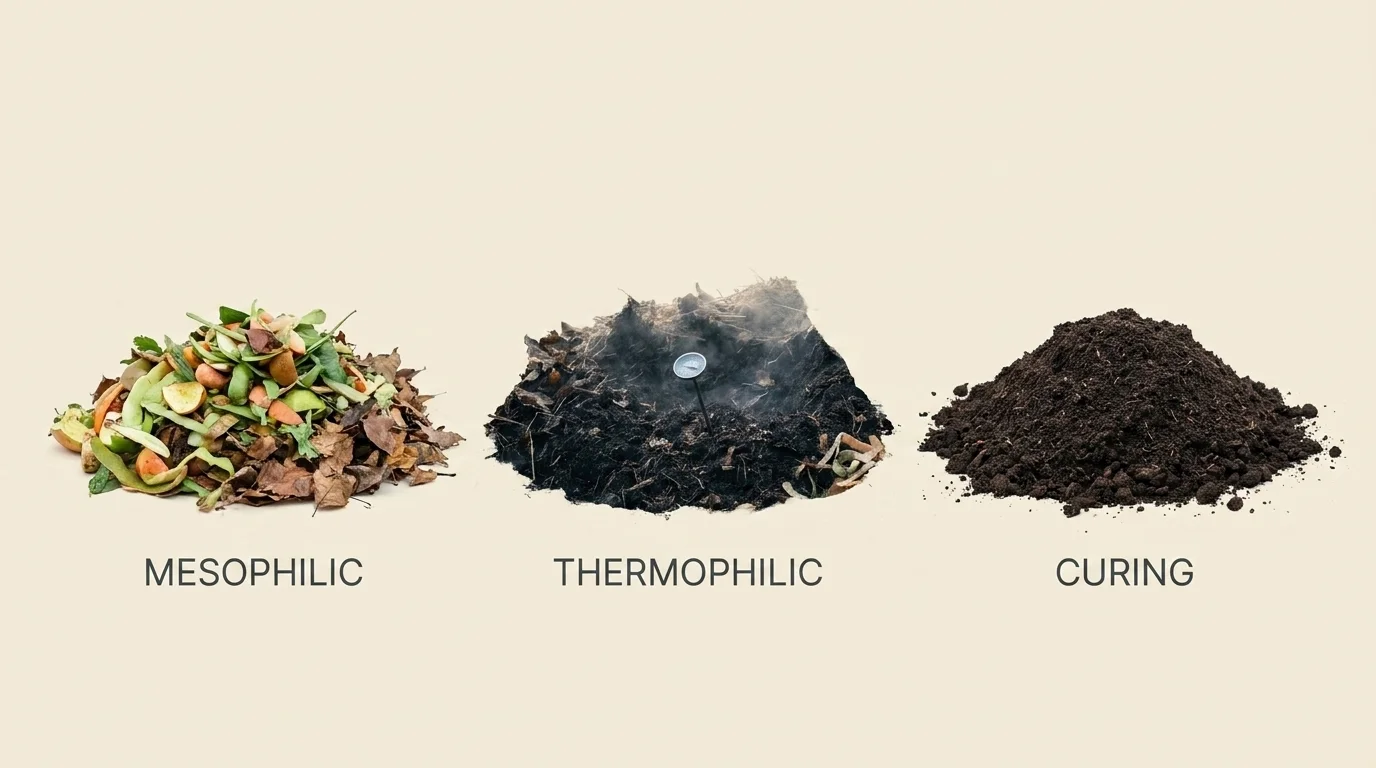
That steam is the science of composting made visible: thermophilic microbes burning carbon and throwing off heat. A pile at 55°C is a chemical engine, not a rubbish heap.
The heap is not waste; it is chemistry
The pile of kitchen scraps and autumn leaves at the back of my pollinator refuge is not, in the strict sense, decomposing. The chemistry inside it is, at this moment in late May, more accurately described as a microbial community oxidising glucose, releasing 484 to 674 kilocalories of heat per gram, and rebuilding the carbon skeletons of broken organic molecules into the long-chain humic compounds that will go onto the beds in autumn. "Compost" is the colloquial name for the result; the science of composting is the chemistry that produces it. The chemistry has settled, in the last decade, into a set of numbers and named reactions the older garden literature consistently skips — and the gardener who learns to read those numbers handles the heap better than the gardener who manages it by smell.
The climate stake is worth naming up front. The EPA's current food-waste figures put wasted food at roughly 58% of landfill methane emissions in the United States — methane that the same food, composted aerobically rather than buried anaerobically, would not produce. A 2023 micrometeorological study indexed on PubMed (PMID 37165058) measured composting emissions at 38 to 84% lower than equivalent landfilling fluxes, with a projected net minimum saving of 1.4 million metric tonnes of CO₂-equivalent for California by 2025. The heap is small infrastructure; in aggregate, it is significant climate work.
This article is the explainer I wanted to read before the first time I tried to build a hot pile and could not work out why it would not heat. It is the composting chemistry in plain English, with the numbers a gardener needs to read on the morning thermometer.
The by-the-numbers cheat sheet
The seven figures below are, between them, ninety per cent of what is worth knowing about a working compost pile. Pin them somewhere you will see them.
Two readings on this table. The minimum-pile figure is the one most home gardeners get wrong — a heap below a cubic metre loses heat to the surrounding air faster than the microbial respiration can generate it, which is why the small kitchen-tower setup stays cool and decomposes slowly. The thermophilic-pathogen-kill range is the one most public-health composting guidance leans on — temperatures sustained between 50 and 70°C kill the human and plant pathogens that an unfinished pile would otherwise pass on to the beds.
How does compost work: the three thermal phases
Composting moves through three named phases, and the temperature in the heap moves with the microbial community that is currently doing the work. The framing below is consolidated from the Compost Magazine science overview and the Wikipedia compost reference, and it is the single highest-leverage piece of knowledge a home composter can carry.
Phase 1: Mesophilic (21–32°C / 70–90°F)
The opening phase begins the moment the pile is built. Mesophilic bacteria — the same broadly-aerobic genera (Bacillus, Pseudomonas, and others) that inhabit the surface centimetre of garden soil everywhere — colonise the freshly mixed substrate and begin to metabolise the most accessible compounds: sugars, simple starches, soluble amino acids. Heat is released as a by-product of glucose oxidation; the literature puts the energy yield at 484 to 674 kilocalories per gram of glucose consumed. The pile warms steadily over two to eight days.
The pH in this phase drops, sometimes dramatically. Early-stage decomposition releases organic acids — acetic, lactic, butyric — and an active mesophilic pile commonly reads pH 4 to 5 in week one. This is the source of the rotten-fruit smell a freshly-built heap can have for a few days. It is not failure; it is the chemistry the literature describes.
Phase 2: Thermophilic (46–60°C / 115–140°F)
As temperature climbs past about 45°C, the mesophilic community is displaced by thermophilic bacteria and actinomycetes that thrive at higher temperatures. The thermophilic phase is the engine of fast composting. The microbes here metabolise the harder substrates — cellulose, lignin, hemicellulose — and they sustain the heap at 46 to 60°C for anywhere from a week to a couple of months depending on pile size, C:N balance, and turning frequency.
Three things matter in this phase. First, the pathogen-kill window — temperatures sustained between 50 and 70°C for several days reliably destroy weed seeds, plant pathogens, and human gut bacteria that may have arrived with the kitchen scraps. Second, the upper ceiling — above about 71°C, microbial activity itself slows; a pile running too hot needs to be turned to dissipate heat. Third, oxygen demand — thermophilic microbes consume oxygen faster than the pile structure can replace it through passive diffusion, which is why a hot pile needs turning every five to seven days to stay aerobic. Below 5% O₂, the pile flips anaerobic and the chemistry changes (producing methane, organic acids, and the rotten smell associated with landfill rather than compost).
Phase 3: Curing (mesophilic, then ambient)
When the thermophilic community has exhausted the easily-metabolised fractions, the pile cools back into the mesophilic range. Fungi — including the white-rot and brown-rot lignin specialists, and actinomycetes — now do the slow work of digesting the remaining tough materials and stabilising the humus chemistry. Curing takes anywhere from a month to most of a year depending on starting materials. The pH rebounds across this phase from the early acid drop toward the mature 7.5–8.0 range.
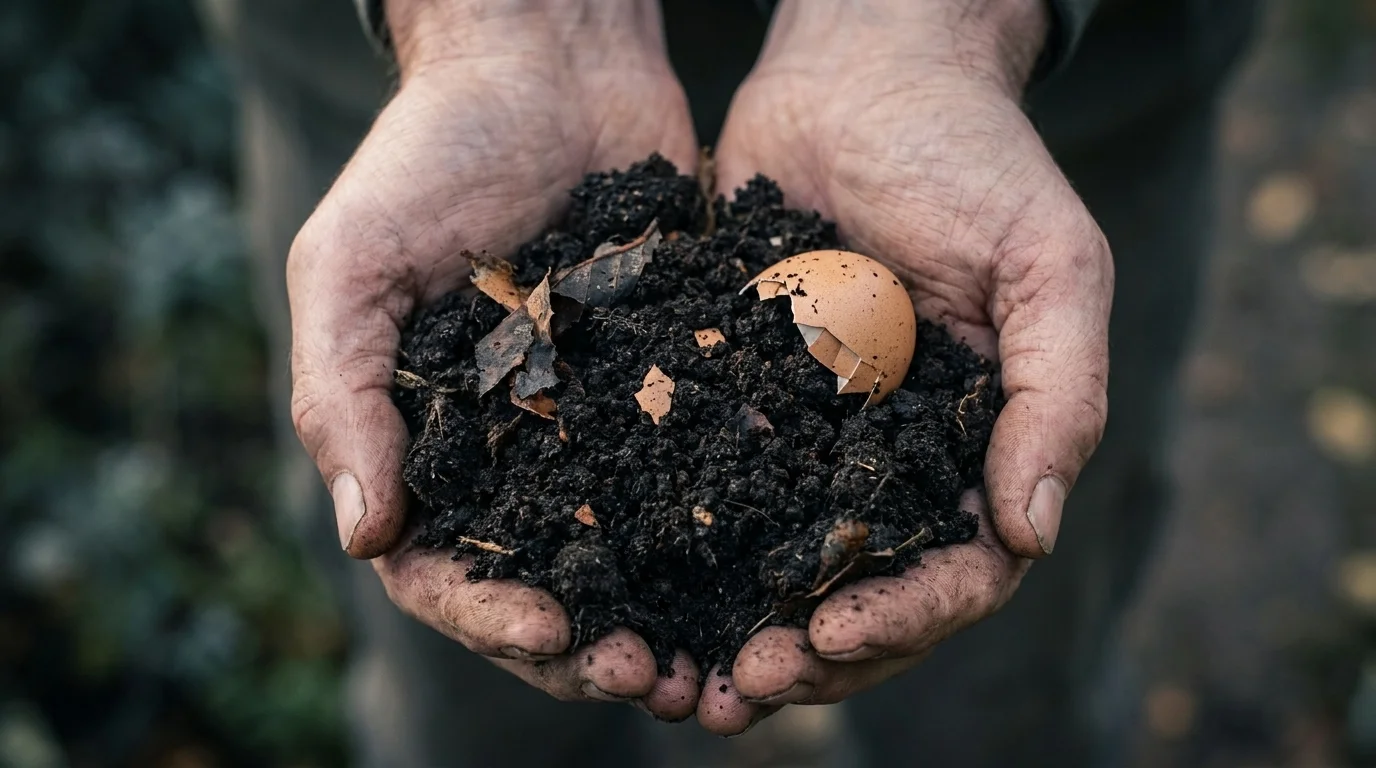
A finished compost smells of forest floor and leaf-mould, not of garden waste; it crumbles cleanly between the fingers; the original materials are no longer individually identifiable. This is the compost the beds want.
Loading image...
Compost moves through three heats: mesophilic 21–32°C, thermophilic 46–60°C, then a long cool cure. The hot middle phase is where pathogens and weed seeds die.
The carbon-nitrogen ratio: a material table with real numbers
The carbon nitrogen ratio composting target is the single most useful piece of knowledge after the thermal phases. Microbes use roughly 25 parts carbon for every 1 part nitrogen — the consensus figure across the Wikipedia compost article and the extension-service literature. Below about 15:1, excess nitrogen outgasses as ammonia (the ammonia smell of a too-green pile); above about 40:1, the microbes are nitrogen-limited and the pile slows to a crawl. The 25:1 to 30:1 range is the operative window for hot composting.
The way to manage the ratio is to mix materials of known C:N, not to memorise prose. The table below gives the working figures.
Material
C:N ratio
Greens or browns
Notes
Fresh grass clippings
~15:1
Green (high N)
Pile-heater; layer thin to avoid matting
Vegetable and fruit scraps
~15:1
Green
The core kitchen contribution
Fresh manure (chicken, horse)
~15:1
Green (very hot)
Powerful nitrogen source; mix with browns
Coffee grounds
~20:1
Green
Mildly acidic; mix evenly
Fresh leaves (summer green)
~30:1
Mid-balance
Easy to layer; useful balancer
Dry autumn leaves
~50:1
Brown
The most useful home-source brown
Straw
~80:1
Brown
Slow-decomposing; keeps pile aerated
Hay (more nitrogenous than straw)
~25:1
Mid-balance
Often confused with straw — check the source
Newspaper, shredded
~170:1
Brown
Avoid heavily-inked colour glossies
Cardboard, shredded
~350:1
Brown
Remove tape and staples
Sawdust (untreated wood)
~400:1
Brown
Use sparingly; mat-forms
Wood chips (untreated)
~400–500:1
Brown
Best in pile bottom for drainage
Pine needles
~80:1
Brown
Slightly acidic; suitable in moderation
The arithmetic on the table is simpler than it looks. A bucket of kitchen scraps (15:1) plus three buckets of dry autumn leaves (50:1) gives roughly 41:1 — too high. Add a half-bucket of fresh grass clippings (15:1) and the ratio drops to about 35:1 — close to operative. The visual rule of thumb the older guides use — "one part green to three parts brown by volume" — is, near enough, the same answer. The numbered table just makes the failure modes diagnosable.
The diagnostic table is the part of compost chemistry the older garden writing most consistently elides. It is also the part the home composter consults at the moment they actually need it — when the heap stops behaving.
What humus actually is — chemically
The end-product chemistry of composting was, until recently, treated as a black box. "Organic matter breaks down into humus" was the level of detail most gardener-facing sources offered. In 2025, a Journal of Agricultural and Food Chemistry study using FT-ICR mass spectrometry on maize-straw compost amended with humus soil identified three dominant chemical pathways by which dissolved organic matter transforms into stable humus during composting. The work is technical, but the three pathways are nameable.
Phenol-protein reactions. Phenolic compounds released by the breakdown of lignin react with proteins and amino acids in the pile to form humic precursors. The reaction is favoured by neutral-to-slightly-alkaline pH — exactly the range a maturing pile sits in.
Polyphenol self-condensation. Polyphenols — flavonoids and tannins released from plant material — condense with one another and with sugars to form stable, complex aromatic structures. This is the polymerisation pathway that produces the dark colour and the long shelf-life of mature compost.
Maillard reactions. The same browning chemistry that browns a loaf of bread runs in the cooler curing phase of compost. Sugars and amino acids react to produce melanoidins — brown, nitrogen-rich, biologically active polymers. The 2025 study found nitrogen-containing molecules to show the highest reactivity across all three pathways, which is why a well-balanced pile produces such dark, biologically active humus.
The implication for the gardener: the humus going on the beds is not just "rotted plant matter." It is a chemically distinct, stable, microbiologically active material whose long-chain compounds bind soil particles, hold cations against leaching, and feed the mycorrhizal fungi every plant in the bed depends on. The chemistry is, in the new literature, finally written down.
Loading image...
Finished humus smells of forest floor and falls apart in the hand. This is stable carbon — the Maillard and polyphenol pathways have turned scraps into soil.
What modern composting science is solving
A small note for readers who want to understand where the field is moving. The recent research literature has converged on two open problems most home guides do not yet mention.
The nitrogen-loss problem. A 2025 review in Microbial Ecology documents that traditional aerobic composting loses a substantial fraction of its nitrogen as ammonia and nitrous oxide gas — both undermining the finished compost's fertiliser value and contributing greenhouse-gas emissions in the wrong direction. The review consolidates three categories of additive strategies that conserve nitrogen: physical adsorbents (biochar, zeolite), chemical acidifiers (calcium superphosphate, organic acids), and specific bacterial inoculants. For the home composter, the practical implication is that adding a small amount of biochar — burnt biomass produced at low oxygen — to the pile measurably reduces nitrogen loss without changing any other aspect of the build.
Synthetic microbial communities. A 2025 research programme led by Professor Li Dejun at the Chinese Academy of Sciences (Phys.org coverage) demonstrated that engineered SynCom inoculants — carefully designed microbial mixes — significantly accelerate lignocellulose degradation and improve downstream crop response. The implication is that the next generation of commercial compost inoculants will be specifically engineered consortia rather than the broad-spectrum "compost starters" currently sold. Home composting will benefit indirectly as products reach the shelves; the underlying chemistry is the same chemistry described above, just running on better-tuned microbial casts.
The discipline has, in short, moved past the "let nature take its course" framing of the older popular literature. The chemistry is named, the failure modes are diagnosable, and the open problems are being solved.
A note on what NOT to add
A small safety callout. A 2025 USDA Limited Scope Technical Report on Compostable Materials flagged that many products labelled "compostable" — including some food-service packaging, synthetic plastics, and cellulosic fibre-based items — are manufactured with per- and polyfluoroalkyl substances (PFAS), the so-called "forever chemicals." PFAS persist through the composting process and contaminate the finished compost. Stick to certified BPI-listed products that explicitly test for PFAS-free status, or simply keep food packaging out of the home compost entirely and add only kitchen scraps, paper that you can verify is not coated, and yard waste.
The same exclusion list applies to the usual suspects: meat scraps, dairy, oily food (anaerobic and attractive to pests); pet waste from carnivorous pets (pathogen load not killed reliably at home-scale temperatures); diseased plant material (some pathogens survive composting); pressure-treated lumber (toxic preservatives); and glossy or heavily inked paper. The shorter rule: if you would not eat it cooked, the heap probably should not.
The chemistry running through the food web
Leaf litter is not garden debris. It is the substrate from which next year's humus will be polymerised, the slow-release source from which next year's nitrogen will be cycled through the rhizosphere, and the foundation of the soil microbiome the entire food web above it depends on. The composting heap, properly read, is a small, controlled, accelerated version of the same chemistry that runs in the leaf litter on the forest floor — pulled into the kitchen yard, given a defined volume and a manageable C:N ratio, and run on a thermal cycle the gardener can read with a thermometer.
By the time the goldenrod blooms in late summer, the autumn heap that fed the pollinator borders this season has already begun its second year of curing in a corner. The humic chemistry the FT-ICR mass-spectrometry studies have named — phenol-protein, polyphenol self-condensation, Maillard — is what is happening inside that pile while the bumblebees are at the flowers above it. The two layers are the same system, on different time-scales, and the home composter who learns to read the chemistry of the lower layer ends up tending the upper layer better.
Three distinct microbial communities run the heap in sequence. Mesophilic bacteria (Bacillus, Pseudomonas, others) dominate the opening 21–32°C phase and metabolise sugars and amino acids. Thermophilic bacteria and actinomycetes take over the 46–60°C phase and break down cellulose and lignin. Fungi and a returning mesophilic community do the final curing work and stabilise humus chemistry. The pile is a community of communities, not a single process.
How does temperature affect composting?
Temperature both indicates and drives microbial activity. Below about 21°C the pile barely decomposes. The 21–32°C mesophilic phase opens the process. The 46–60°C thermophilic phase is when the fast work happens and pathogens are killed (50–70°C). Above 71°C, microbial activity itself slows — a pile too hot needs turning to dissipate heat. Below 50°C, weed seeds and plant pathogens survive.
What is the ideal nitrogen-carbon ratio for compost?
25:1 to 30:1 carbon-to-nitrogen by weight. Fresh grass and food scraps run about 15:1 (nitrogen-rich greens); dry autumn leaves run about 50:1 (carbon-rich browns); sawdust and cardboard run 350–400:1. Mix materials so the overall ratio sits in the 25–30:1 window. Below 15:1 the pile smells of ammonia; above 40:1 it stalls.
Why is pH important in composting?
The mature microbial range is 6.5–8.0. Early-stage decomposition releases organic acids and pulls pH down to roughly 4 in week one; this is normal and not a failure mode. As thermophilic activity takes over and acids are metabolised, pH rebounds and finished compost typically reads 7.5–8.0. Persistent low pH past the first fortnight signals an anaerobic problem — turn the pile.
How can I improve my composting process?
Four levers. Maintain 50–60% moisture (wrung-out sponge feel). Mix to a 25:1–30:1 C:N ratio using the material table. Build a pile of at least 1 cubic metre so it can retain heat. Turn every five to seven days during the thermophilic phase to keep oxygen above 5%. These four parameters drive most of the variability in home composting outcomes.
What materials can I use in my compost pile?
Kitchen scraps (fruit and vegetable peelings, coffee grounds, tea leaves, eggshells); yard waste (grass clippings, dry leaves, prunings); uncoated paper and cardboard (shredded). Avoid: meat, dairy, oily food (anaerobic and pest-attracting); pet waste from carnivores; diseased plant material; pressure-treated wood; glossy or heavily inked paper. A 2025 USDA report also flagged that many compostable food-service packaging items contain PFAS that persist through composting — stick to BPI-listed PFAS-free products or skip packaging entirely.
What are the three phases of composting?
Mesophilic (21–32°C / 70–90°F, lasting 2–8 days) where moderate-temperature bacteria break down sugars and amino acids; thermophilic (46–60°C / 115–140°F, lasting a week to a couple of months) where heat-loving bacteria and actinomycetes dominate and pathogens die at 50–70°C; and curing (a returning mesophilic phase, several months) where fungi finish the tough materials and humus chemistry stabilises.
How small can a compost pile be and still heat up?
Heat-retaining thermophilic composting requires a pile of at least 1 cubic metre (about 35 cubic feet). Smaller piles lose heat to the surrounding air faster than microbial respiration can generate it, so they remain in the cooler mesophilic range and rely on slower, longer cold-composting cycles. Tumbler systems below this volume work, but they decompose over months rather than weeks.
The Ultimate Guide to Organic Pest Control Methods for Home Gardens
Join
Loading...
Our Green Community!
Loading...
VerdeNook is more than just a source of gardening wisdom; it’s a platform for sharing, learning, and growing together. We invite you to join our community, share your stories, and spread the joy of gardening. Let’s sow the seeds for a greener, healthier, and more sustainable future, one garden at a time.