The Future of Gardening: Predicting Sustainable Innovations and Green Technologies
Share this article:
Tech amplifies noticing; it does not replace it. The single best deployment is the bed you visit least, while you keep walking the beds you visit most.
The first Andrena bee of the season emerged from a south-facing patch of unmulched soil beside my compost bin on the twenty-fourth of March, before any of the smart garden hardware on the workbench inside had finished its overnight firmware update. The bee does not know what an Internet of Things gateway is. She does, however, know — in the way ground-nesting bees know — that the soil temperature reached the threshold the willow catkins needed, and she has six weeks of work ahead of her that no app will help with. That is the frame in which I want to talk about smart-garden technology in 2026: not as a replacement for the small, patient acts of noticing a garden depends on, but as a tool that, used well, amplifies them and, used badly, distracts from them.
The smart-garden category itself changed in 2025, more than any year I can remember. AeroGarden — the brand most gardeners would have named first if you'd asked them about indoor smart hydroponics — was quietly discontinued by Scotts Miracle-Gro in late 2024, and the category reorganised around three different archetypes. AI moved from the marketing copy into actual hardware. Soil sensors got affordable enough that any gardener can buy one. The subscription model arrived, and not always for the better. The honest version of this article is the one that names the trade-offs.
The smart-garden landscape changed in 2025
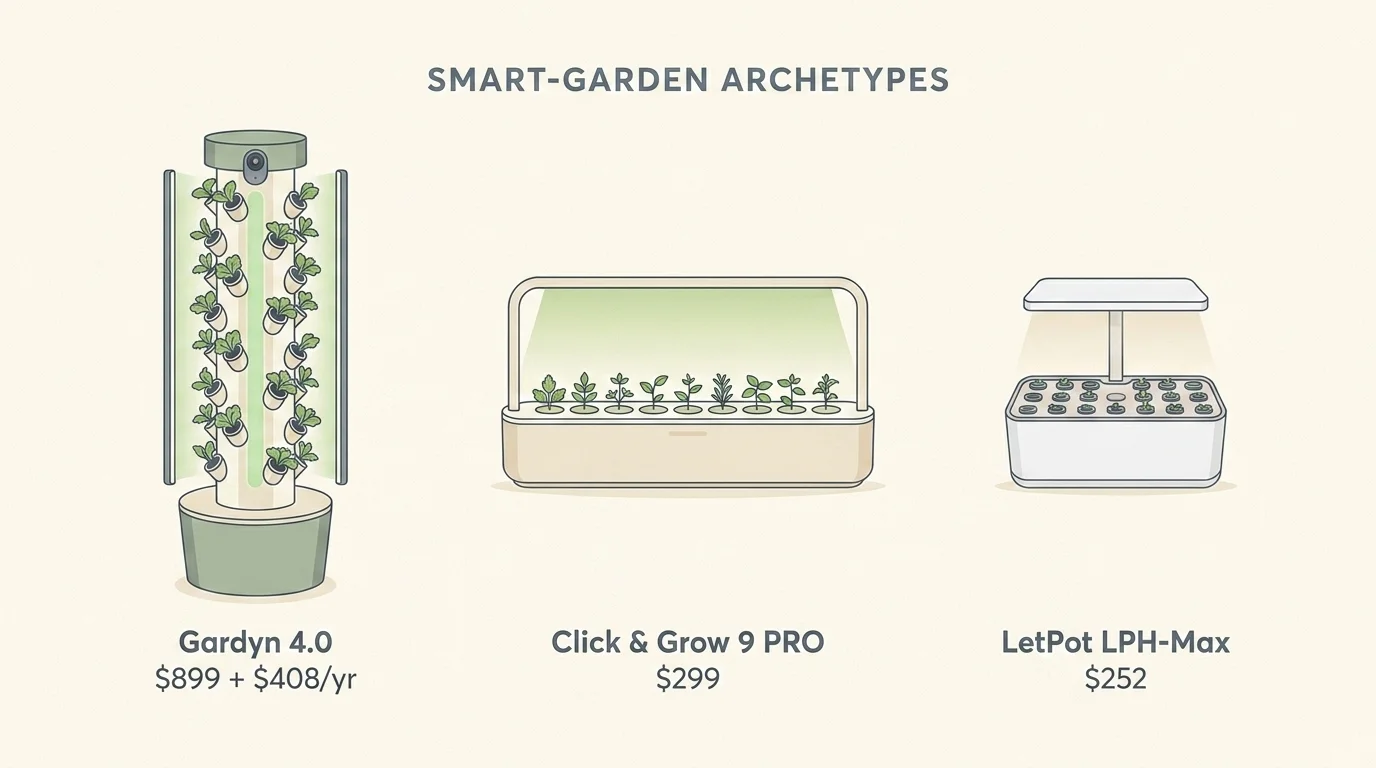
The post-AeroGarden landscape sorted itself into three archetypes that map cleanly to three different buyer profiles. Budget WiFi systems — LetPot LPH-Max at around $252, iDOO at similar entry prices, Ahopegarden's twelve-pod LCD unit at around $60 — run on universal pod compatibility, no proprietary lock-in, and no ongoing subscription. Design-led European brands — Click & Grow (the Smart Garden 9 at $249.95, the Smart Garden 9 PRO at $299.95, the Smart Garden 25 at $949.95) and Plantaform — sell a more aesthetically considered product with a proprietary pod ecosystem and more than sixty plant varieties available. AI-monitored premium systems — primarily Gardyn 4.0 — sell genuine computer-vision monitoring at a price point that includes a meaningful subscription.
The lesson for the reader trying to buy is that "best smart garden" is the wrong question. The right question is which buyer profile you are, and the three archetypes answer different versions of the same need.
Loading image...
Five-year cost is the honest number — a LetPot owner spends around three hundred dollars; a Gardyn 4.0 owner running Kelby closer to three thousand.
AI in the garden: what it actually does, and what it actually costs
The phrase "AI gardening" did real work for marketing teams between roughly 2021 and 2024, when much of what was being sold as AI was a thermostat with a phone app. That is no longer entirely true. Gardyn 4.0, released in 2025, is the first consumer-grade smart garden with genuine computer-vision AI — built-in cameras monitor each of thirty pods individually, identify wilting, discoloration, and visible pest damage, and push pod-specific alerts to the user's phone. The AI assistant is called Kelby, and it is reliable enough that the reviews I read while preparing this piece treat it as the consumer benchmark.
The honest part of the Gardyn story is the cost. The hardware is $899. The Kelby subscription that powers the AI monitoring, automated nutrient adjustments, and monthly seed credits is $408 a year. Without the subscription, you lose the AI experience and most of what justified the premium hardware price; the upfront purchase becomes a manual hydroponic system at a premium-product price. This is the question Reddit threads about smart gardens return to most often, and it is the question most product roundups avoid surfacing. A reader considering a Gardyn should know up front that the five-year cost of ownership is closer to $3,240 than to $899.
A useful pairing of named products and named compromises:
Gardyn 4.0 — genuine AI, premium aesthetics, subscription gating. Best for the early adopter who wants the camera-and-vision experience and is comfortable budgeting the annual subscription as part of the product.
Click & Grow 9 PRO — proprietary Smart Soil pods, sixty-plus plant varieties, no subscription required to operate. Best for the buyer who values design and pod selection and who does not want a monthly bill attached to the kitchen counter.
LetPot LPH-Max — twenty-one pods, WiFi-connected, universal pod compatibility, no subscription. Best for the budget-conscious or experimentation-minded gardener who wants to mix and match seed sources.
What a smart garden actually costs in 2026
The headline price of the hardware is rarely the cost of running it. The five-year math is more honest. A LetPot LPH-Max owner who uses third-party seed pods and runs the system without any subscription typically spends around three hundred dollars over five years — that is the unit plus nutrients plus a modest replacement budget. A Gardyn 4.0 owner running the Kelby subscription for the full five years is closer to $3,240. The ten-times spread inside a single product category tells you everything about how this market is shaped in 2026.
Two other costs are worth knowing before buying. The first is the reservoir-refill cadence, often called vacation autonomy in product copy: most consumer smart gardens run unattended for two to three weeks before the water reservoir needs topping up, which determines whether you can travel without arranging a sitter for the lettuce. The second is the ecological cost of the LED grow lights running twelve to sixteen hours a day; this is a small number relative to whole-house electricity use, but it is not zero, and a south-facing windowsill remains the cheapest and quietest grow-light arrangement we have invented.
A final note on the AI part of "AI gardening". The honest test of whether a system's AI is doing work is whether you would notice the same problem without it. Wilting in a leaf is something a thirty-second visit to the kitchen will catch; a camera-and-cloud system that catches it for you is not adding ecological insight, it is adding convenience. That is fine, as long as the price you pay matches the convenience you actually wanted.
Water savings by the numbers
The single most important thing smart-garden technology can do in 2026 is reduce the water a garden consumes — and the numbers, where competitors have left them out, are surprisingly concrete.
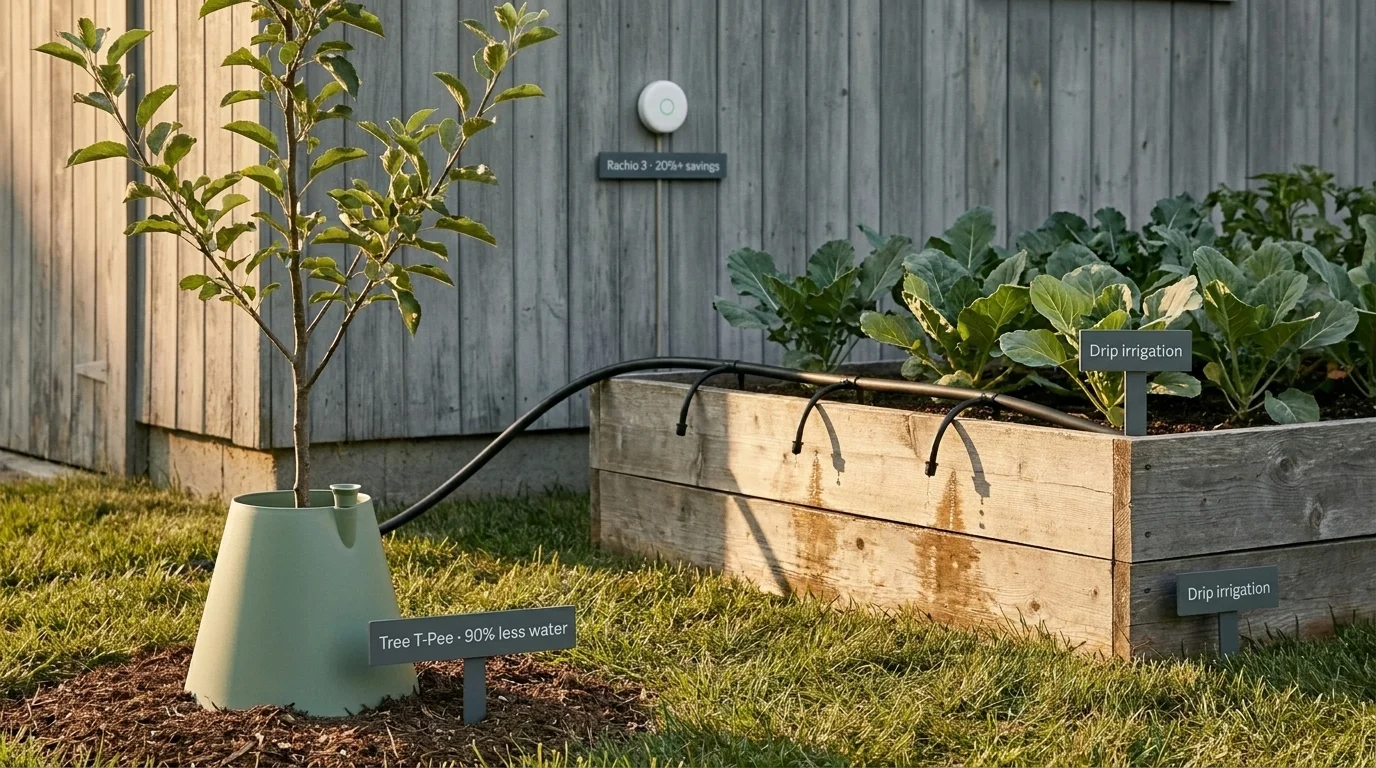
Rachio 3 smart irrigation controllers blend hyper-local weather data with per-zone soil telemetry to calculate the gallonage each bed actually needs that week. Independent reporting consistently shows users saving twenty per cent or more on landscape irrigation water compared to traditional time-based controllers. This is the highest-ROI smart-garden purchase a U.S. homeowner can make if their yard is already on an automatic irrigation system.
For young trees and shrubs, Tree T-Pee — a recycled-plastic water-and-nutrient containment cone placed around the base of a young tree — reports up to ninety per cent water reduction compared to open watering, plus a measurable frost-protection benefit. The cost is low, the technology is essentially passive, and the per-tree water savings compound across an orchard or a fruit-tree planting more than any sensor array I am aware of.
Inside the kitchen, Plantaform's egg-shaped fogponic system — around $500 for a fifteen-pod unit — uses thirty to fifty per cent less water than a comparable hydroponic system by atomising the nutrient solution into a fog rather than circulating it as liquid. The first consumer fogponic product to gain meaningful distribution, it is a useful reminder that the most water-efficient watering technique is not the one that delivers water more accurately but the one that wastes less of it to evaporation and overflow.
The principle that ties these three numbers together is hydrozoning — the xeriscape idea of grouping plants by water need rather than by visual layout. Every smart-irrigation product that delivers real water savings does so because it allows the gardener to act on hydrozoning per zone rather than treating the whole yard as a single irrigation block. The technology amplifies the principle; the principle does the work.
Loading image...
Every smart-irrigation product that delivers real water savings does so because it lets you hydrozone — group plants by water need, not by visual layout.
Soil sensors: the cheapest amplifier on the workbench
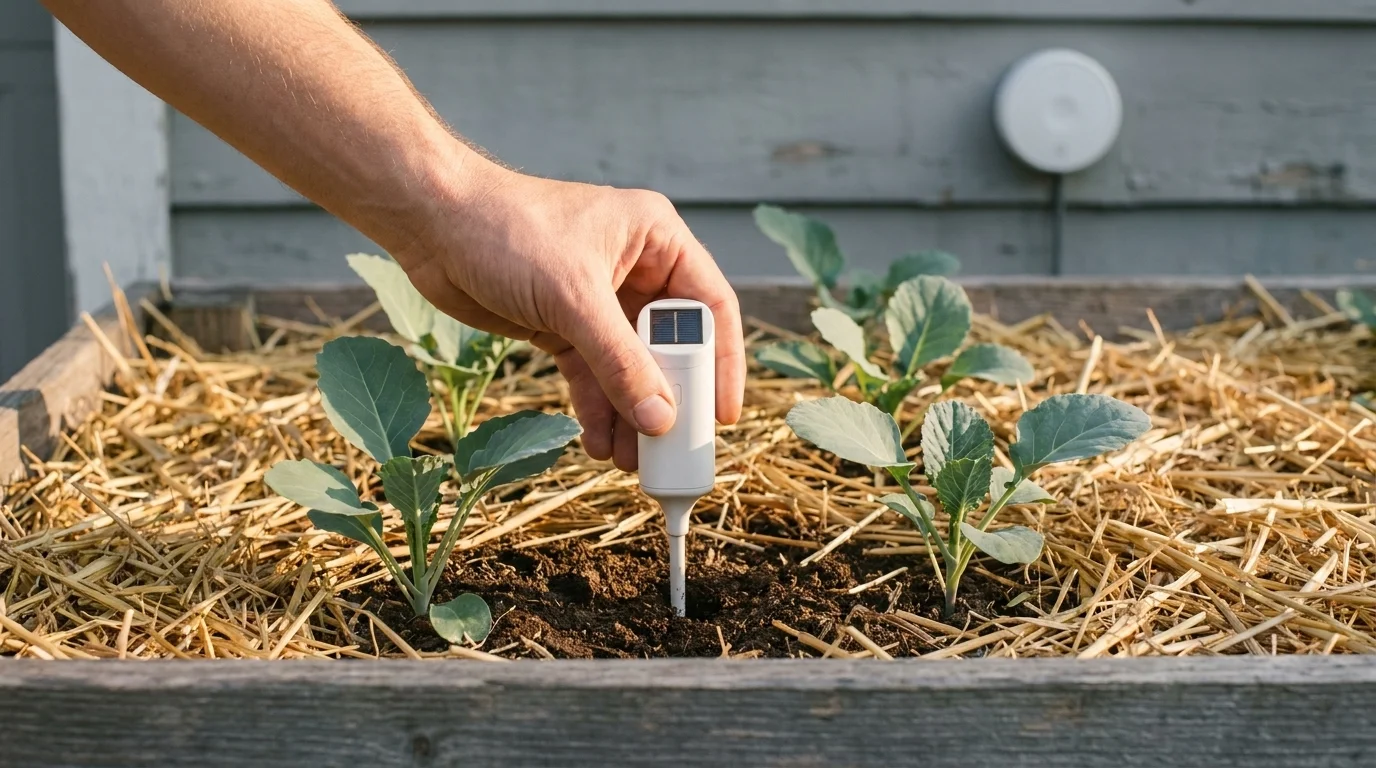
The cheapest meaningful piece of smart-garden technology a home gardener can buy in 2026 is a soil moisture sensor, and the entry price is much lower than the product roundups suggest. The Ecowitt WH51 wireless soil moisture sensor is fifteen to twenty dollars per unit, runs on 433 MHz radio with solar assistance (so it does not need its own WiFi connection), and pairs with a GW2000 hub at sixty to eighty dollars. The XLUX budget alternative came in at thirteen dollars as recently as April 2026. Either system gives a gardener per-bed soil-moisture telemetry that was institutional-grade five years ago.
The use case I keep returning to is the bed that you cannot easily see from the house — a vegetable patch behind a hedge, a far corner of a community plot, the strip beside a garage that never gets the attention the front border does. A ten-dollar soil sensor in that bed catches the early dry-out before the plants do, which is the bee-keeper's logic applied to vegetables: if you do not visit a hive every day, you put a scale under it.
What sensors do not do — and where the food-web part of this article reasserts itself — is tell you whether the leaves of the brassica row in the next bed are sheltering a small population of cabbage-white caterpillars that the neighbourhood paper wasps would, if left alone for another week, work on. Sensors amplify noticing; they do not replace it. The single best deployment is on the beds you visit least, while you continue to walk through the beds you visit most.
Robotics, vertical farming, and the rest of the toolkit
The robotics conversation has narrowed considerably in the home garden. Drones for plant monitoring remain commercial-agriculture territory — the imaging is genuinely useful at field scale, but a one-acre yard does not generate the imagery volume that justifies the equipment cost. Consumer-grade robot weeders are a different story. Tertill, a solar self-charging weeder small enough to live inside a raised bed, has settled into a real niche: it does not pull deep roots, but it does prevent any seedling under a certain height from becoming a weed, which keeps a vegetable bed essentially weed-free between plantings with no human input.
Robotic mowers have crossed an interesting line. MAMMOTION LUBA 3 AWD, released in 2025, combines 360-degree LiDAR, NetRTK GPS, and AI vision to deliver the first consumer mower that genuinely does not require a perimeter wire. The ecological question, however, is whether a closely mown lawn is worth optimising for; the food-web answer is that it is not, and the more interesting use of a robot mower is to maintain a no-mow May regime on the lawn while keeping a clean path around the borders.
Vertical farming for the home — the Click & Grow Smart Garden 25 and similar tower systems — answers a real question for apartment dwellers and small-space gardeners. The ecological cost is the same LED-electricity question as the smaller indoor units, scaled up; the ecological benefit is real food growing in a footprint smaller than a kitchen chair. For an urban gardener who does not have access to an outdoor bed, this is a serious tool.
What to do with this in 2026
The cadence for new smart-garden announcements concentrates at two points in the year: the Consumer Electronics Show in January and the Earth Day window in late April. Both produce a wave of product launches and incremental updates; both are sensible times to read a refreshed buyer's guide if you are deciding what to buy in the second half of the year.
For the gardener weighing all of this in May, the practical sequence is straightforward. If you have an outdoor irrigation system already wired, a Rachio 3 controller is the highest-ROI smart purchase in the catalogue — the twenty-per-cent water savings compound across the lawn and the borders. If you have young trees, a Tree T-Pee per sapling is a near-zero-tech, near-passive sustainability win. If you have a sunny indoor counter, a Click & Grow 9 PRO without a subscription is the lowest-friction entry to a smart garden. If you are budgeting for the AI experience and want the camera-and-vision part, Gardyn 4.0 is the only consumer product that delivers it, and the five-year cost should be on your spreadsheet before you click buy.
What none of these tools will do is notice the first Andrena bee in the willow catkins, or remember that the swamp milkweed in the rain garden is the only larval host the monarch caterpillars will accept, or pay attention to the way the late-afternoon light falls on the bed you forgot you planted. The future of gardening, as the original version of this piece named it, is not a list of products. It is the careful pairing of the practice you already do with the small handful of tools that genuinely amplify it. The rest is, in the gentlest possible terms, optional.
Loading image...
A fifteen-dollar soil sensor in the bed you cannot easily see catches the early dry-out before the plants do — bee-keeper logic for vegetables.
Consumer smart gardens range from around sixty dollars for budget twelve-pod LCD units to eight hundred and ninety-nine dollars upfront plus four hundred and eight dollars a year for the AI-monitored Gardyn 4.0. Mid-tier options like LetPot LPH-Max at around two hundred and fifty-two dollars and Click & Grow 9 PRO at two hundred and ninety-nine dollars sit in the sweet spot. The five-year ownership math is the more honest number: LetPot owners typically spend around three hundred dollars over five years with no subscription; a Gardyn 4.0 owner running the Kelby subscription for five years is closer to three thousand two hundred and forty dollars, a roughly tenfold spread inside a single product category.
How much water does smart garden technology save?
Smart irrigation controllers like Rachio 3 save twenty per cent or more compared to traditional time-based timers by blending hyper-local weather data with per-zone soil telemetry. Fogponic systems such as Plantaform use thirty to fifty per cent less water than a comparable hydroponic system by atomising the nutrient solution into a fog rather than circulating it as liquid. Tree T-Pee, a recycled-plastic water-containment cone placed around young trees, reports up to ninety per cent water reduction with a measurable frost-protection benefit. Drip irrigation eliminates most evaporation losses entirely, and the principle that ties all of these numbers together is hydrozoning — grouping plants by water need rather than by visual layout.
What happened to AeroGarden, and what should I buy instead?
Scotts Miracle-Gro discontinued AeroGarden in late 2024, ending pod restocking for the once-dominant indoor smart-garden brand. The replacement landscape sorted itself into three archetypes: budget WiFi systems like LetPot LPH-Max at around two hundred and fifty-two dollars, design-led European brands like Click & Grow 9 PRO at two hundred and ninety-nine dollars, and AI-monitored premium systems like Gardyn 4.0 at eight hundred and ninety-nine dollars plus an annual subscription. Most universal pod systems remain cross-brand compatible, with Click & Grow and Gardyn the two notable proprietary-pod exceptions.
VerdeNook is more than just a source of gardening wisdom; it’s a platform for sharing, learning, and growing together. We invite you to join our community, share your stories, and spread the joy of gardening. Let’s sow the seeds for a greener, healthier, and more sustainable future, one garden at a time.