We keep being sold the screen as if it were the soil. In 2026 a "virtual garden" means four different things — and none of them is a patch of ground you can dig.
A few years ago, around the height of the metaverse talk in 2021 and 2022, the phrase "virtual garden" was doing a great deal of work it could not really support. Interest in it spiked hard — by one search-trend measure it ran close to its ceiling in those two years — and then, just as quickly, it eroded back to a quiet baseline once the headsets came off and the hype moved on. I find that little rise and fall useful, because it is a tidy record of a recurring mistake: we keep being sold the screen as if it were the soil. So it is worth asking, plainly and without the brochure language, what a virtual garden actually is in 2026, what it can do for someone who likes to grow things, and — because the receipt always matters — what it costs.
The honest answer is that "virtual garden" now means four quite different things, and most of the confusion comes from treating them as one.
What a "virtual garden" actually means in 2026
There is no single product called a virtual garden, and any article that implies otherwise is selling you something. What exists, in practice, splits four ways: virtual-reality gardening games you play in a headset; a narrow professional use of VR for previewing a designed landscape; the real consumer design tools, which live on your phone as augmented-reality and AI apps; and virtual nature used for relaxation and mental wellbeing, which is a separate thing again. Each is real. None of them is a substitute for a spade, a season, and a patch of ground you are allowed to dig.
It is worth walking through them in turn, because the gap between what people imagine and what they can actually buy is the whole story here.
Loading image...
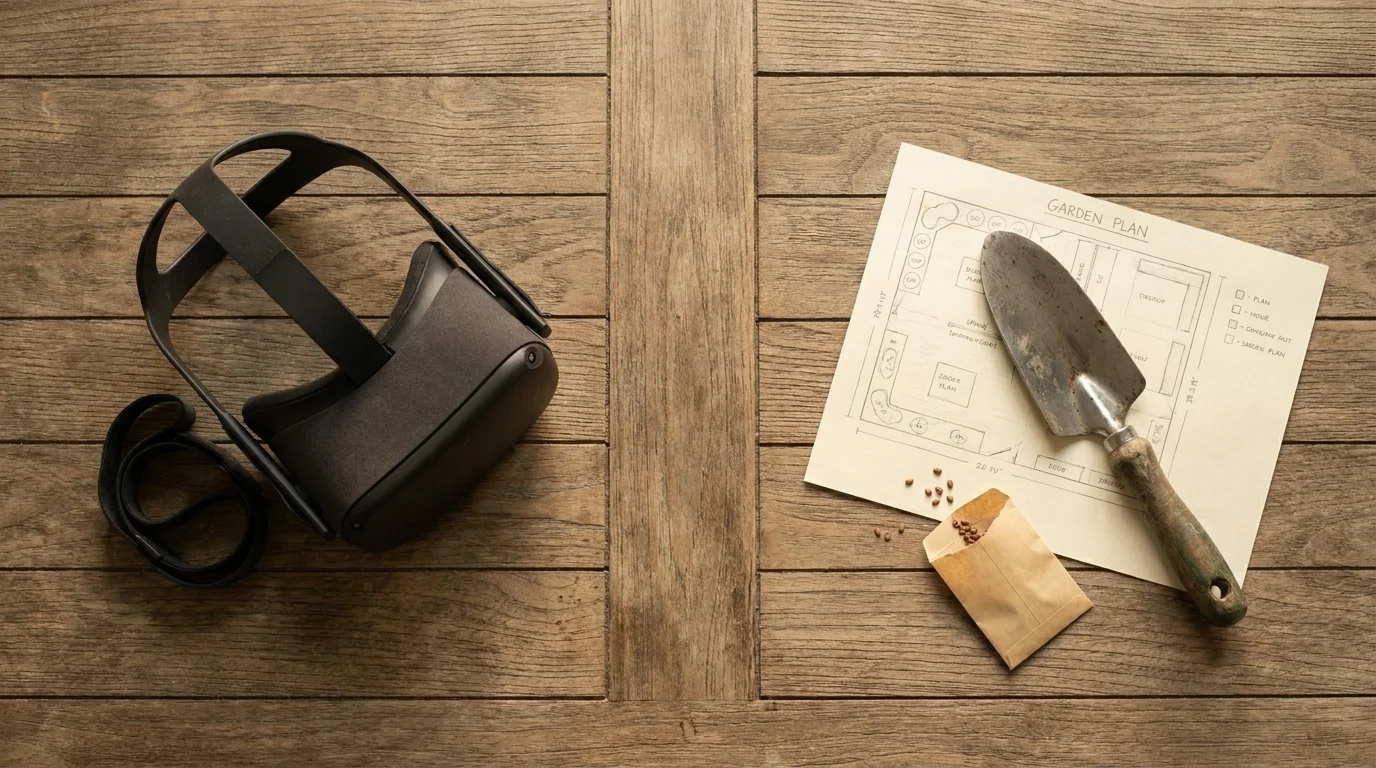
The gap between what people imagine a virtual garden is and what they can actually buy is the whole story — the headset on one side, the real planning on the other.
The VR gardens you can walk into are games
If you put on a headset expecting to design your back garden, you will instead find yourself in a leisure simulation — and there is nothing wrong with that, provided you know it going in. The actual VR-gardening titles in 2026 are entertainment: Garden of the Sea and Potioneer: The VR Gardening Simulator on the established stores, Bwah – Grows Offline on Meta Quest, and a newer arrival, Tend with Friends from Theory Studios, which launched for Meta Quest in early 2026 using mixed reality and hand-tracking so several people can tend the same virtual plot together. They are pleasant, often genuinely calming, and they are games. They will not tell you whether your real fence line gets enough sun.
The one legitimate exception sits at the professional end. SimLab's VR garden tool lets a designer or a client walk through a planned landscape before a single plant goes in — judging scale, materials, and the way light falls — and that is a real, useful application (SimLab). But it is a business tool for people who design gardens for a living, not the urban hobbyist's everyday kit. For everyone else, the useful technology turned out not to need a headset at all.
The real design tools live on your phone
The genuine shift since this topic was last worth writing about is not VR; it is the phone in your pocket. Two overlapping classes of app now do what the headsets promised. The first is augmented reality: iScape lets you stand in your own yard, point the camera, and drop individual plants and hard-landscaping elements onto a photo of the real space, with its plant library filterable by USDA hardiness zone and support for Apple's visionOS. It has somewhere around four million downloads and a 4.6-star rating, which tells you the demand was always for this, not for a simulated meadow (iScape).
The second class is newer and, frankly, the headline of the last two years: AI photo-to-design. As one 2026 roundup puts it, "AI tools that didn't exist two years ago now generate professional landscape designs from a single photo" (Gardenly). You photograph the yard, the app returns a photorealistic, climate-adapted redesign — Gardenly claims to do it in under thirty seconds. Alongside them sit the older, more capable design programs (Planner 5D, SketchUp, Realtime Landscaping Pro) and the plant-identification giants that feed the whole ecosystem — PlantNet, at 43 million downloads, and PictureThis, processing over a million identifications a day (Gardenly).
This is where the real search demand lives, too — people looking for a garden design app or a garden planner app, not a metaverse. So here, with the prices up front, is the honest comparison. iScape's own guidance is the right frame: "choosing the right tool depends on how you plan to use it rather than how many features it offers" (iScape).
Tool
Type
Free tier?
Paid price
Best for
iScape
AR (phone)
Yes
~$14.99/mo
Placing real plants onto a photo of your own yard
Gardenly
AI photo-to-design
Limited
~$4.50–$7/mo
A fast, photorealistic redesign from one photo
Remodel AI
AI photo-to-design
Limited
Subscription
AI restyling of an existing yard photo
Planner 5D
2D/3D design
Yes
Paid upgrade
Drag-and-drop layouts without a learning curve
SketchUp
3D modelling
Free (browser)
~$129–$819/yr
Detailed, dimensioned design work
Realtime Landscaping Pro
3D design
No
~$149–$599 one-time
A serious one-off purchase for keen amateurs
GrowVeg
Planting planner
Trial
~$29/yr
Planning a productive vegetable bed by season
(Prices are 2026 anchors drawn from the Gardenly roundup; free tiers and exact figures shift, so check before you subscribe.)
The pattern worth noticing is that the most useful tools are the cheapest, and the free tiers are real. If your aim is to picture a new border before you commit a weekend to digging it, a phone app you already own most of the hardware for will do it. Which brings us to the hardware, and the part of this conversation that the brochures tend to skip.
What the hardware actually costs
Here is the count, because it changes everything and it is the question everyone is too polite to ask first. The AR and AI design apps run on the phone you already carry — effectively no new hardware, a few dollars a month at most. A virtual-reality headset is a different order of commitment: a Meta Quest 3 or 3S sits at roughly $299, and an Apple Vision Pro at around $3,499. That is not a small gap. It is the difference between trying an idea on your lunch break and buying a device that costs more than a decent secondhand rotavator and most of a season's seed.
I labour the money deliberately, the way I do with the price of home-grown lettuce, because the spreadsheet is never the whole answer but it is always part of it. If the only thing you want is to plan a real garden, the headset is the wrong purchase. The headset earns its keep for something else entirely.
Loading image...
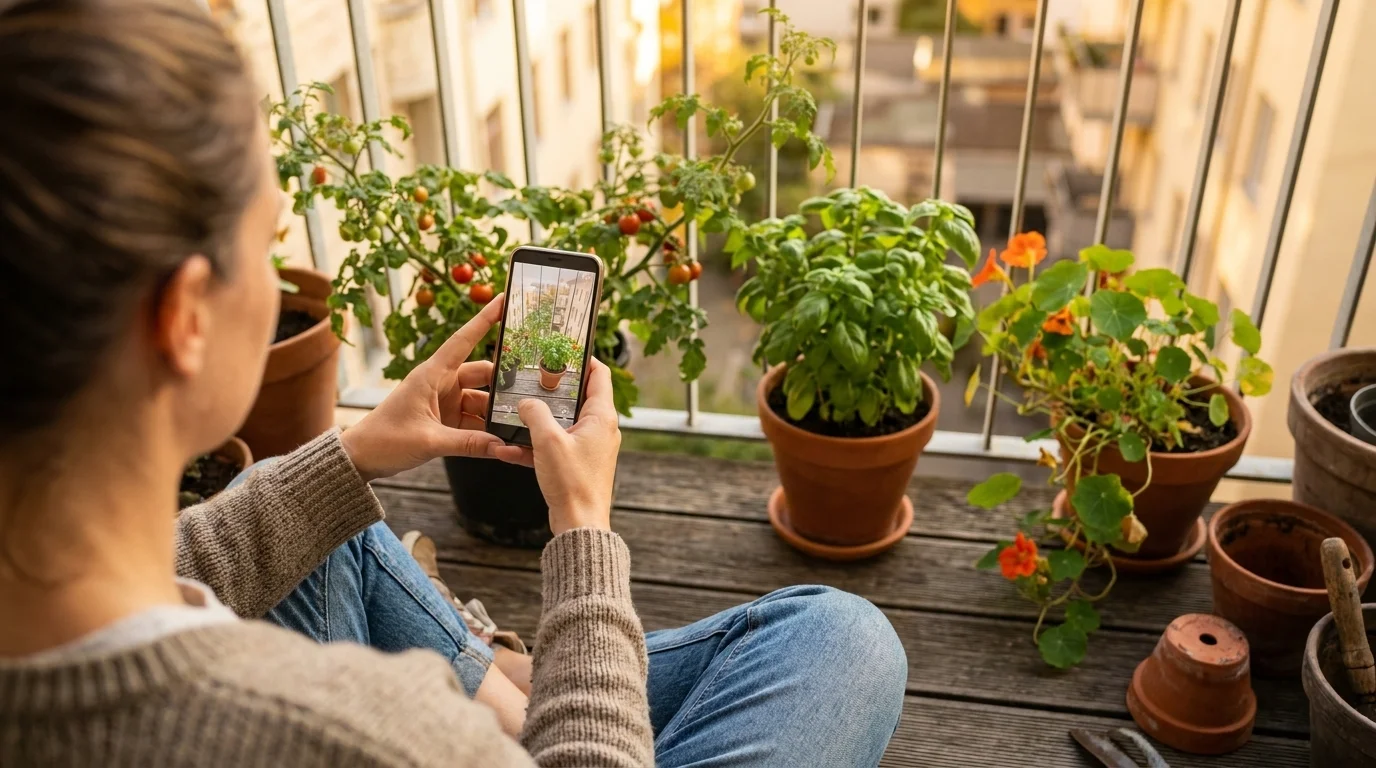
The useful tools turned out not to need a headset at all — they run on the phone in your pocket, for a few dollars and the hardware you already own.
Virtual nature, and the evidence on wellbeing
The original promise buried under all the product talk — that a screen can offer some of what a garden offers — turns out to be the one claim that has gained real support. Where it was once a soft gesture, there is now a body of peer-reviewed work. A 2025 meta-analysis in npj Digital Medicine found that VR nature reduced anxiety with a large effect, and stress and depression with moderate effects, in healthy adults (npj Digital Medicine). A 2026 pilot study reported statistically significant improvements in depression, anxiety, stress, and wellbeing among psychiatric inpatients after just four immersive VR sessions (Advances in Mental Health). And a 2025 study following 35 young adults through a four-week course of weekly fifteen-minute sessions — undersea, sky, forest, river — found it facilitated meaningful stress reduction, while being careful to note that virtual nature works "through mechanisms aligned with both ART and SRT, though with important modifications specific to the virtual context" (Finding Peace in Pixels, PMC).
Loading image...
A quarter-hour in a virtual forest can measurably settle a stressed mind — real relief when there is no balcony, though it complements the soil rather than replacing it.
I read that evidence as genuinely good news and as something to hold honestly. A quarter of an hour in a virtual forest can measurably settle a stressed mind, and for someone in a hospital bed or a flat with no balcony, that is not nothing — it may be a great deal. But it complements the real thing; it does not replace it. The studies measure relief, not the slow, particular satisfaction of having grown something. Those are different goods, and it does no one a service to pretend the second can be downloaded.
So what is a virtual garden good for?
Strip away the phantom products and the four meanings settle into plain advice. If you want to play, the VR sims are a calm and decent way to spend an evening. If you design gardens for clients, VR walkthroughs are a real professional tool. If you want to plan your own ground, the answer is a phone — an AR app like iScape or an AI photo-to-design app like Gardenly, for a few dollars and no new hardware. And if you are reaching for a screen because the real garden is, for now, out of reach, virtual nature can offer some sourced, measurable relief while you wait.
What none of it resolves is the older question I keep coming back to: who gets the ground in the first place. An app can show you a beautiful border in thirty seconds; it cannot give you the soil to dig it in, or the tenure to know you will still be there when it matures. The tools have got remarkably good at the planning. The plot itself — the time, the labour, the land — is still the part that does not appear on any screen, and still the part that matters most.
Mostly as entertainment simulations — Garden of the Sea, Potioneer, and Tend with Friends. Real garden design happens via phone AR and AI apps, while full VR design is a professional tool like SimLab, not a consumer product.
What is the best app to design my garden from a photo?
AI apps like Gardenly and Remodel AI turn a single photo of your yard into a photorealistic, climate-adapted redesign in under a minute, while iScape lets you place real plants onto a photo using augmented reality.
Is there a free app to design my garden?
Yes — iScape and Planner 5D have free tiers, and SketchUp offers a free browser version. They are enough to plan a border or layout before you commit to digging it.
Do I need a VR headset to plan a garden?
No. The useful design tools run on the phone you already own through augmented reality and AI. A VR headset (Meta Quest ~$299, Apple Vision Pro ~$3,499) is for games or professional walkthroughs, not everyday planning.
Can virtual nature actually reduce stress?
Peer-reviewed 2025–2026 studies find VR and virtual nature meaningfully reduce anxiety and stress, including among psychiatric inpatients. It complements real time outdoors rather than replacing it.
Can I visit famous gardens virtually?
Yes — VR experiences and 360-degree tours let you walk through recreated and real gardens worldwide, which is useful for inspiration and education even though it cannot tell you how a plant will grow in your own soil.
What is the difference between VR, AR, and AI garden apps?
VR immerses you in a fully virtual scene through a headset; AR overlays digital plants onto a live photo of your real yard through your phone; AI design apps generate a finished redesign from a single photo. For planning a real garden, AR and AI are the practical choices.
Who benefits most from virtual garden tools?
Apartment and small-space gardeners planning a layout, hobbyists visualising changes before they dig, professionals presenting designs to clients, and anyone using virtual nature for relaxation when a real garden is out of reach.
The Future of Gardening: Predicting Sustainable Innovations and Green Technologies
Join
Loading...
Our Green Community!
Loading...
VerdeNook is more than just a source of gardening wisdom; it’s a platform for sharing, learning, and growing together. We invite you to join our community, share your stories, and spread the joy of gardening. Let’s sow the seeds for a greener, healthier, and more sustainable future, one garden at a time.