The Sustainable Revolution: Embracing Eco-Friendly Practices in Home Gardening
Share this article:
Roughly 70 per cent of native bees nest in the ground. Leave one south-facing patch of bare soil unmulched and they will find it.
The first bee I see every year is not a honeybee. It is a small, dark, ground-nesting Andrena, emerging from a south-facing patch of bare soil by my compost bin in the last week of March, working the willow catkins before most gardeners have picked up a trowel. That bee is the test of whether a garden is sustainable in any meaningful sense — not whether it looks neat in May, not whether it produces more salad than it costs in water, but whether the small organisms that keep the system running are still present and busy.
Sustainable gardening, in the workable sense of the term, is the practice of growing plants on a piece of land in a way that adds to the ecology of the place rather than subtracts from it. That means conserving water rather than treating it as free, building soil structure rather than buying it in bags every year, choosing plants the local pollinators have evolved alongside, and accepting a slightly less tidy aesthetic in exchange for a slightly more alive one. This guide is the practical version of that argument — what to do, how much it costs, what the numbers say, and where each move actually moves the needle.
What is sustainable gardening?
Sustainable gardening is the practice of growing plants in ways that conserve water, build soil health, support local biodiversity, and avoid synthetic chemical inputs — so the garden gives back to the environment instead of taking from it. In practice that breaks into five repeating moves: water conservation, organic soil-building (composting, sheet mulching, no-till), native and drought-tolerant plant selection, organic pest and fertility management, and ecological design (food forests, rain gardens, leaf-litter habitat).
Three related terms are often used interchangeably but mean different things:
Organic gardening is the negative definition — no synthetic chemicals.
Sustainable gardening is the resource-light, ecologically neutral definition.
Regenerative gardening is the active-positive definition — practices that rebuild soil, capture carbon, and increase biodiversity year over year, not just hold steady.
Most home gardens that aim sustainable end up regenerative by accident — composting, no-till, native planting all do regenerative work whether you label them that way or not.
Why sustainable gardening matters in 2026
Three numbers explain why this topic is rising as fast as it is.
Water.Outdoor irrigation accounts for roughly 30 per cent of US household water use, and in dry climates that rises to 60 per cent — up to 70 per cent in the driest regions. Across the country, residential landscape irrigation consumes nearly 9 billion gallons of water per day. And as much as 50 per cent of that water is wasted — lost to evaporation, wind, runoff, and broken or mistimed sprinkler systems. Sustainable gardening is, at the household scale, the single biggest lever a homeowner has on residential water consumption.
Carbon. Food scraps that go to landfill instead of a compost heap decompose anaerobically and release methane, which traps about 28 times more heat per unit mass than carbon dioxide (University of Maryland Extension). Diverting the kitchen scraps from a single household to a compost bin is a measurable climate action, not a symbolic one.
Biodiversity. UMD Extension's current research-backed recommendation is that at least 70 per cent of plants in a residential landscape be native if the garden is to meaningfully support local pollinator and bird populations. That is the threshold; below it, the food web is too thin to hold. Above it, the bumble bees come back, the song sparrows nest, the Andrena find their patch of bare earth. This is the number to remember.
Add to that a 2026 trend line — search volume for "sustainable gardening" is up roughly 60 per cent year-over-year and 310 per cent quarter-over-quarter, with the March 2026 peak more than twice the 2024 baseline — and the topic is moving from the niche to the centre of the conversation. The garden is one of the few sites where ordinary people can make a non-symbolic environmental difference.
Sustainable gardening for beginners: a starter checklist
If you have a free weekend and a $200 budget, five moves get you most of the way to a sustainable garden. None of them requires you to dig up your existing beds.
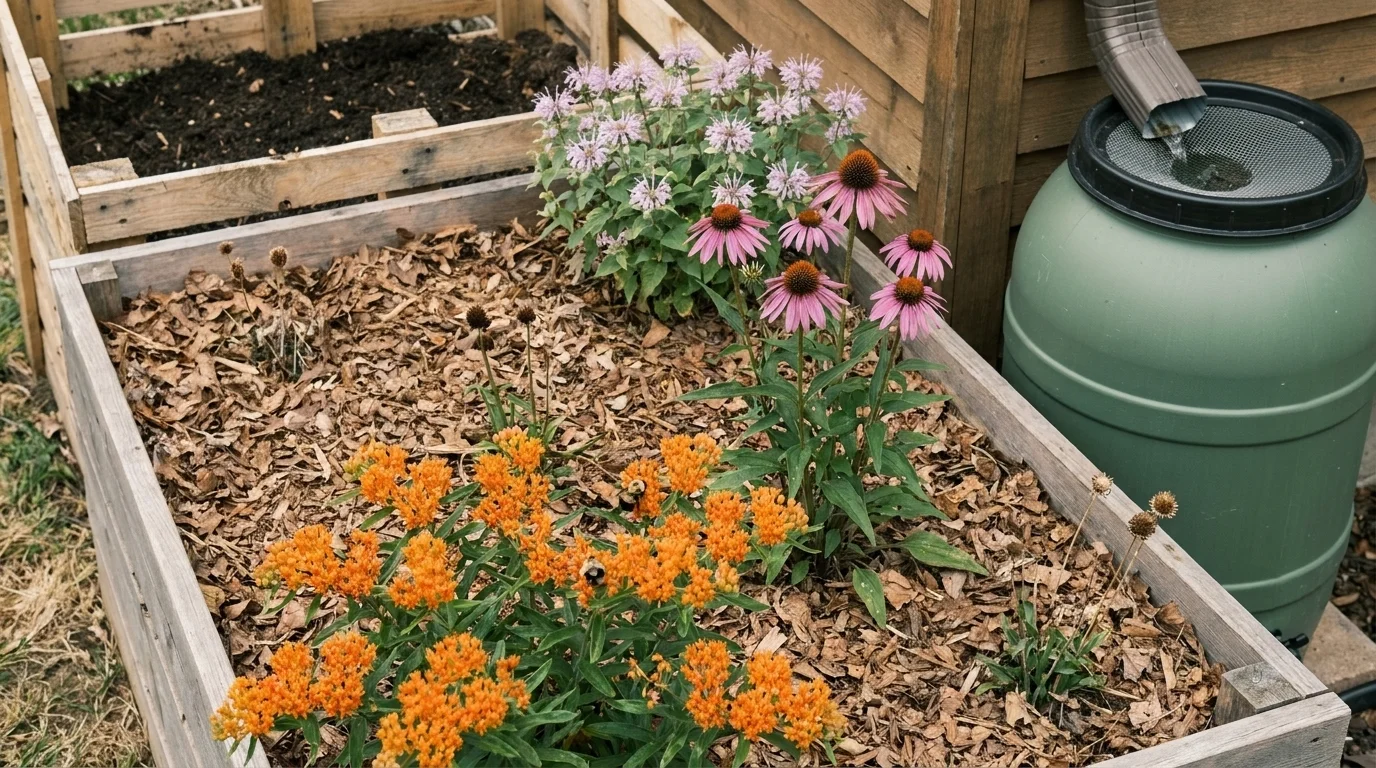
Mulch every bed to 2–3 inches. Shredded leaves, bark chips, or arborist wood chips (often free from local tree services). Mulch retains soil moisture, suppresses weeds, and feeds the soil food web as it breaks down. Cost: $0–$30 if you scavenge.
Start a compost bin. Any kind. A pallet enclosure, a tumbler, a worm bin in the apartment kitchen — the form is much less important than starting. Cost: $0–$120.
Install one rain barrel under a downspout. A standard 50-gallon rain barrel costs $80–$150 and captures enough roof runoff in a single rainstorm to water a 4×8 ft bed for a week. Cost: $80–$150.
Plant three native, drought-tolerant species for your USDA zone. From a local native-plant nursery, not the big-box store — and not from any source that cannot confirm the plants are free of neonicotinoid pesticide treatments. Cost: $30–$60.
Swap one synthetic product for an organic equivalent. Whichever bottle you reach for most — chemical fertiliser, broad-spectrum pesticide, weed-and-feed lawn product — replace it with a compost top-dress, an OMRI-listed insecticidal soap, or simply hand-pulling for a season. Cost: $10–$30.
That is a sustainable garden in one weekend, under $200. Everything else in this guide is depth on top of that foundation.
Loading image...
A weekend, two hundred dollars, and five moves: mulch the beds, start the compost, hang the rain barrel, plant three natives, drop one synthetic.
Water conservation gardening: where your water actually goes
The water section in most sustainable-gardening guides reads "use drip irrigation, mulch your beds." That is correct and inadequate. Here is the longer version.
Drip irrigation, not sprinklers
Sprinklers throw water through the air, where it is subject to evaporation and wind drift. A drip line delivers water at the root zone with almost no loss. A basic 100 ft drip kit with emitters at every plant runs $35–$60 and pays back in water savings within a season for any bed bigger than four square feet.
Mulch the soil surface
Two to three inches of organic mulch reduces soil-surface evaporation by 25–50 per cent depending on conditions, suppresses weeds, moderates soil temperature, and slowly builds organic matter. Apply once a year and replenish as it breaks down. The most useful mulches are shredded leaves (free, abundant, ecologically active) and arborist wood chips (free from local tree-service crews, longer-lasting, perfect for paths and around shrubs).
Smart irrigation controllers
A clock-based sprinkler runs whether it rained or not. A WaterSense-labeled smart irrigation controller uses local weather and soil-moisture data to skip cycles that don't need to happen. The EPA reports that a smart controller saves an average home up to 15,000 gallons per year — about a 30 per cent reduction in irrigation water use. Setup cost: $150–$300. Payback period in most US climates: one to two seasons on a water bill alone.
Rain gardens and rainwater harvesting
A rain garden is a shallow depression planted with deep-rooted species that captures roof and lawn runoff and lets it soak into the soil rather than running off the property. A rain barrel is a 50-gallon container that catches roof runoff for re-use. Both are 2026-trend moves — rainwater capture is now treated as integrated water management, not as a niche, in the better sustainable-design literature. A rain barrel costs $80–$150 and pays for itself in water bills within a year on most roofs.
Xeriscaping for arid climates
In zones where summer rainfall is genuinely scarce, xeriscaping — replacing turf and high-water ornamentals with low-water natives, succulents, and drought-tolerant Mediterranean plants — is the single highest-leverage sustainable-gardening move available. A converted xeriscape lawn can use a tenth of the water of the turf it replaced.
Regenerative gardening: five practices that rebuild the soil
Regenerative gardening is the active-positive cousin of sustainable gardening. Its core question is not "did I avoid harm?" but "did I leave the soil better than I found it?" Five practices do most of the work, and a home gardener can adopt all five in a single season.
1. No-till + sheet mulching
Tilling destroys soil structure, breaks the fungal hyphae that took a season to establish, and releases stored carbon into the atmosphere. The 2026 regenerative replacement is sheet mulching: layer cardboard or thick newspaper directly on top of the existing soil or lawn, cover with 4–6 inches of compost, then top with 2–3 inches of mulch. Plant directly into the compost. The cardboard suppresses what was below, the compost builds new soil, and the structure of the existing soil is preserved. UMN Extension names sheet mulching as the regenerative method most home gardeners can adopt this spring.
2. Hot or vermi composting (not just a pile in the corner)
A hot compost pile that is turned weekly produces finished compost in 4 to 8 weeks. A cold pile takes 6 to 12 months. A worm bin (vermicompost) runs year-round indoors, even in apartments, and produces some of the highest-quality compost available. Whichever method you choose, the methane math above makes this the highest-ROI climate action a home gardener can take.
3. Cover crops over winter
Bare soil over winter is soil eroding into the storm drain. A cover crop — winter rye, crimson clover, hairy vetch — planted in September or October holds the soil, fixes nitrogen, and is cut and dropped in spring to feed the next season's planting.
4. Carbon-rich amendments
Biochar, well-finished compost, and partially decomposed wood chips all add stable organic carbon to the soil profile, where it stays for years. This is genuine carbon sequestration at the household scale — modest, but cumulative and durable.
5. Living edges and unmulched bare-soil patches
Roughly 70 per cent of native bees are ground-nesting. They cannot dig through three inches of shredded hardwood. Leave at least one south-facing patch of unmulched bare earth in any garden that wants to support ground-nesting pollinators. It is not untidy; it is habitat. Hand-pull anything that surfaces that you don't want; do not bury the patch.
Native and drought-tolerant plants by USDA zone
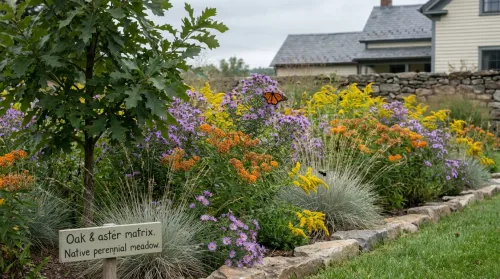
The "70 per cent native" rule is the single most important plant-selection guideline in this guide. The table below lists eight reliable native and drought-tolerant species across USDA zones 4–10, drawn from the consensus across regional cooperative-extension recommendations.
Plant
Botanical name
Hardiness
Sun
Role
Wild bergamot / bee balm
Monarda fistulosa
USDA 3–9
Full sun
Pollinator magnet, hummingbird draw
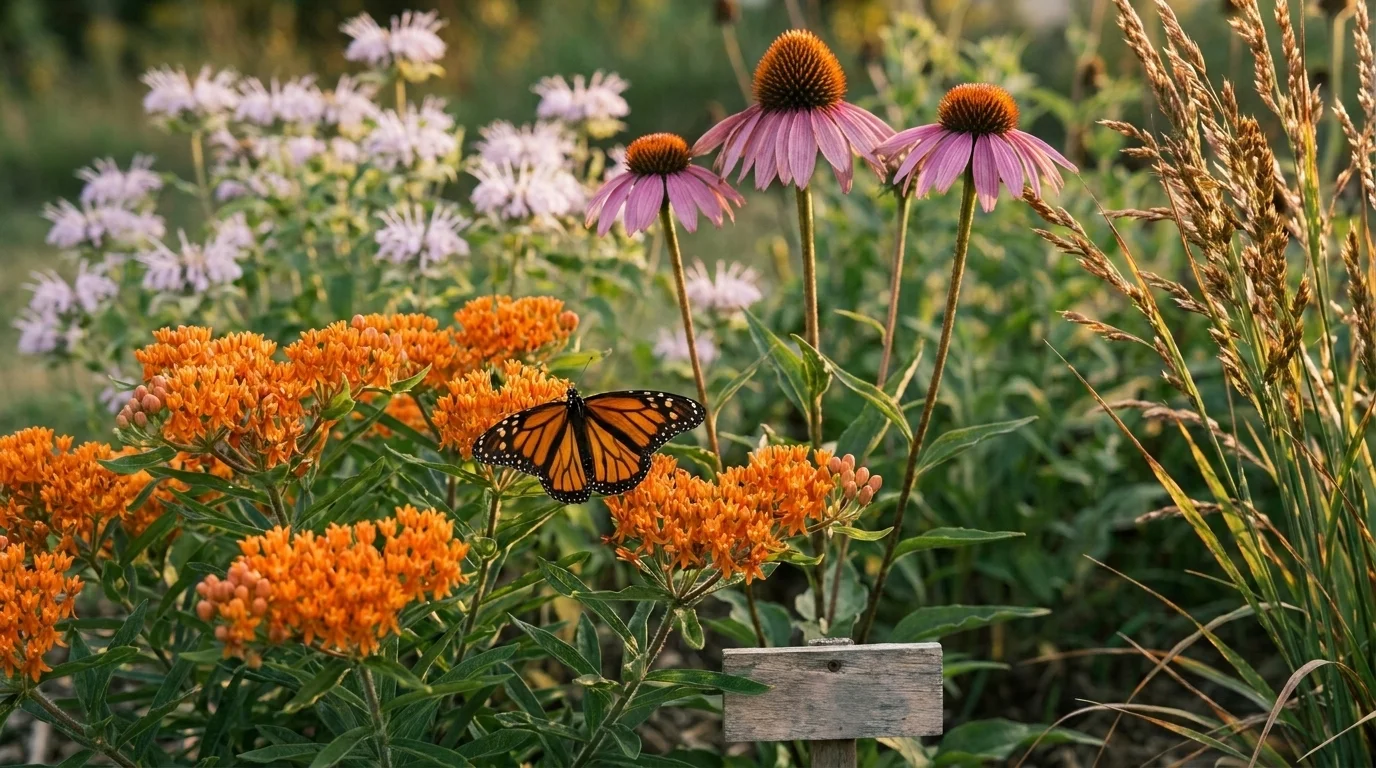
Butterfly milkweed
Asclepias tuberosa
USDA 3–9
Full sun
Larval host for monarchs
Purple coneflower
Echinacea purpurea
USDA 3–8
Full sun
Long bloom, seed-head winter food
Black-eyed Susan
Rudbeckia hirta
USDA 3–7
Full sun
Drought-tolerant, easy beginner
New England aster
Symphyotrichum novae-angliae
USDA 4–8
Full sun
Late-season pollinator nectar
Prairie blazing star
Liatris pycnostachya
USDA 3–8
Full sun
Bee + butterfly magnet, vertical structure
Switchgrass
Panicum virgatum
USDA 5–9
Full to part sun
Native grass, bird seed, structure
Penstemon (regionally appropriate species)
Penstemon spp.
USDA 3–9
Full sun
Drought-tolerant, dry-zone star
Note that the 2023 USDA Plant Hardiness Zone Map shifted most of the United States half a zone warmer than the 2012 map. Drought-tolerant species are now reliable a half-zone farther north than they used to be — check your current zone at planthardiness.ars.usda.gov before committing to a perennial.
Source the plants from local native-plant nurseries, not big-box garden centres. Local-ecotype seed and nursery stock matter — a Lurie Garden Echinacea from an Illinois seed house is not the same plant as a Hudson Valley ecotype from a regional nursery, and the pollinators that have co-evolved with the local genetics know the difference. And under no circumstances bring home a plant that was treated with a neonicotinoid pesticide — the residue in pollen and nectar persists for years and is implicated in the population declines the Xerces Society documented across North American bumble bee species over the past two decades.
Loading image...
Monarchs develop only on Asclepias. A "pollinator mix" packet is not the same plant, and the butterfly knows.
A small food forest is the entry point to permaculture
Permaculture in its full form is a design philosophy more than a gardening technique, and a beginner can easily get lost in the vocabulary (zones, sectors, guilds, swales). The most accessible doorway is the food forest — a small, multi-layer planting of perennial edible species that mimics a forest's structure.
A 25 sq ft starter food forest in a sunny corner of a back garden:
Canopy (one): a semi-dwarf apple or pear tree.
Understorey (two): a serviceberry (Amelanchier) and a hazelnut shrub.
Herbaceous / ground (three or four): comfrey, strawberry, chives, and a clump of mint in a sunken pot.
Plant the tree first, the shrubs in year two, the herbaceous layer in year two or three. The whole system reaches maturity in five to seven years and produces fruit, nuts, herbs, and ground cover from a footprint smaller than a parking space. This is the dominant 2026 trend in the sustainability-forward gardening press, and it is not as theoretical as the permaculture textbooks make it sound.
Composting at home: hot, cold, and vermi compared
A short reference. The methane math (food waste in landfill produces about 28× the climate impact of the same waste composted) makes this the highest-leverage single move most households can make.
Method
Time to finished compost
Effort
Where it fits
Cold pile
6–12 months
Very low
Backyard space, low priority on speed
Hot pile (turned)
4–8 weeks
Medium
Backyard space, want fresh compost fast
Tumbler
6–10 weeks
Low–medium
Small yards, suburban, smell-conscious
Worm bin (vermicompost)
2–3 months
Low
Apartments, indoor, year-round
The ratio that matters in any of them: roughly three parts browns (dried leaves, straw, shredded paper) to one part greens (kitchen scraps, grass clippings) by volume, which targets a carbon-to-nitrogen ratio of around 25:1 to 30:1 by weight — the band in which compost microbes work efficiently without going sour.
Cost and effort matrix
A practical comparison of the seven highest-impact sustainable practices. Costs are 2026 USD; weekly effort is once the system is in place.
Practice
Setup cost
Weekly effort
Annual savings / impact
Mulching beds
$0–$30
10 min
25–50% less surface evaporation; weed suppression
Backyard compost bin
$0–$120
15 min
Diverts ~250 lb of kitchen + yard waste; methane offset
Worm bin (indoor)
$30–$80
5 min
Year-round composting; high-quality compost
Rain barrel (50 gal)
$80–$150
5 min
800–2,000 gallons captured/yr depending on roof + rainfall
Drip irrigation kit
$35–$60
5 min
30–60% less water vs sprinkler
Smart irrigation controller
$150–$300
0 min (automatic)
Up to 15,000 gal/yr (≈30% of irrigation use)
Convert 100 sq ft turf → natives
$80–$200
Less, after year 2
70% less water; pollinator support
The cheapest move is mulch. The highest-impact move is the compost bin. The biggest water-saver is the smart irrigation controller. The longest-term move is the native-plant conversion. Done in this order, the cumulative effect on the garden and the water bill is what convinces neighbours.
A closing note on the food web
This guide has been about practices and numbers, which is what readers came for, but the underlying argument is ecological. A sustainable garden is one in which the Andrena still finds her patch of bare soil in March, the swallowtail caterpillar finds the larval host plant in May, the luna moth's cocoon overwinters in the rolled oak leaves in December, and the song sparrow finds the seeds and the nesting material the garden produces for free. None of that survives without the gardener's deliberate restraint — leaving the leaves in the back of the borders, naming which pollinators a planting actually serves, sourcing seed locally, refusing the neonic-treated plant.
This weekend, if you do one thing: leave a south-facing patch of bare soil somewhere in your garden, three feet by three feet, and don't mulch it. By the time the serviceberry flowers next spring, the mining bees will be working it. You will have built a garden the food web can use.
Sustainable gardening is the practice of growing plants in ways that conserve water, build soil health, support local biodiversity, and avoid synthetic chemicals — so the garden gives back to the environment instead of taking from it.
Why is sustainable gardening important in 2026?
It tackles two of the biggest household-scale environmental impacts at once: outdoor irrigation (up to 60% of home water use in dry regions, per the EPA) and organic waste (food scraps in landfills release methane, a greenhouse gas roughly 28 times more potent than CO₂ per unit mass, per UMD Extension). A sustainable garden cuts both while supporting pollinators whose populations have declined sharply over the last decade.
How do I start sustainable gardening as a beginner?
Start with five low-cost moves: (1) mulch every bed to 2–3 inches, (2) start a compost bin (any kind), (3) install one rain barrel under a downspout, (4) plant three native, drought-tolerant species for your USDA zone from a local nursery that does not use neonicotinoid-treated stock, and (5) swap one synthetic product for an organic equivalent. All five fit into a single weekend for under $200.
How much water can sustainable gardening save?
A lot. Replacing a clock-based sprinkler with a WaterSense-labeled smart irrigation controller saves an average home up to 15,000 gallons per year (about 30% of irrigation water). Adding mulch, drip lines, and drought-tolerant natives on top can cut outdoor water use by 50–70% in dry climates.
What's the difference between sustainable, organic, and regenerative gardening?
Organic means no synthetic chemicals. Sustainable means resource-light and ecologically neutral. Regenerative goes one step further — it actively rebuilds soil, captures carbon, and increases biodiversity year over year. Most home gardens that aim sustainable end up doing some regenerative practices (composting, no-till, native planting) by default.
How many native plants should be in a sustainable garden?
University of Maryland Extension recommends a minimum of 70% native plants in residential landscapes to meaningfully support local pollinators and birds. The remaining 30% can be non-invasive ornamentals or food crops chosen for your climate.
What's the cheapest sustainable gardening practice to start with?
Composting. A backyard pile costs $0, a tumbler $60–$120, and a worm bin $30–$80. It diverts food waste from landfills (preventing methane emissions), produces free fertilizer, and improves soil structure — no other practice has that ROI profile.
Landscaping with Natives: Designing Gardens to Celebrate Local Flora and Fauna
Join
Loading...
Our Green Community!
Loading...
VerdeNook is more than just a source of gardening wisdom; it’s a platform for sharing, learning, and growing together. We invite you to join our community, share your stories, and spread the joy of gardening. Let’s sow the seeds for a greener, healthier, and more sustainable future, one garden at a time.