The Rise of Indoor Gardening: Bringing the Outdoors Inside
Share this article:
Indoor gardening rewards patience and accurate observation in the same way an outdoor border does. The difference is that the food web is missing.
The Tradescantia zebrina on my kitchen windowsill is a runaway from the cutting garden — a slip a friend pulled off a roadside planter in Brooklyn three years ago, rooted in a glass of water, now twelve feet of trailing stripes across two sashes and a curtain rod. It is also, gently and quietly, the most reliable performer in my house. Indoor gardening rewards patience and accurate observation in the same way an outdoor border does; the difference is that the food web is missing and the ground is in a pot.
This guide is for the reader who has either killed enough houseplants to want a more systematic approach, or has never owned one and would like to start without immediately killing it. Indoor gardening — defined here as growing plants indoors year-round, whether for foliage, herbs, microgreens, or a single trailing pothos in a low-light hallway — is the most accessible entry into horticulture: low overhead, no zone constraints, and an honest, immediate feedback loop on whether what you are doing is working.
A note before we begin. Indoor plants are an ecologically tame substitute for outdoor gardening. They look beautiful and they do measurable work on the people in the room, but they do almost nothing for the pollinators, the soil food web, or the ecology of the place you live. If you have outdoor space, an indoor windowsill of houseplants is a complement to a small patch of native planting outside, not a replacement. With that framing in place, on to the practical part.
How to start an indoor garden in 30 days
A workable four-week onramp. Each week is one decision.
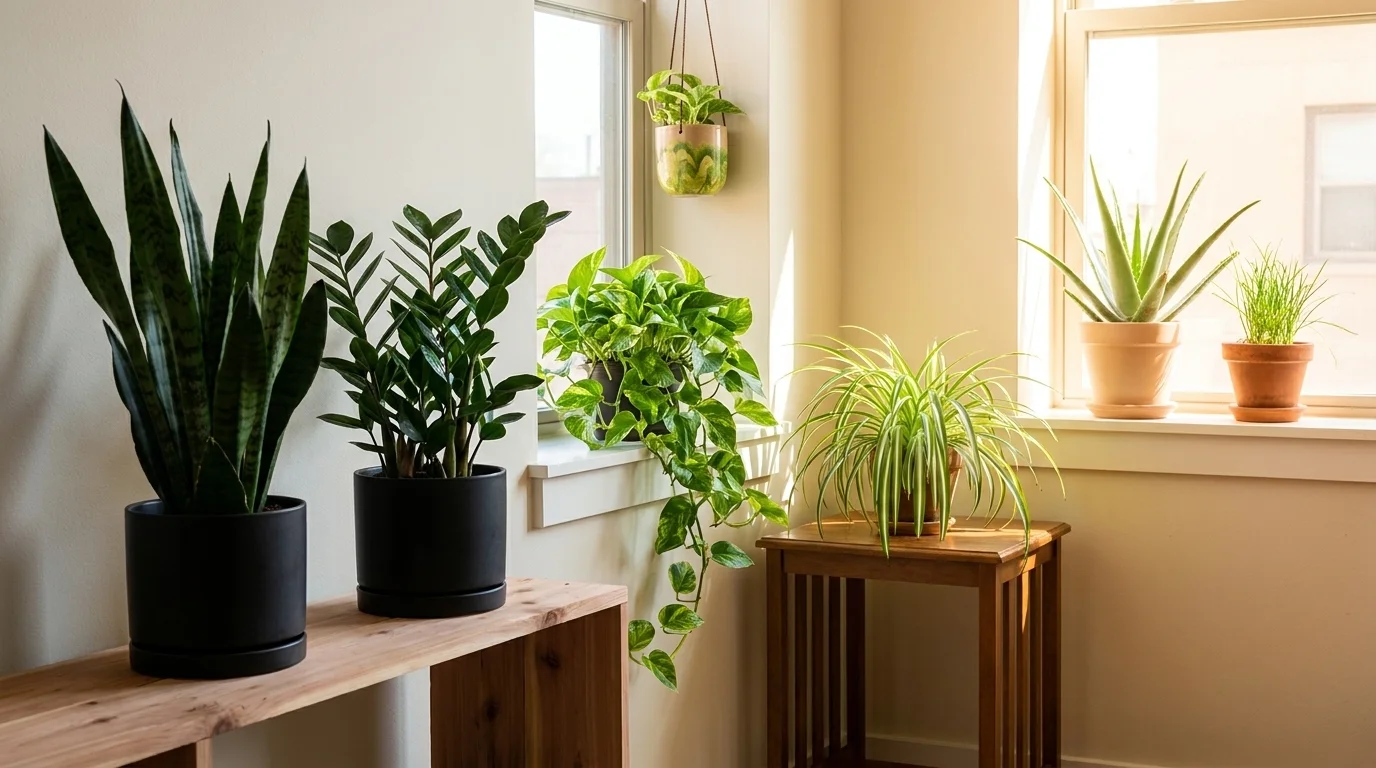
Week 1 — Choose one plant. Walk into a local nursery (not a big-box garden centre — local stores are far less likely to sell neonicotinoid-treated stock). Pick one plant from the Light × Care matrix below that matches your sunniest window. Snake plant, pothos, ZZ plant, spider plant, or cast iron plant are the five most forgiving starters and will tolerate the mistakes you are about to make.
Week 2 — Audit the light. Stand at each window in the room at 10 a.m., noon, and 2 p.m. Note where direct sun falls (bright shaft moves across the floor), where bright indirect sits (reads as bright but no shaft), and where the light is low (you can read but the page is dim). Most indoor-plant deaths trace to a plant being put in light it cannot use.
Week 3 — Watering check-in. Push your finger into the soil to the second knuckle. If the soil at that depth feels cool and damp, do not water. If it feels dry, water until you see a trickle from the drainage hole. Repeat the check every five to seven days for hardy plants, more often for tropicals. Most indoor gardens are killed by overwatering, not underwatering — the watering test is the single most valuable skill in this guide.
Week 4 — First feeding. Most new plants come with enough fertiliser in the soil for four to six weeks. Once you have run through that window, a diluted liquid fertiliser at half the bottle's recommended strength every two to four weeks during the growing season (March through September) is the most common protocol. Less is reliably better than more.
If you make it through the first thirty days, you have learned more from the plant than any guide can teach you. The second plant is a much smaller leap than the first.
What are the best indoor plants for low light, medium light, and bright light?
The matrix below is the single most useful asset in an indoor garden. It captures fifteen forgiving starter plants by light tier, watering frequency, humidity preference, and pet-safety status (the ASPCA classification matters for households with cats and dogs). Where I have noted a plant is toxic, please take that seriously — the consequences for a cat are not theoretical.
Plant
Light needed
Watering
Humidity
Pet-safe? (ASPCA)
Difficulty
Snake plant (Sansevieria)
Low to bright indirect
Every 2–4 weeks
30–60%
Toxic to cats/dogs
Beginner
ZZ plant (Zamioculcas zamiifolia)
Low to bright indirect
Every 2–4 weeks
30–60%
Toxic
Beginner
Pothos (Epipremnum aureum)
Low to bright indirect
Weekly
40–60%
Toxic
Beginner
Cast iron plant (Aspidistra elatior)
Low to medium indirect
Every 2–3 weeks
30–50%
Pet-safe
Beginner
Spider plant (Chlorophytum comosum)
Medium to bright indirect
Weekly
40–60%
Pet-safe
Beginner
Parlor palm (Chamaedorea elegans)
Medium indirect
Weekly
50–60%
Pet-safe
Beginner
Peace lily (Spathiphyllum)
Low to medium indirect
Weekly
50–60%
Toxic
Beginner
Heartleaf philodendron
Low to bright indirect
Weekly
40–60%
Toxic
Beginner
Monstera deliciosa
Bright indirect (no direct)
Weekly
50–60%
Toxic
Easy
Calathea (e.g., C. orbifolia)
Medium indirect
Twice weekly
60–70%
Pet-safe
Intermediate
African violet (Saintpaulia)
Bright indirect
Weekly, from below
40–60%
Pet-safe
Intermediate
English ivy (Hedera helix)
Medium to bright indirect
Weekly
40–60%
Toxic
Intermediate
Aloe vera
Bright direct (south window)
Every 2–3 weeks
30–50%
Toxic
Beginner
Bamboo palm (Chamaedorea seifrizii)
Medium indirect
Weekly
50–60%
Pet-safe
Beginner
Boston fern (Nephrolepis exaltata)
Bright indirect
Twice weekly
60–80%
Pet-safe
Intermediate
A few cautions the table cannot capture. Calathea, Boston fern, and African violet all want consistent humidity above 50 per cent, which the average heated apartment in winter does not provide. They are not beginner plants in a dry house; they are intermediate plants the first time you commit to running a small humidifier. The cast iron, snake, and ZZ are the plants you can take to a friend's place for a fortnight and come home to find still standing.
Loading image...
Most indoor plants do not die from neglect; they die from being put in light they cannot use. Match the plant to the window before the watering can.
Do indoor plants really purify the air?
This is the question that determines whether a houseplant article can be trusted, and it deserves a careful answer.
The canonical citation is the NASA Clean Air Study conducted by B. C. Wolverton and colleagues in 1989, which tested twelve common houseplants — including peace lily, snake plant, English ivy, spider plant, and bamboo palm — for their ability to remove benzene, formaldehyde, and trichloroethylene from sealed chambers (NASA NTRS, Interior Landscape Plants for Indoor Air Pollution Abatement; summarised on Wikipedia). The original results were genuinely encouraging in a chamber, and the study has been cited millions of times since.
The honest 2026 framing is more careful. As the American Lung Association summarises the follow-up research, the chamber results do not translate well to a real home. To match Wolverton's VOC-removal rates in a 1,500-square-foot home, you would need roughly 680 plants, packed at a density no household will achieve. In practical use, natural ventilation (opening a window) does the vast majority of the actual VOC removal that takes place in a typical living space.
This is not a reason to throw out the houseplants. Plants do contribute modestly to air humidity, measurably to perceived air quality, and substantially to the psychological and physiological responses we associate with the presence of greenery indoors. They do not, despite decades of marketing, replace ventilation. A reasonable position: keep the plants because they are beautiful and they have well-documented effects on stress and mood, and open the window because that is what actually clears the air.
How much light do indoor plants need? A grow-light guide
Natural light is the first option in every indoor garden, but most apartments and most rooms in most houses do not provide enough natural light to grow leafy greens or fruiting plants. The shortfall is solved with a grow light, and the specs that matter are stable enough to summarise.
Spectrum
Full-spectrum white LED at a colour temperature of 5000–6500 K is the general-purpose answer for foliage plants and vegetative growth. For dedicated growing of fruiting crops (tomatoes, peppers), red-heavy spectrums (around 660 nm) supplement the full spectrum during flowering. The blue-and-red "blurple" lamps that dominated the early 2010s have largely been displaced by white full-spectrum bars — they look more natural in the room and perform as well or better.
Leafy greens, herbs, microgreens: 12–16 hours/day under full-spectrum LED.
Foliage houseplants (pothos, monstera, philodendron): 8–12 hours/day if supplemented; for many low-light foliage plants a south-facing window's natural light alone is enough.
Fruiting indoor crops: 12–16 hours/day with a stronger red spectrum during flower set.
Run the lamp on an inexpensive plug timer from any hardware shop. The single greatest cause of failed indoor-light setups is forgetting to turn the light off; the timer solves it permanently.
Placement
For most bar-style LED grow lights of 20–40 watts: position the bar 6–12 inches above the canopy, raised as the plants grow so the gap stays roughly constant. Closer than six inches risks leaf scorch on tender foliage; farther than fifteen inches and the photon density at the canopy drops below what a leafy green can use to grow rather than just survive.
Coverage area
A 30-watt full-spectrum LED bar typically covers a 12 × 24 inch growing footprint at six-inch height. Two bars covers a small bookshelf grow space. A 100-watt panel covers a 24 × 24 inch space and is what an indoor microgreens or salad-tower setup wants.
Watering: the test most people skip
The single most common cause of indoor-plant death is overwatering, and the single most useful diagnostic is the finger test. Push your index finger straight down into the substrate to the second knuckle (roughly one inch). If the soil at that depth is cool and slightly damp, do not water. If it is dry, water thoroughly — until you see a trickle from the drainage hole — and then leave the plant alone until the next time the finger test says it is ready.
Schedule notes by plant category:
Hardy succulents and "neglect" plants (snake, ZZ, cast iron, aloe): every 2–4 weeks.
Pothos, spider plant, philodendron, monstera, peace lily: roughly weekly, slightly less in winter when growth slows.
Tropicals with high humidity preferences (calathea, fern, African violet): roughly twice weekly during growth, plus a humidifier nearby.
Herbs and edibles in bright light: every 1–2 days in summer, less in winter.
Use room-temperature water; cold tap water shocks tropical roots and is one of the small things that quietly stresses plants over months. If your tap water is heavily chlorinated, leaving it in an open jug overnight allows most of the chlorine to evaporate before you use it.
Common indoor-garden problems: a diagnostic table
A short table from years of fielding the same questions in workshops. The first column is what you see; the rest is what to do about it.
Symptom
Likely cause
What to try first
Yellow lower leaves, soft stems
Overwatering / root rot
Stop watering; check root ball, trim mushy roots, repot in dry mix
Leggy growth, pale leaves
Insufficient light
Move closer to a brighter window or supplement with LED
Crispy brown leaf edges
Low humidity, dry air
Group plants together; small humidifier; pebble tray
Move away from open windows in winter; check radiator proximity
White crust on substrate surface
Salt buildup from synthetic fertiliser
Flush pot with water for 5 minutes; dilute fertiliser strength
Most of these are reversible if you catch them in the first week. Most beginners notice them in the third week, by which point the plant has stopped giving you the benefit of the doubt.
Indoor garden ideas: five starter setups
Five low-friction project shapes, each scalable to your space:
Single-plant bright corner. One monstera or fiddle-leaf fig in a south-facing corner with a 12-inch ceramic pot. Total cost in 2026: $30–$80. Effort: water weekly, rotate the pot a quarter-turn each watering so the plant grows evenly.
Low-light hallway trio. Three snake plants in matte-black pots, evenly spaced along a hallway. A small-budget starter project. Effort: water every three weeks.
Sunny kitchen herb row. Five 6–8 inch pots on a south-facing kitchen windowsill — basil, mint, thyme, chives, parsley. Inexpensive — herb starts and clay pots are the only outlay. Effort: daily water in summer, weekly otherwise.
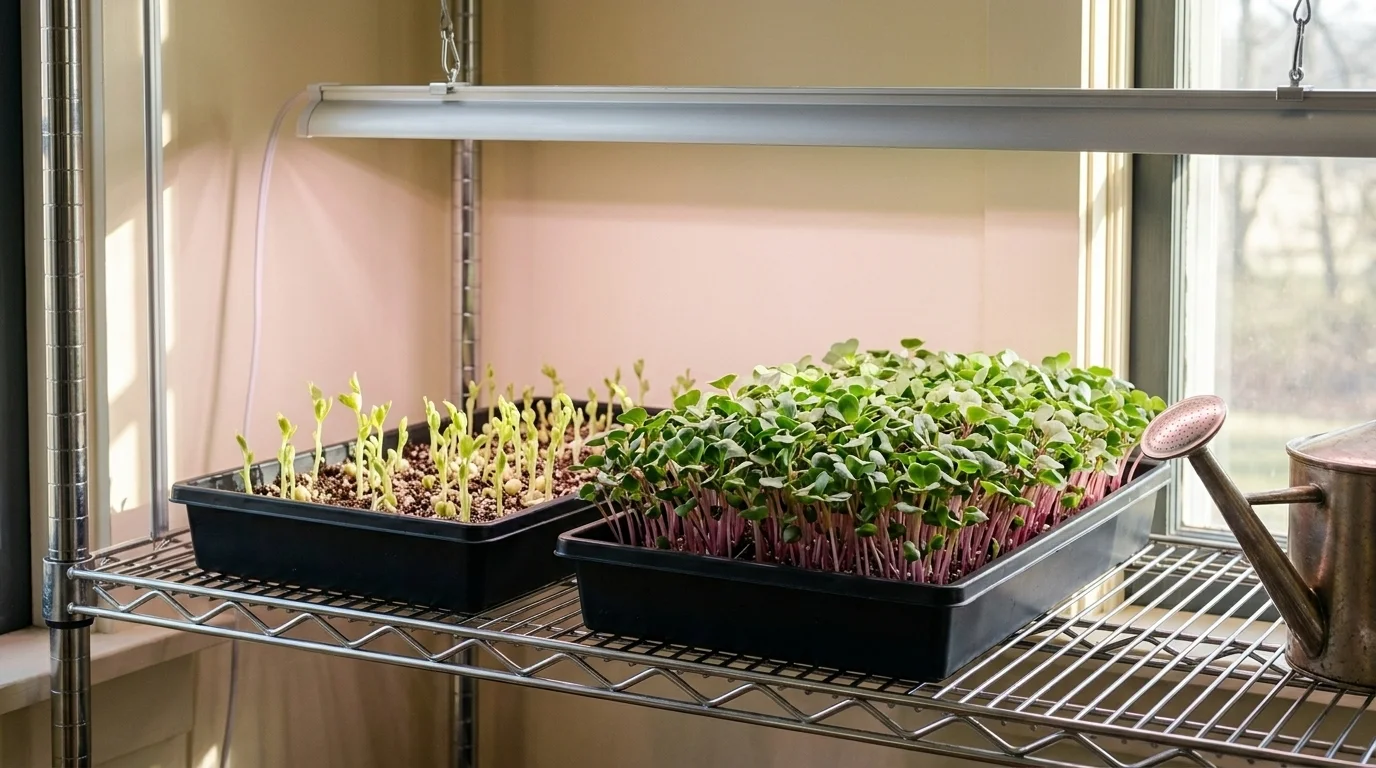
Microgreens shelf. A two-tier shelf with a 30-watt LED bar above each tier, two seed trays per tier, sown weekly in succession. Mid-range cost — the LED bars are the main expense. Effort: water trays from below daily; cut and replace every 10–14 days.
Hydroponic lettuce tower. One countertop tower (20–30 plants in a 1×1 ft footprint). The highest of these five setups — a countertop tower is a several-hundred-dollar commitment. Effort: refill reservoir weekly; harvest leaves cut-and-come-again.
2026 trends: living soil, smart tech, and the rise of microgreens
Three currents worth knowing about, drawn from the Pennsylvania Horticultural Society's 2026 trend report and adjacent industry coverage.
Living soil and microbial fertilisers. Indoor-gardening guidance in 2026 is shifting away from inert potting mix plus bottled synthetic NPK and toward "living soil" approaches: organic matter, mycorrhizal inoculant, and microbial-rich liquid fertilisers. Reported outcomes — bigger leaves, tougher plants, fewer pest issues — are real (Elm Dirt's 2026 coverage). For an indoor gardener, this looks like: switching from the cheapest bag of generic mix to an organic peat-free or coir-based mix, and feeding with a diluted seaweed or fish-emulsion drench rather than blue-crystal salts.
Smart-tech crossover. Soil-moisture probes, app-connected timers, full-spectrum LEDs running on schedules — these have moved from niche to table-stakes in 2026 beginner coverage. They are useful precisely insofar as they prevent the watering and lighting errors above. They are not useful as a substitute for paying attention to the plant.
Microgreens as the new "first plant." Microgreens — radish, pea, sunflower, broccoli shoots — are now the most-recommended starter "crop" for first-time indoor growers. Two trays under an LED bar, watered from below, cut at one to two weeks. They produce real, edible greens with almost no commitment and almost no failure mode. If a friend is hesitating to start indoor gardening, microgreens are the project I now suggest first.
Loading image...
Microgreens are the lowest-friction indoor crop: two trays, an LED bar, ten to fourteen days to harvest. Hard to overwater, harder to fail.
A closing note on what indoor plants do not do
Indoor plants do not replace outdoor habitat. A windowsill of houseplants is genuinely worth keeping for the colour, the humidity, the calming effect, and the slow education in how a plant actually grows. But the mining bee emerging from bare soil in March, the swallowtail caterpillar on a golden alexander in May, the luna moth cocoon overwintering in a rolled oak leaf in December — those happen outside, on plants the bee and the moth and the butterfly evolved alongside. If you have outdoor space, even a small one, please give some of it back to those organisms. A pothos is a friend. A patch of native milkweed or wild bergamot or unmulched soil outside your kitchen window is something more.
This weekend, if you are starting indoors: pick one plant and one window. That is the whole entry fee. The rest is what you observe over the next four weeks.
Snake plant, pothos, ZZ plant, spider plant, and cast iron plant are the five most forgiving — all tolerate low to bright indirect light, need watering only every two to four weeks, and survive periods of neglect. Start with one of these before adding fussier tropicals like calathea or Boston fern.
How much light do indoor plants need?
Most foliage houseplants want 8–12 hours of bright indirect light daily; sun-loving herbs and succulents need 4–6 hours of direct light, ideally from a south- or west-facing window. If natural light is limited, supplement with a full-spectrum LED grow light placed 6–12 inches above the canopy for 12–16 hours per day on a plug timer.
Do indoor plants really purify the air?
Partly. NASA's 1989 Wolverton study showed common houseplants remove benzene, formaldehyde, and trichloroethylene in sealed chambers, but follow-up research and the American Lung Association note that natural ventilation does most of the real-world air-cleaning work — you would need roughly 680 plants in a typical 1,500 sq ft home to match the chamber results. Plants do measurably improve perceived air quality, humidity, and well-being.
How often should I water indoor plants?
Check weekly by pushing your finger 1 inch into the soil — water thoroughly only when that top inch feels dry. Overwatering kills more indoor plants than any other cause. Hardy plants (snake, ZZ, cast iron) tolerate two to four weeks between waterings; tropicals and herbs need more frequent attention.
Can I grow vegetables and herbs indoors?
Yes — herbs like basil, mint, chives, and parsley do well on a sunny windowsill or under a grow light. Microgreens (radish, pea, sunflower shoots) are the fastest, lowest-friction starter crop, ready in 10–14 days. Full-size fruiting vegetables (tomatoes, peppers) need full-spectrum grow lights running 12–16 hours daily.
Cultivating Resilience: Adapting International Home Gardening Practices to Climate Change Realities
Join
Loading...
Our Green Community!
Loading...
VerdeNook is more than just a source of gardening wisdom; it’s a platform for sharing, learning, and growing together. We invite you to join our community, share your stories, and spread the joy of gardening. Let’s sow the seeds for a greener, healthier, and more sustainable future, one garden at a time.