Social Media Influence on Urban Horticulture: Analyzing Consumer Engagement Patterns
Share this article:
A mason bee on a sixth-floor Eryngium — proof that a thin urban corridor of small balconies, fire escapes, and window boxes still adds up to a working food web.
A mason bee was working an Eryngium on a sixth-floor Brooklyn balcony this April — I saw the video on Instagram, and the gardener tagged it #urbangarden #balconygarden #pollinatorgarden because she wanted other balcony growers to find her. That single 18-second clip and its small set of hashtags is, in compressed form, what urban gardening on social media actually does in 2026: it brings the right viewer to the right plant, and through that connection, occasionally, it brings real ecology into spaces — the rooftop, the fire-escape herb wall, the council-block window box — that conventional gardening media has spent a century pretending do not count.
This article is for the urban gardener trying to use Instagram, TikTok, Pinterest, and the rest of the feed deliberately, rather than be used by them. It anchors on the practical decisions an urban gardener actually makes — what to plant in a 40 cm container, which trellis system will hold up to a balcony cross-wind, which viral hack is worth trying and which is bad gardening dressed in a sound effect — and uses social media as the discovery layer for those decisions, not as the topic in itself. The next sections name the urban hashtags that actually find readers, evaluate the viral tactics that have been making the rounds, set out the platform-by-platform reasons an urban gardener might use each one, and close on what the algorithm cannot see.
Millennials and Gen Z are the current urban-gardening wave
The single biggest 2024-2026 shift in gardening trade reporting is the consolidation of "Gen Z gardening" framing into a combined Millennials + Gen Z story, because the spend data finally caught up to the social-media interest. The Axiom 2025 and 2026 Gardening Outlook Studies are now the canonical citation; the numbers worth fixing in mind:
70% of UK 18-to-35-year-olds describe themselves as passionate about gardening, and 83% call gardening "cool" (Simple Spring summary of Axiom 2025).
Millennial garden-centre visits are up 65% and Gen Z visits up 40% over the recent multi-year horizon (Simple Spring).
18-34-year-olds account for around 25% of total garden spending, despite lower household incomes than older cohorts.
50% of Gen Z respondents spent 50% more time gardening in 2024 than in 2023; another 15% doubled their gardening time.
66.7% of Millennials and 65.2% of Gen Z expect to spend more time gardening in 2026 — against 50.2% of gardeners overall (Nursery Management coverage of Axiom 2026).
61.1% of Millennials spent more money on gardening in 2025 — the highest year-on-year increase of any cohort.
The implication for urban gardening specifically is that this is no longer a "future audience" to be courted; it is the current audience setting demand. The cohort tends to live in flats and have balconies, fire-escape gardens, window boxes, and container collections rather than back gardens — and is using social media as the primary discovery channel for everything from which container to buy to which plant will tolerate a north-facing third-floor sill. The Gen Z reframe in the original version of this article ("the next wave of urban gardeners") is past-tense; they have already arrived.
Hashtags that find your kind of urban garden
The most useful single change an urban gardener can make to their social-media presence — both for finding other urban gardeners and for being found by them — is to use a small, deliberate, urban-specific hashtag set rather than a long mixed-purpose list. The general gardening hashtag bundles (#gardening, #growyourown) put your post into a feed of allotment gardeners with thirty-foot beds; the urban-specific set finds the people whose constraints actually match yours.
A working bundle for an urban-gardening post, grouped by purpose. Pick five to seven total — Instagram's own guidance is three to five, independent engagement studies peak around five to fifteen, and beyond that the algorithm starts treating the post as spammy.
Discovery (one or two) — #urbangarden, #urbanjungle, #urbangardener, #smallspacegardening. These signal what kind of garden you have.
Space type (one or two) — #balconygarden, #containergardening, #apartmentgardening, #windowsillgarden, #rooftopgarden, #firescapegarden. These tell the algorithm whose feed your post should appear in.
Activity (one) — #growyourown, #growyourownfood, #gardentoharvest, #urbanfarming, #urbanhomestead. These connect you to people who garden the way you do.
Aesthetic / community (one) — #plantsofinstagram, #plantparent, #plantmom, #urbanjunglebloggers, #growfoodnotlawns. These signal a stance and find the audience that shares it.
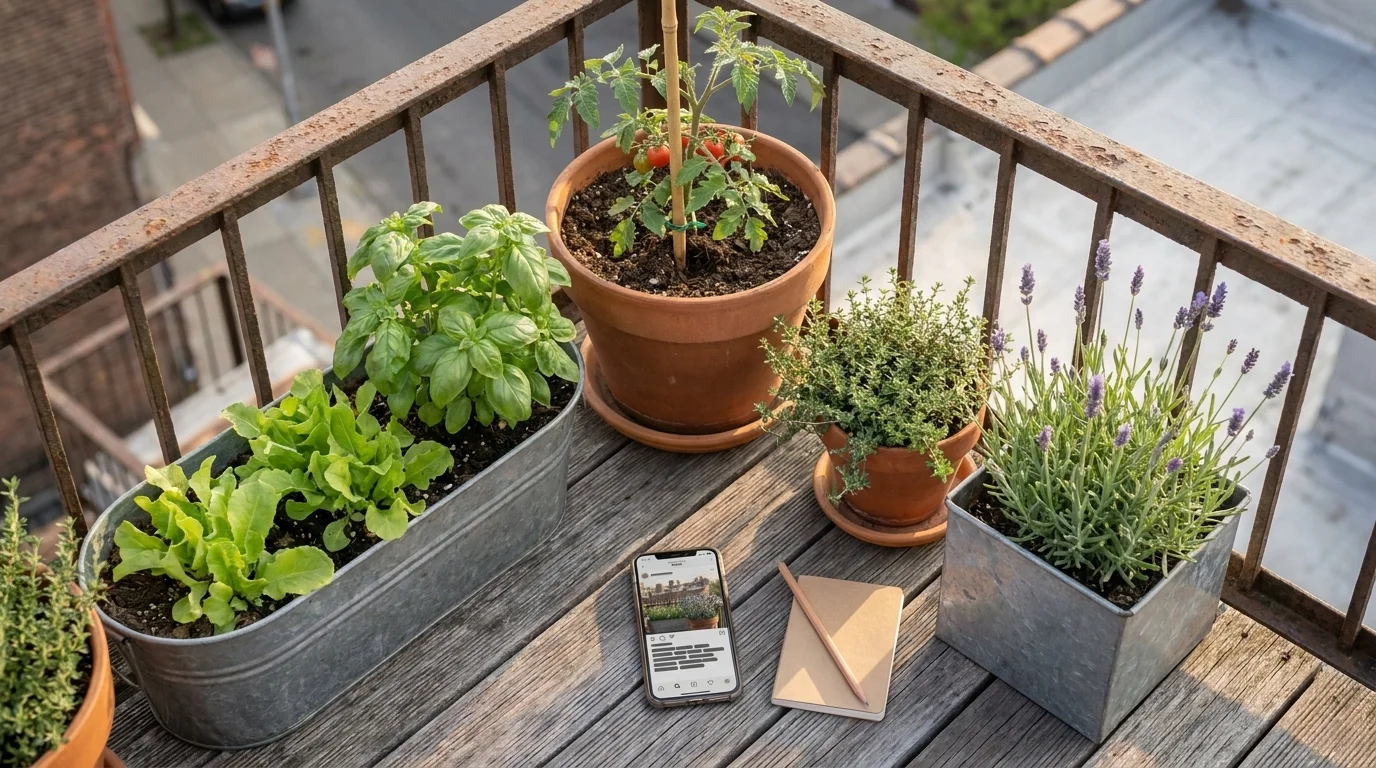
A working real post: #urbangarden #balconygarden #containergardening #growyourown #plantsofinstagram — five tags, three sub-niches, one activity, one aesthetic. That set will pull in urban container gardeners specifically, which is the audience an urban gardener actually wants. The thirty-tag general-gardening dump that worked in 2020 has been deprecated by Instagram itself; the data on engagement uplift now favours fewer, more relevant tags every time.
For TikTok the same logic applies with platform-native tags layered on: #gardentok, #planttok, #urbangardening, #balconygarden, #fyp. The platform's algorithm sorts users into sub-vertical feeds quickly once a couple of urban-tagged posts have circulated.
Loading image...
Five urban-specific tags beat thirty general ones. The point is to find the gardeners whose four-foot balcony actually looks like yours.
Viral urban-space tactics: what actually works
The visible SERP for urban gardening on social media in 2025-2026 is dominated by tactic videos rather than influencer personality — the unit of virality is the trick, not the creator. Epic Gardening's 2025 round-up of social-media garden trends is structured entirely around hacks that gained traction on TikTok and Pinterest (Epic Gardening — Social Media Garden Trends That Work). The four most visible in urban feeds, with an honest assessment of which actually deserve the air time:
Vertical shoe-organiser herb walls — a hanging fabric shoe organiser, each pocket filled with potting compost, planted with herbs against a south-facing wall. Works as advertised for short-life salad herbs (basil, parsley, mint) for one season; the pockets dry out fast in summer heat (drip-irrigate or accept twice-daily watering), and the fabric degrades inside 18 months. Not a permanent installation, but for a renter wanting six square feet of working herb growth on a small balcony, the £8 entry cost is justified.
GreenStalk-style stacked vertical planters — five-tier rotating planters that hold 30+ plants in roughly a one-square-foot footprint. Works for the right crops — strawberries, salad greens, herbs, compact peppers. Does not work for anything with a deep tap root (carrots, full tomatoes) because the per-tier soil depth is shallow. The rotating-tower design is genuinely useful for getting even light on all sides on a constrained balcony.
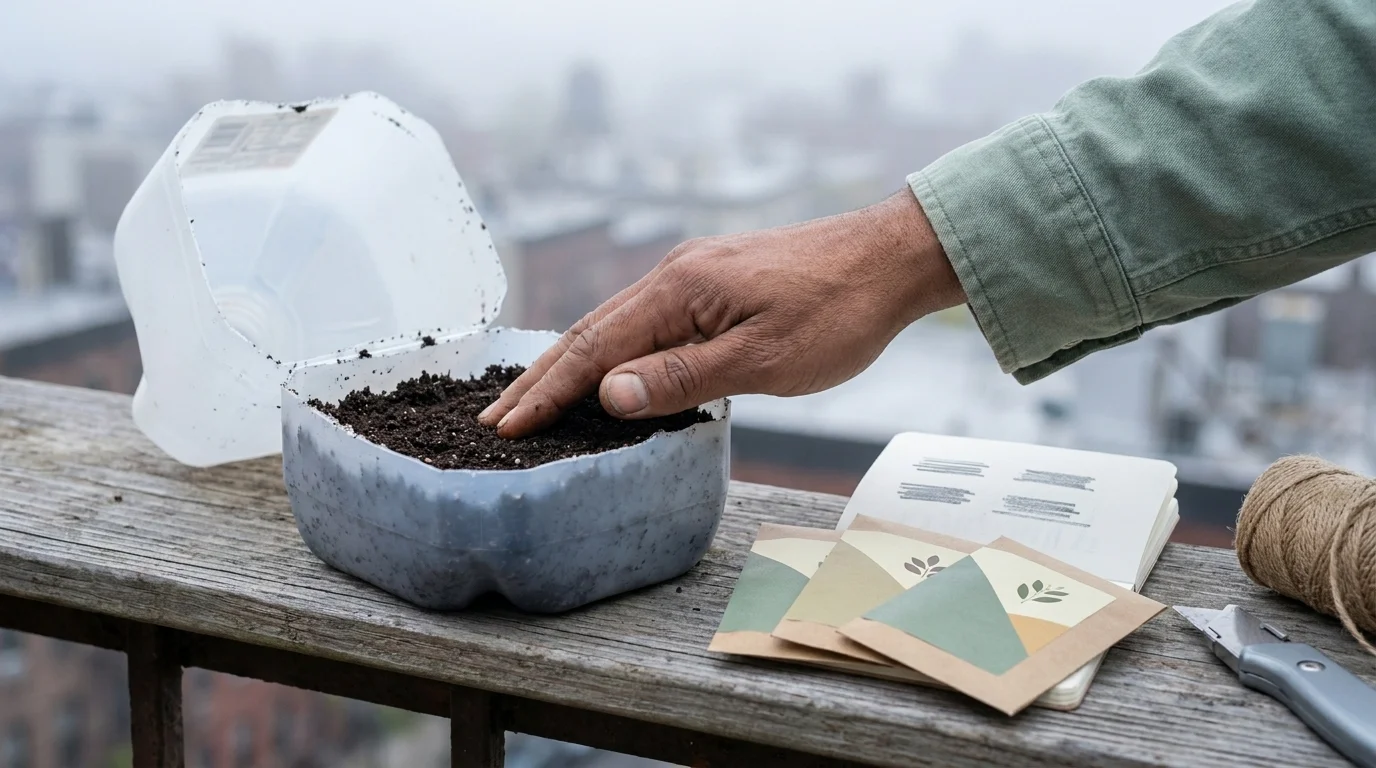
Milk-jug winter sowing — cutting plastic milk jugs in half, filling them with seed compost, sowing inside, and leaving them outside through late winter to germinate when spring conditions arrive. Works, with caveats — it genuinely produces strong, cold-hardened seedlings of any plant that tolerates the freezing-and-thawing cycle (most hardy annuals, brassicas, native perennials). It does not work for warm-season crops (tomatoes, peppers, basil) that need protected indoor starts. The viral version of the tactic often skips that distinction.
Scrap regrowth (spring onions, lettuce bases, celery hearts) — placing supermarket scraps in water and growing replacements. Partially works. The first regrowth is real and edible for spring onions and lettuce, but yields diminish sharply; a £2 packet of spring onion seeds will give you 20 times the harvest of any scrap-regrowth setup. Useful as a teaching exercise with children and a nice on-camera moment; not a serious food strategy.
Two tactics that get heavy social-media airtime and do not deserve it: composting at very small scale in a sealed container with no airflow (anaerobic, smells, kills the worm if there is one), and the "coffee grounds will fix all your soil problems" claim (coffee grounds are nitrogen-rich but acidic, and pile up impressively wrongly when applied without compost). The pattern with viral content is that the technique often works in the original creator's specific climate and setup, and survives transplantation poorly. Reading the comments on the original post — the ones from gardeners in your climate, with your light and your space — is the cheapest way to find out whether a tactic will travel.
Herbs are the entry point
The single category that has driven the urban-gardening boom on social media is the herb garden. Trade-press coverage now reports a "herb garden revival" specifically led by Millennials and Gen Z (The Daily Dirt — Herb Garden Revival), and the reason is straightforward: herbs deliver an enormous return on a very small footprint. A 60 cm trough planted with basil, mint, chives, parsley, and oregano will produce a season's worth of cooking herbs at supermarket-equivalent quality for about £8 in seed and £15 in compost — and the social-media metric matters too, because a herb plant brushed by a hand in a Reel produces a visible motion the algorithm rewards.
The harder-edged ecological version of this story is that the right herb planting also feeds pollinators. Origanum vulgare (marjoram) in flower is one of the most productive nectar sources for solitary bees in a UK or US urban summer; Thymus serpyllum (creeping thyme) in a windowsill pot will be worked by honeybees through May. The urban gardener who plants a herb container both eats from it and contributes a small piece of nectar corridor to whichever city she happens to be in. Both kinds of return matter, and neither one shows up in the spend-per-cohort tables.
Platform-by-platform, urban-first
A short version of the platform map, focused on what each platform is actually useful for in an urban-gardening context. The longer treatment of the same map lives in our companion article on garden influencers and online communities — this one keeps the lens urban.
Pinterest is the pre-planting layer — small-space designs, balcony layouts, container combinations, vertical-wall builds. The platform's archival, searchable structure suits the "I am planning what to do this spring with a 1.2 m balcony" question better than any feed-driven platform.
Instagram is the seasonal-documentation layer for urban gardeners. The visual format rewards balcony shots and the chronological-ish feed lets you watch a particular Brooklyn or Camden balcony move through its season. Best place to find named creators in your urban context.
TikTok is where the hack videos live. The platform's micro-niche sorting will put you into #balconygarden, #containergarden, or #urbanfarming territory within a few taps. Watch for tactics; cross-check before applying.
Reddit — r/UrbanGardening, r/balcony, r/IndoorGarden, r/houseplants — is the troubleshooting layer. When your container tomato suddenly has yellow leaves, this is the platform with the fastest useful answer.
YouTube is the long-form how-to layer. Epic Gardening's long videos on container vegetable growing and Kevin Espiritu's deeper raised-bed walkthroughs live here; the platform suits the gardener wanting to learn the underlying principles, not just a 60-second trick.
Most active urban gardeners use at least two of these in combination — typically Pinterest for planning, Instagram or TikTok for seasonal discovery, Reddit when something goes wrong.
Don't believe everything you scroll
The most useful single posture for an urban gardener on social media is mild scepticism. The viral incentive on every platform rewards a confident claim that sounds like a hack; the gardening reality is that most genuinely useful techniques are slow, climate-specific, and unphotogenic. A short list of the most commonly repeated bad advice circulating on garden social in 2025-2026:
"Coffee grounds will fix any soil problem." Coffee grounds are nitrogen-rich and acidic. Used in moderation as a small compost contributor, they're fine. Piled directly onto soil at any meaningful volume, they form a hydrophobic crust, depress nitrogen availability as they break down, and acidify soil unpredictably. The complete claim is roughly the opposite of the truth.
"Epsom salts as a universal plant booster." Magnesium sulphate helps where there is a documented magnesium deficiency. Most urban container soils have plenty of magnesium; adding more does nothing useful and can disrupt calcium uptake. Don't bother unless a soil test tells you to.
"Beer in a saucer to kill slugs." Works at the saucer; does not noticeably reduce the slug population in the bed. The slugs that drown are replaced from the surrounding population within days. A real reduction comes from nematode treatment, copper barriers, and removing daytime hiding spots — none of which produce a 15-second video.
"Banana peel water as a potassium fertiliser." A peel in water leaches a small amount of potassium that the plant can use, but the same potassium would be more available in a 10p sprinkle of wood ash, and the banana-water solution often grows mould on its way to the plant. Theatre with a kitchen origin story; the chemistry is not flattering.
"Plants 'talk' / love specific music." Pleasant story; weak to non-existent evidence. The real audio question is whether the gardener tends the plant more attentively when they are spending time with it — which they probably do. The plant has not noticed Mozart.
The general filter that works: any claim that can be expressed as a single sentence in a viral video without a caveat is suspicious; the gardening that actually works requires the caveat. Cross-checking with a university extension service (RHS in the UK, your state's land-grant cooperative extension in the US, or a published horticultural-trial site like Charles Dowding's in Somerset) is the cheapest reality test available.
Loading image...
Milk-jug winter sowing works for brassicas, hardy annuals, and native perennials — anything that survives a freeze-thaw cycle. Not for tomatoes or basil.
A counterweight worth keeping in mind
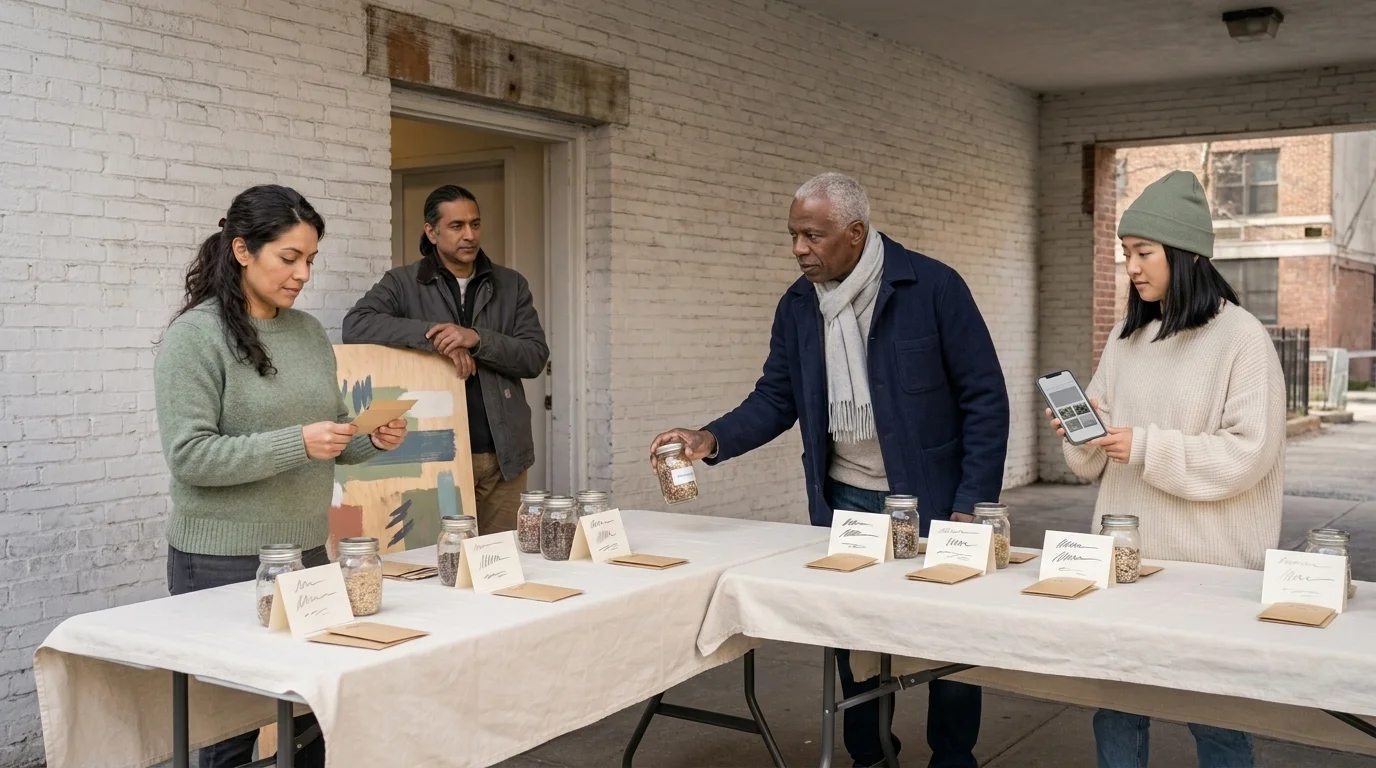
The Garden Media Group's 2025 Garden Trends Report (Garden Media Group) notes a consumer-preference shift back toward in-person community interactions over purely social-platform engagement — a real counterweight to the "online community is the future" thesis that was true through 2022 and is more complicated now. What we are seeing in our own community-gardening networks is consistent with the report: the gardeners who use social to find their local seed swap, plant exchange, or community plot tend to thrive. The gardeners whose entire gardening life is mediated through a feed tend, eventually, to wear out — the algorithm cannot offer the meal, the seed swap, or the friendship that the in-person version of the same network can.
The right posture is to treat the platforms as a doorway rather than as a room. They are useful for finding the people, the plants, and the techniques worth following; they are not the place the gardening itself eventually has to happen.
Loading image...
The platform is a doorway to the seed swap, not the room itself. The gardeners who use it that way are the ones who still know each other's names by April.
Urban-gardener creators worth following
A small, deliberately short list of named creators whose feeds reflect actual urban-gardening practice rather than a wider gardening brief. For a longer general round-up across niches see our companion piece on garden influencers; the list here is anchored on the urban / small-space / container subset.
Alessandro Vitale — Spicy Moustache (TikTok / Instagram): London balcony specialist; the urban-renter playbook in short-form video. Strong on food-scrap reduction and low-input vertical systems.
Kevin Espiritu — Epic Gardening (TikTok / YouTube / podcast): not exclusively urban but with deep container-vegetable and small-space content. Best long-form on the underlying horticultural principles.
The Urban Harvest (Instagram, UK-based): rooftop and balcony focus with practical bed-layout videos.
Garden Marcus (Instagram, Houston): southern-US container and houseplant grower whose calm tutorials are an excellent entry point for new urban indoor gardeners.
NYC GreenThumb (Instagram, official): not an individual creator but the City of New York's community-garden programme, with 550+ member gardens — useful for the urban gardener wanting to find a local plot rather than build one from scratch.
r/UrbanGardening (Reddit community): not a single voice but the largest active urban-gardening peer community on the web. Best place to find climate-specific advice for a particular city.
The list is short because following a small number of voices well beats following a long list weakly. Five accounts followed deeply, with the time taken to actually act on what they say, will produce more measurable changes in an urban garden than fifty followed loosely.
The garden that the algorithm cannot see
The first bee I saw on the Brooklyn balcony in the video I started with was a small, dark, ground-nesting mason bee — Osmia lignaria, in all likelihood — working an Eryngium flower a hundred and twenty feet above the street. The thing the video could not show was what the bee had to fly over to get there: thirty thousand square feet of paved roof, a fire escape with three pots of pelargonium that had been deadheaded last Sunday, a single window box on the third floor with one Lavandula angustifolia in flower. The food web that brought the bee to the balcony was not the gardener's work alone — it was a thin, distributed corridor of small urban gardens, each of which had been built by someone who probably found the techniques on a phone.
This is the part the urban-gardening corner of social media gets right, when it works. The platforms cannot see the bee, the soil microbiome, the slow accumulation of nectar corridor that an urban neighbourhood builds across decades. But they can put the right plant in front of the right grower at the right time of year, and the cumulative effect of that — a few hundred Eryngium plants now in flower on third-floor balconies across a city — is a real ecological intervention, hidden inside what looks like a content-marketing trend. The hashtags, the hacks, and the creators are the surface; the ground-nesting bee is the receipt. Use the surface deliberately, follow the small set of voices whose work you actually trust, and put the phone down occasionally to look at what your plant is doing — by next April, the bees will tell you whether the rest of it was worth the screen time.
What are the best Instagram hashtags for urban gardening?
Pick five to seven urban-specific tags grouped by purpose: discovery (#urbangarden, #urbanjungle), space type (#balconygarden, #containergardening, #apartmentgardening, #windowsillgarden), activity (#growyourown, #urbanfarming), and aesthetic (#plantsofinstagram, #plantparent, #urbanjunglebloggers). A working bundle is #urbangarden #balconygarden #containergardening #growyourown #plantsofinstagram.
Which social media platform is best for urban gardening inspiration?
Pinterest is strongest for pre-planting design and balcony layouts. Instagram suits seasonal documentation and finding creators in your urban context. TikTok (#gardentok, #planttok, #balconygarden) is where short hack videos live. Reddit's r/UrbanGardening, r/balcony, and r/IndoorGarden are the fastest places to troubleshoot. YouTube hosts the long-form how-to. Most active urban gardeners use at least two in combination.
Are Millennials and Gen Z actually driving urban-gardening growth?
Yes. The Axiom 2025/2026 Gardening Outlook Studies show 70% of 18-to-35-year-olds describe themselves as passionate about gardening and 83% call it 'cool'. Millennial garden-centre visits are up 65% and Gen Z visits up 40%. 66.7% of Millennials and 65.2% of Gen Z expect to spend more time gardening in 2026, against 50.2% of gardeners overall. 61.1% of Millennials spent more money on gardening in 2025 than the previous year — the highest of any cohort.
Which viral gardening hacks actually work in a small urban space?
Vertical shoe-organiser herb walls work as a one-season project for salad herbs (basil, parsley, mint) but degrade and dry out fast — drip-irrigate or accept twice-daily watering. GreenStalk-style stacked planters work for strawberries, salad greens, and compact peppers; not for tap-root vegetables. Milk-jug winter sowing works for cold-tolerant seeds (brassicas, hardy annuals, native perennials); not for warm-season crops. Scrap regrowth is partly real but yields tiny harvests — a £2 seed packet beats it twenty times over.
Should I trust gardening advice I see on social media?
Treat platform content as inspiration and cross-check before acting. Common bad advice circulating in 2025-26: coffee grounds as a universal soil fix (acidic and depresses nitrogen), Epsom salts as a universal booster (only helps in documented magnesium deficiency), beer in a saucer for slug control (kills a handful, doesn't reduce the population), banana-peel water as fertiliser (theatre with weak chemistry). Cross-check viral claims against your local university extension service, the RHS, or a published horticultural-trial site before applying.
Bridging the Digital Divide: Empowering All Home Gardeners with Accessible Technology
Join
Loading...
Our Green Community!
Loading...
VerdeNook is more than just a source of gardening wisdom; it’s a platform for sharing, learning, and growing together. We invite you to join our community, share your stories, and spread the joy of gardening. Let’s sow the seeds for a greener, healthier, and more sustainable future, one garden at a time.