The Art of Successful Seed Starting and Transplanting for a Bountiful Garden
Share this article:
Seed-starting is not a craft of secrets. It is a sequence of conditions — mix, light, temperature, airflow — that you control until the plant can take over.
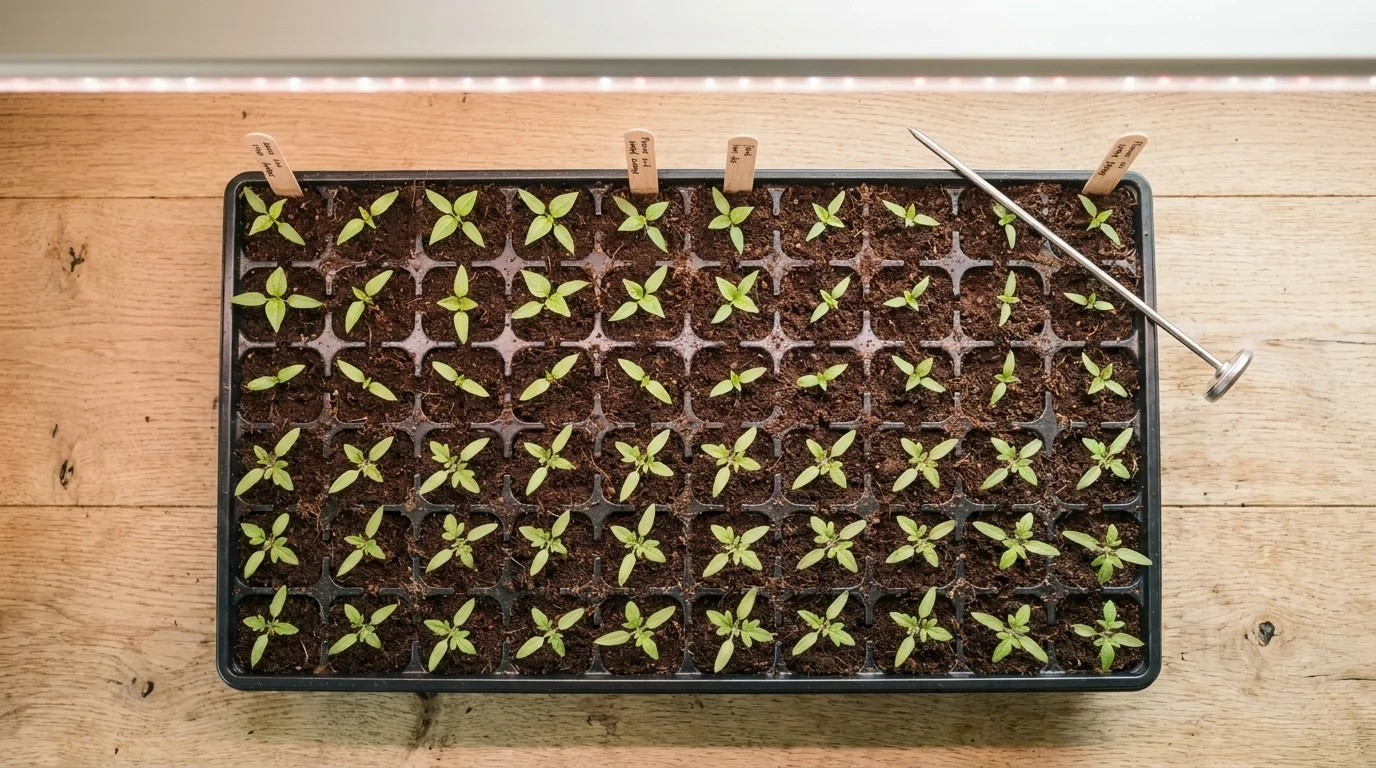
Lift the lid on a propagator in late February and you will see what every gardener is really chasing: a tray of seed leaves the colour of clean linen, perfectly even, the stems thumb-thick and short. That is the goal. Everything else — the lights, the timing, the mix you use, the fan in the corner — is in service of producing that one tray. Starting seeds indoors is not a craft of secrets; it is a sequence of conditions you control until the plant can take over.
Most vegetable seeds should be started indoors six to eight weeks before your last frost date. Peppers want a little longer, brassicas a little less, and a few crops (carrots, beans, radishes) should not be started indoors at all. The rest of this guide explains why those numbers hold, what equipment actually matters, and how to fix the three failures that account for nearly every wasted tray: damping off, leggy stems, and a flat refusal to germinate.
When to start seeds indoors (by crop and zone)
The simple arithmetic: take your last frost date, count backwards the recommended number of weeks for the crop, and that is your sowing date. If your last frost is around 15 May and you are starting tomatoes (six to eight weeks), you sow somewhere between 20 March and 3 April. Start too early and your seedlings outgrow their trays and turn leggy waiting for the weather; start too late and you forfeit the head start that was the whole point.
The timing windows below are drawn from Park Seed's crop-by-crop guidance and the long-running indoor-start calendars used at large mail-order suppliers.
Crop
Weeks before last frost
Germination soil temp
Peppers (sweet and chilli)
8–10
75–85°F (24–29°C)
Aubergine
8–10
75–85°F (24–29°C)
Tomatoes
6–8
70–80°F (21–27°C)
Onions and leeks (seed)
8–12
65–75°F (18–24°C)
Brassicas (broccoli, cabbage, cauliflower, kale)
4–6
65–75°F (18–24°C)
Lettuce
4–6
60–70°F (15–21°C)
Cucurbits (cucumber, squash, melon, courgette)
2–4
70–85°F (21–29°C)
Basil
4–6
70–75°F (21–24°C)
Snapdragon, lobelia, petunia (flowers)
8–10
65–75°F (18–24°C)
One footnote on the date itself. The USDA hardiness zone map was revised in 2023 and is still the authority in 2026; for much of the United States the zones moved half a step warmer, which means last-frost dates have crept one to two weeks earlier than they were in the calendars most gardeners learned from. If your chart predates 2023, recheck it against your local cooperative extension or national meteorological service before you build a sowing schedule on it.
Loading image...
Six to eight weeks before last frost is the rule for most crops — but check your zone first. The 2023 USDA revision shifted dates earlier across much of the US.
Starting seeds indoors: a step-by-step
The mix is the experiment
A seed-starting mix is not soil; it is the controlled environment in which a seed is asked to germinate. Most home gardeners reach for a bag labelled "seed-starting compost" without ever looking at the ingredient list, which is a shame, because what is in the bag determines half the outcome.
For decades the default base was sphagnum peat moss — light, sterile, water-retentive, slightly acidic. Since around 2023 that has changed. The industry has shifted under pressure from peat-bog conservation campaigns and, by 2026, most major brands have moved to coconut coir as the principal base, often blended with perlite or vermiculite for aeration and water-holding respectively. Coir behaves differently from peat: it wets more easily after drying out (peat repels water once it has gone dust-dry), holds proportionally more air, and is closer to pH neutral. None of those differences will sink your seedlings, but the watering rhythm shifts. Coir-based mixes need slightly less frequent watering than peat-based ones, and they recover from a missed day far more forgivingly.
Whatever the base, the rule is the same: do not use garden soil. Garden soil compacts in the small volume of a seed cell, blocks the pore space the roots need, and carries fungal spores against which young seedlings have no defence.
A handful of skilled growers skip the cell tray entirely and use soil blocks — compressed cubes of mix that the seedling roots into directly, with no plastic walls to hit. The technique was once confined to market gardeners; it is now a mainstream option in 2026 editorial guides because it eliminates the brief root-binding shock that happens when a seedling sits in its cell a week too long. A soil-block maker costs roughly the same as a decent pair of secateurs.
Light, properly specified
Light is where well-meant guides fail to be useful. "Place the trays in a sunny window" or "use a grow light" tells you nothing. The seedling does not care about your window; it cares about the photon flux density reaching its leaves and the hours per day it receives that flux. Most household windowsills in February deliver neither — even south-facing glass in temperate latitudes typically gives a few hours of usable intensity, and the seedling responds by stretching toward the light, producing the long, pale, weak-stemmed plant gardeners call "leggy".
A serviceable seed-starting LED has three characteristics: a photosynthetic photon flux density at the canopy of roughly 150 to 300 µmol·m⁻²·s⁻¹, an efficacy of at least 2.3 µmol per joule (this is what tells you the lamp is not just wasting electricity as heat), and a full spectrum with a defined red peak around 660 nm. Those numbers come from the current grow-light reference data summarised in the Gorilla Grow Tent LED distance chart; they are now the accepted baseline for home seed-starting in 2026, replacing the old "two fluorescent tubes" advice that dominated guides up to around 2022.
The single most useful clarification on seed-starting is that germination temperature and growing-on temperature are different problems. A seed germinating wants warm soil — not warm air. A seedling, once up, wants the opposite: cool, steady air to prevent stretchy growth.
For germination, the consensus across Cooperative Extension and editorial sources is a soil temperature of 65–75°F (18–24°C) for most crops, with peppers and aubergines wanting the upper end and even a touch above. A simple heat mat under the tray, with a thermostat probe in the mix, is the only reliable way to deliver that. Once the seedlings are up and into their first true leaves, lift the mat away and let the air temperature drop into the 60–70°F (15–21°C) range. Cool air plus strong overhead light plus gentle airflow gives you short, thick stems.
Watering: bottom, not top
Almost every seedling failure traces to overhead watering. Water from above drives mix particles down onto the cotyledons, splashes spores around, and creates the warm wet film at the soil surface that the damping-off fungi adore. Instead, sit the tray in a reservoir of water for ten or fifteen minutes and let the mix draw moisture up by capillary action; lift the tray out as soon as the surface darkens. The mix should feel like a wrung-out sponge — moist enough to hold its shape when pressed, never wet enough to glisten.
How to harden off seedlings
Hardening off is the slow translation from greenhouse to garden. A seedling raised under LEDs and still air has neither the leaf cuticle nor the stem rigidity to survive a single afternoon outdoors. The transition takes seven to fourteen days, and the upper end of that range is not laziness — it is a hedge against the weather giving you three good days and four bad ones in your first week. The 7-to-14 window is the current consensus across editorial and extension guidance.
A serviceable schedule:
Days 1–2. Two hours in dappled shade, out of direct wind. Bring the tray back indoors before midday.
Days 3–4. Three to four hours, still mostly shaded, with brief direct sun in the morning.
Days 5–7. Half a day outside, including a couple of hours of direct sun. Begin leaving the trays out overnight if temperatures stay above 50°F (10°C).
Days 8–14. Full days and nights outdoors, in the position they will be transplanted into. Withhold water just enough to make the plants visibly less turgid before each watering — this thickens the cuticle and reduces post-transplant wilting.
Watch the leaves. A faint silvering or a slight curl is acceptable; outright wilting, scorch, or a windburn brown on the leaf margins means you have moved too quickly. Pull back a stage and resume the next day.
How to transplant seedlings without transplant shock
Choose an overcast afternoon, or the hour before dusk on a clear day — bright midday sun is the worst possible time to ask a root system to start over. Water the trays an hour before transplanting so the rootball comes out as a single cohesive plug rather than crumbling on the way to the hole.
Set the seedling at the same depth it grew at in the tray, except for tomatoes and tomatillos, which can be buried up to their lowest pair of true leaves — the buried stem will throw adventitious roots within a week and produce a sturdier plant. Firm the soil with your fingers only; a tamping motion compacts the rhizosphere and undoes the work of every season's worth of mulch and compost beneath. Water in with a fine rose, slowly, until the surface darkens for two inches in every direction.
Then leave them alone. Resist the temptation to fertilise; an unestablished root cannot use the nitrogen and the surplus draws away the soil bacteria that should be colonising the new root surface. Three days of observation will tell you whether the transplant has taken: a seedling that holds its leaf turgor through a sunny afternoon has rooted; one that goes flat by 11 a.m. and recovers by evening is still in shock and should be shaded with an upturned cloche or a sheet of fleece for another forty-eight hours.
Direct sowing vs. starting indoors
A short list does most of the work here. Some crops resent being moved at all; others gain six weeks by starting under cover. The rule of thumb is that tap-rooted, fast-germinating, or cold-tolerant crops want to go straight into the ground, while slow-germinating, heat-loving, or transplant-friendly crops want a head start indoors.
The "either" column is where personal preference reigns. I direct-sow lettuce in succession from late March and pot-sow it under cover in February for the first early crop, depending on what bed is free at the time.
Loading image...
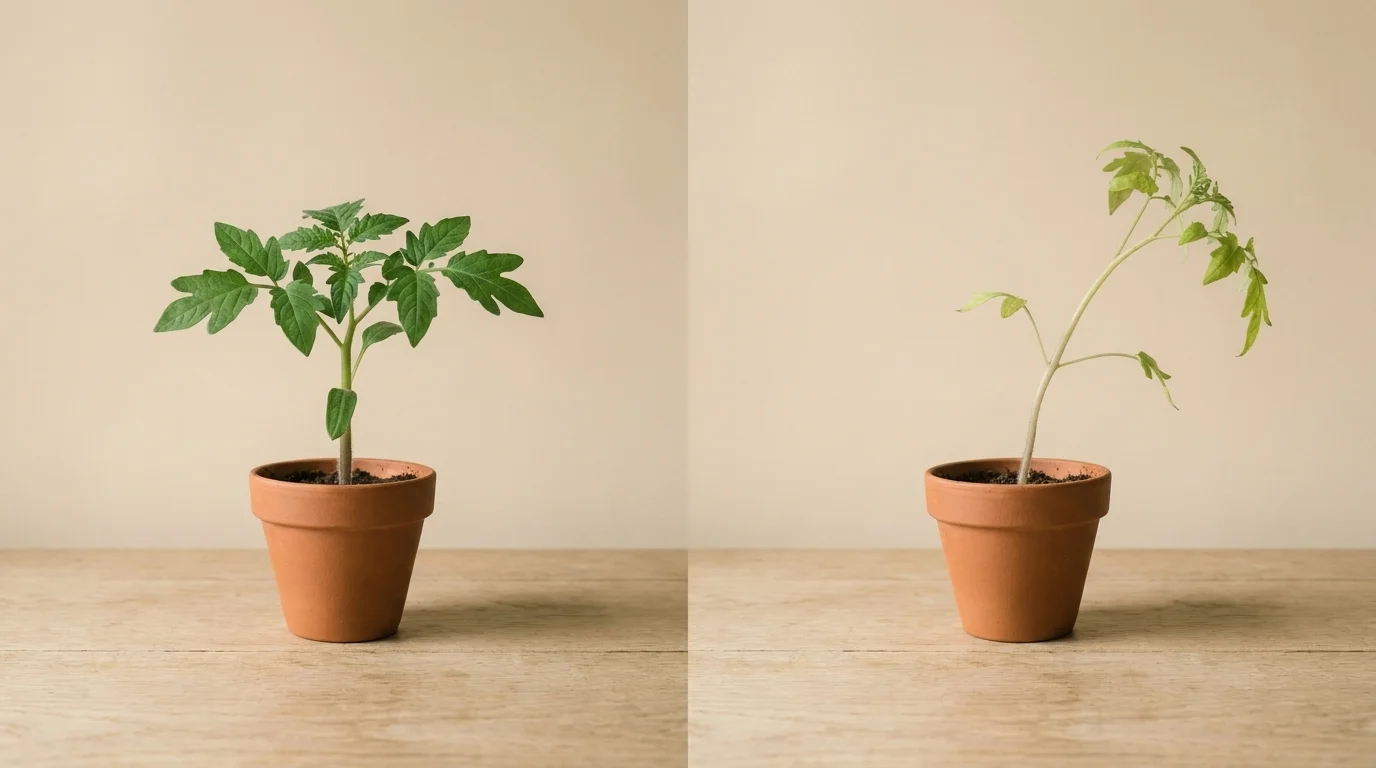
A seedling stretches when it is hunting for light it cannot find. The fix is rarely more water; it is more light, closer to the canopy.
Troubleshooting common seed-starting problems
Damping off
You water the tray on Friday morning. By Sunday, two or three seedlings have collapsed at the soil line as if pinched, and a fine grey-white bloom is visible at the base of the stems. That is damping off — the catch-all name for several fungi (Pythium, Rhizoctonia, Fusarium) that target seedling tissue when the surface stays warm and wet.
Prevention is structural and dependable. Use a sterile, fresh seed-starting mix — never the previous season's leftovers, never compost from the garden heap. Water from the bottom, not the top. And run a small clip-on fan on its lowest setting near the trays for a few hours a day. The bottom-watering plus low-speed fan pairing is the protocol that has replaced the older "just don't overwater" advice in 2026 guides — and it works because it disrupts the still, humid micro-layer at the soil surface that the fungi need. Once damping off appears in a tray, the affected seedlings will not recover; remove them, allow the surface to dry out completely between waterings, and consider re-sowing in fresh mix.
Leggy seedlings
A seedling stretches when it is hunting for light it cannot find. The fix is rarely "more water" or "more fertiliser" — it is more light, closer. Drop the lamp to within six to eight inches of the canopy, extend the daily run to 14–16 hours, and direct a slow-moving fan across the seedlings for two hours a day. The mechanical stress from the airflow triggers thicker secondary cell-wall deposition in the stem; a fortnight of fan exposure produces visibly sturdier plants. Severely leggy seedlings can sometimes be saved by replanting deeper at the next transplant — particularly tomatoes — but prevention is straightforward and reliable.
Slow or no germination
When a tray sits for ten days with nothing emerging, three causes account for almost every case. The soil temperature is too low (most failures); the seed is older than its viability window (a packet stored warm and dry for three years will give you patchy germination at best); or the seed has a specific pre-treatment requirement you missed — scarification for hard-coated seeds like nasturtium, cold stratification for some perennials, a 12-hour pre-soak for parsley and chard. A probe thermometer pushed into the mix to the depth of the seed will diagnose the first cause in thirty seconds. The second is solved by replacing the seed. The third requires looking up the species before sowing rather than after.
A small diagnostic to close
Press a thumb into the surface of any seed-starting tray. If the print holds a sharp edge and feels cool, the moisture is right; if the surface beads and refuses the impression, the mix has gone hydrophobic and needs an overnight bottom-soak; if your thumb sinks into a film of water, the tray has been over-watered and is on the road to damping off. A single check, repeated every morning, will save more seedlings than any amount of theory.
Most seeds should be started six to eight weeks before your last frost date. Peppers and aubergines need eight to ten weeks; tomatoes six to eight weeks; brassicas four to six weeks; cucumbers and squash only two to four weeks. If your hardiness chart predates the 2023 USDA zone revision, recheck your last-frost date before counting backwards.
How long do seeds take to germinate?
Most vegetable seeds germinate in five to fourteen days at a soil temperature of 65–75°F (18–24°C). Peppers and aubergines can take up to three weeks; lettuce and radishes can sprout in three to five days. A probe thermometer pushed into the mix is the fastest way to diagnose a slow tray.
Do I need grow lights to start seeds indoors?
For most setups, yes. Even a sunny windowsill rarely provides the 12 to 16 hours of strong, overhead light seedlings need. A basic full-spectrum LED bar suspended six to twelve inches above the canopy, run on a plug timer, prevents legginess and delivers consistent growth.
Why are my seedlings leggy and falling over?
Legginess is a light problem, not a water or fertiliser problem. Move the grow light closer to within six to eight inches of the canopy, extend the daily run to 14–16 hours, and run a small fan on low speed for a couple of hours a day. The airflow triggers thicker stem cell-wall deposition and produces visibly sturdier seedlings within two weeks.
What is damping off and how do I prevent it?
Damping off is a fungal disease that collapses seedlings at the soil line, leaving a fine grey-white bloom at the stem base. Prevent it with a sterile, fresh seed-starting mix, bottom-watering instead of overhead watering, and a small clip-on fan running on low speed near the trays for a few hours a day. Once a seedling has collapsed it will not recover; remove the affected plants and let the surface dry.
How deep should I plant seeds?
A reliable rule is to plant seeds at a depth two to three times their diameter. Tiny seeds such as lettuce and basil sit on the surface; medium seeds like tomato and pepper go a quarter inch deep; large seeds such as beans and squash go an inch deep.
Can I reuse seed starting mix?
Reusing seed-starting mix is risky because it may carry fungal spores that cause damping off. If you must reuse it, sterilise by baking at 180°F for thirty minutes; otherwise, compost the old mix and start your seed trays with a fresh, sterile bag. Coir-based mixes from 2026 wet up more easily on reuse than older peat-based ones, but the fungal risk is the same.
What's the difference between starting seeds indoors and direct sowing?
Indoor starting gives heat-loving slow-germinators such as tomatoes, peppers, and aubergines a six-to-ten-week head start before the frost ends. Direct sowing suits tap-rooted and fast-germinating crops that dislike being moved — carrots, beans, peas, radishes, and parsnips. Lettuce, spinach, and onions can be handled either way.
Join
Loading...
Our Green Community!
Loading...
VerdeNook is more than just a source of gardening wisdom; it’s a platform for sharing, learning, and growing together. We invite you to join our community, share your stories, and spread the joy of gardening. Let’s sow the seeds for a greener, healthier, and more sustainable future, one garden at a time.