Digital Gardening Intelligence: Leveraging Data Analytics for Optimal Plant Health
Share this article:
Four tiers, one honest answer: a $15 analog dial read three times a week tells most gardeners what they need. Buy up the table only when the readings must drive something.
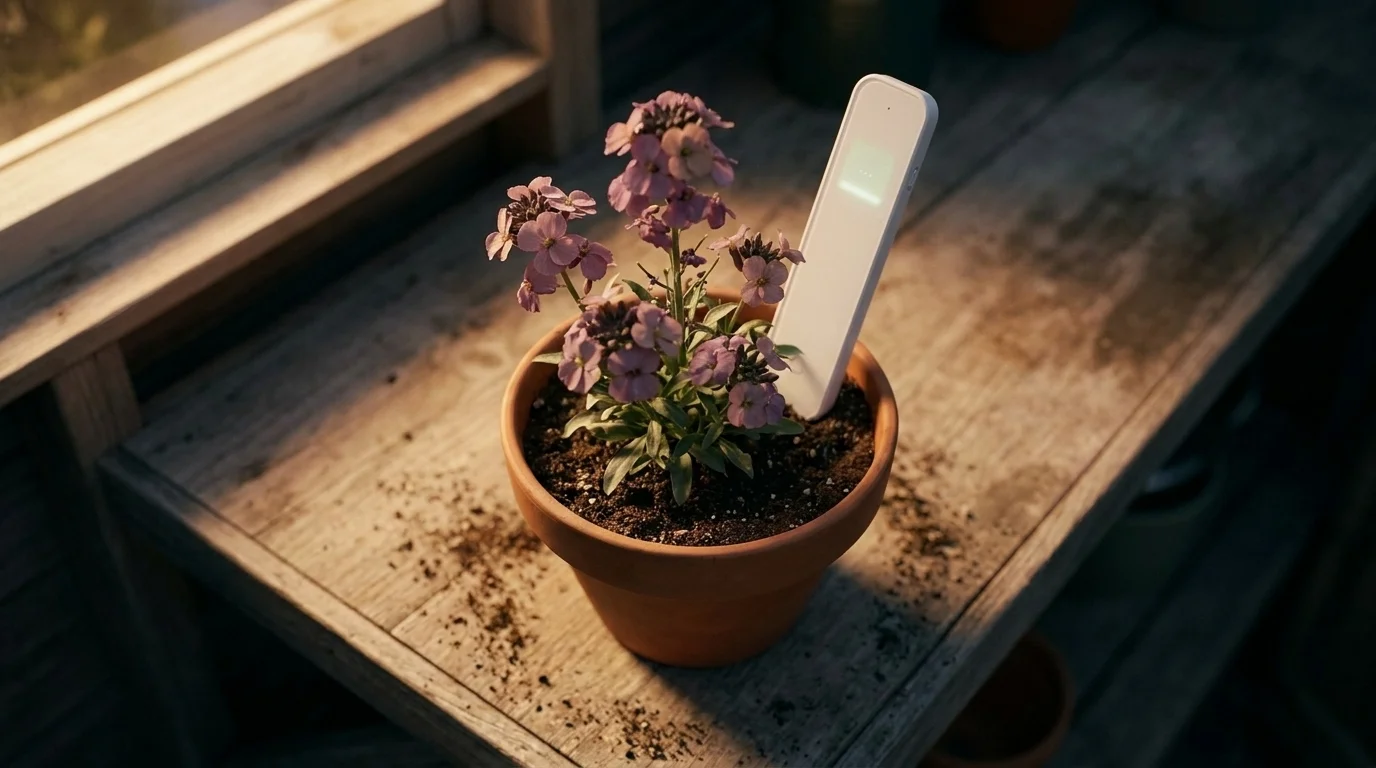
A soil moisture sensor in a pot at dusk
At the end of May, in the hour before the light goes, the south-facing window of my walled garden's potting shed holds three terracotta pots: a long-cultivated Erysimum 'Bowles's Mauve' that has now been in its pot for seven years, a Nepeta 'Walker's Low' cutting in its second summer, and a small Salvia 'Caradonna' that did not quite take last year and is still convalescing. Last August I was away for nine days. The Erysimum, which has the deepest pot and the lowest place in the watering rota, came through it; the Salvia did not. I came home to a plant that had been told, by my absence and by a kind neighbour who watered too carefully, that the soil was wetter than it actually was at the root zone. I have, since then, kept a soil moisture sensor in that pot. I am not, by temperament, the sort of gardener who instruments her plants — but I am the sort who notices a Salvia that nearly died, and the probe was the thing that closed the loop the neighbour and I could not close between us.
This piece is a designer's honest reading of the small category of consumer soil moisture sensors as they sit in 2026. It covers what the tools are, which one to buy for which job, how to read the number once you have it, and — for the readers with an interest in the wider system — how to wire a sensor to a valve so that the watering happens whether you are at home or not. It is the piece I wish someone had written for me before I bought my first one.
Soil moisture sensors: a practical overview
The category has three useful sub-names that consumer retail uses more or less interchangeably and which mean slightly different things to the engineers who design them.
A plant moisture meter is the older form: a handheld probe with a dial, an LCD, or a coloured band that you push into the soil, read, and remove. It is usually battery-free in the cheapest analog versions, runs on a coin cell in the digital ones, and gives one reading per push of the probe. It is the right tool for someone who walks a row of pots on a Saturday morning and wants to know which of them needs water.
A soil moisture sensor in the strict sense is a probe that stays in the soil and reports the data continuously — usually to a phone app, a hub, or a smart-home controller. It is the right tool for someone who wants the watering decision to happen without their being in the room.
A plant monitor is the marketing name for the same continuous-sensing probe when its app includes a plant-care layer (the species's preferred moisture range, light requirement, fertiliser schedule). It is the same hardware, with a more opinionated app on top.
These are not separate technologies. They are three product positions inside the same engineering category — capacitive or resistive probes that measure the dielectric properties of the soil around them, the dielectric properties tracking water content closely enough to be useful at the household scale. The measurement they all share is volumetric water content, or VWC: the volume of water per volume of soil, expressed as a percentage.
The four price tiers, side by side
The market in 2026 has settled into four bands, each with a use case it suits and one or two it does not. Vendor-agnostic figures below are drawn from Bob Vila's 2025–2026 testing and Farmonaut's 2026 buyer's guide; the table is editorial, not endorsement.
The honest reading of this table is that the first tier is the right answer for most of the readers of this column. An inexpensive analog dial from the first tier, used three times a week through the growing season, will tell you with adequate precision whether the Erysimum in the south-facing pot is dry or moist or in between, and it will not run out of battery while you are away. The second tier — the digital wireless — is the right answer for a vegetable bed or a border whose dryness you cannot easily check by walking out in slippers. The third tier earns its place when you want the readings to drive something else: an alert on your phone when you are at work, a smart valve that opens by itself, or a plant-care app whose species library you trust. The fourth tier belongs on land scales the home gardener rarely reaches.
Loading image...
A probe reads the soil it sits in, not the soil the roots drink from. In a small pot, 4 to 7 inches reaches the root zone without bottoming into the drainage layer.
Matching the probe to the plant and the pot
The single most consistent mistake the consumer reviews make is treating one probe length as universal. The 2024–2025 testing at Bob Vila found, in one direct comparison, that a 7-inch probe showed a dry reading at the surface of a pot whose soil was sopping wet twelve inches down. The probe is reading the soil it is in, not the soil the roots are drinking from.
The rule of thumb the testing supports is:
Houseplants and shallow indoor pots: 4 to 7-inch probes. The probe needs to reach the root zone but not the drainage layer at the bottom; in a small terracotta or ceramic pot, the difference is centimetres.
Raised beds and outdoor borders: 7 to 12-inch probes. The root zone of an established perennial sits at six to ten inches in well-drained loam; a shorter probe will systematically under-read.
Lawns and turf: probes with a 1/4-inch diameter or thicker. The thinner indoor-meter probes (1/8 inch) bend in compacted lawn soil and read inaccurately as a result.
Compost heaps and deep containers: 12-inch-plus probes with a 1/4 to 5/16-inch diameter. A compost heap is layered and unevenly hydrated; the probe needs to reach the active microbial zone in the centre to be worth reading.
For Carrington's own walled garden the practical answer has been a small analog meter (a six-inch probe, batteryless, kept on a hook by the potting-shed door) for indoor pots, a 12-inch digital wireless for the cutting garden's three deepest beds, and the smart sensor in the Salvia. Three tools, three jobs, all within the first three tiers of the table above, accumulated across two seasons.
Reading the number once you have it
This is the part the consumer guides almost universally skip, and it is the part that matters. A reading on a probe is not a verdict; it is an observation that has to be translated against the soil type and the plant.
Most analog meters use a 1–10 dial or a low/medium/high colour band. The translation that holds for most ornamental plants in a normal potting mix is:
1 to 3 (dry): water now, unless the plant is a known dry-soil species (succulent, lavender, or a Mediterranean herb that prefers to dry out between waterings).
4 to 7 (moist): the target zone. Most houseplants and most border perennials sit here comfortably. Do not water; check again in two or three days.
8 to 10 (wet): skip the watering; check that the pot is draining and that the saucer is not holding standing water at the base.
A digital sensor will usually report a percentage — volumetric water content (VWC), the volume of water per volume of soil. The translation here is harder and is where most consumer guides fail their readers. A reading of 43% VWC, as the METER Group's measurement-insights writers have argued at length, can mean "waterlogged" in a sandy soil whose plant-available range is much narrower, or "approaching plant stress" in a clay soil whose plant-available range is broader. The number is not the answer; the number against the soil's known field capacity and wilting point is the answer.
The University of Minnesota Extension's irrigation-scheduling guide frames the same point in plain language: the useful question is not "what is the VWC" but "where is this VWC inside the plant-available window for this soil." For practical home use, the operating rule is this — note the VWC reading on the day after a thorough watering (this is roughly your field capacity), note the VWC at which the plant first begins to look unhappy (this is roughly your wilting point), and water somewhere in the upper third of the range between the two.
A 60-second calibration
The sub-$20 capacitive sensors that most home gardeners buy do drift over time. A 2024 academic study published in Sensors and indexed on PubMed Central — Improving the Calibration of Low-Cost Sensors Using Data Assimilation — confirms that the cheap capacitive class has documented accuracy drift, and that low-cost calibration routines materially improve the readings.
The household version of the routine takes a minute. Push the probe into a pot you have just watered until water runs out the bottom; note the reading. Push the probe into the same pot's soil after seven days of no watering, when the plant is visibly thirsty; note the reading. Those two numbers are, near enough, the practical wet and dry endpoints for that soil. Water somewhere in the upper third of the range between them, and trust the probe.
This is the part of the work the retailer guides will not write. I write it because it has saved me, in the last two years, from buying a more expensive sensor twice.
The closed-loop pattern: when the sensor opens the tap
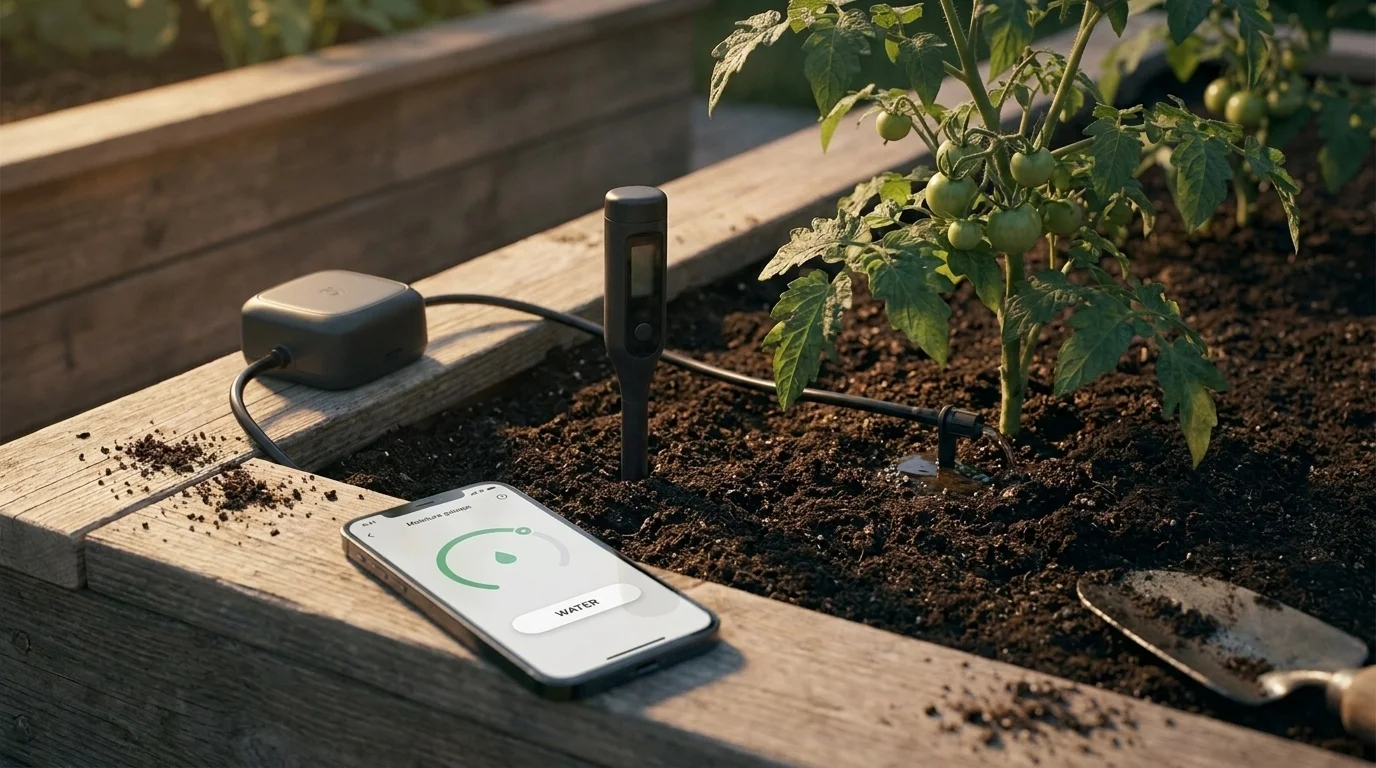
For readers who want the watering to happen without them being there, the architecture has converged. The 2026 buyer's guides — Smart Home Explorer's annual round-up is the clearest of them — treat the closed-loop pattern as default rather than advanced: a smart soil moisture sensor reports a dry reading; a smart irrigation valve or a smart plant pot with an integrated reservoir opens and delivers a measured volume of water; the sensor confirms that the target VWC has been reached; the valve closes. The whole loop, in a Matter-compatible system, runs without a phone in the room.
The piece of this architecture that has changed in the last two years is the protocol layer. Until 2024, sensors and valves tended to be brand-locked: a Gardena valve worked with a Gardena sensor; an Eve sensor with an Apple HomeKit valve; a Bosch hub with Bosch peripherals. The shift to the Matter smart-home standard, and to the Thread mesh protocol that runs underneath it, has meaningfully changed the buying decision. A Matter-compatible sensor — and Matter 1.4 has specifically improved support for the sleeping, battery-powered devices that garden sensors are — will speak to Apple Home, Google Home, Alexa, SmartThings, and Home Assistant alike, with the practical effect that the buyer is no longer betting their five-year garden infrastructure on the survival of one vendor's app (Matter Smart Home 2026 — Thread Protocol and Interoperability, Matter & Thread Explained 2026).
The category has matured commercially as well. THIRDREALITY's Smart Soil Moisture Sensor Gen2, launched in March 2026, is a useful marker — the product positioning explicitly targets everyday plant care rather than the early-adopter / DIY audience that dominated the category through 2022. The 2026 question for a home gardener buying her first smart sensor is no longer "is this a hobby toy or a real product"; it is "which interoperability standard will still be supported in five years," and the honest answer in mid-2026 is Matter over a brand-locked Bluetooth.
For a single pot the closed-loop is more than the situation requires. For a holiday cottage's herb planter, a holiday-rental's window boxes, a balcony's tomato pots while you are at work, or a community-plot allotment whose gardener cannot be there on a weekday — the closed-loop smart garden system, sensor plus valve plus reservoir, is the design pattern that earns its keep. Automatic plant watering, in 2026, is no longer the science-fiction-sounding phrase the older marketing made it; it is a $90 weekend installation that any technically literate gardener can configure across an afternoon.
Loading image...
The loop closes itself: probe reads dry, valve opens, sensor confirms, valve shuts. Buy for the Matter standard, not the brand — it's the part still working in five years.
A short word on plant-identification apps
A neighbouring reader interest, worth naming briefly: the moisture sensor's nearest cousin in the consumer market is the plant identification app category — Picture This, Seek by iNaturalist, Google Lens's plant mode, PlantNet. These are not the same tool. A moisture sensor answers a question about a plant you already own. A plant ID app answers a question about a plant you have just seen on a wall, in a borrowed garden, or growing through a fence. The two markets shop the same shelves but serve different jobs. If you are in the second job — the question of what is this plant — most of the apps now identify common species to about ninety per cent accuracy in a clear photograph, and any of the named four is a reasonable place to start.
The diagnostic to check tomorrow morning
Press a thumb into the soil of the pot you are most worried about. If the print holds sharp edges and stays dry, the soil is below field capacity and the plant is in the lower half of its plant-available window. If the soil compresses softly and your thumb comes out clean, the soil is somewhere in the middle of that window. If the soil compresses and clings to the thumb and the imprint glistens, you are at or above field capacity and watering is the last thing the plant needs.
The probe in the pot does this same reading numerically, more often, and from a distance. It is, in the honest reading of all the literature, a faster way to do a job an experienced gardener already does with her hands. For the experienced gardener it is a convenience. For the gardener who is away in August, or the gardener whose Salvia did not survive the kind neighbour, it is the cheap insurance the older perennials in the older pots will quietly thank her for.
What's the difference between a soil moisture sensor and a plant moisture meter?
The terms are used interchangeably in consumer retail, but a moisture meter usually refers to a handheld probe with a dial or LCD that you push into the soil and remove. A soil moisture sensor more often refers to a probe that stays in the pot and reports data continuously to an app or hub. Both measure the same thing; the difference is how often you read it and where the data goes.
Do soil moisture sensors work well for houseplants?
Yes, with one caveat: pick a short-probe model (4–7 inches) designed for indoor potting soil. Long-probe outdoor meters can hit the bottom of small pots and give false readings. Sub-$20 analog meters with no batteries are reliable for indoor use as long as you push them in slowly to avoid bending the probe.
How accurate are cheap soil moisture sensors?
Inexpensive capacitive sensors (under $20) are accurate enough to tell dry from moist from wet, but they drift over time and aren't precise enough to read absolute volumetric water content (VWC). A 60-second calibration — pushing the probe into a known-saturated pot and noting the reading, then into the same pot after a week of no watering — fixes the practical gap for home use. Research published in 2024 confirmed this drift and the value of low-cost calibration routines.
Do I need WiFi for a soil moisture sensor?
No. Plenty of effective sensors use Bluetooth (no WiFi required, works within ~10 meters of your phone) or a stand-alone analog dial with no wireless at all. WiFi or Matter/Thread sensors are only worth the premium if you want remote alerts when you're away from home, or if you're tying the sensor into automated watering.
What does a soil moisture reading actually mean?
Most analog meters use a 1–10 scale where 1–3 means dry (water now for most plants), 4–7 means moist (the target zone for most houseplants), and 8–10 means wet (skip watering, check drainage). Digital sensors usually report a percentage — volumetric water content (VWC). Translating VWC into water now or wait depends on the soil type and plant; sandy potting mix and dense clay garden soil are not comparable at the same VWC number.
Can a soil moisture sensor turn my watering on and off automatically?
Yes — pair a smart soil sensor with a smart irrigation valve or smart plant pot that supports the same protocol (Matter, Thread, or a vendor app). The sensor reports a dry reading, the valve opens and waters, the sensor confirms the target moisture is reached, and the valve closes. This closed-loop pattern is the foundation of modern automatic plant watering systems and the default architecture in 2026 buyer guides.
Should I buy a Matter-compatible soil moisture sensor in 2026?
If you want the sensor to integrate with smart-home hubs (Apple Home, Google Home, Alexa, SmartThings, or Home Assistant), yes — Matter and Thread support let one sensor work across all of them, and Matter 1.4 specifically improved battery life for sleeping devices like garden sensors. If you only want a handheld reading for a few houseplants, a $14 analog probe is the right answer; Matter is overkill.
Bridging the Digital Divide: Empowering All Home Gardeners with Accessible Technology
Join
Loading...
Our Green Community!
Loading...
VerdeNook is more than just a source of gardening wisdom; it’s a platform for sharing, learning, and growing together. We invite you to join our community, share your stories, and spread the joy of gardening. Let’s sow the seeds for a greener, healthier, and more sustainable future, one garden at a time.