The poinsettia was never a two-week bouquet — it's a Mexican shrub that will keep a calendar with you if you slip off the foil and treat it like the houseplant it is.
The poinsettia you were handed in December is Euphorbia pulcherrima, a shrub that grows several feet tall on the hillsides of Mexico — not a bouquet with a two-week clock ticking on it. That distinction is the whole of good poinsettia care: treat the plant as the perennial it actually is, and it will outlast the wrapping paper, green up through spring, and flush red again next winter. Most people don't, which is why the poinsettia has a reputation as a disposable prop. It doesn't deserve one.
The short version, if you keep four things steady: give it bright, indirect light, hold the room at a stable 65–70°F, water only when the top inch of soil is dry, and slip the decorative foil off the pot so the roots never sit in water. Below is the full arc — everyday care, the honest answer to whether it's poisonous, how to carry it through the whole year, and the one photoperiod trick that makes it rebloom.
How Do You Care for a Poinsettia? A Quick-Start Answer
To care for a poinsettia, set it in bright, indirect light for six or more hours a day, keep the room at a steady 65–70°F, and water only when the top inch of soil feels dry — then let it drain fully, never sitting in a foil-wrapped pot. Skip fertilizer entirely while it's in bloom.
Factor
What it needs
Light
Bright, indirect — 6+ hours a day; no hot direct glass, no deep shade
Water
Only when the top inch is dry; remove the foil so the pot drains
Temperature
65–70°F by day, 55–65°F at night; never below 50°F
Humidity
Prefers moist air; group plants or use a pebble tray in dry winter heat
Fertilizer
None while in bloom; every 3–4 weeks once spring growth appears
That table is the entire job for the six weeks the plant is on your table. What separates a poinsettia that lives from one that gets composted in January isn't the holidays — it's what you do after the color fades, and whether you fell for the two-week-flower assumption in the first place. You don't have to. And if you keep other houseplants, the same seasonal, day-length-aware thinking runs through VerdeNook's Pollinator Care guides. First, though, the question everyone quietly asks.
Poinsettia Safety — The Truth About Toxicity to Pets and Kids
Poinsettias are not dangerously poisonous. They can cause mild mouth, stomach, or skin irritation — so keep them out of reach of pets and toddlers, but don't panic.
I spend a good part of the year telling people that a plant they fear is harmless and a plant they trust is not, so I have patience for this one. The poinsettia's "poison" reputation is one of the most durable myths in American horticulture, and the evidence against it is overwhelming. Per POISINDEX, the national database that U.S. poison centers rely on, a 50-pound child would have to eat 500 to 600 leaves — roughly 1.25 pounds of plant material — to reach the experimental dose at which researchers still recorded no toxicity (Poison Control). One analysis of 22,793 reported exposures found essentially no meaningful toxicity across nearly twenty-three thousand cases (Pet Poison Helpline).
The myth even has a birthday. In 1919, a two-year-old's death was blamed on a poinsettia leaf; the plant was later exonerated, and Ohio State University researchers formally disproved the toxicity story in 1971 (OSU BuckMD). What's actually in the plant is the same thing that's in my milkweed: Euphorbia is a latex-bearing genus, and its milky sap can raise a mild skin rash — "not poisonous, but the sap may cause dermatitis," as the University of Minnesota Extension puts it (UMN Extension). Wash your hands after pruning and keep the sap out of your eyes.
For pets, the ASPCA classifies poinsettias as mildly toxic to dogs, cats, and horses — "irritating to the mouth and stomach, sometimes causing vomiting, but generally over-rated in toxicity." The signs are self-limiting, and the Pet Poison Helpline advises calling your veterinarian only if they persist past 12 to 24 hours. Set the plant somewhere a cat can't casually chew it, and you've managed the entire real risk.
Why aren't poinsettias allowed in some hospitals?
Some hospitals still discourage poinsettias, and it isn't because they're dangerous. The restriction, where it exists, is a holdover from the exaggerated myth above — precaution rooted in the plant's reputation, not in any real toxicity. The mild sap irritation is a non-issue for nearly everyone who isn't eating the leaves by the handful.
Everyday Poinsettia Care — Light, Water, Temperature, Humidity & Feeding
Here is the day-to-day, grounded in what the university extension services actually measure. Five dimensions; keep them steady and the plant mostly runs itself.
Light
Bright and indirect is the whole rule. A poinsettia wants six or more hours of indirect light a day — an east- or south-facing window with the plant set back from hot, direct glass. Deep shade at one end, hot direct glass at the other: those are the two ways to get light wrong.
Watering (and the foil trap)
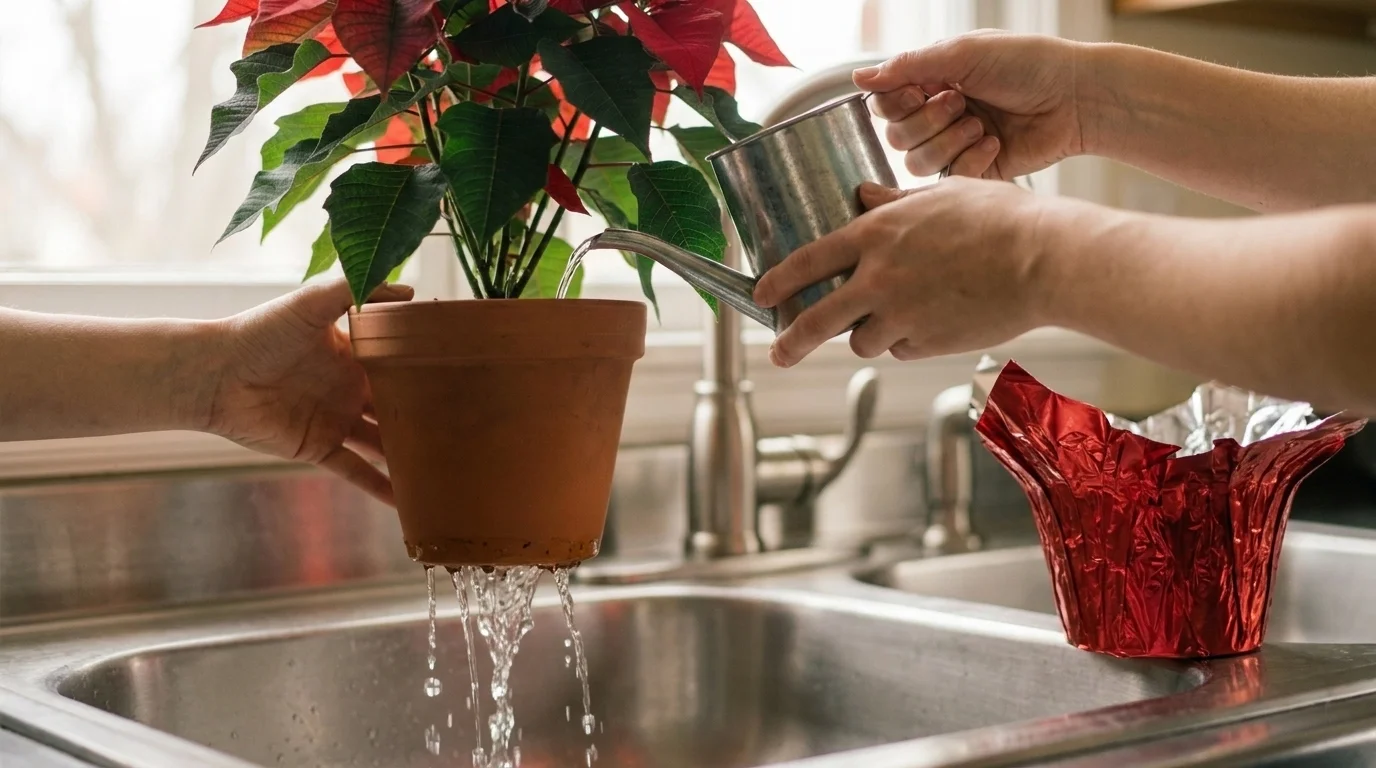
This is the dimension that kills poinsettias. Utah State University is blunt about it — poinsettias "are very sensitive to overwatering and will develop root rot quickly if kept too wet." Water only when the top inch of soil is dry, or when the pot feels light in your hand; then water thoroughly and let it drain completely. The single most useful habit is to take the plant out of its decorative foil, or punch holes through the bottom of it, so the pot never stands in a reservoir of its own runoff. A poinsettia sitting in a foil-lined sleeve of water is a poinsettia with rotting roots, whatever the top of the plant looks like today.
Temperature
Poinsettias hold best at 65–70°F during the day and 55–65°F at night — which is simply ordinary living-room weather. The danger is at the edges: below 50°F they take cold damage, and a spot against a cold windowpane, beside a drafty door, or directly above a hot radiator or heat vent will stress the plant into dropping leaves. Steady is the operative word; poinsettias resent sudden swings more than any single temperature.
Humidity
Coming from a subtropical climate, a poinsettia dislikes the bone-dry air of a heated winter room. You don't need to fuss over it — grouping it with other houseplants, or standing the pot on a tray of pebbles and water (pot resting above the waterline, never in it), keeps the local air a little more humid and the leaf edges from crisping.
Fertilizer
Skip it entirely while the plant is in color — a blooming poinsettia isn't putting on growth and doesn't want feeding. Once new growth appears in spring, feed every 3 to 4 weeks with a balanced houseplant fertilizer through the growing season. That's the whole feeding schedule.
Loading image...
Overwatering is what actually kills a poinsettia, and the foil sleeve is the trap — peel it off so the pot can drain, and water only when the top inch goes dry.
Can Poinsettias Go Outside? Indoor vs. Outdoor Care
Indoors is home for a poinsettia almost all year. It's frost-tender and takes damage below about 50°F, so "outside" is a summer arrangement only — and even then a conditional one.
Never leave a poinsettia outdoors once nights begin dropping toward 50°F. That same tenderness is why the trip home matters: a plant left on a doorstep in December, or carried across a cold parking lot without a sleeve, can drop its leaves overnight from a single chill. Treat it like the tropical plant it is between the store and your living room.
In summer, once nights reliably stay above 55–60°F — after your last frost date, wherever you garden — a poinsettia can spend the warm months outdoors in bright shade, out of direct afternoon sun. Think in terms of your USDA zone's frost calendar rather than a fixed date on the wall. Then bring it back inside well before autumn nights cool, which happens to line up with the reblooming schedule below: the plant needs to be indoors and on its dark-period regimen by the start of October regardless.
Keeping Your Poinsettia Alive After the Holidays
Keeping a poinsettia alive after Christmas is mostly a matter of not giving up on it the moment it stops looking festive. Hold it in bright, indirect light at 65–70°F through the winter; as the bracts fade, understand that the plant is finishing its bloom, not dying.
March or April, once the color is gone, is when you step in. Cut the whole plant back to about 4 to 6 inches and ease off the watering. It will look like a bare stick for a few weeks — that is exactly right, not a failure. By May you'll see new growth push from the cut stems, and that's your cue to resume feeding every three to four weeks. Over summer, repot it into fresh potting mix and pinch back the growing tips a couple of times to force a bushy, many-branched plant instead of one leggy stalk. This is also when it can summer outdoors, if you'd like. Everything you do from spring onward is quietly building the framework that will carry next winter's color.
How to Make a Poinsettia Rebloom — The Dark-Period Method
To make a poinsettia turn red again, you have to give it long, unbroken nights. The bracts recolor on a light cue, not a calendar one — and the cue is darkness.
This is the step that fits the way I think about plants better than any other part of the job, because it is pure day length. Poinsettias are short-day plants — long-night plants, more precisely — running the same photoperiod machinery that tells a chrysanthemum or a wild aster when to flower. The colored bracts form only once the plant registers nights long enough to mean winter is coming, and it registers them through a pigment that even a little stray light will reset.
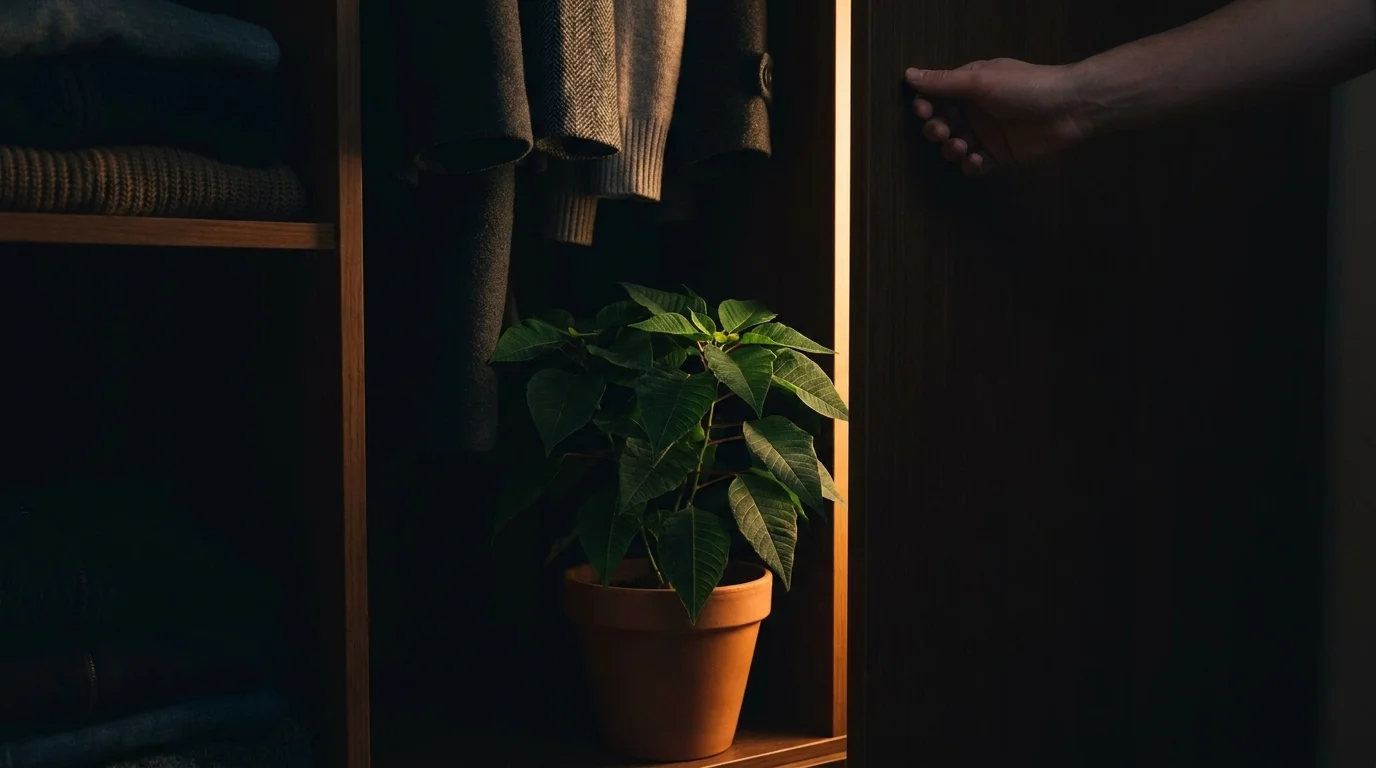
The schedule, from Utah State University's extension: starting October 1, give the plant a minimum of 14 hours of complete, uninterrupted darkness every single night — a closet, an unused room, or a cardboard box all work — plus bright light during the day. Keep it up through November, until the bracts color up.
The near-universal reason this fails is a light leak. A hallway lamp under the closet door, a streetlight through a gap in the curtains, a phone screen, the television across the room — a few minutes of light in the middle of that 14-hour night resets the clock, and the plant simply stays green. If yours never recolors, this is almost always the culprit. Expect color to build over roughly 8 to 10 weeks from the day you begin, which lands you right back at the holidays.
Loading image...
Reblooming is pure photoperiod: from October 1 the plant needs fourteen unbroken hours of dark a night, and that sliver under the door is exactly what keeps it green.
Poinsettia Care by Month — A 12-Month Calendar
If you'd rather run the whole year off one schedule, here it is — the same guidance above laid out month by month, with the dark-period window built in. Set an October 1 reminder and the hardest part takes care of itself.
Month
What to do
December
Enjoy the bloom: bright indirect light, 65–70°F, water when the top inch is dry, no fertilizer.
January
Same steady care. Bracts may begin to fade — that's normal, not decline.
February
Continue steady light, warmth, and dry-check watering as the plant finishes blooming.
March
As the bracts fade, cut the plant back to 4–6 inches and reduce watering.
April
Keep it in bright light, water sparingly; this is the bare "stick" stage.
May
New growth appears — resume feeding every 3–4 weeks.
June
Repot into fresh mix; pinch growing tips for bushiness. Optional bright-shade outdoors if nights stay above 55–60°F.
July
Bright indirect light, regular water and feeding; pinch again if it's getting leggy.
August
Keep feeding and pinching — the last window to shape the plant.
September
Bring it back indoors before nights cool; hold it in bright light.
October
From Oct 1: 14+ hours of complete darkness nightly plus bright days — the rebloom trigger.
November
Continue the dark treatment until the bracts recolor, then stop and display.
Poinsettia Problems and Fixes — Troubleshooting Table
When a poinsettia goes wrong, it's almost always one of five things, and almost always about water or temperature. Here's the quick diagnosis.
Problem
Likely cause
Fix
Leaves or bracts dropping
Cold draft, a sudden temperature swing, or soil lurching between bone-dry and soggy
Move it away from drafts and heat vents; keep the room steady at 65–70°F; water on the dry-check
Wilting
Under- or over-watering
Check the top inch of soil; if it's wet, the roots are the problem — let it dry, remove the foil so it drains
Yellowing lower leaves
Overwatering or poor drainage
Let the soil dry, take off the foil sleeve, and check the roots for rot
Root rot (mushy stems, sour smell)
The pot has been sitting in water
Repot into fresh, well-draining mix, remove the foil for good, and water only on the dry-check
Stays green / won't rebloom
A light leak during the dark period
Enforce a full 14 hours of uninterrupted darkness every night from October 1
Loading image...
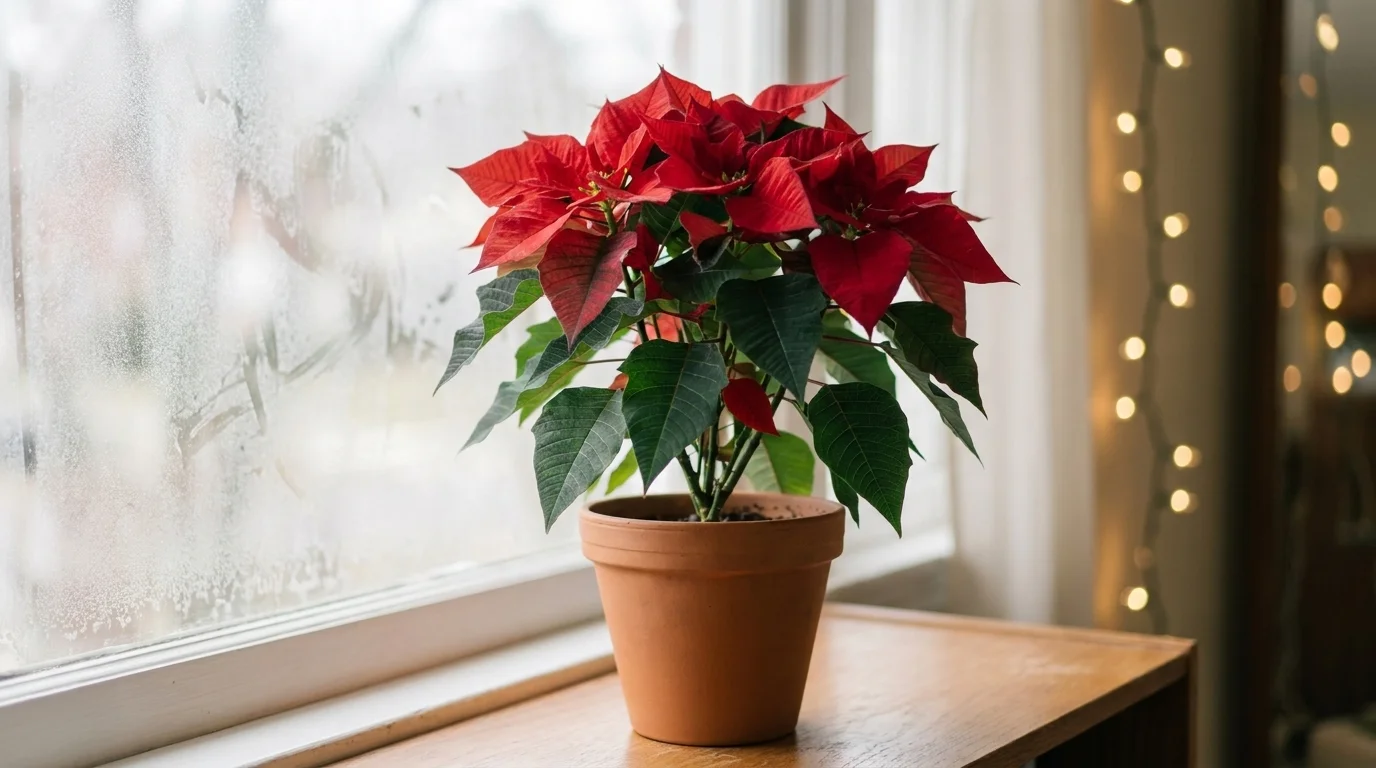
This is the payoff the dark treatment buys: a plant that recolors on a schedule you set, paying you back in red every December instead of the compost in January.
The Poinsettia Is Not Disposable
Good poinsettia care comes down to four steady habits: bright indirect light, a stable warm room, watering only on the dry-check, and — for the ambitious — 14 hours of darkness a night from the first of October. Do the first three and your holiday gift becomes a houseplant that lives for years. Do the fourth and it becomes a plant that pays you back in color every December, on a schedule you set. That's the reframe worth making: the poinsettia was never a two-week bouquet. It's a Mexican shrub willing to keep a calendar with you. Bookmark the month-by-month table, set that October 1 reminder, and find more seasonal houseplant care in VerdeNook's Pollinator Care hub.
Frequently Asked Questions
Are poinsettias poisonous to cats, dogs, or children?
No — they're only mildly irritating. POISINDEX found a 50-pound child would need to eat 500+ leaves to reach a dose that still showed no toxicity, and the sap causes only mild mouth, stomach, or skin upset. Keep it out of reach of pets and toddlers, but don't panic.
How do you keep a poinsettia alive after Christmas?
Keep it in bright indirect light at 65–70°F and water only when the top inch of soil is dry. After the bracts fade in March or April, cut it back to 4–6 inches and reduce watering; it will releaf by May.
How do you get a poinsettia to rebloom?
Starting October 1, give it a minimum of 14 hours of complete, uninterrupted darkness every night (a closet or box) plus bright light by day, continuing through November until the bracts recolor. Any stray light during the dark period resets it.
How often should you water a poinsettia?
Water when the soil surface feels dry to the touch or the pot feels light, then let it drain fully. Remove any foil wrapper so it can drain — poinsettias develop root rot quickly if left sitting in water.
How long do poinsettias stay colorful indoors?
The bracts typically hold their color for many weeks — often through the holidays and beyond — as long as light, temperature, and watering stay steady. Fading afterward is normal, not a sign the plant is dying.
The Benefits of Starting a Pollinator Garden in Your Backyard
Join
Loading...
Our Green Community!
Loading...
VerdeNook is more than just a source of gardening wisdom; it’s a platform for sharing, learning, and growing together. We invite you to join our community, share your stories, and spread the joy of gardening. Let’s sow the seeds for a greener, healthier, and more sustainable future, one garden at a time.