The Rise of Gen Z Gardeners: Redefining Traditional Horticultural Practices
Share this article:
A young gardener with three feet of railing, seven cultivars chosen carefully, has — in any meaningful sense — made a garden.
At Glee Birmingham, the UK garden trade show, retailers in September 2024 reported a clear surge in young gardeners: 70% of 18-to-35-year-olds describe themselves as interested in gardening, 83% of young people describe gardening as "cool", and British garden centres now serve a Gen Z customer base around 40% larger than they did a few years ago, with Millennials up by roughly 65% on the same horizon (Glee Birmingham, Sep 2024). The same survey put per-person Gen Z spending on houseplants at around £414 a year, a figure that until recently belonged to a quietly older customer. What is interesting about all of this is not that young gardeners exist — they always have — but that the gardens they are making look measurably different from the ones their grandparents inherited.
The young gardener I have in mind, watching this generation arrive in the trade, is not the lawn-and-bedding gardener of the 1970s. She is more often a renter with a Victorian flat in Manchester or a balcony in Bristol; he has perhaps a strip of paving outside a Camden housing co-op; they want plants that earn their place by feeding something — pollinators, foxes, the human eye at dusk — and they are unsentimental about the plants that don't. This article is for that gardener: a working guide to the borders, the balcony containers, and the design ideas the young UK garden is actually being built from.
What young gardeners are actually planting
The Royal Horticultural Society relaunched its Plants for Pollinators list in July 2025 after a full six-year review, published in BioScience (RHS — Plants for Pollinators update). The new list runs to more than 10,000 plants, and — usefully — promotes nineteen plant groups to whole-genus status: every hardy species of Lavandula, Campanula, Euphorbia, Prunus, Salvia, Eryngium (sea holly), and Origanum (marjoram), among others, now counts. At the same time the RHS removed fourteen plants for lack of evidence, including Catananche caerulea, Cleome hassleriana, and Cuphea ignea. The list is, in other words, harder-edged than it used to be: a plant earns its place because the evidence supports it, not because it looks pollinator-friendly to a human eye.
Drought is the second axis the 2025 list now foregrounds. With UK water restrictions tightening, the RHS has begun to promote drought-tolerant pollinator picks — plants that pay back twice in a hot summer (Landscape & Amenity, 30 July 2025). A working shortlist for a young gardener building a first pollinator scheme in 2026, with cultivars named for the gardener who wants to act on the list this weekend:
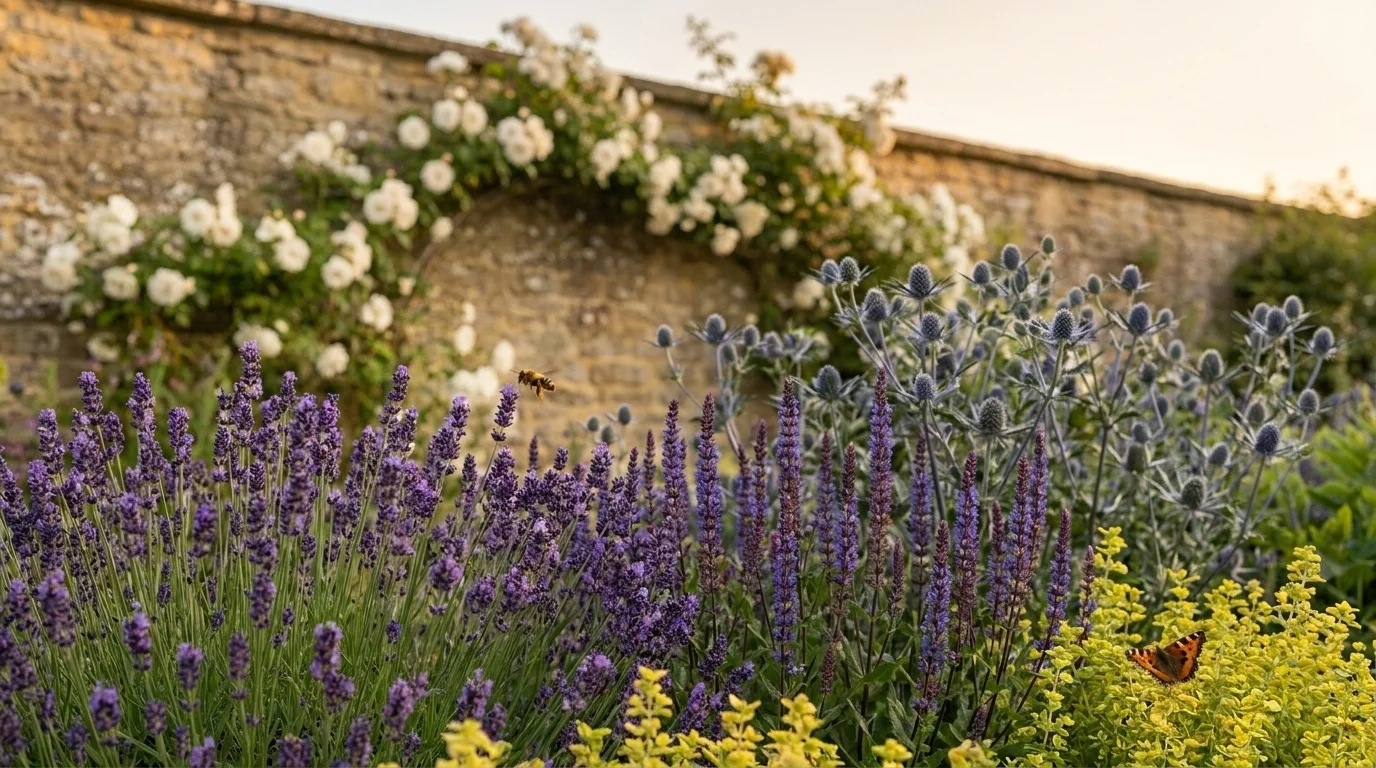
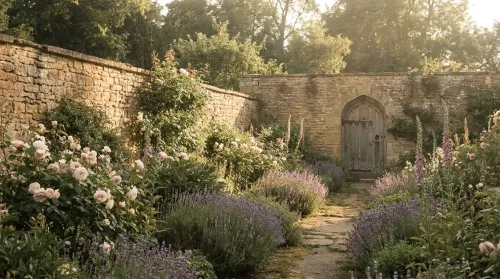
Lavandula angustifolia 'Hidcote' — the small, dark-purple English lavender, denser and tidier than 'Munstead'; takes drought, smells of August, and bees of half a dozen species will work it from June to September.
Salvia nemorosa 'Caradonna' — the slate-blue spikes that hold their colour through the worst of a July heatwave; bees and hoverflies; cut back hard in early July for a second flush.
Eryngium x zabelii 'Big Blue' — sea holly, drought-tolerant to the point of being indifferent to it, a magnet for solitary bees and a structural plant of real interest at twenty paces.
Origanum vulgare 'Aureum' — golden marjoram; the flowers feed honeybees and bumblebees through August when the borders thin; the leaves are kitchen-useful, which a young gardener appreciates.
Euphorbia characias subsp. wulfenii — the architectural Mediterranean spurge; chartreuse heads in spring, drought-tolerant, and providing nectar in March when very little else does.
Campanula persicifolia — peach-leaved bellflower; harebell-blue, will self-seed politely into gravel, and feeds the smaller solitary bees.
Helianthus 'Lemon Queen' — the perennial sunflower; six feet tall by August, drought-handles in established borders, and a late-season nectar station for bees winding up for winter.
The seven of these, in even a small border, will carry pollinators through from the first warm March afternoon to the last September dusk. Each is on the 2025 RHS list and each pays back in drought. None of them is clever, and that is the point.
Loading image...
Seven cultivars in a Cotswold border, each on the 2025 RHS list. From the first warm March afternoon to the last September dusk; nothing clever, all kind.
A pollinator garden in a rented flat
The Gen Z reality, more often than not, is a balcony, a windowsill, or a square of paving outside a back door. Urban European households reported a 38% rise in balcony gardening activity post-COVID and have not turned back (Hongmao Garden, 2025). The good news, for a gardener with three feet of railing rather than thirty feet of border, is that a small container scheme will do real pollinator work; the plants do not know they are in a pot.
Three containers, planted thoughtfully, will carry a small pollinator garden through a season:
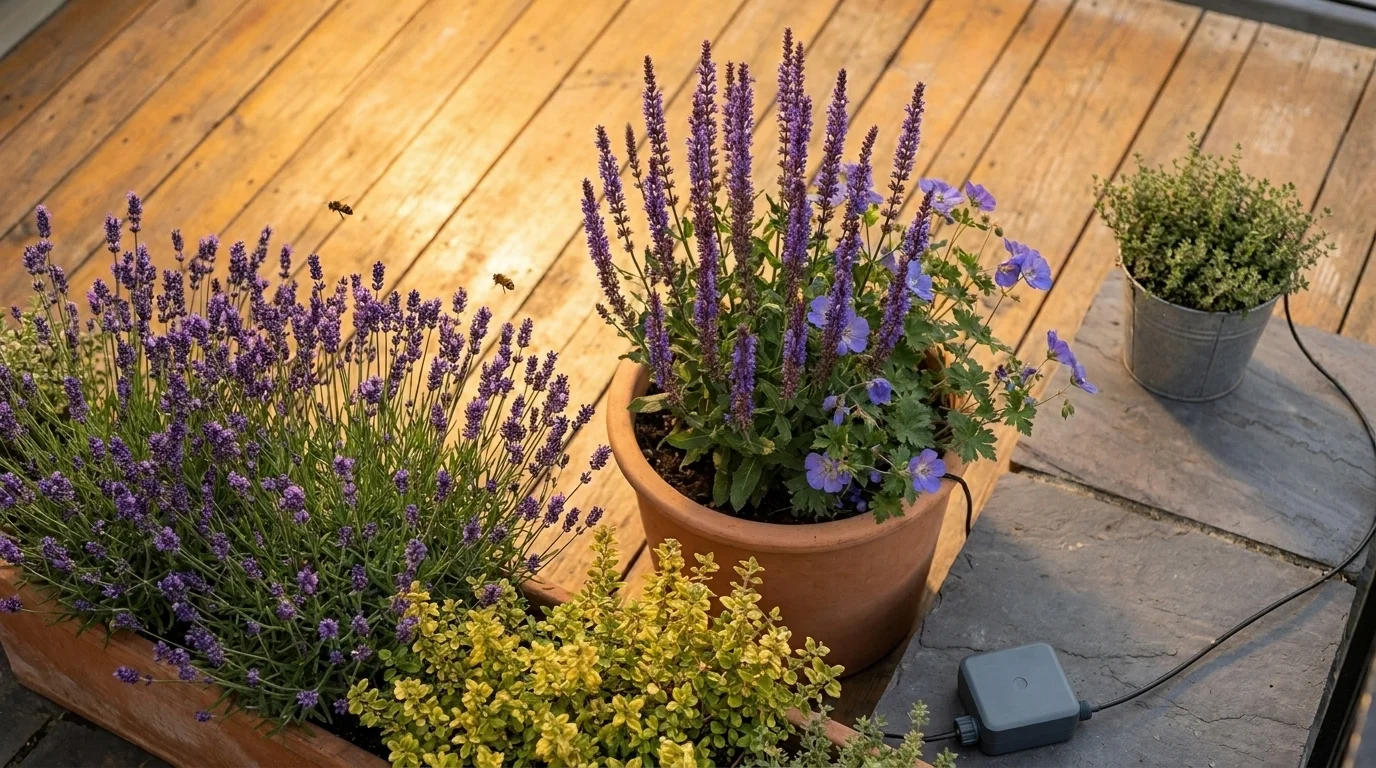
A long terracotta trough planted with Lavandula angustifolia 'Hidcote' along the back and Origanum vulgare 'Aureum' along the front — the structure of the lavender behind, the running golden marjoram beneath. Place against a south- or west-facing wall.
A round 40 cm pot of Salvia nemorosa 'Caradonna' with Geranium 'Rozanne' threading through the front. The salvia gives the upright structure, the geranium spills, and both flower into October if deadheaded once in midsummer.
A small zinc bucket of Thymus serpyllum (creeping thyme) and Origanum vulgare on the windowsill. The thyme flowers in May, the marjoram in August, and the windowsill becomes a working bee station for half the year.
If the balcony gets less than four hours of direct sun a day, swap the lavender and salvia for Astrantia major and a small Geranium phaeum — both will flower in part shade, both are on the RHS list, and both will feed early bumblebees. The unlovely truth is that a balcony in deep shade cannot do everything a south-facing border can; but it can still feed something, and the something is more interesting than the empty pot.
The single piece of equipment that makes balcony gardening sustainable rather than aspirational is a drip-irrigation kit on a battery timer — typically £40 to £100 for a balcony-scale setup in the UK, depending on whether you start with a basic Hozelock-style hose-end timer or step up to a smartphone-controlled tap timer such as the Hunter BTT. Either way, it is half an hour to install. Forgetting to water on a hot August weekend is the most common failure mode for a young gardener with a balcony scheme; a timer removes the failure mode.
The heritage-seed thread runs through the new generation's gardening for a reason that has nothing to do with marketing language. A heirloom — or heritage — vegetable variety is, broadly, an open-pollinated cultivar passed down through at least fifty years of gardener-to-gardener selection: 'Brandywine' tomato, 'Hidcote Yellow' courgette, 'Painted Lady' runner bean. They breed true, meaning the seed you save this year produces the same plant next year. F1 hybrids, by contrast, are deliberately crossed for first-generation vigour; the seed they produce will not breed true and is essentially commercially useless to a home seed-saver.
What the young gardener has rediscovered, in choosing heritage varieties, is a kind of horticultural autonomy that was lost somewhere in the mid-twentieth century when commercial F1 hybrids took over the supermarket end of the vegetable trade. The Garden Organic Heritage Seed Library in Coventry now distributes over 800 vegetable varieties that are not legally allowed to be sold commercially in the UK because they are not on the National List — varieties saved from extinction by exactly the gardener-to-gardener network that the heritage label gestures at. Joining the library, or one of the regional seed-swap groups that have appeared in most British cities in the last decade, is the practical version of the heritage-seed cultural turn.
It is also a useful corrective to the idea that young gardeners are interested only in aesthetic novelty. The same gardener who is sourcing a 'Crimson Flowered' broad bean from a Coventry seed library is, very often, the same gardener who is reading about Edwardian planting schemes in old copies of Gardens Illustrated; the heritage thread runs in both directions through this generation, and a planting scheme that ignores it is reading the moment wrong.
Wildlife-first design
The dominant trend running through the 2026 garden coverage from the RHS, Spring Fair, spoga+gafa, PHS and UMN Extension is the same one: wildlife-first design. Where the late twentieth century framed a garden as a visual composition first and a habitat second, 2026 inverts the order. The garden is designed around habitat value — what it feeds, what it shelters, what it composts back into the soil — and the visual composition emerges from those choices (Gardening Know How, 2026 trends).
In practice, in a small UK garden, this means a few clear shifts:
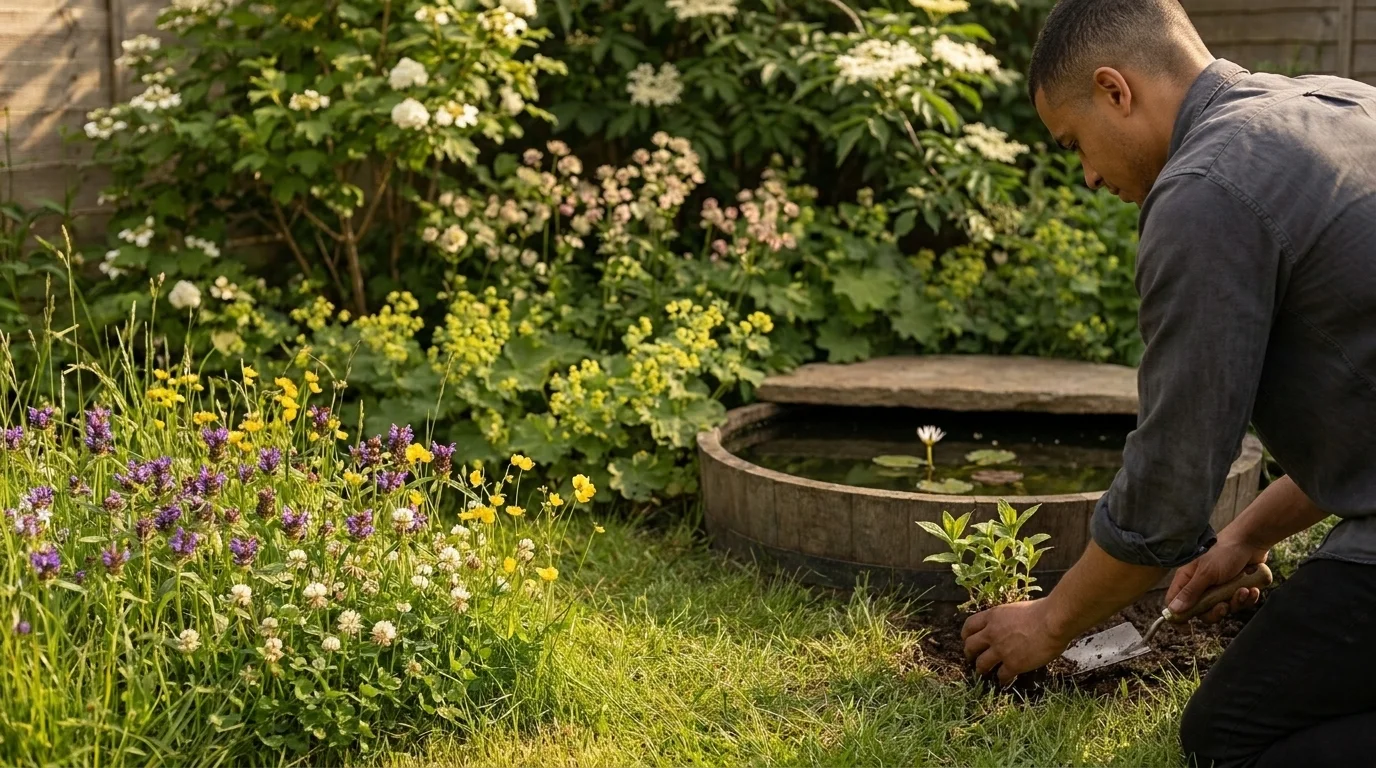
A no-mow patch somewhere on the lawn — not the whole lawn, but a 1 × 2 m corner left unmown from late April to the end of July, where selfheal (Prunella vulgaris), bird's-foot trefoil (Lotus corniculatus), and white clover (Trifolium repens) will flower in their own time and feed solitary bees that the rest of the garden does not.
Native shrubs in the back of borders — Viburnum opulus (guelder rose), Sambucus nigra (elder), Crataegus monogyna (hawthorn) — that flower for pollinators and fruit for thrushes. The Soil Association's recent organic-gardening data cited in this year's trend coverage tracks a 30% uplift in soil biodiversity from organic practices compared with conventional (Gardening Know How, 2026 trends), and a native-shrub layer is part of how that uplift compounds.
A layered planting matrix — instead of the bedding-style monoculture, a structure of trees, shrubs, perennials, and ground-cover that mimics the layers of a woodland edge. Astrantia, Alchemilla, hardy geranium, and creeping thyme do the connective work; named perennials sit within that matrix rather than against a bare-soil background.
A small water source — a half-barrel pond, a tin bath sunk into a corner, a stone basin on the patio with a single oxygenator and a flat stone for the bees to land on. Water transforms a small garden's bird and insect count within a single season.
The wildlife-first frame is also, usefully, the frame the RHS is now using in its 2025 garden predictions: edible perennials, sponge cities, hortivoltaics, smaller 9cm starter plants as an affordable entry point for new gardeners (RHS 2025 predictions). The Gen Z gardener and the RHS researcher are, for once, looking at the same garden through the same window.
Loading image...
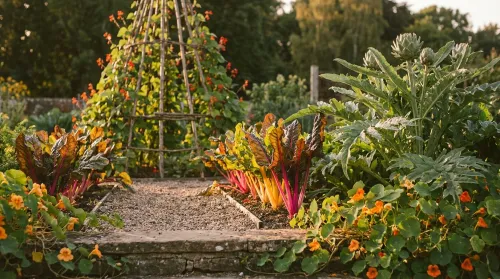
A square metre of unmown grass and a half-barrel of water will lift a small garden's bird and insect count within one season; the layered matrix does the rest.
Mindful gardening, made specific
Mindful gardening has become a phrase that gets used so often it has nearly lost its content. Used precisely, it refers to a small set of practices that change the way a gardener pays attention — slowing observation, naming what is seen, choosing planting for scent and touch rather than only for sight, and writing the garden down. None of these is new, and most of them belong, more or less, to the contemplative tradition of horticultural writing that Gertrude Jekyll inherited and Vita Sackville-West kept alive.
Three practices that translate the phrase into something a young gardener can act on this week:
The slow walk — fifteen minutes in the garden with no tool in the hand, in the morning or at dusk, looking only. The point is not to find work to do; it is to notice what has changed since yesterday. The same border in late May at seven in the morning is a different garden from the same border in late May at seven in the evening, and both are correct.
A small handwritten journal — one page a week, undated if you must but ideally dated, noting what is in flower, what has finished, what has been visited by what. A pencil sketch of a single leaf is more useful than a phone photograph, because the drawing forces the eye to look longer. The young UK gardeners profiled in Gardens Illustrated's 2024 generational piece — among them Anna McLoughlin, Tom Leonard ("The Drag Queen Gardener"), Luke Senior at Great Dixter, and Ashleigh Aylett, the 2024 RHS Young Designer of the Year — almost all keep some form of garden journal (Gardens Illustrated, Gen Z gardening advice).
Sensory planting — designing one corner of the garden for scent and touch rather than visual impact. Rosmarinus officinalis under a south-facing window for the brush-past; Stachys byzantina (lamb's ear) at the edge of a path for the hand; Nicotiana sylvestris by an open window for the evening scent in July; Lonicera periclymenum trained against a porch for the same purpose in May. None of these plants is clever; all of them ask the gardener to notice differently.
The composting and water side, briefly
The eco-conscious practices that the original framing reached for are worth keeping, sharper. Home composting (3,600 monthly UK searches alone) reduces household waste, returns nutrients to the soil, and — usefully — gives a working gardener a place to put the inevitable failed seedling trays. The Soil Association's 30% soil-biodiversity uplift from organic methods (Gardening Know How) is, in plain terms, what the composting bin produces.
A simple two-bin system works for most small UK gardens: one active bin being filled, one resting bin maturing for use. Mix roughly two parts brown (leaves, cardboard, straw) to one part green (kitchen scraps, lawn clippings, soft prunings) by volume, turn once or twice a season, and a working compost will be ready in eight to twelve months. The same logic applies to rainwater — a 200 L water butt on a downpipe will catch enough water in an average UK month to keep a balcony or small border through a dry fortnight without touching the mains tap; a drip-irrigation line fed from the butt is the next step up.
Loading image...
Half an hour to install, between £40 and £100; a battery timer turns a forgotten hot August weekend from disaster into the same garden you left.
Cultural threads, briefly held
The cultural-diversity thread the original article reached for is real, and it is worth naming without overclaiming. Young UK gardeners now plant Vietnamese mint and shiso alongside marjoram and chives; carry methods learned from Punjabi grandmothers, Jamaican uncles, and Lithuanian neighbours into a small London allotment; and treat the seed-swap table at the local horticultural society as a place where varieties travel as freely as the gardeners who carry them. None of this is new in the UK garden — the long Victorian tradition of botanical exchange was its own version of the same impulse — and it is good to see it returning to amateur soil after a long century of formal-bedding monoculture.
The gardens that result are, if you stand back from them, more layered, more useful, and more interesting than the lawns they replace. Their character is not in any one bold gesture but in the texture of small, considered choices: this plant here because the bees come to it in March; this thyme along this path because the hand brushing it will release the oil; this no-mow corner because the gardener has chosen to leave it. A young gardener with three feet of railing and seven container plants chosen this carefully has, in any meaningful sense, made a garden.
The Erysimum 'Bowles's Mauve' on my own south-facing wall has now been in that spot for seven years, was planted in a hurry on an autumn afternoon, and shows no sign of getting tired. The thing it has taught me — and I think it is what the young gardeners coming through have already learned, faster than my generation did — is that the borders and balconies that last are not the clever ones. They are the ones that are kind to the people who weed them, and kind to the bees that work them, and small in their decisions in a way that compounds into something worth looking at for longer than a season. Walk past your garden tomorrow morning before you reach for a tool, and see whether you can tell what has changed since yesterday. That, in the end, is the only practice that any of the rest of this rests on.
What plants should young gardeners grow to support UK pollinators?
The RHS 2025 Plants for Pollinators list highlights drought-tolerant choices that work in small UK gardens and balcony containers: Lavandula angustifolia 'Hidcote', Salvia nemorosa 'Caradonna', Eryngium x zabelii 'Big Blue' (sea holly), Origanum vulgare 'Aureum' (golden marjoram), Euphorbia characias subsp. wulfenii, Campanula persicifolia and Helianthus 'Lemon Queen'. All support bees, butterflies, and hoverflies and cope with hotter, drier UK summers.
Can you garden for pollinators on a balcony or in a small flat?
Yes — even three or four containers can do real pollinator work. A long terracotta trough with Lavandula 'Hidcote' and golden marjoram, a 40 cm pot of Salvia 'Caradonna' with Geranium 'Rozanne' threading through, and a windowsill of creeping thyme will feed bees from May to October on a south-facing balcony. A battery-timer drip kit (typically £40-£100 in the UK) makes it sustainable through hot summers.
Why is gardening so popular with Gen Z right now?
Garden-centre retailer data from Glee Birmingham (Sep 2024) shows around 70% of UK 18-to-35-year-olds describe themselves as interested in gardening, 83% call gardening 'cool', and Gen Z customer numbers are up roughly 40% (Millennials up 65%). The pull is a mix of wellbeing, environmental awareness, food provenance, and the urban-renter reality that a balcony can become a productive green space.
What is the difference between heritage seeds, heirloom seeds, and F1 hybrids?
Heritage and heirloom seeds are largely interchangeable terms — open-pollinated cultivars passed down through gardener-to-gardener selection for at least 50 years, which breed true when saved. F1 hybrids are deliberately crossed for first-generation vigour; their seed will not breed true and is essentially useless for home saving. The Garden Organic Heritage Seed Library in Coventry distributes more than 800 vegetable varieties that are not legally allowed to be sold commercially in the UK.
What is wildlife-first garden design?
The dominant 2026 design trend: planting schemes built around habitat value (pollinators, birds, beneficial insects, soil biodiversity) rather than purely visual impact. In practice it means a no-mow lawn corner, native shrubs (Viburnum opulus, Sambucus nigra, Crataegus monogyna), layered planting matrices instead of bedding-style monocultures, and a small water source. The Soil Association's organic-practices data tracks a 30% soil-biodiversity uplift compared with conventional methods.
What is mindful gardening, in practical terms?
Three concrete practices: a slow walk of 15 minutes in the garden with no tool in the hand (morning or dusk), a small handwritten journal noting what is in flower and what has visited, and sensory planting that uses scent and touch as the primary design axis (rosemary by a door, lamb's ear at a path edge, Nicotiana sylvestris by an open summer window).
Which young UK gardeners and designers are worth following?
Anna McLoughlin, Harry Baldwin, Tom Leonard ('The Drag Queen Gardener'), Luke Senior at Great Dixter, and Ashleigh Aylett — the 2024 RHS Young Designer of the Year — are among the named voices in Gardens Illustrated's generational profile. They tend to share a habit of keeping a garden journal and a preference for layered, wildlife-led planting rather than bedding-style schemes.
Nurturing the Muse: Integrating Fine Art Principles into Your Vegetable Plot
Join
Loading...
Our Green Community!
Loading...
VerdeNook is more than just a source of gardening wisdom; it’s a platform for sharing, learning, and growing together. We invite you to join our community, share your stories, and spread the joy of gardening. Let’s sow the seeds for a greener, healthier, and more sustainable future, one garden at a time.