Empowerment Through Collective Gardens: Amplifying Social Equity and Inclusion Efforts
Share this article:
An arrangement with the council, the railway, and each other that no spreadsheet will hold; the seedlings are the easy part of what just changed hands.
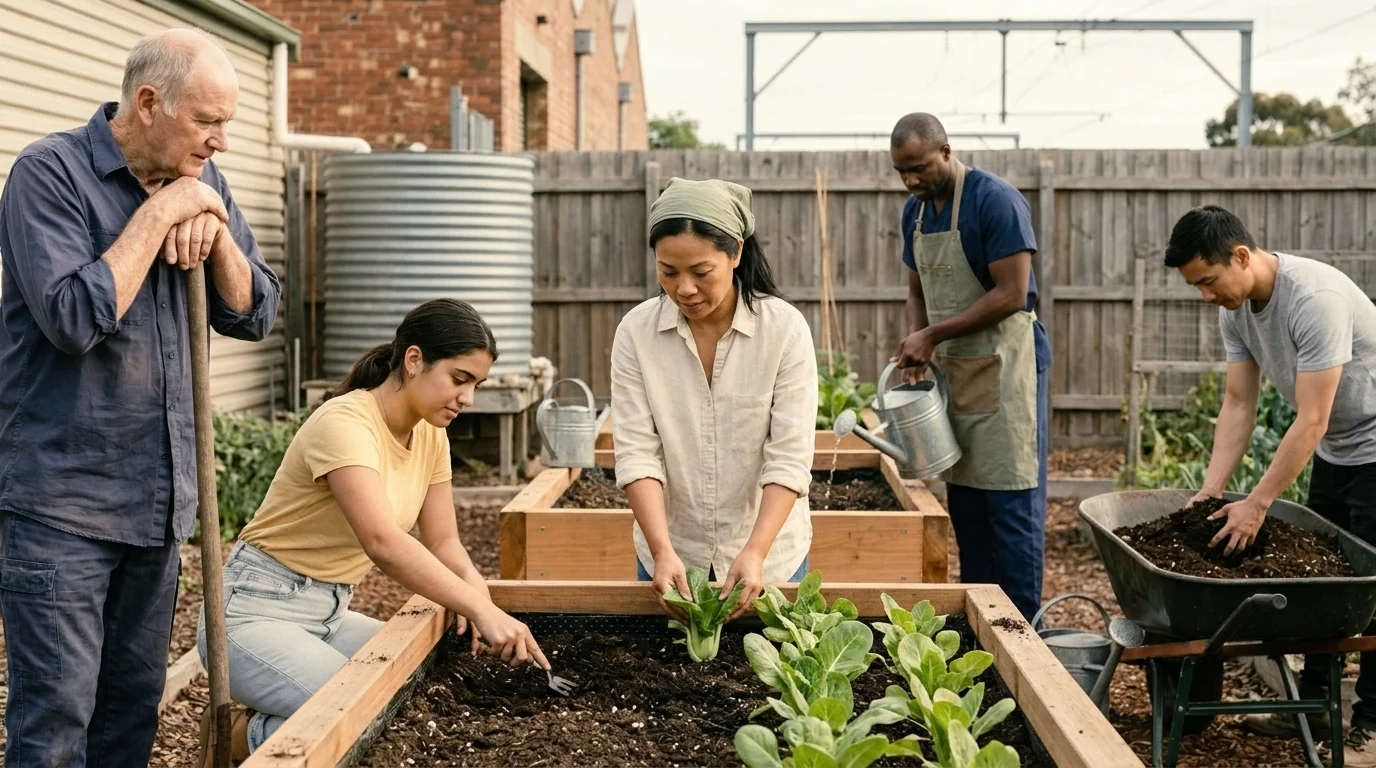
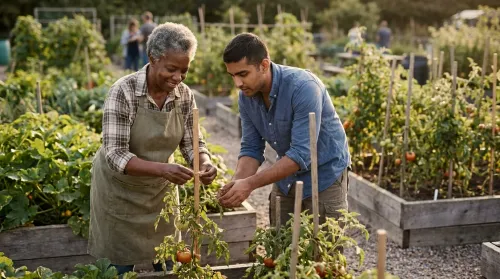
There is no faster way to understand community garden benefits than to spend a Saturday morning at one. On the Saturday I am thinking of, there were nine of us at a community plot behind a train line in Brunswick — a retired electrician, a night-shift nurse who had come straight from a hospital car park, the woman from the Vietnamese grocer two streets across, two exchange students from Lisbon, and four of us somewhere in between. We spent the morning turning a bed, digging through two barrows of aged mushroom compost, and arguing in the most good-humoured way about whether the new pea variety from the seed library was worth the price. By eleven we had a square metre of freshly planted soil each, about three hundred dollars' worth of collective labour by the standards of any rational economy, and a kind of arrangement with the council, the railway, and each other that is harder to put on a spreadsheet. It is that arrangement, more than the lettuce, that the rest of this article is about — what community garden benefits actually look like once you stand inside one, and what it takes to build one that lasts.
What a community garden actually is
A community garden is a single piece of ground — usually leased, sometimes owned outright by a non-profit or council — that a defined group of people cultivates collectively, dividing labour, harvest, or both. The classic form gives each member an individual plot inside a larger shared site, with common paths, taps, tools, and a roster of communal work; the variant forms range from fully collective beds (no individual plots, all hands work all beds) to allotments-with-services (private plots on shared infrastructure) to school and workplace gardens that fold a teaching or staff-wellness brief into the same shape. The unifying thread is shared tenure of land that none of the gardeners individually owns, and a governance model — however informal — that decides who plants what, when, and on whose behalf.
The post-pandemic generation of community gardens has new origins. Google searches for "community garden" jumped about 200% in April 2020 over the same month in 2019 (community-gardening.org), and the wave of plots that started in the years that followed are now four to six years old — old enough that their long-run effects on neighbourhoods, household food bills, and gardener wellbeing are being studied in earnest for the first time. The picture that has emerged is more interesting, and more honest, than the breathless coverage of 2020.
Benefits, with the receipts
Most articles about community gardens start with the benefits and never quite reach the numbers. The numbers exist now, and they are worth setting out plainly because they sit at almost every level of public life — household economy, public health, neighbourhood safety, municipal budget, urban climate.
On the household balance sheet. A 20-foot-by-20-foot community plot delivers about $380 of net economic benefit per growing season after expenses, and lowers participating households' monthly food spend by roughly 14% across the season (Gitnux 2025). The same households consume about 1.4 extra servings of fruit and vegetables per day (community-gardening.org). An average plot produces about 200 lb of fresh produce a year (Gitnux 2025) — not enough to feed a family of four, but enough to anchor a weekly shop and to make some choices the supermarket trolley does not.
On the public-health ledger. A 2025 scoping review of community-garden mental-health research confirmed a "positive role for gardening and horticultural therapy activities" on stress and wellbeing (ScienceDirect, 2025). Households involved in community gardening are 2.5 times less likely to experience hunger-related anxiety (Gitnux 2025). A community-garden cohort study found 17% of children classified as obese or overweight improved their BMI over seven weeks of regular participation (Wikipedia: Community gardening).
On the street and the council balance sheet. Crime drops about 9% within a two-block radius after a community garden opens; residential property values rise about 7% within five years, with the largest effects in the most disadvantaged neighbourhoods (community-gardening.org; Gitnux 2025). Municipalities save roughly $4 in maintenance costs for every $1 they invest in facilitating community-garden land use, because the gardens absorb upkeep that would otherwise fall to parks departments (Gitnux 2025).
On the city's climate. A working plot reduces the local urban-heat-island effect by 1–3 °C (Gitnux 2025) — measurable, modest, and exactly the order of magnitude that compounds across a borough if enough plots exist.
The scale, by way of context. The 2025 Wikipedia compilation puts Australia at roughly 800 community gardens, Singapore at more than 2,000, and US adult support for community-garden policy at 47.2% (Wikipedia: Community gardening). The infrastructure exists in more cities than most people realise, and the proportion of the population that would welcome more of it is consistent in every survey that has bothered to ask.
Loading image...
Nine people, four hours, two barrows of compost, one argument about pea varieties — about three hundred dollars of collective labour, by the standards of any rational economy.
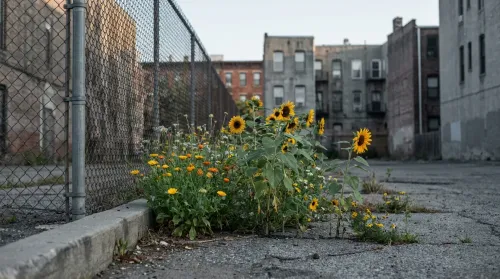
Most of the social-equity case for community gardens is real but it is not where the brochures put it. The brochure version says gardens "bring people together across difference." They do — the Brunswick plot's Saturday roster is evidence enough — but bringing people together is the easy part of the equity argument. The harder, more useful part is land access.
In any city where housing has been priced and subdivided away from working renters for a generation, the question of who has a quarter-acre and a spade is itself a political question. A council allotment, a school-yard plot, a strip of unused railway land turned into shared beds — these are all small reversals of that pricing-out. They give people who do not own the ground beneath their feet a place to plant something perennial in it, even if their tenure is annual and the lease is on council letterhead. The 7% property-value lift in disadvantaged neighbourhoods, the 9% crime reduction, the food-security gains — these are the measurable echoes of that small reversal. They are not the cause of the equity case; they are the receipts of it.
The marginalised-voice work that the original framing reached for happens here too, in concrete form: shared plots make space for cultural crops that supermarkets rarely stock (Vietnamese herbs, Caribbean callaloo, Mexican papalo), and they give people whose food traditions were never on the local greengrocer's shelf the means to grow them themselves. The cultural-harmony language is the part the brochure gets right.
How to start one in your neighbourhood
The honest version of the how-to guide is that starting a community garden takes about eighteen months and a small core of people who will still be in town in two years. The unhonest versions promise a season. Below is the unromantic checklist, drawn from the most thorough practical guide on the open web (community-gardening.org how-to), with the framing adjusted for what I have actually seen work in Melbourne, Brunswick, and the regional plots I advise on.
Find five people who will stay. Not fifty supporters at a launch night — five who will commit to a Saturday roster for two years. The core determines whether the garden survives the third winter, which is when most volunteer projects fail.
Find the land before you fall in love with the land. Council parks departments, school grounds, church car parks, railway easements, vacant lots whose owners can be traced. The site needs 6–8 hours of summer sun, a water source within 200 ft, reasonably flat ground (under 5% slope), and a lease horizon of at least three years. Shorter than three and the founders will burn out before the soil pays back.
Test the soil. Especially on former industrial land, urban lots, anything near old paint or treated timber. A lead-and-heavy-metal test at a US university extension lab runs about $15–$30 (UVM Extension's basic soil panel is $17, with a $10 add-on for heavy metals; lead-only screening is $15). It is the cheapest insurance the project will ever buy. If the result is bad, raised beds with imported soil solve it; if you skip the test, you find out the wrong way.
Design the layout. Plot sizes (3 m × 6 m is a common middle), shared infrastructure (compost, tool shed, water spigots, communal beds), paths wide enough for a wheelbarrow and a wheelchair (more on this below), and a governance bed that is everyone's responsibility before anyone's. A simple sketch on graph paper, not a CAD render.
Write the rules before there is a dispute. Plot lease length, fees, planting-out date, what happens if a plot is abandoned, who waters in August, how new members are admitted, what happens at harvest. Boring documents save friendships.
Find the money. A modest garden runs $3,750–$7,500 to start; if a new water tap has to be installed, add $1,500–$3,000 (community-gardening.org). US funding sources include the USDA People's Garden initiative, Whole Foods Community Giving grants, and Bonnie Plants' annual community-garden grants. UK funding sources include Social Farms & Gardens grants, the National Lottery Community Fund, and the Tree Council's small-grants programme. Local hardware stores will frequently donate timber and tools if asked in writing; they almost never do if asked verbally.
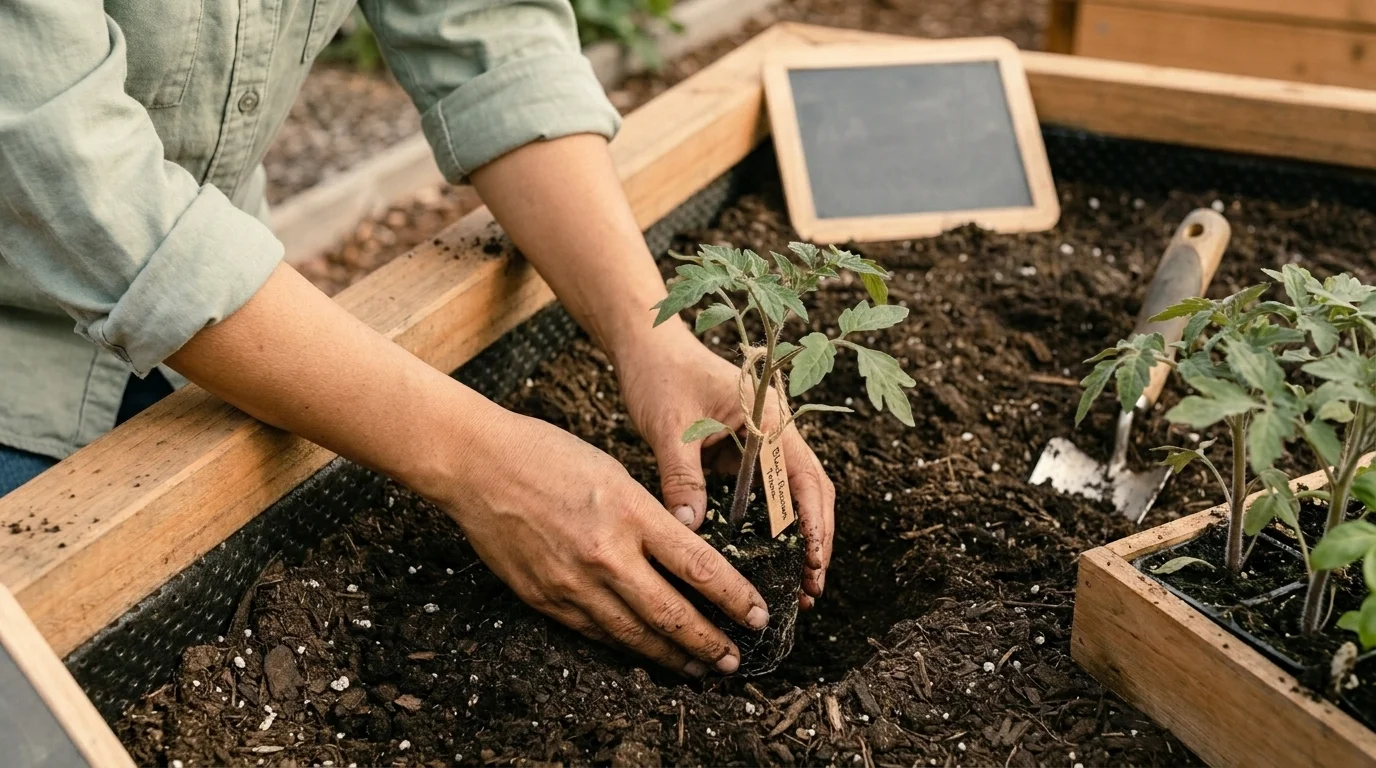
Plant the first season conservatively. Salad greens, beans, tomatoes, herbs. Things that will succeed in poor soil, deliver visible harvests in eight to twelve weeks, and reward the people who showed up. Save the perennial fruit collection and the bee hotel for year two.
The order matters. Most failed community gardens I have watched at close range failed because they did the launch night before they did points 1 and 2.
Loading image...
Year-one planting: salads, beans, tomatoes, herbs. Visible harvests in eight to twelve weeks, and a reason for the people who showed up to come back.
The budget below is a working starting point for a 200 m² shared garden with 12–16 individual plots, raised beds for accessibility, basic shared tooling, and a metered tap. Numbers are USD with rough sterling equivalents in brackets — they will scale meaningfully up or down depending on the city, the labour rate, and the local cost of imported topsoil.
Site preparation, fencing, signage: $1,000–$2,500 (£800–£2,000)
Raised beds and timber for paths: $1,500–$2,500 (£1,200–£2,000) for a mix of standard and accessible heights
Compost, soil, and first-year inputs: $500–$1,000 (£400–£800)
Insurance and council registration: $200–$600 (£150–£500) per year ongoing
First-season seeds and plant starts: $200–$400 (£150–£300)
Total first-year outlay: $3,750–$7,500 for a modest garden, plus the water-tap if you need it. Annual ongoing cost lands somewhere around $600–$1,500 once you are established. Member plot fees of $20–$75 per plot per season (£20–£60 in the UK) typically cover the annual operating budget; the startup money usually comes from grants and donations, not from members.
A community garden that includes everyone
The disability-accessibility section in the original draft was one paragraph. It deserves more space, because universal-design choices are easier and cheaper to build in at the start than to retrofit five years later, and because no large competitor in this search cluster covers them with any depth. The universal-design checklist below pulls from the most-cited US municipal sources and from UK accessibility-gardening practice; it is also the structure I use when advising new groups in Melbourne.
Raised beds at usable heights. 24 in (60 cm) for seated wheelchair gardening from a side approach; 28–34 in (70–86 cm) for the ADA-compliant optimal range for standing or roll-under access. Knee clearance under a roll-under bed should be about 30 in wide × 27 in high × 8 in deep so a wheelchair footplate clears the frame.
Paths a wheelchair can actually use. 36 in (91 cm) minimum width for a single wheelchair; 1.2 m (47 in) for a wheelchair plus a walking companion; 1.8 m (71 in) at any point where two wheelchairs need to pass or a chair needs to turn. Flat, continuous, non-slip surfaces — packed decomposed granite or smooth pavers, not gravel or stepping stones.
Slope under 5%. Anything above that turns a path into a challenge for chairs, walkers, and anyone with balance difficulty. Where the ground will not cooperate, terracing solves it.
Tactile and high-contrast markers. Pale path edges against dark mulch help low-vision gardeners stay on the path; raised letters or braille on plot signs help blind gardeners find their own bed; named species on signs help everyone learn.
Adaptive tools in the shared shed. Easi-Grip cushioned-handle tools, ratcheting pruners, long-reach pruners around 1.2–1.8 m, lightweight pots under 1 kg, two-wheeled wheelbarrows (more stable than single-wheel) for arthritis or balance-affected gardeners.
Water at standing and seated heights. A second tap at 75 cm above the ground, or a hose reel that does not require bending, makes the water station usable from a wheelchair or a seated cane.
Shade and rest stops every 15 m. Benches with armrests so a tiring gardener can stand up again without help, and a shaded space for breaks in summer.
A garden built to this checklist works for the wheelchair user, the gardener with arthritis, the gardener recovering from surgery, the elderly volunteer, the parent with a stroller, and the new participant who is simply tired. Building these features in from the start adds modestly to the initial construction cost; retrofitting them later costs several times more.
Programs worth studying
The most useful thing any new community-garden founder can do is borrow shamelessly from organisations that have already run the experiment. Four worth knowing, drawn from the named programs the research consistently surfaces:
NYC GreenThumb — the largest community-gardening programme in the United States, with 550-plus member gardens across the five boroughs and a governance model that has held together through forty years of leadership turnover. Study it for how a single municipal programme can support hundreds of distinct, locally-governed sites without flattening them.
Ron Finley Project — Ron Finley's South Central Los Angeles food-desert advocacy, which began with planting on the verge in front of his own house and grew into a worldwide reframing of street-edge land as cultivable space. Study it for how a single articulate practitioner reshapes a national conversation.
Detroit Black Community Food Sovereignty Network (DBCFSN) — the most thoughtful working example of an equity-led, Black-led food-sovereignty model, anchored by the seven-acre D-Town Farm in Rouge Park. Study it for how the equity argument is made structurally, not rhetorically — through ownership, governance, and seed-keeping.
Incredible Edible — the UK movement that started in Todmorden, Yorkshire, by planting vegetables on every patch of unused public land in town. Study it for how a low-permission, high-visibility model recruits an entire town without ever holding a launch meeting.
A community garden is good for a neighbourhood. It is also a sustained piece of voluntary labour that takes more out of a small number of people than is usually acknowledged, and the part of the brochure that says "join us, it's easy" is the part the founders are too tired to write. The honest version of the tradeoffs:
It is real time. A working plot is four to six hours of labour a month from each member at minimum, with surge weeks during planting and harvest where it climbs to ten or twelve. People with caring responsibilities, shift work, or unreliable transport find that ceiling hard.
It depends on a small number of organisers. Most community gardens have three or four people — a coordinator, a treasurer, a plot manager, a working-bee captain — who shoulder a disproportionate share of the operational work. They burn out. The gardens that survive a coordinator's departure are the ones that have written down what the coordinator does; the ones that have not, fold.
It is exposed. Vandalism happens, theft happens, the occasional broken lock and trampled bed happen. Insurance covers some of it, the rest is part of the cost of working on land that is not behind a private fence.
Benefit distribution is uneven. A 2024 paper in Sustainability Science finds that community gardens produce a great deal of food, but that "benefit distribution is uneven across the gardener community" (Springer, 2024) — established members tend to harvest more than newer ones. Active onboarding, plot rotation, and shared communal beds reduce the gap; ignoring it widens it.
The economics, on paper, do not add up. A kilogram of cos lettuce from any community plot I have ever worked on costs the gardener more in labour hours than the same lettuce at the supermarket. If the case for community gardens rested on the spreadsheet, no one would do them, and no one ever did. The case rests on the things the spreadsheet does not measure: the dignity of the plot, the slow building of a skill that cannot be outsourced, the small stubborn fact of feeding someone you know from soil you have tended. That is the part the receipts have never been able to print.
Loading image...
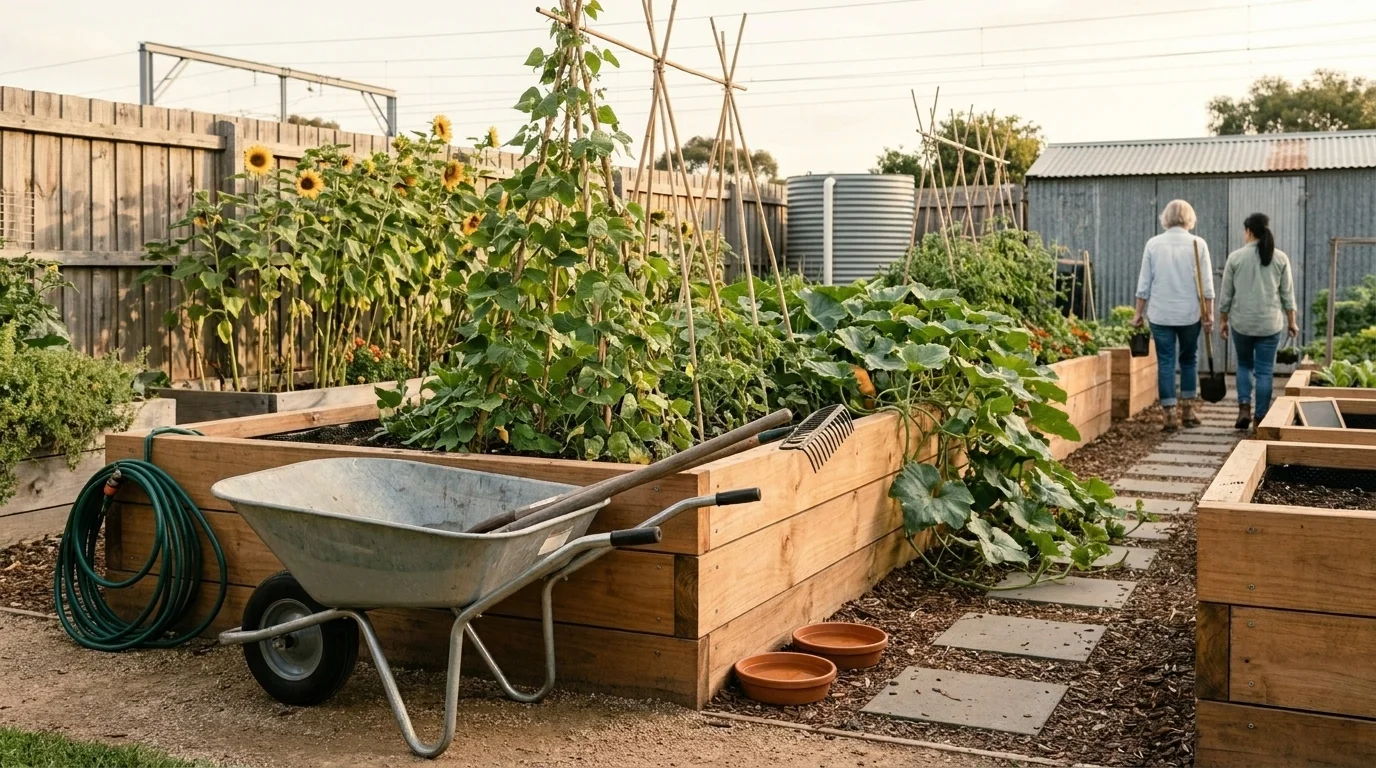
The kilogram of lettuce still costs more in labour than the supermarket charges. We are still not counting, and that is still almost — but not quite — the whole point.
The Brunswick plot behind the train line is entering its ninth season. The first season had eight people and a broken tap; the ninth has thirty-two members on the roster, a waiting list, two new accessible beds installed last spring at the height a wheelchair gardener can reach without straining, and an unresolved argument about pea varieties that I expect will outlive us all. The lettuce on the plot still costs more in labour than the same lettuce at the supermarket. We are still not counting, and that is still almost — but not quite — the whole point.
A community garden is a single piece of leased or owned land that a defined group of people cultivates collectively, with shared paths, water, and tools, and a governance model that decides who plants what, when, and on whose behalf. The classic form gives each member an individual plot inside a shared site; variants include fully collective beds, allotments-with-services, and school or workplace gardens.
What are 5 key benefits of a community garden?
Lower household food bills (around 14% during the growing season), measurable mental-health gains backed by a 2025 scoping review, stronger neighbourhood ties with a roughly 9% local crime reduction and 7% property-value lift, environmental gains including 1–3 °C urban-heat reduction, and educational opportunities for children and adults (a community-garden cohort improved BMI in 17% of overweight children over seven weeks).
How do I start a community garden in my neighbourhood?
Find five people who will still be in town in two years; secure a site with 6–8 hours of sun, water within 200 ft, slope under 5%, and at least a three-year lease; test the soil (especially for lead on former urban land); design the layout and write the rules before there is a dispute; secure funding ($3,750–$7,500 startup, plus $1,500–$3,000 for a new water tap if needed); plant conservatively the first season — beans, salads, herbs, tomatoes.
Are community gardens free to join?
Most charge a small annual plot fee — typically $20–$75 in the US and £20–£60 in the UK — to cover water, tools, compost, and insurance. Many programmes waive fees for low-income members, and produce grown on your plot is yours to keep.
What are the cons of community gardens?
Real time commitment of 4–6 hours per month per member (with surge weeks at planting and harvest); reliance on a small number of organisers who risk burnout; exposure to vandalism and theft; and uneven benefit distribution — a 2024 Sustainability Science paper found that established members tend to harvest more than newer ones, so active onboarding, plot rotation, and shared communal beds matter.
What is the difference between an allotment and a community garden?
An allotment is a private plot rented from a council or trust where the renter gardens individually on shared infrastructure (paths, water, fencing). A community garden typically adds explicit collective elements — shared beds, communal work rosters, equity-focused governance — and a wider social-purpose brief. The line is blurry; many UK 'allotments' function as community gardens, and many US 'community gardens' function as allotments.
How do I find a community garden near me?
In the US, search the American Community Gardening Association directory or check your local parks and recreation department. In the UK, Social Farms & Gardens maintains the national network and the National Allotment Society lists allotment sites. In Australia, Community Gardens Australia lists the national network of around 800 gardens. Most municipal websites list registered plots with waiting-list links.
Blossoms of Resistance: The Impactful Role of Gardening in Social Movements
Join
Loading...
Our Green Community!
Loading...
VerdeNook is more than just a source of gardening wisdom; it’s a platform for sharing, learning, and growing together. We invite you to join our community, share your stories, and spread the joy of gardening. Let’s sow the seeds for a greener, healthier, and more sustainable future, one garden at a time.