Navigating Legal Terrain in Home Gardening: An Overview of Regulatory Frameworks and Compliance Considerations
Share this article:
A bag of beans handed over the gate is the last uninterrupted transaction in food retail. Sell the jam, though, and the cottage food law engages.
Cottage food laws: a 1943 leaflet, a 2025 statute
I keep on my desk a photocopy of a 1943 leaflet from the Australian Department of Agriculture titled Dig for Victory: A Guide for the Home Gardener. It runs to sixteen pages, uses the word "duty" eleven times, and assumes the reader has access to a back yard, a spade, and the legal right to do something useful with both. Eighty years later, the last of those assumptions is doing a great deal of quiet work — and on the American side of the Pacific, where I read most of the modern statutes, the cottage food laws governing what a home gardener may sell from her kitchen are being unpicked and re-written at a pace I have not seen in a decade.
The legal terrain a home gardener crosses in 2026 is no longer the unmarked field the leaflet imagined. It runs in four layers, and most of the trouble comes from confusing them. There is federal food-safety law, which in the United States means the FDA's Produce Safety Rule. There is state-level cottage food laws, which govern what you may sell from your kitchen and at what scale. There is municipal zoning — the city's say on what your land may do. And underneath the lot of it, often more powerful than any statute, there is the private covenant: the homeowners' association deed restriction that can stop a state-protected vegetable bed at the front-yard line. None of the consumer-facing guides I have read holds these four together. They treat them as separate countries, which is part of why a reader who has spent an afternoon trying to work out whether she may legally sell the surplus from her tomato bed usually gives up before tea.
This piece is an attempt to hold them together, in plain English, with the figures correct to mid-2026. It is the article I wish a friend had handed me the first time I tried to read a state cottage food bulletin without the patience to do so.
What the FDA actually asks of a home gardener (almost nothing)
The federal layer is, for almost every home gardener, the layer that does not apply. The relevant rule is the FDA Produce Safety Rule, one of the implementing rules under the Food Safety Modernization Act, and it is written for commercial produce farms. Personal-consumption produce — anything you grow and eat or share with neighbours — is fully exempt and never enters the question.
The threshold that matters, if you ever start selling, is the not covered line. A farm whose average annual produce sales sit under $25,000 over a rolling three-year window (inflation-adjusted) is "not covered" by the rule. The figure is small enough that any home gardener selling at a local market is almost certainly under it; the FDA's exemptions page lays out the threshold and the qualified-exemption tier above it.
The next tier up — the produce safety rule "qualified exemption" — catches farms between $25,000 and $500,000 in annual food sales, provided more than half their sales go to qualified end-users (in-state buyers, buyers within 275 miles, or end consumers regardless of location). This is the bracket a serious market gardener has to think about. The home grower with a roadside stand and a regular customer at the office almost never does.
The practical reading: if your produce sales would not buy a second-hand car in a year, federal food-safety law is not your problem. The state cottage food law, which I will come to next, almost certainly is.
Can I sell vegetables — or jam, or honey — from my home garden?
This is the question almost everyone is actually asking, and the answer is two answers stitched together.
For raw, unprocessed produce — a punnet of cherry tomatoes, a bunch of radishes, a dozen eggs from your own hens — most states let you sell directly to consumers without a license, provided you stay below the FDA's $25,000 threshold and your local zoning permits a residential sale. Some states require a basic produce-handler registration; most do not. A neighbour buying a bag of beans from the gate is, in most jurisdictions, the last freely traded transaction in modern food retail, and the law has not yet found a reason to interrupt it.
For anything processed or packaged — jam, salsa, baked goods, dried herbs, infused honey, pickles — you are inside the cottage food laws framework. Forty-nine states and the District of Columbia now have one (every state except New Jersey, per the National Agricultural Law Center's state-by-state compilation), and they differ in three ways that matter:
The annual sales cap — from $30,000 in Vermont up to no cap at all in Georgia.
The allowed-foods list — most laws permit non-perishable items (jams, baked goods, dried herbs); a growing minority permit Time/Temperature Control for Safety (TCS) foods like dairy and refrigerated baked goods.
The sales venues — direct-to-consumer everywhere; farmers' markets in most states; online and mail order in a rising number; retail stores and restaurants in only a few.
The decision tree, written out:
Are you selling at all? No → no license needed; the law has nothing to do with you. Yes → continue.
Are total produce sales under $25,000 (three-year rolling average)? Yes → federal Produce Safety Rule does not cover you; check state cottage food only if you process or package. No → talk to your state department of agriculture before scaling further.
Are you processing, packaging, or value-adding (jam, baked goods, pickled, dried, infused)? No → raw produce sales are governed almost entirely by state and local rules; check zoning. Yes → cottage food law applies; see your state's cap and allowed-foods list.
Past the state cottage food cap? Yes → you are operating a regulated food business; commercial kitchen, license, and inspection requirements engage. No → label correctly and keep records.
In a state with a home based food business license requirement separate from cottage food registration? Check the state DOA page — fees and registration thresholds vary, and they have changed materially in the last twelve months.
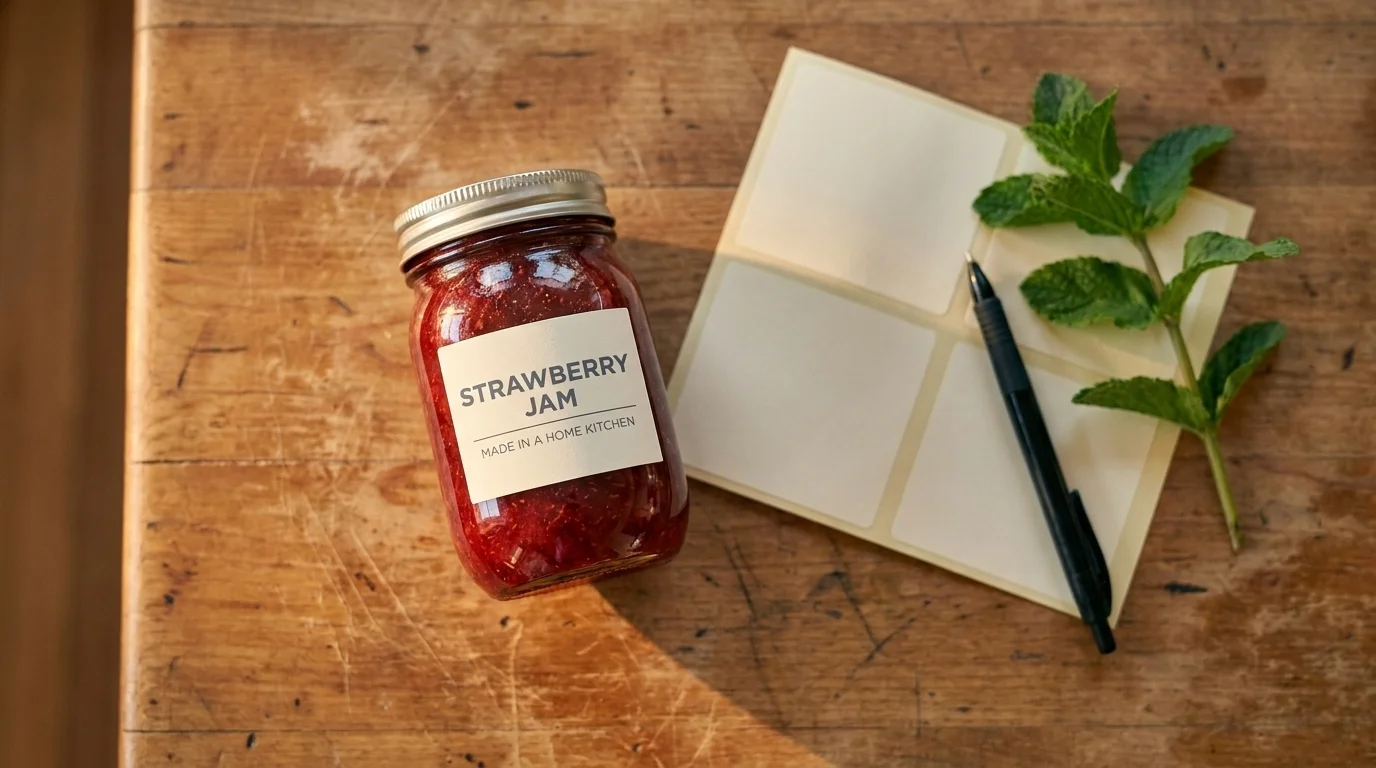
The label requirement is universal and the simplest thing to get right: name and address of the operator, common name of the food, ingredient list in descending order of weight, allergen statement, net weight, and — in most states — a printed disclosure that the food was prepared in a home kitchen not subject to inspection. The disclosure language is set by statute; do not paraphrase it. Print the statute's words on the label.
Loading image...
Every jar carries the same line: operator, ingredients, allergens, net weight, and the home-kitchen disclosure. The statute sets the words — print them, don't paraphrase.
What changed in 2025 and 2026
If the cottage food map looked settled a few seasons ago, it did not stay settled. The 2024–2026 legislative window was the most active for cottage food law in a decade, and the direction of every change was the same: higher caps, broader venues, looser geographic restrictions. The National Agricultural Law Center's trend round-up tracks it state by state; the headline items are these:
Georgia eliminated its revenue cap entirely under HB 398, effective July 1, 2025, removed the state licensing requirement, and opened sales to retail stores and restaurants. A Georgia cottage food operator now needs only an ANAB-accredited food-safety course, and the ceiling on a kitchen-table business is, for the first time in the law's history, set by the operator's own kitchen rather than by statute.
Texas raised its annual gross-sales cap from $50,000 to $150,000 under SB 541, effective September 1, 2025, indexed the cap to inflation, added nonprofit eligibility, and — usefully — prohibited local health departments from charging permit fees to cottage food operators. The official guidance is at the Texas DSHS cottage food page.
Michigan doubled its cap from $25,000 to $50,000 and legalised online sales under HB 4122 (effective March 2026).
Vermont tripled its cap to $30,000. Nevada raised cottage and craft food caps to $100,000. Virginia legalised internet, phone, and mail-delivered cottage food sales under HB 402. Washington enacted a new $35,000 cap. Minnesota cut its registration fee, expanded operator eligibility to two-person cohabitating LLCs, and authorised mail shipping from August 1, 2027. Illinois added mobile farmers' markets as a permitted sales venue. Each of these moves traces back to the same legislative reading: that the cottage food regime, originally written as a hobby exception, has grown into something the bill drafters now treat as a small-business framework. Comprehensive figures are tracked in the Butterbase 2026 state-by-state guide.
Nine states now permit TCS foods — Time/Temperature Control for Safety foods like dairy, refrigerated baked goods, and certain meat products — produced in home kitchens: California, Iowa, Montana, North Dakota, Oklahoma, Utah, Wyoming, Texas, and Tennessee. A decade ago, far fewer did, and the TCS category was treated in most cottage food bills of that period as the line home kitchens were not asked to cross. The category is now crossed in those nine jurisdictions, and the public-health argument over whether it should be is still being had — worth knowing if you intend to sell anything refrigerated.
A snapshot of representative state cottage food rules, mid-2026
The table is representative, not exhaustive. The figures move. Before you label your first jar, open your state department of agriculture's cottage food page and check the cap and venue list as they sit today; the 2025–2026 wave is not finished.
HOA covenants and the line state right-to-garden laws will not cross
One of the most-contested home-gardening conflicts of the last decade is not federal and not, strictly speaking, statutory. It is the front-yard vegetable bed against the homeowners' association covenant. The conflict surfaces in housing-law forums and state preemption fights more than the FDA Produce Safety Rule does in any home-grower's mailbox, and the law on it is doing something interesting.
Two states have moved decisively. Florida Statute 604.71 (2019) and the Illinois Vegetable Garden Protection Act (2021) preempt municipal restrictions on residential vegetable gardens. If a Florida city tries to ban a front-yard vegetable plot under a generic "tidy lawn" ordinance, the state statute overrides it. The right-to-garden movement — the modern, narrower cousin of the older agricultural right-to-farm regime — is sitting on roughly a dozen state legislative agendas, and the trend is in the same direction as the cottage food trend.
But the preemption stops at the public-private line. Neither Florida 604.71 nor the Illinois VGPA overrides a private HOA covenant. If your HOA's CC&Rs restrict front-yard food gardens — and a great many do, in the inherited language of mid-twentieth-century deed restrictions written when the front lawn was treated as a civic amenity — the restrictions are generally enforceable as a matter of contract. You bought into the covenants when you bought the house. The state's quarrel is with the city, not with the deed.
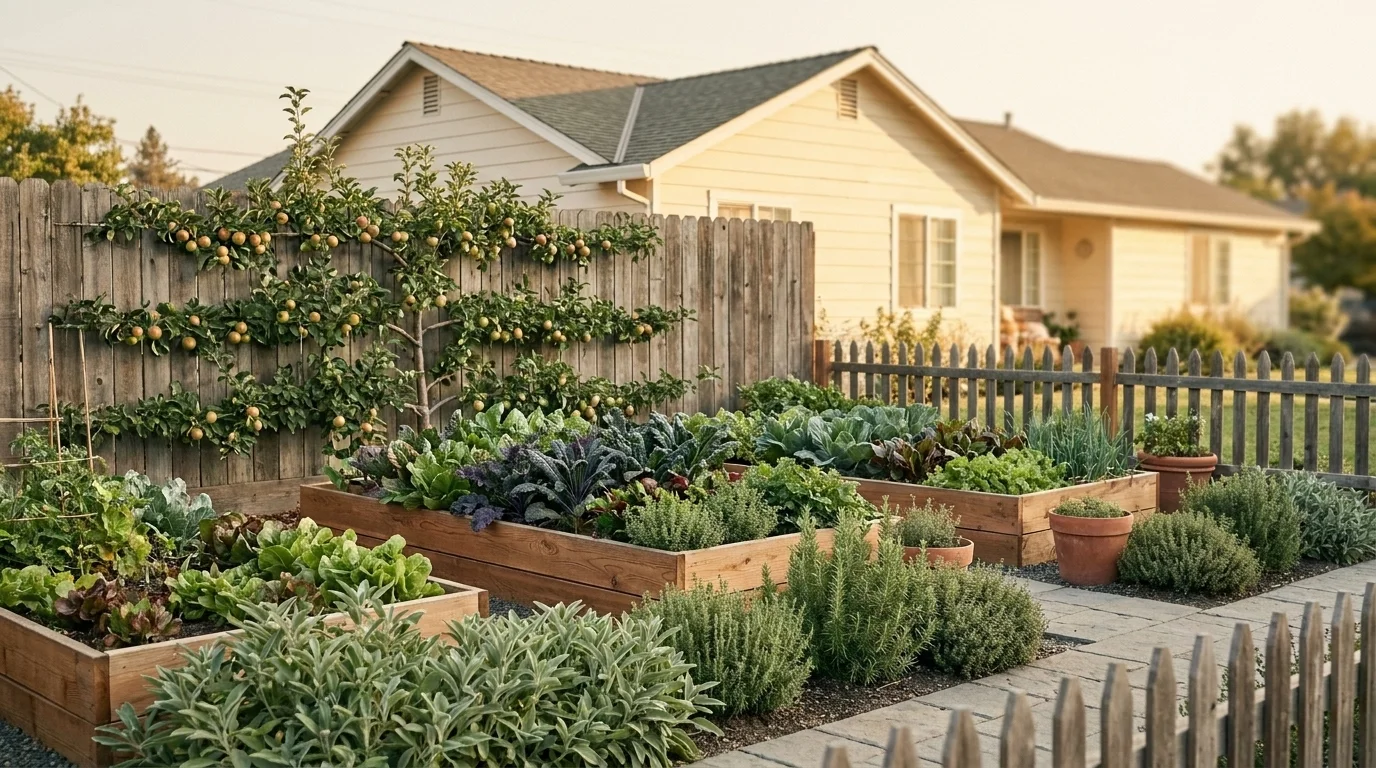
The practical posture is to read your own HOA documents before you plant. If a covenant restricts visible food gardening, you have three options: cultivate a backyard plot the covenant does not reach; petition the architectural committee with a planting plan that reads as ornamental (espaliered fruit, raised cedar beds, herb borders that pass for cottage planting); or, if you have the energy, organise to amend the covenant. The third path is harder than it sounds and slower than the growing season.
What this means in practice is that the same state can preempt a city's ban on your tomatoes and decline to touch your HOA's. Strictly speaking, the right to garden in 2026 is a right against your municipality, not against your neighbour-bound contract. Older homestead laws, which the search box still sees a fair amount of, mostly govern property-tax exemptions and creditor protections; they do not, in their modern form, settle a front-yard planting fight.
Loading image...
State law overrules a city's lawn ordinance but not your HOA's covenant. The workaround is camouflage — make the food bed read as ornamental, then petition the committee.
Zoning, water, neighbours, and chickens
The remaining layer is the city's. Zoning is the rulebook for what your land may be used for: residential, agricultural, mixed. Most home gardening sits comfortably inside residential, but the edges are where the trouble lives. A municipal water restriction during drought can curtail an irrigation schedule overnight. A pesticide application that drifts onto a neighbour's property is, almost everywhere, a nuisance claim waiting to happen. Backyard chickens laws — a small adjacent search cluster but a substantial real-world question — vary block by block: some cities permit six hens and no rooster; some prohibit poultry altogether; some require setbacks measured from the coop to the property line.
The composting guidelines in most residential zones are permissive but not unlimited; an open pile that draws rats will, sooner or later, draw a code enforcement letter. The rule of thumb I have learned to give friends starting a community plot is the rule the older permaculture writers — Bill Mollison, P. A. Yeomans — were already articulating in the 1970s and 80s: design so that no part of your garden is a problem for the property next door. The legal layer is, in this respect, the formalisation of a neighbour-relations rule that long predates it.
Right-to-farm laws, in plain English
State right-to-farm laws are the older, broader cousin of the new right-to-garden statutes. Every US state has one in some form. They protect established agricultural operations from nuisance claims brought by neighbours who move in later — typically complaints about smells, noise, or dust. They were drafted in the 1970s and 80s to defend working farms against suburban expansion, and most of them still read that way. A home gardener with a small plot is unlikely to invoke a right-to-farm defence; the statute is usually written for a scale of operation a backyard does not reach. But the underlying principle — that an established legal use survives a later-arriving complaint — does sometimes apply to home plots in rural-residential transition zones, and it is worth knowing the law exists.
Community garden plots
A community garden plot — the kind of council-or-municipality-licensed shared ground I have spent a great many Saturday mornings in — operates under whichever agreement the host land's owner has set out. The legal architecture is rarely statutory; it is almost always a licence or sub-licence from the landholder (council, church, school, private benefactor) to the gardening group, and the group's by-laws bind the individual plot-holder. The licence is renewable. The tenure is, in practice, less secure than the gardeners on it generally believe — which is why every long-running community garden network I know spends a measurable share of its volunteer hours on the unglamorous work of keeping the council on side. The labour of compliance is part of the labour of the plot.
What this is and is not
This is general legal background, not legal advice. Cottage food law, FDA produce safety thresholds, state right-to-garden statutes, and municipal zoning all change — the cottage food layer is changing now, this season — and figures here are accurate to mid-2026. Before you sell, plant a front-yard food bed under an HOA, scale a kitchen business past a state cap, or use a pesticide near a property line, check your state department of agriculture's cottage food page, read your HOA covenants, and where the answer matters financially, talk to a lawyer who has read the local ordinances more recently than I have.
The honest reading of all of this — the federal threshold, the state cap, the municipal zoning code, the deed restriction — is that the legal question about a home garden is almost never can I, and almost always what does the law actually ask of me before I do. The answer is usually less than the framing suggests. The work, as so often in this trade, is finding out for sure rather than guessing. Spend the Saturday reading the statute; you will spend the next ten Saturdays planting.
Do I need a license to sell vegetables from my home garden?
In most US states, you can sell raw, unprocessed produce (whole vegetables, fruit, eggs from your own flock) directly to consumers without a license, provided your total annual produce sales stay under the FDA's $25,000 three-year rolling average. Once you process, package, or value-add (jam, salsa, baked goods), your state's cottage food law applies — and caps range from $30,000 (Vermont) to no cap at all (Georgia, as of July 2025). Always check your state department of agriculture page for the current threshold before selling.
What is the FDA Produce Safety Rule and does it apply to my home garden?
The FDA Produce Safety Rule sets food safety standards for commercial produce farms. It does not apply to home gardens grown for personal consumption. Even if you sell some surplus, you're not covered if your average annual produce sales stay under $25,000 over three years (inflation-adjusted). Farms between $25,000 and $500,000 in annual food sales may qualify for a modified qualified exemption if more than half their sales go to in-state buyers or end consumers.
Can my HOA stop me from growing vegetables in my front yard?
Often, yes — even where state law protects gardens. Florida (Statute 604.71, 2019) and Illinois (Vegetable Garden Protection Act, 2021) preempt local municipal bans on residential vegetable gardens, but neither overrides private HOA covenants. If your HOA's CC&Rs restrict front-yard food gardens, those restrictions are generally enforceable. Read your HOA's governing documents before planting, and check whether your state has a right-to-garden statute that limits municipal — but not private — restrictions.
Which 2025–2026 cottage food law changes should I know about?
Several states materially expanded cottage food rules: Georgia eliminated its revenue cap and state licensing requirement (HB 398, July 2025); Texas raised its cap to $150,000 and banned local permit fees (SB 541, September 2025); Michigan raised its cap to $50,000 and legalized online sales (HB 4122, March 2026); Vermont tripled its cap to $30,000; Nevada raised cottage and craft food caps to $100,000. Nine states now permit Time/Temperature Control for Safety (TCS) foods in home kitchens: California, Iowa, Montana, North Dakota, Oklahoma, Utah, Wyoming, Texas, and Tennessee.
What's the difference between right-to-farm laws and right-to-garden laws?
Right-to-farm laws (in most US states) protect established agricultural operations from nuisance claims by neighbors who move in later — for example, complaints about smells, noise, or dust. Right-to-garden laws are narrower and newer: they typically preempt municipal bans or excessive restrictions on residential vegetable gardens. Right-to-farm is older and broader; right-to-garden is a 2010s–2020s development specific to home growers facing local-government overreach.
Can I sell jam, honey, or baked goods from my home kitchen?
Yes, in 49 states plus DC (every state except New Jersey, as of 2026), under your state's cottage food law. Allowed foods, sales caps, and venues vary state by state. Most laws permit non-perishable items like jams, jellies, baked goods, and dried herbs sold direct-to-consumer or at farmers' markets. A growing number of states now allow online and mail sales, and nine states permit certain refrigerated (TCS) foods produced at home. Check your state department of agriculture for the current list.
Join
Loading...
Our Green Community!
Loading...
VerdeNook is more than just a source of gardening wisdom; it’s a platform for sharing, learning, and growing together. We invite you to join our community, share your stories, and spread the joy of gardening. Let’s sow the seeds for a greener, healthier, and more sustainable future, one garden at a time.