Roots of Recovery: Transforming Lives One Garden at a Time
Share this article:
Horticultural therapy isn't gardening that happens to feel nice; it's a structured clinical practice with real outcomes — the bench, the seedling, the routine all doing measured work.
What horticultural therapy actually is
A Saturday at the community plot I help run in Brunswick begins, as it has for the better part of nine seasons, with the same eight or ten people arriving with the same eight or ten different reasons for being there. The retired electrician comes because his wife died two years ago and he prefers the bed of compost to the empty kitchen. The nurse finishing her night shift comes because the half-hour of weeding before sleep is the one half-hour her shoulders unknot. The exchange students from Chile come because their host family does not have a garden. None of these people would describe what we are doing as therapy, and none of them are wrong to leave the word aside. But the discipline that takes the same work — soil, seed, attention, repetition — and applies it within a clinical or community programme with documented goals and a trained facilitator is horticultural therapy, and that discipline has accumulated, in the last decade, enough evidence behind it to deserve a careful explainer.
Horticultural therapy is the use of plants and gardening activities, delivered by a credentialed practitioner within a treatment plan, to support the rehabilitation, recovery, or maintenance of mental, physical, social, or vocational function. The shorter form, horticulture therapy, is the same discipline; the field uses both spellings. The work is older than the modern profession — accounts go back to Mesopotamian temple gardens, Benjamin Rush wrote about agricultural work as mental-health intervention in late-eighteenth-century Philadelphia, and World War II rehabilitation hospitals across the United States and Britain folded gardening into convalescence almost as a matter of course — but the credentialed profession dates to a much shorter timeline. The first dedicated university programme launched in 1972 (per the Wikipedia historical scaffold and corroborating professional sources), national credentialing began in 1973 with the NCTRH, and the American Horticultural Therapy Association (AHTA) was founded in 1987 and remains the field's credentialing authority in the United States.
This article is the explainer I wanted to read before I sat in on my first community workshop facilitated by a registered horticultural therapist. It covers the discipline plainly, names what the evidence says and what it does not, and lays out who the work is actually for.
Horticultural therapy vs. therapeutic horticulture: the credentialed line
A distinction the consumer-facing literature consistently muddles is the line between horticultural therapy and therapeutic horticulture programs. The Care Farming Network's plain-language explainer and AHTA's own credentialing materials draw the line in roughly the same place.
Horticultural therapy (HT) is clinical practice. It is delivered by a credentialed horticultural therapist (HT-BC or HTR in the AHTA framework) within a documented treatment plan, with specific goals tied to a diagnosis, and outcomes assessed against those goals. The setting is typically clinical: hospitals, rehabilitation centres, psychiatric facilities, hospice, addiction recovery programmes, schools serving specific populations.
Therapeutic horticulture (TH) is community practice. It is delivered by trained non-clinical staff, volunteers, or community facilitators, in community gardens, libraries, senior centres, and parks, with the goal of supporting general well-being rather than treating a diagnosed condition. The credential for this side of the work is the Therapeutic Horticulture Practitioner (THP), a more recent AHTA designation that recognises community-based practice without requiring the full clinical training pathway.
The practical implication for readers: most of what happens at a community plot — the work my Brunswick group does on a Saturday morning — is therapeutic horticulture in the broad sense, not clinical horticultural therapy in the strict one. Both are legitimate. They are not interchangeable. The clinical work requires the credential; the community work requires the discipline of running an inclusive, well-facilitated group.
The 2024–2026 evidence base for horticultural therapy is broader than most consumer-facing pages report, and more honest than the older marketing-shaped explainers admit. Three peer-reviewed meta-analyses and an umbrella review now anchor the field's claims.
The 2025 Frontiers in Psychology meta-analysis on depression synthesised 33 studies (mixed RCT + quasi-experimental) and found a large effect on depressive symptoms: standardised mean difference (SMD) of −0.95, 95% confidence interval −1.27, −0.62. The same analysis identified an optimal dose: sessions of more than 60 minutes, fewer than three times weekly, sustained for 5 to 8 weeks. This is the most concrete dose-response parameter the field has produced for the depression population, and it shapes what a credible community programme should look like.
The 2023 Frontiers in Psychology meta-analysis on stress reduction pooled 31 studies covering 1,036 participants. The effect on psychological stress was strong (SMD = −0.73, p < 0.0001). The effect on physiological stress markers — cortisol, heart rate, blood pressure — was not statistically significant (SMD = −0.10, p = 0.13). This is the honesty point most consumer-facing pages elide. Horticultural therapy measurably reduces felt stress; it does not, on its own, reliably move the biomarkers people sometimes assume "real" stress reduction must move. Both findings are worth holding together.
The 2024 PMC umbrella review on gardening, well-being, and quality of life consolidated 40 systematic reviews and pooled a well-being effect size of 0.55 (95% CI 0.23–0.87, p < 0.001) — a medium effect, consistent across reviews. The same umbrella review flags a caveat that anyone reporting these numbers should also report: 71% of the underlying systematic reviews were rated critically low quality on the AMSTAR 2 instrument. The evidence is consistent in direction; it is not yet clinical-trial-grade in quality. The field's own methodologists know this, and the responsible reading of the data is that horticultural therapy looks like a useful adjunctive intervention with growing — though not yet pharmacologically rigorous — empirical support.
The honest summary, then: large effects on depression, medium-to-large effects on psychological stress, no reliable effects on physiological stress markers, and a body of evidence that is consistent but methodologically uneven. This is more than most older review pieces admit; it is also less than the field's most enthusiastic advocates sometimes claim.
A note on what horticultural therapy is not, and what to do if you are in crisis
Horticultural therapy is a supportive intervention. It is not a substitute for clinical mental-health care, psychiatric medication where indicated, or emergency crisis support. If you or someone you know is in immediate distress or suicidal crisis, call or text the 988 Suicide and Crisis Lifeline in the United States, or your local equivalent (Lifeline 13 11 14 in Australia; Samaritans 116 123 in the UK and Ireland). The plot is, in the long view, useful. It is not the right tool for an acute hour.
A clinical horticultural-therapy session, in the framing used by the AHTA practitioner literature, follows a recognisable rhythm. A session typically runs 60 to 90 minutes — consistent with the dose parameter the 2025 meta-analysis identified — and breaks roughly into four parts.
The session opens with a brief check-in and orientation. The therapist greets each participant by name, reads the room (energy, mood, group composition), and introduces the day's activity in plain language. For a clinical group, the therapist will also review individual treatment goals quietly: improving fine-motor coordination for one participant, building task-completion confidence for another, supporting executive function in a third.
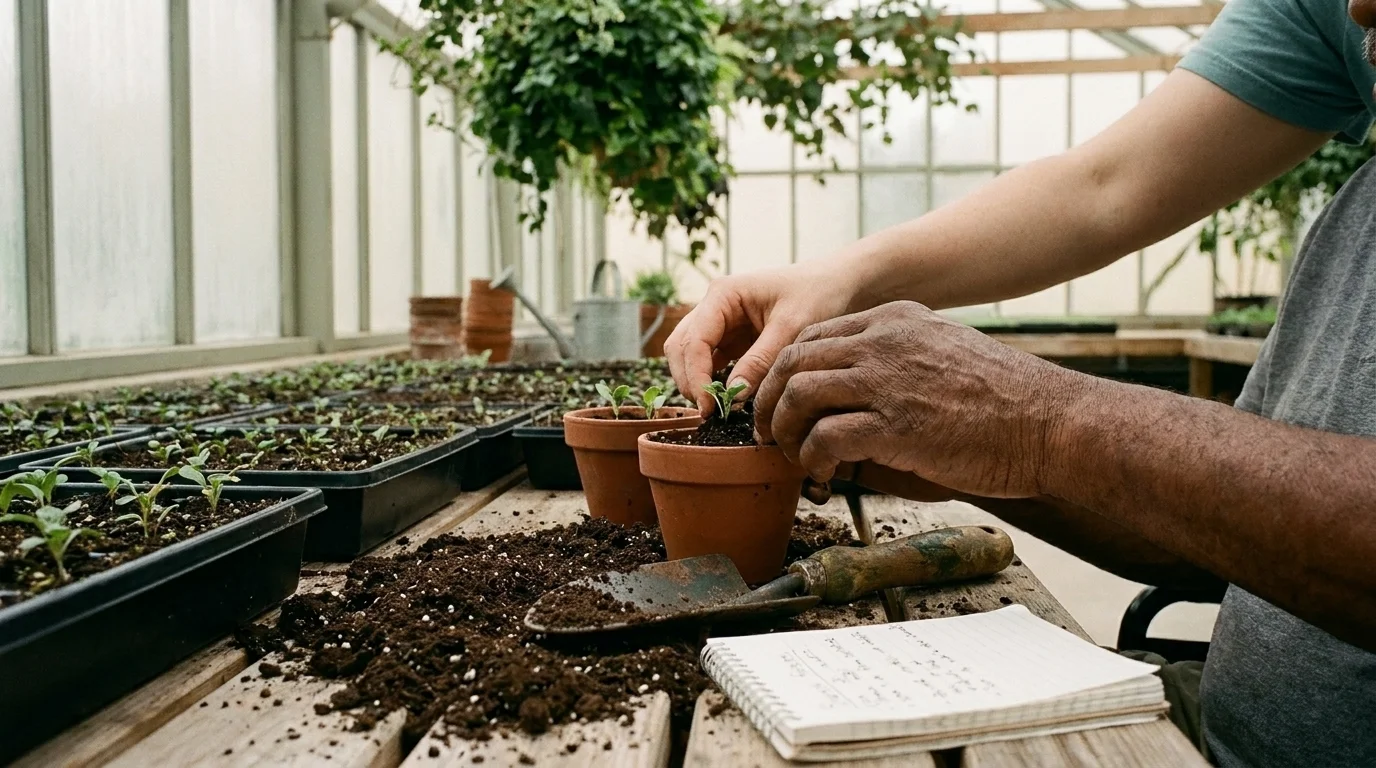
The middle of the session is the horticultural work itself. The activity is matched to the population and the goals. For a dementia-care group, this might be transferring seedlings from a propagation tray to small individual pots — the repetition is calming, the fine motor task is achievable, the sensory load (soil texture, mint or rosemary brushed in passing) is grounding. For an addiction-recovery group, it might be building a raised bed from cedar boards — the task requires sustained attention, the group works together, the result is visible at the end. For a psychiatric inpatient group, it might be propagating cuttings from herbs — small, low-stakes, immediately repeatable.
The third part is reflection. The therapist invites participants to describe what they did, what they noticed, and what felt different. This is not optional decoration — it is where the work becomes therapeutic. A participant in the addiction-recovery group who says "I didn't think I could finish a project that took two hours" is articulating something measurable.
The session closes with a wrap-up: tools cleaned, hands washed, a small take-home (a seedling, a sprig of herb, a written observation in a notebook the therapist keeps for the participant). The take-home connects the session to the participant's life between sessions, and the notebook gives the therapist longitudinal documentation of progress against the treatment plan's goals.
The whole rhythm is recognisable to anyone who has been in a well-facilitated community workshop. What distinguishes the clinical version is the documented treatment plan, the credentialed practitioner, and the formal assessment against goals.
Loading image...
A session is purposeful, repeatable work — transplant, water, tidy. A 2025 meta-analysis put the effect on depression at a large SMD of −0.95. The task is the medicine.
How long does it take to work
The 2025 Frontiers in Psychology depression meta-analysis is the most concrete answer the literature currently gives. Programmes sustained for 5 to 8 weeks, with sessions of more than 60 minutes delivered fewer than 3 times per week, produced the largest effects on depressive symptoms. Shorter programmes still showed measurable improvement, but the large-effect dose-response converged in that window.
For practical purposes: a six-week pilot at one 90-minute session per week is the credible minimum a clinical or community programme should plan for if it wants to expect measurable outcomes. Anything shorter than four weeks should be understood as introductory rather than therapeutic in the strict sense.
The three tiers of horticulture therapy programs
The discipline broadly classifies horticulture therapy programs into three tiers, drawing on the taxonomy summarised in the Wikipedia horticultural therapy article and expanded in AHTA practitioner materials. The tiers are not hierarchical — they describe different goals — and many programmes combine elements of all three.
Vocational horticultural therapy uses horticulture as a route to employment skills. The participant is learning to propagate, transplant, prune, water on a schedule, run a small retail nursery, or maintain a public landscape — and the goal is paid work in the green-industry sector. The setting is often a sheltered workshop, a transitional employment programme, or a vocational rehabilitation centre. Outcomes are measured in job placement, sustained employment, and wage data, not in mood scales.
Therapeutic (or treatment) horticultural therapy uses horticulture to support specific clinical goals tied to a diagnosis. The setting is clinical (hospital, rehabilitation centre, psychiatric facility). The therapist is credentialed. The activities are deliberately matched to the participant's treatment plan. The outcomes are measured against clinical assessment tools — depression scales, cognitive function batteries, motor-skill assessments — and documented in the participant's care record.
Social (or community) horticultural therapy uses horticulture to build community, reduce isolation, and support general well-being. The setting is community-based (gardens, libraries, senior centres). The credential is THP rather than HT-BC. The activities are inclusive and accessible. The outcomes are measured in participation, social connection, and self-reported well-being. The community plot I help run in Brunswick sits squarely in this tier; most home gardeners who describe their plot as "therapeutic" are practising a personal version of this tier without the formal facilitation.
Populations served, and the evidence by population
Population
Setting (typical)
Cited outcome
Source
Adults with depression
Clinical and community
SMD −0.95 (large effect) on depressive symptoms over 33-study meta-analysis
The general pattern across populations is the one the meta-analyses surfaced: consistent positive direction on subjective and behavioural measures, weaker and less consistent effect on physiological biomarkers, evidence quality uneven but improving. The Brunswick plot's role in any of this is, honestly, in the last row — general well-being for the older neighbours who come in winter clothes on Saturday mornings.
Healing gardens at home
Most readers arriving at this page will not, in the near term, work with a credentialed horticultural therapist. The longer-tail question is what they can do at home, and the question maps onto healing gardens (3,600/mo, KD 10) — the design-led version of therapeutic horticulture. The University of Minnesota's Taking Charge of Your Wellbeing collects the design principles most consistently:
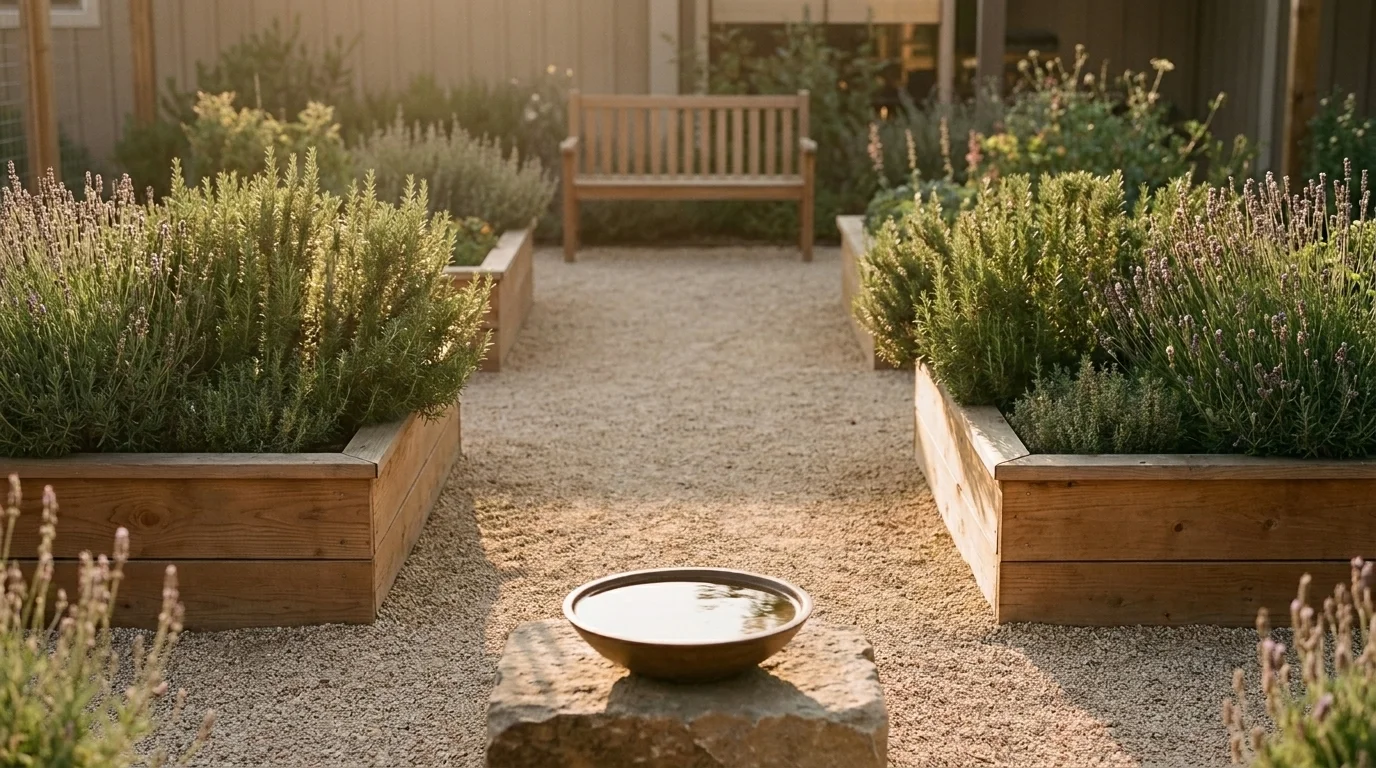
Real nature beats abstract art. A garden that draws on living plants, water, and natural materials supports the same calming response that the formal research measures. A garden that is heavily abstract or sculptural may be beautiful, but it does not do the therapeutic work.
Calm water rather than dramatic water. A small dripping fountain, a still reflecting bowl, a low-flow stream stone — these are calming. A large showy fountain is the wrong instrument for the room.
Sensory plants at hand height. Rosemary, lavender, mint, lemon balm, scented geraniums — plants you can brush in passing and that smell of something. The sensory layer is doing measurable work that visual layout alone cannot reproduce.
Accessibility from the ground up. Wide paths (at least 1 metre), raised beds at wheelchair height (around 70 cm), seating at regular intervals, level changes minimised. The garden is for people of all ages and mobility; the design should not silently exclude anyone the household includes.
A place to sit and not garden. A bench, a shaded chair, a corner where the work pauses. Therapeutic horticulture is the discipline that takes the work seriously; the place to sit is the discipline that takes the rest seriously.
A healing garden at home will not deliver clinical horticultural therapy. It will deliver the social-tier benefits the umbrella review measured, and it will deliver them at low cost. Build one, sit in it.
Loading image...
You can build the principles at home: waist-high beds, a wheelchair-wide path, scented rosemary and lavender, and still water to slow the eye. Access is the design.
Becoming a horticultural therapist: HT-BC, HTR, THP
The American Horticultural Therapy Association maintains three credentials, and horticultural therapy certification (110/mo, KD 5) interest has risen 136% year-on-year per DataForSEO — a real growth signal worth covering plainly.
HT-BC (Horticultural Therapist – Board Certified) is the current gold-standard clinical credential. It requires a bachelor's degree (or equivalent), completion of an AHTA-accredited horticultural therapy education programme, a documented internship under a credentialed supervisor, and a national examination. The credential is positioned by AHTA as the unified, psychometrically validated benchmark for clinical practice.
HTR (Horticultural Therapist – Registered) is the legacy clinical credential that predates the HT-BC restructure. It is still recognised, and many practising therapists hold HTR rather than HT-BC for historical reasons. The HTR pathway is being layered into the HT-BC framework over time.
THP (Therapeutic Horticulture Practitioner) is the non-clinical credential for community-based practice. It recognises trained practitioners delivering therapeutic horticulture in libraries, senior centres, community gardens, and other non-clinical settings. The educational requirement is lower than HT-BC; the supervised practice and examination are scaled to the non-clinical scope.
The full requirements and current education programmes are listed on the AHTA website. The honest reading of the credentialing landscape is that the field is moving toward HT-BC as the clinical standard and THP as the community-practice standard, with the legacy HTR remaining valid through a transition period. A reader thinking about training should pick the credential that matches the work they actually intend to do.
Closing — the dignity of the plot, applied
The community plot in Brunswick is not a clinical site. The eleven of us at the bed on a Saturday morning are not delivering documented treatment plans, and we are not measuring our work against the AMSTAR 2 instrument. But the discipline that the credentialed practitioners and the meta-analysts have been quietly building — the discipline that knows what dose to recommend for a depression-rehabilitation cohort, knows the difference between psychological and physiological stress, and knows that 71% of its own underlying reviews are still methodologically uneven — that discipline is doing the field a service. It is taking the older intuition — that gardening is, in some quiet way, good for you — and giving it the structure required to take that intuition seriously enough to apply it to people who need more than intuition.
For the reader with the plot, the bench, the rosemary at hand height, and the bowl of water on a low stone: you are practising the social tier of the field whose research base I have been quoting throughout this piece. The work counts. Practise it carefully, do not mistake it for clinical care, and call 988 if the work is not enough.
What is horticultural therapy and how does it help in rehabilitation?
Horticultural therapy is the use of plants and gardening activities, delivered by a credentialed practitioner within a treatment plan, to support rehabilitation, recovery, or maintenance of mental, physical, social, or vocational function. It is used clinically with populations including adults with depression, dementia, addiction recovery, psychiatric inpatients, veterans with PTSD, and at-risk youth, and is delivered in hospitals, rehabilitation centres, and community settings. The American Horticultural Therapy Association is the credentialing authority in the United States.
What is the difference between horticultural therapy and therapeutic horticulture?
Horticultural therapy is clinical practice delivered by a credentialed horticultural therapist (HT-BC or HTR in the AHTA framework) within a documented treatment plan, with specific goals tied to a diagnosis. Therapeutic horticulture is community-based, can be delivered by trained non-clinical staff or volunteers (often holding the THP credential), and supports general wellbeing without requiring a clinical treatment plan.
How long does horticultural therapy take to work?
A 2025 Frontiers in Psychology meta-analysis of 33 studies on depression found measurable improvement within 4 to 8 weeks, with the largest effects appearing in programmes sustained 5 to 8 weeks. The optimal dose identified was sessions of more than 60 minutes, fewer than 3 times per week, for 5 to 8 weeks. Shorter programmes still show benefits but smaller effects.
What conditions can horticultural therapy help treat?
Current peer-reviewed evidence supports horticultural therapy as a supportive intervention for depression (SMD −0.95 in a 2025 meta-analysis), psychological stress (SMD −0.73 in a 2023 meta-analysis), dementia-related cognitive decline, post-traumatic stress, and recovery-oriented rehabilitation (addiction, psychiatric inpatient care). Effects on psychological well-being are consistently positive; effects on physiological markers like cortisol or heart rate are weaker and less consistent.
How do I become a horticultural therapist?
The American Horticultural Therapy Association offers three credentials. HT-BC (Horticultural Therapist – Board Certified) is the current gold-standard clinical credential, requiring a bachelor's degree, AHTA-accredited education, supervised internship, and national examination. HTR (Horticultural Therapist – Registered) is the legacy clinical credential still recognised. THP (Therapeutic Horticulture Practitioner) is for non-clinical community practice with lower training requirements.
Can I practise horticultural therapy at home?
Strictly speaking, no — true horticultural therapy requires a credentialed practitioner and a documented treatment plan. But you can practise therapeutic gardening at home: short, regular sessions in a sensory-rich healing-garden space with real plants, calm water, and accessible paths deliver many of the same well-being benefits. The 2024 PMC umbrella review of 40 systematic reviews found a medium positive effect on general well-being (ES 0.55) from gardening activities outside formal clinical settings.
Is horticultural therapy a replacement for mental health care?
No. Horticultural therapy is a supportive intervention, not a substitute for clinical mental-health care, psychiatric medication where indicated, or emergency crisis support. The evidence base is consistent in direction but methodologically uneven — a 2024 umbrella review found 71% of underlying systematic reviews rated critically low quality on AMSTAR 2. If you or someone you know is in immediate distress or suicidal crisis, contact the 988 Suicide and Crisis Lifeline in the United States, or your local equivalent.
Blossoms of Resistance: The Impactful Role of Gardening in Social Movements
Join
Loading...
Our Green Community!
Loading...
VerdeNook is more than just a source of gardening wisdom; it’s a platform for sharing, learning, and growing together. We invite you to join our community, share your stories, and spread the joy of gardening. Let’s sow the seeds for a greener, healthier, and more sustainable future, one garden at a time.