Cultivating Resilience: Adapting International Home Gardening Practices to Climate Change Realities
Share this article:
By the time the milkweed flowers in June, the ground-nesting bees have been working bare soil for ten weeks — sustainable gardening is what keeps up with them.
The squash vine borer arrived in my Hudson Valley garden ten days earlier than it did five years ago, and the willow catkins are already shedding pollen when the first ground-nesting Andrena emerges in the last week of March, where it used to be the first week of April. These are small numbers, individually — a week here, ten days there — and collectively they are what climate change looks like to a gardener on the ground. Sustainable gardening is no longer a separate practice for people who care about it; it is the only practice that has a chance of keeping pace with a moving target.
This is a playbook for that pace. It pulls from the techniques that have been working in different climates for generations — Australian permaculture, Vietnamese terraced rice, Japanese satoyama, Middle Eastern qanats, sub-Saharan zaï pits — and grounds them in the specific U.S. reality of an updated USDA Plant Hardiness Zone Map, a rising demand for heat-tolerant edibles, and the seventy-per-cent native-plant benchmark that the University of Maryland Extension and other state extension services are now publishing as a concrete target.
Your USDA hardiness zone just shifted — here's what to do
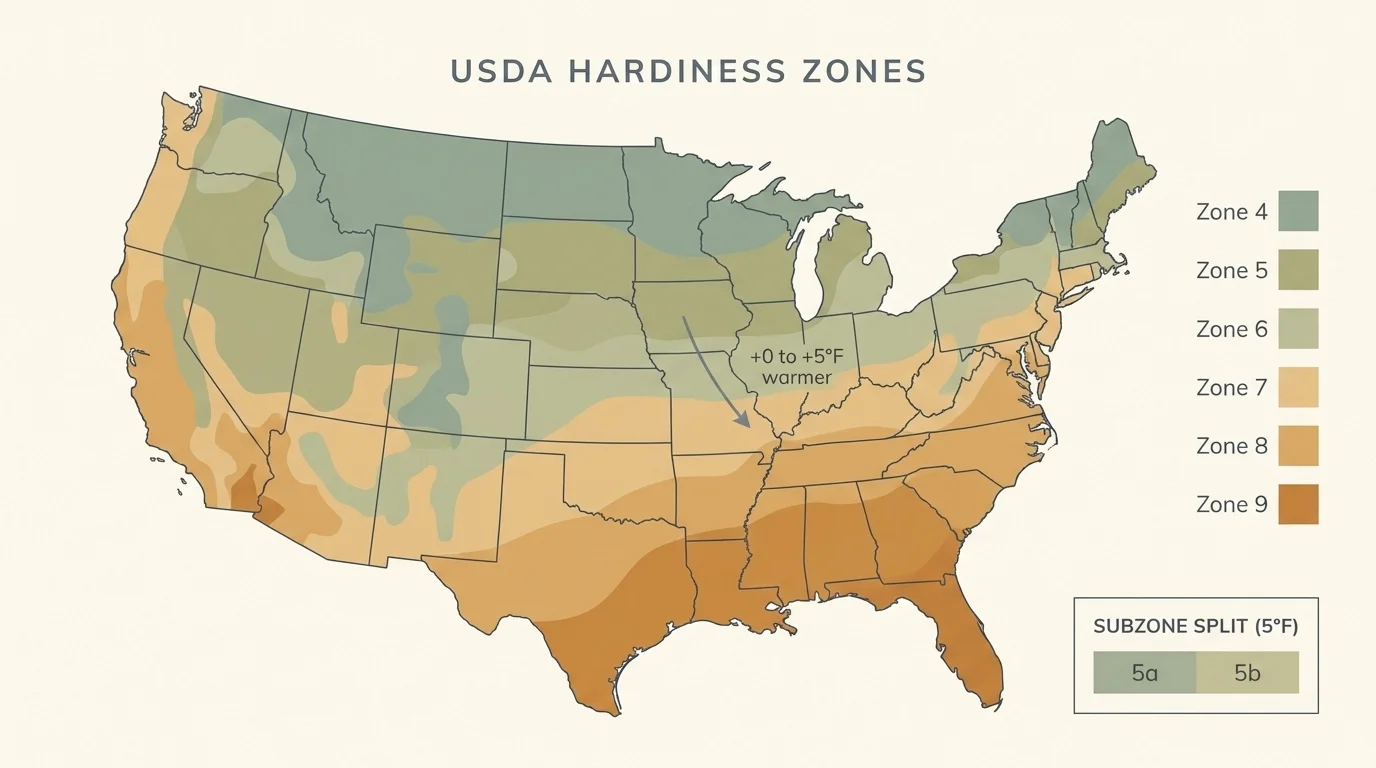
In November 2023, the USDA released a new Plant Hardiness Zone Map rebuilt on thirty years of data — 1991 through 2020 — and roughly half the United States moved into a warmer half-zone, with average winter low temperatures running about zero to five degrees Fahrenheit warmer than the prior 2012 map indicated. This is the single most concrete thing that has happened to American home gardening in the last decade, and the great majority of gardeners have not yet updated their plant lists to match.
The map structure is worth understanding before you adjust anything. It runs thirteen zones in ten-degree Fahrenheit bands, with each band split into a and b half-zones of five degrees each. A local microclimate — a sheltered south-facing wall, a low-lying frost pocket, a windward slope — can shift a site by roughly half a zone in either direction, which means your microclimate matters as much as the map.
The practical action is simple and seasonal. Look up your current zone at the USDA site. Then walk your perennial beds with one question in mind: which plants were on the cold edge of your old zone, and which were on the warm edge? The cold-edge plants are now safer — a borderline-hardy figure of speech that was risking your zone-five winter might be reliable now. The warm-edge plants — heat-sensitive shrubs and trees that wanted your old summers — may struggle in the next decade of hotter Julys. Make a short list, this winter, of the species you would replace if a single hard summer killed them, and have the substitutes researched before you need them.
Loading image...
Roughly half the United States moved into a warmer half-zone in the latest map rebuild — your perennial list is the first thing that needs updating.
International techniques, named — with U.S.-zone equivalents
The international framing in the original version of this article — "Australia", "Asia" — does no useful work for a gardener trying to plan a bed. The named lineages do. What follows is a short list of the techniques that have already worked in climates harder than most North American ones, with notes on where they translate to home gardens here.
Australian permaculture swales — developed in the 1970s by Bill Mollison and David Holmgren, swales are shallow trenches dug along contour lines to slow and infiltrate rainwater into the soil. They work in any sloped landscape that receives uneven rainfall — USDA zones 4–10, broadly — and they pair well with fruit-tree plantings on the downslope side, where the captured water is most useful.
Vietnamese and Filipino terraced rice systems — terracing converts a slope into a series of level beds, each holding water and topsoil that would otherwise wash to the bottom. The home-garden version is a contoured raised-bed run on any lot with more than about ten degrees of slope. It works in every U.S. zone where the slope is the limiting factor.
Japanese satoyama — a traditional management pattern of woodland, paddy, and village edge that maintained biodiversity for centuries through deliberate mosaic plantings rather than monoculture. The home-garden translation is the multi-layered edge planting — canopy tree, understory shrub, herbaceous layer, ground cover — which holds far more pollinator and bird life per square foot than turf.
Middle Eastern qanats and shaded courtyards — underground irrigation channels and tree-shaded courtyards have kept gardens viable in hot-dry zones for two millennia. The home-garden lessons are the value of deep mulch, the use of woody plants for shade rather than structures, and the placement of seating and edibles on the cooler north side of any garden wall. Most translatable in USDA zones 8–11.
Sub-Saharan zaï pits — small planting pits dug into hardpan soils, filled with compost, and used as moisture-collecting basins for staple crops in drought-prone West Africa. In USDA zones 7–10 with degraded urban soils or compacted clay, the zaï-pit principle — concentrate organic matter and water at the root, not across the whole bed — converts hostile ground into productive ground faster than tilling does.
Plant choice, by the direction your zone is shifting
The competitor plant lists I read while preparing this article are uniformly mono-climate — Californian or Arizonan, mostly, organized as if drought were the only direction of change. It is not. Below is a short, named list of perennials and shrubs organized instead by the four directions a North American gardener's local climate might be moving.
Warming and drying (most of the inland West, parts of the central Plains): lavender (Lavandula angustifolia), agastache (Agastache foeniculum), butterfly milkweed (Asclepias tuberosa), prairie smoke (Geum triflorum), little bluestem (Schizachyrium scoparium), sedum 'Autumn Joy', yarrow (Achillea millefolium). All tolerate full sun, lean soil, and irregular watering once established.
Warming and wetter (much of the Northeast, mid-Atlantic, Pacific Northwest): swamp milkweed (Asclepias incarnata), Joe-Pye weed (Eutrochium maculatum), New England aster (Symphyotrichum novae-angliae), sweetspire (Itea virginica), blue-flag iris (Iris versicolor), red-osier dogwood (Cornus sericea). Most prefer a moist site and will handle the heavier, flashier rain events that are becoming the norm.
Warming with volatility (much of the Southeast and lower Midwest): heat-tolerant pepper cultivars, okra, eggplant in the edible layer; coneflower (Echinacea purpurea), beebalm (Monarda fistulosa), false indigo (Baptisia australis), and ornamental grasses in the ornamental layer. Choose plants that tolerate both wet and dry stretches rather than optimising for one.
Cooling at the margins (high-latitude or high-elevation sites where the trend is locally variable): native serviceberry (Amelanchier species), pussy willow (Salix discolor), high-bush blueberry, and any zone-5-hardy native that has done well for a decade. Microclimate matters more than headline trend in these sites.
Xeriscape vs. rain garden: which fits your microclimate?
These two techniques get framed as alternatives across most of the top-ranking SERPs I read for this piece. They are not alternatives; they are opposite-extreme responses to opposite extremes of rainfall, and a sustainable garden frequently needs both.
Rain gardens sit at the opposite end of the same conversation. A rain garden is a shallow, planted depression sited to capture runoff from roofs, driveways, and downspouts — slowing the water down, letting it infiltrate the soil instead of the storm drain, and supporting a native-plant community adapted to wet feet through the spring and a drier summer. The plants of a Northeast rain garden — swamp milkweed, blue-flag iris, sedge species, red-osier dogwood — are some of the same species that support the native bees and Lepidoptera most under pressure from habitat loss.
A short decision aid for which to build first:
If your yard sits on a slope above a storm drain, has a downspout that erodes the lawn under it, or floods in any spring rain greater than an inch, build a rain garden first.
If your yard requires more than an inch of supplemental irrigation per week to keep a lawn green from June onward, convert the thirstiest turf area to a xeriscaped bed first.
If both are true — and across an increasing number of U.S. zones, both are true — you need a rain garden at the low end of the yard and a xeriscape at the high end, and the principle of hydrozoning links them.
Heat-tolerant vegetables for warming zones
The crops that home gardeners in the upper Midwest and Northeast are starting to grow now are the crops that used to belong to the Gulf Coast. Soil-temperature thresholds explain why.
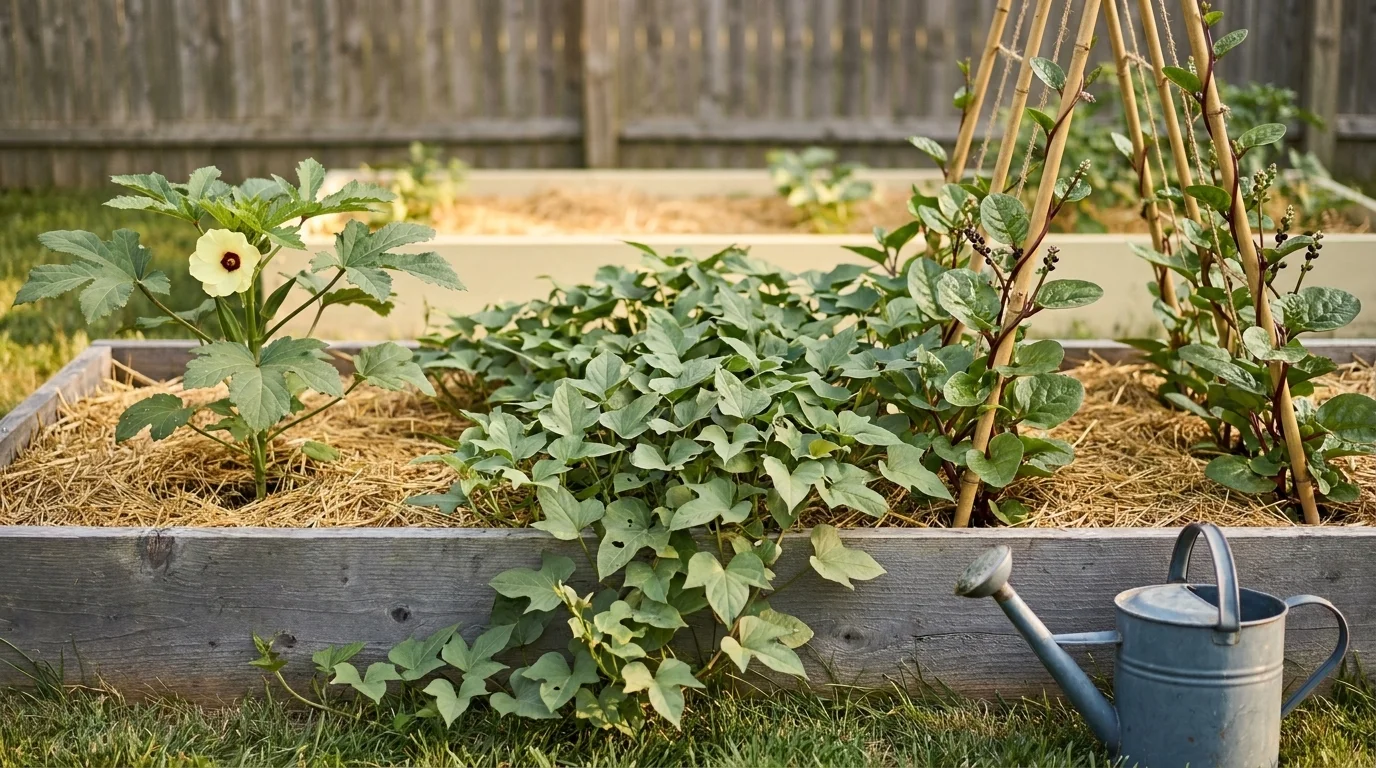
Okra germinates at soil temperatures above 65°F and produces best when the soil is consistently above 75°F. In zones that used to sit at 75°F soil for only six weeks of summer, the window is now closer to ten.
Sweet potato is planted as slips into soil consistently 70–80°F; the cured tubers are increasingly common in Northeast farmers' markets that did not carry them ten years ago.
Yard-long beans (Vigna unguiculata sesquipedalis) and southern peas germinate reliably above 70°F soil and produce heavily through summer heat that would have stalled common bush beans in earlier decades.
The pollinator consequence is worth a sentence. Okra, eggplant, and southern peas are all worked by native bees — primarily mining bees and the larger bumblebees — and adding any of them to a home garden in a shifted zone expands forage for the pollinators that the same shifted zone is pressuring.
Loading image...
The crops Northeast gardeners are growing now are the crops that used to belong to the Gulf Coast — soil-temperature thresholds explain why.
The seventy-per-cent native benchmark
University of Maryland Extension and a growing number of other state services now publish a concrete benchmark for the native-plant question that gardeners have been asking informally for a decade: at least seventy per cent of the plants in a home landscape should be native to the local ecoregion. The rationale is that natives need less water, less fertiliser, and less pesticide than imported ornamentals — and they support the pollinator and beneficial-insect communities that the local food web depends on. Climate resilience at the yard scale is, in large part, what seventy per cent native looks like when you build it.
A note on provenance, because this is the part most plant lists get wrong. A coneflower (Echinacea purpurea) grown from Illinois ecotype seed and a coneflower grown from a Dutch nursery selection are the same species and different plants. The native pollinators know the difference. Where possible, source native plants from regional nurseries — the Northeast has the Hudson Valley Seed Company, Prairie Moon Nursery, and the regional seed libraries; other regions have their equivalents — rather than from big-box-store stock that may be propagated from clones with no local genetic record.
Composting the kitchen scraps that did not make it to the cutting board is part of the same calculus. Food-waste sent to landfill produces methane, a greenhouse gas that traps roughly twenty-eight times as much heat per unit mass as carbon dioxide. Composting in the garden returns the nutrients to the soil instead, supports the no-till layered-compost approach that has gone mainstream in 2026, and avoids the emissions you would have caused by sending the same scraps to the kerb.
What to do next, by the weekend
Look up your current USDA hardiness zone — the USDA Plant Hardiness Zone Map is free and searchable by ZIP code. Note whether it has shifted from your old zone. Walk one bed in your garden and identify one plant that sat on the cold edge of your old zone — likely safer now — and one that sat on the warm edge — likely at risk in coming summers. Then choose one principle from this article to run in one bed this season: a hydrozone rearrangement, a strip of native milkweed for the swamp-edge of your yard, an okra row in the bed where you used to fight a failing crop of lettuce. Sustainable gardening is the accumulation of those small bed-scale choices, made deliberately, in the direction the climate is already moving. The garden will tell you within a season whether you read the direction correctly.
Loading image...
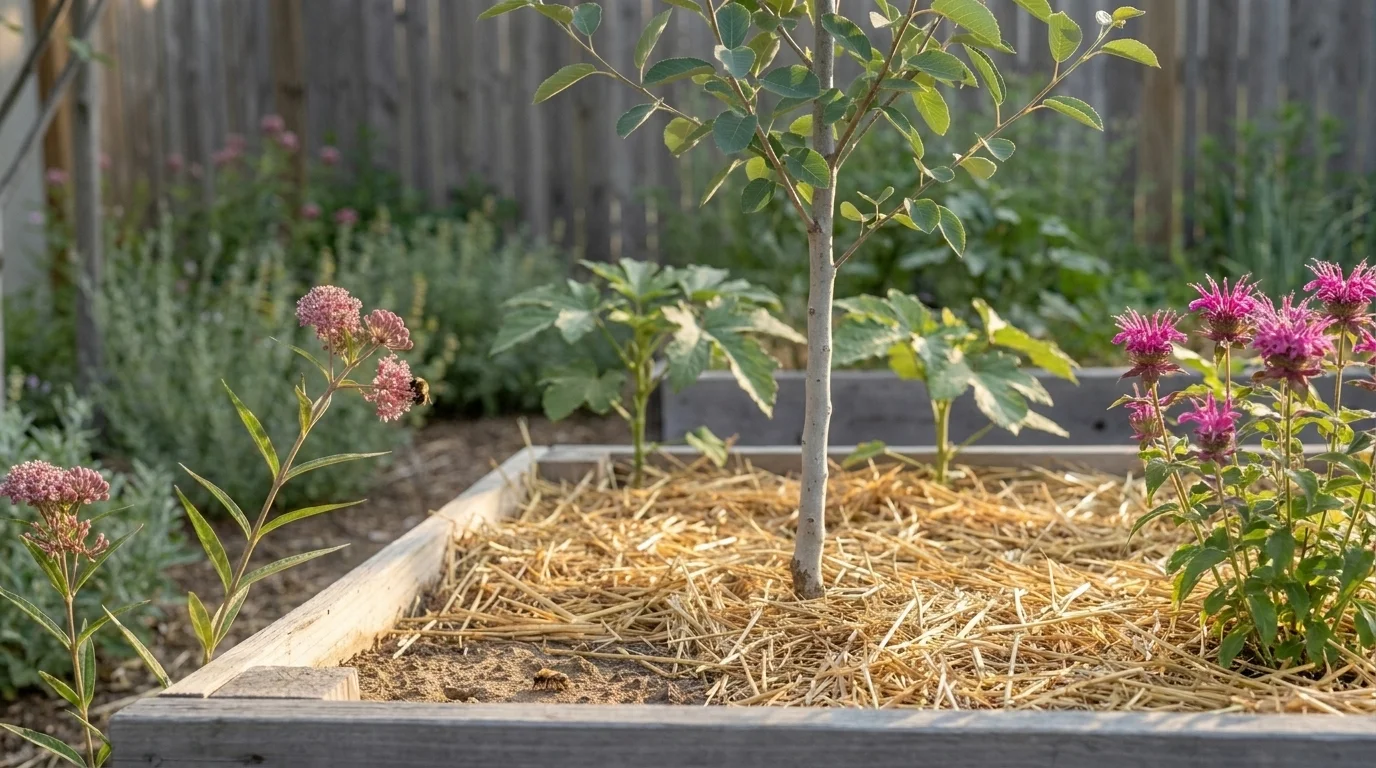
Climate resilience at the yard scale is what seventy per cent native looks like when you build it — layered, mulched, and busy at dawn.
Did my USDA hardiness zone change in the 2023 update — and what should I do about it?
Yes. The USDA updated the Plant Hardiness Zone Map in November 2023 using thirty years of data from 1991 to 2020, and roughly half the United States moved into a warmer half-zone — about zero to five degrees Fahrenheit warmer than the prior 2012 map. Look up your current zone at the USDA site, then review your perennial and tree choices: plants on the cold edge of your old zone are now safer, but heat-sensitive species at the warm edge may struggle in coming summers. Make a short list of the warm-edge species you would replace if a single hard summer killed them, and have substitutes researched before you need them.
What's the difference between xeriscaping and a rain garden — and which one fits my yard?
Xeriscaping is the seven-principle design approach developed by Denver Water for water-scarce climates — planning, soil improvement, plant selection, practical turf areas, efficient irrigation, mulching, and appropriate maintenance — and it cuts landscape water use by fifty to seventy-five per cent compared to a conventional turf-and-bed yard. A rain garden is the opposite-extreme tool: a shallow planted depression that captures runoff from roofs and driveways and supports native plants adapted to wet feet in spring and a drier summer. Choose xeriscape if your microclimate trends hot and dry; choose a rain garden if it trends wetter or flashier; pair both if you sit between extremes, with the rain garden at the low end of the yard and the xeriscape at the high end.
Which vegetables can I grow when my summers keep getting hotter?
Heat-tolerant edibles thrive once soil temperatures cross seventy to ninety degrees Fahrenheit: okra (soil above sixty-five degrees, best above seventy-five), sweet potato slips (soil consistently seventy to eighty), Malabar spinach (soil above eighty, air in the nineties), yard-long beans, southern peas, and eggplant (soil eighty to ninety, nights above seventy). These crops are no longer a Deep South niche — gardeners in shifted zones across the central and northern United States can now grow them reliably, and several of them also expand forage for the native bees and bumblebees that the same shifted zones are pressuring.
How many native plants should my garden have to actually help with climate resilience?
University of Maryland Extension and a growing number of state extension services now point to a concrete benchmark: aim for at least seventy per cent native plants in your landscape. Natives are adapted to local rainfall and soils, need less water and fertiliser, support pollinators and beneficial insects, and compound climate resilience at the yard scale. Provenance matters as much as the percentage — source from regional nurseries with local ecotype seed where possible, since the native pollinators do recognise the difference between a locally adapted plant and a clone propagated from elsewhere.
Exotic Plant Adventures: Growing and Caring for Unique and Unusual Plants
Join
Loading...
Our Green Community!
Loading...
VerdeNook is more than just a source of gardening wisdom; it’s a platform for sharing, learning, and growing together. We invite you to join our community, share your stories, and spread the joy of gardening. Let’s sow the seeds for a greener, healthier, and more sustainable future, one garden at a time.