These are the toughest, most generous plants you can grow — holding an open landscape together from three metres down, and nearly all of them for sale as seed.
A big bluestem sends its roots several feet down; across the grasslands, roots reach three, sometimes four metres into the soil. That is the quiet genius of grassland plants: the grasses and hardy wildflowers that hold an open, treeless landscape together almost entirely from below. Nearly every one of those landscapes is now a story about loss — an estimated 98% of North America's tall-grass prairie is already gone — but here is the part worth holding onto. The plants that live in grasslands are among the toughest, most generous species you can grow, and you do not need a prairie to grow them. This guide gives you both halves of what the search asks for: the named species, with their pictures and adaptations, and then how to turn a sunny corner of a yard into a pocket prairie that feeds pollinators and stores carbon. The student after a quick, correct answer and the gardener after their next bed are, it turns out, looking at the same plants.
What Are Grassland Plants?
Grassland plants are the grasses and hardy wildflowers — botanists call the non-grass flowering ones forbs — adapted to open biomes where grasses, not tall trees or shrubs, dominate the ground. They are deep-rooted, sun-loving, and built to regrow fast after fire or grazing.
That definition splits the whole subject into two working groups, and the rest of this article follows the split: grasses (the structural matrix of the biome) and wildflowers / forbs (the color-and-pollinator layer), with a scattering of low shrubs at the margins. If you have seen "types of grassland plants" asked as a question, that grasses-versus-forbs division is the honest answer.
The biome itself comes in two broad kinds. Temperate grasslands — the North American prairie and the Eurasian steppe — run through cold winters and warm summers. Tropical grasslands are the savannas. North American prairie is a temperate grassland, which matters here because the species I am about to name are temperate-prairie plants, not the baobabs and acacias of an African savanna. Competitors blur those together; a gardener in Ohio cannot use that list, so this one stays clean.
One more thing worth knowing, because it sweeps up a common question: the same vegetation carries different names by region — prairie in North America, steppe in Eurasia, savanna in the tropics, pampas in South America, and veld in southern Africa. Same idea, five names. For the growing that follows, we stay in the prairie. If seasonal, region-matched planting is your thing, it lives in our Seasonal Gardening work.
Why Grasslands and Their Plants Are Disappearing
The short version is hard to soften: an estimated 98% of North America's native tall-grass prairie has been eradicated, in the words of grassland ecologist Ryan Sensenig of the University of Notre Dame. This is not old history finishing its course. Roughly 1.9 million acres of Great Plains grassland were plowed into cropland in 2022 alone — the ten-year average runs closer to 2.6 million acres a year — and only about 55% of the U.S. and Canadian Great Plains grassland is still intact, according to the WWF Plowprint Report. Across the continental United States, we have lost roughly half of our historic grasslands.
I find the carbon figure sharpens it further: grasslands may hold something like 30% of the world's soil-based carbon, most of it locked in exactly those deep root systems — carbon that a plow releases and a lawn never rebuilds.
Here is the turn, and it is the reason this article does not stop at the homework answer. The plants doing that work are not rare or difficult. They are for sale as seed and plugs, and a single sunny bed of them is a small, real piece of habitat. The pocket prairie further down is where that goes from sentiment to a Saturday's work — so hold the number, and I will show you the square of ground.
How Grassland Plants Survive: Key Adaptations
Grassland plants survive open, dry, disturbance-prone country with a shared toolkit: very deep roots, narrow waxy leaves, flexible stems, growing points held low at the soil surface, and the ability to regrow fast after fire or grazing.
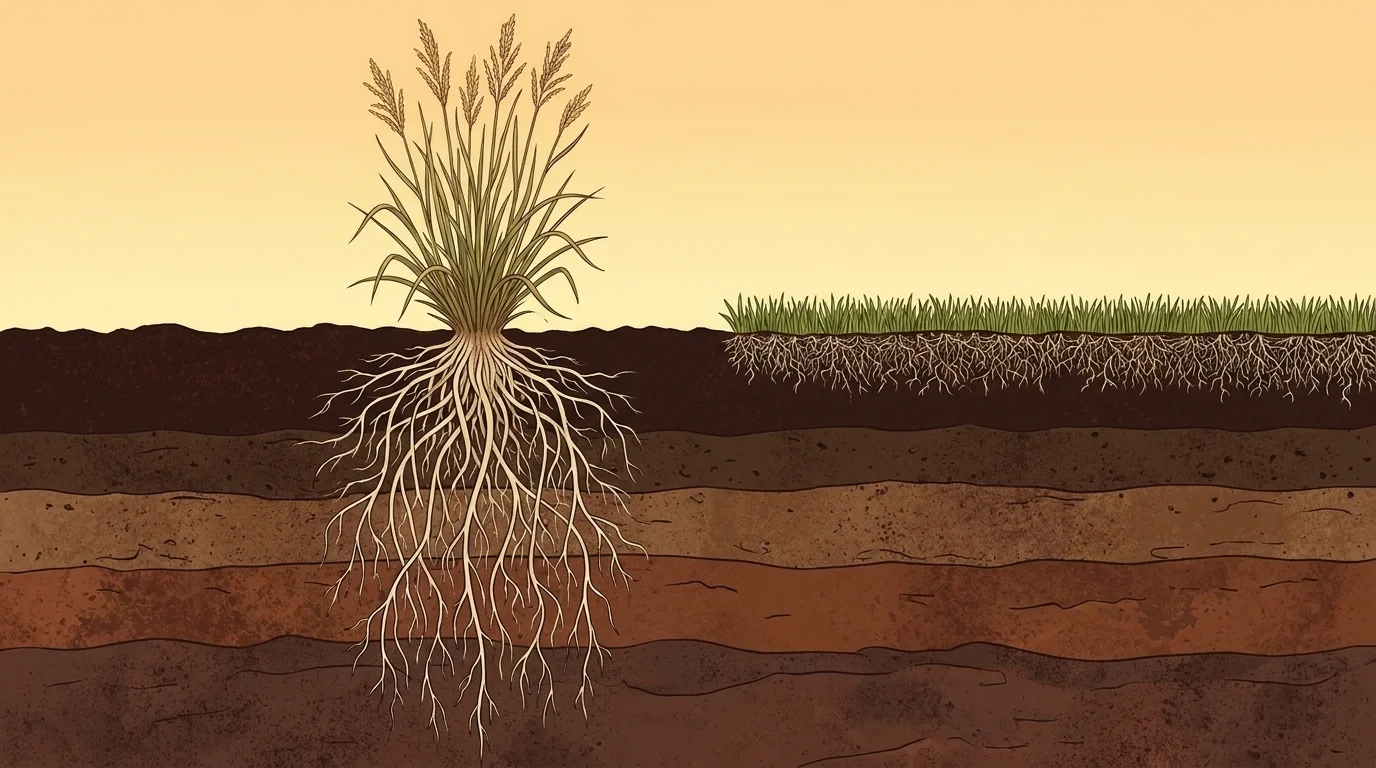
Start underground, because that is where a grassland actually lives. The roots of prairie grasses commonly reach three to four metres down — deeper than the plant is tall — which anchors them through drought, reaches water no shallow-rooted plant can, and stores the carbon from the section above. Aboveground, the leaves are narrow and often waxy, which cuts water loss, and the stems are flexible: in a place with no trees to break the wind, a stem that bends survives and a stiff one snaps.
The cleverest adaptation is the one you cannot see at a glance. Grasses hold their growing points — the meristems — low, right at or just below the soil surface, rather than at the tips of shoots the way many garden plants do. When fire or a grazing bison removes everything above, the growing point is untouched, and the plant is back within weeks. Fire and grazing are not disasters to a prairie; they are the disturbances it is built to answer, which is why grasslands persist under both.
Recent research frames these strategies through Grime's CSR model of plant life-histories and finds grassland species can shift traits rapidly, over just a few generations — a reminder that this is living, adapting biology, not a fixed textbook diagram. For a gardener, the payoff is direct: the same traits that beat drought and fire on the prairie make these plants remarkably drought-tolerant and low-maintenance in a bed.
Loading image...
A prairie plant roots three to four metres down — deeper than it stands — which is how it beats drought and stores the soil carbon a mowed lawn can never rebuild.
Grassland Grasses: 7 Species to Know (and Grow)
The grasses are the bones of the biome — the matrix everything else grows through. Here are seven North American prairie grasses worth knowing and, in most temperate gardens, worth growing. These are the wild relatives of the ornamental grasses you already see in borders; the difference is provenance, not toughness.
Big bluestem (Andropogon gerardii) is the tallgrass icon, reaching well over head height, with distinctive three-parted "turkey-foot" seed heads and the several-feet-deep roots from the section above. It is the plant people mean when they say "tall-grass prairie."
Switchgrass (Panicum virgatum) throws up upright clumps topped with airy, cloud-like seed panicles. It is tough, widely adaptable across zones, and the easiest crossover into an ordinary garden.
Little bluestem (Schizachyrium scoparium) is the shorter cousin — blue-green stems through summer that turn a warm russet-copper in autumn and hold that color into winter. It is genuinely drought-proof once established.
Indiangrass (Sorghastrum nutans) carries golden, feather-plumed seed heads in late summer and is a warm-season classic, the standard companion to big bluestem in a real prairie planting.
Blue grama (Bouteloua gracilis) is a low shortgrass-prairie specialist with charming, one-sided seed heads that hang like little eyelashes off the stem. It thrives on dry, lean sites where taller grasses sulk.
Buffalo grass (Bouteloua dactyloides, formerly Buchloe dactyloides) is a short, sod-forming native that spreads to knit a low turf — the go-to if you want a no-mow, low-water lawn alternative rather than a tall bed.
Prairie dropseed (Sporobolus heterolepis) is the tidiest of the group: fine, arching, fountain-like clumps that smell faintly of coriander in bloom. It is the prairie grass most at home in a formal garden.
Loading image...
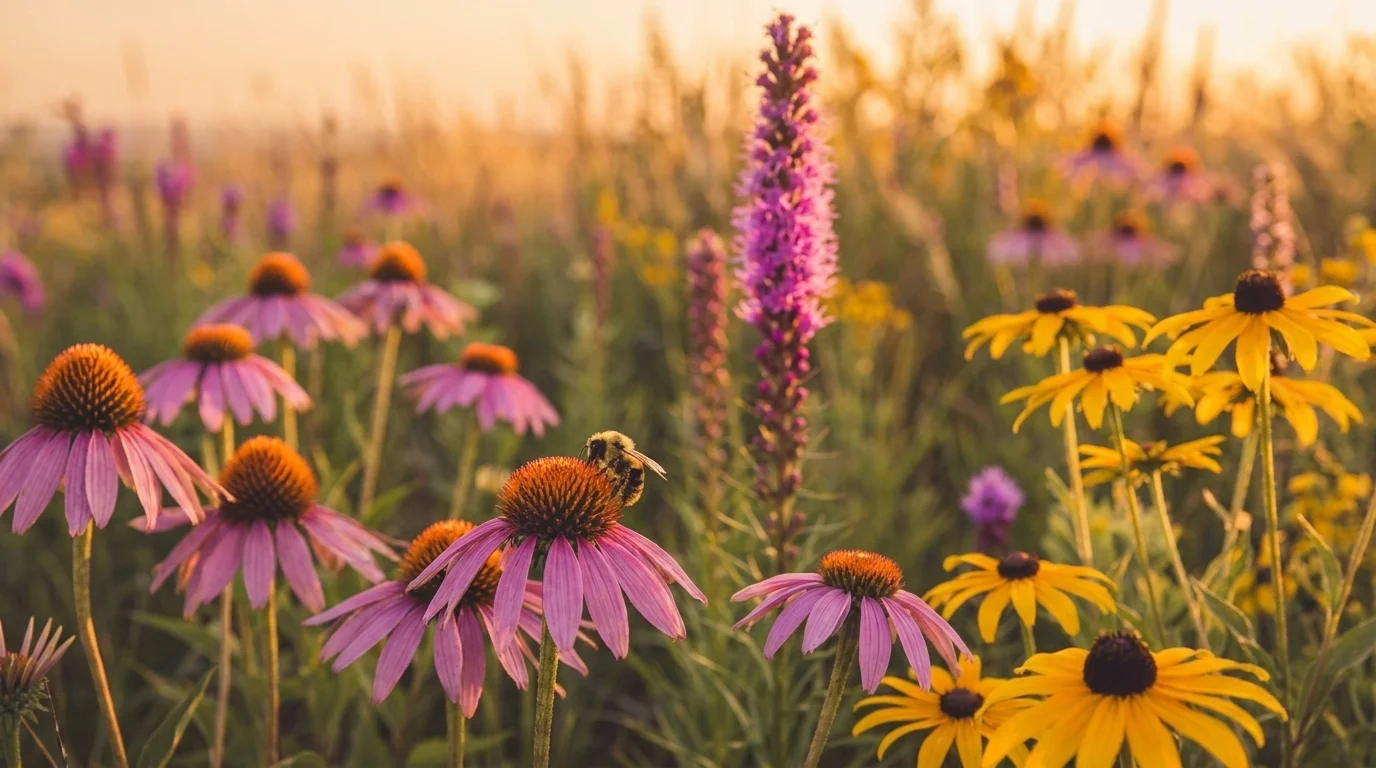
The forbs are why the prairie hums in July — each one feeds or hosts a specific insect, which is the difference between a bed that looks alive and one that is.
Grassland Wildflowers and Forbs: 8 to Know
If the grasses are the matrix, the forbs are the reason the prairie hums in July. These eight carry the color, and more to the point, they carry the food web — each one feeds or hosts specific insects, which is the difference between a planting that looks alive and one that is.
Purple coneflower (Echinacea purpurea) holds daisy-form purple blooms on stiff stems, is drought-tough, and is a reliable magnet for bees and butterflies; leave the seed heads standing and goldfinches work them all winter.
Black-eyed Susan (Rudbeckia hirta) is the easy one — golden petals around a dark central cone, long-blooming, and happy to self-sow into any gap you leave it.
Blazing star (Liatris spp.) sends up vertical purple spikes that, unusually, open from the top down. It is one of the highest-value pollinator plants on this list, covered in butterflies when it flowers.
Milkweed (Asclepias spp.) is the example everyone knows, and the detail matters: monarch caterpillars can develop on milkweed and nothing else — not a butterfly bush, not a "pollinator mix." The adults sip nectar widely, but only Asclepias is the larval host. Choose common milkweed for room to spread or butterfly milkweed (A. tuberosa) for a tidy dry bed. One safety note, because I recommend it in every workshop: the milky sap is a skin and eye irritant, and the plant is toxic to dogs, cats, horses, and people if eaten, per the ASPCA — wear gloves to cut it and site it away from where pets graze.
Goldenrod (Solidago spp.) lights up late-season borders with yellow plumes that fuel the last pollinators before frost. And to retire an old libel: goldenrod does not cause hay fever — its pollen is heavy and insect-carried. The culprit blooming at the same time is ragweed.
Wild bergamot, or bee balm (Monarda fistulosa), carries lavender, tubular, faintly minty flowers that bees and hummingbirds work all summer. It is one of the two plants — with milkweed — that fill my own cutting garden, and it earns the space every year.
Prairie clover (Dalea spp.) holds slim purple or white thimble-shaped blooms and, being a legume, fixes its own nitrogen — it quietly builds the soil it grows in.
Pasque flower (Pulsatilla, sometimes Anemone patens) is one of the earliest prairie plants to bloom, opening silky, cup-shaped lavender flowers in early spring when little else is up. It matters for the pollinators emerging that early. For more of this plant-and-insect layer, see our pollinator work.
Why Native Prairie Plants Belong in Your Garden
Beyond the ecology, native prairie plants make an unusually easy case as garden plants. As the team at Discover + Share put it in their pocket-prairie guide, "Many native prairie plants are naturally drought tolerant, pest resistant and adaptable to low-nutrient soils" — three properties most gardeners spend money and effort chasing.
The pollinator return is the part I care about most, and it is concrete rather than decorative. The forbs above feed bees, butterflies, and — through milkweed — monarchs specifically, milkweed being the monarch's only larval host. That is a functioning food web, not a "pollinator-friendly" label. Below the soil, the same deep roots that beat drought are building and storing carbon and cutting your irrigation to a fraction of what a turfgrass lawn demands.
Set against a conventional lawn — mown, watered, fed, and ecologically close to empty — a bed of native prairie plants is the direct, small-scale answer to the 98% from earlier. Small plantings genuinely add up.
One insistence, because it is where good intentions leak away: buy locally-adapted, native-ecotype plants from a regional native-plant nursery. An echinacea grown from a distant seed house is not quite the same plant as your local ecotype, and the pollinators that co-evolved with the local one can tell. If you would rather ease in, our Seasonal Gardening guides pace it by month.
How to Start a Pocket Prairie at Home
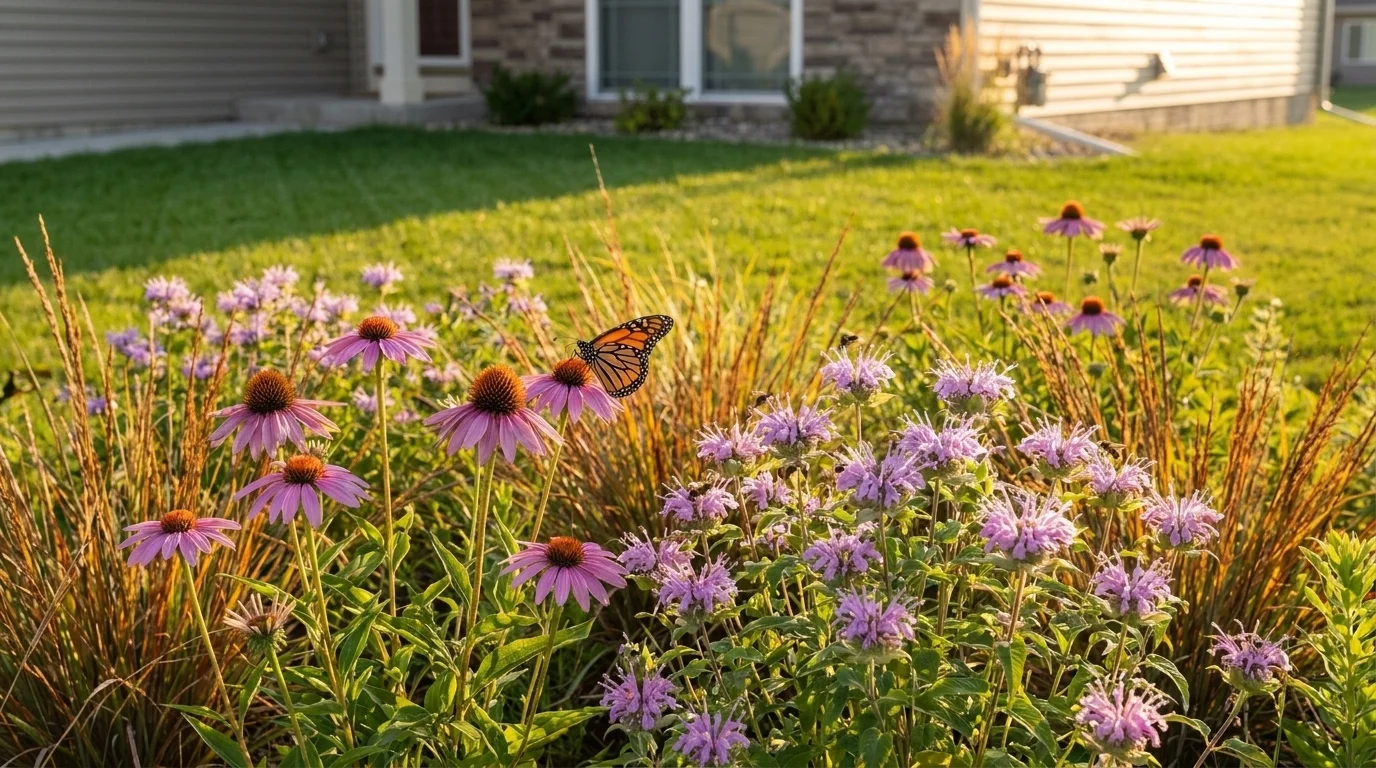
A pocket prairie is a small native planting — a sunny, level 10-by-10-foot square is plenty, or a 20-by-5-foot strip along a fence. Start from seed or plugs and expect two to five years to full establishment. That is the whole idea; the rest is detail.
Site. Full sun is the one non-negotiable — these are plants of open, treeless country, and they will not perform in shade. A level square catches water evenly; a sunny strip along a boundary works just as well and reads as intentional.
Seed versus plugs. Seed is economical and right for larger areas, but slow and a little unpredictable. Plugs — young rooted plants — cost more per square foot and give faster, more reliable results, which is why I steer small first-time plantings toward plugs. You see something living by the first summer instead of waiting on germination.
Timeline. Do not panic in year one. The prairie gardener's rule is "sleep, creep, leap": the first year the plants build those deep roots and look like almost nothing, the second they fill out, and by the third they leap. Two to five years to full establishment is normal, not failure.
Soil and zones. Match species to your USDA hardiness zone — most of the plants above are broadly hardy, but check — and resist the urge to improve the soil. These natives are adaptable to low-nutrient ground, so amending it buys you nothing they need. Plant into what you have.
Design. Combine a few grasses for structure and winter standing with several forbs for color and pollinator waves across the season, pulling specific picks from the two lists above. If a full prairie feels like a leap, start with a clump or two of ornamental grasses as the gentlest on-ramp and add forbs as your confidence grows.
Loading image...
A sunny ten-foot square of natives is a real piece of habitat — the direct, small-scale answer to the lost 98 percent, and small plantings genuinely add up.
Your Corner of the 98%
Grassland plants are both answers at once: the correct response to the homework question — deep-rooted grasses and hardy forbs, with the names, pictures, and adaptations laid out above — and a genuine ecological loss you can do something about. You do not need a prairie to grow one. You need a sunny square, a few of the grasses and forbs named here, and the patience to let them sleep, creep, and leap.
Start this season if your soil is workable, or bookmark this for the September–October planting window when these natives settle in best. Then come back to our Seasonal Gardening category for the month-by-month steps. Every small native planting is one more corner pushing back on the 98%.
Frequently Asked Questions
What plants grow in grasslands?
Mainly deep-rooted grasses (big bluestem, switchgrass, little bluestem, indiangrass) and hardy wildflowers or forbs (purple coneflower, black-eyed Susan, blazing star, milkweed, goldenrod).
What are the adaptations of grassland plants?
Deep roots (to about 3–4 m), narrow waxy leaves, flexible stems, low growing points near the soil, and fast regrowth after fire and grazing.
What are the three types of grasslands?
Temperate grasslands (prairies and steppes), tropical grasslands (savannas), and their regional variants; North American prairie is a temperate grassland.
Can I grow prairie or grassland plants in my garden?
Yes — a "pocket prairie" of native prairie plants thrives in a sunny 10×10 ft spot. Start from seed or plugs, with full establishment in about two to five years.
What is another name for grassland vegetation?
It varies by region — prairie (North America), steppe (Eurasia), savanna (tropics), pampas (South America), and veld (southern Africa).
Join
Loading...
Our Green Community!
Loading...
VerdeNook is more than just a source of gardening wisdom; it’s a platform for sharing, learning, and growing together. We invite you to join our community, share your stories, and spread the joy of gardening. Let’s sow the seeds for a greener, healthier, and more sustainable future, one garden at a time.