Heirlooms Reimagined: Bridging Traditional Seeds and Genetic Engineering in Home Gardening
Share this article:
Heirloom means open-pollinated and saveable — the seed comes true year after year. That's the whole value, and it's exactly the line the GMO Purple Tomato just blurred.
A balcony, a Brandywine, and the question the seed packet does not answer
My first attempt at growing a Brandywine on a north-east-facing forty-two-square-foot balcony was a small disaster. The plant set six fruit, lost two to blossom-end rot, and the remaining four ripened slowly because the heirloom seeds I had bought were bred for a Pennsylvania kitchen garden in the 1880s, not a wind-funnelled sixth-floor ledge in southern Ontario. The Brandywines tasted as advertised. The yield was, conservatively, about a third of what a modern hybrid in the same pot would have given me. The seed packet had not warned me about either of these things, and the educational explainers I read afterwards — Cornell's brief comparison, the older homestead blogs — told me what a heirloom seed was without telling me what it would actually do on the balcony. This article is the piece I wish someone had written for me before that first season.
A heirloom seed, taken plainly, is three things at once. It is open-pollinated, meaning pollinated by insects, wind, or itself rather than in a controlled laboratory cross. It is old — most extension services and seed organisations use a 50-year threshold, though the Wikipedia entry on heirloom plants walks through the live debate between the 1945, 1951, and rolling-50-years dates the industry uses. And it is non-GMO by classification — heirloom and GMO are categorically distinct, and the line between them is the topic of the longest single section of this piece because the line moved in 2024 and the explainers have not caught up.
What you get for those three properties is a seed you can save: a tomato grown from a Brandywine plant will produce, with reasonable consistency, another Brandywine. What you give up is the engineered yield, disease resistance, and uniformity that hybrid breeding has spent the last seventy years optimising for. The Brandywine on my balcony was, in trade-off terms, exactly the trade I had implicitly signed up for. I had just not read the contract closely.
Heirloom vs open-pollinated vs hybrid vs GMO: the comparison
Every consumer-facing explainer I have read either avoids this comparison or makes it three columns wide. The honest version is four columns. The fourth column — open-pollinated but not yet old enough to qualify as heirloom — is the one most people skip, and it matters because it is where most modern non-hybrid breeding actually lives in 2026.
Category
Breeding method
True-to-seed
Saveable
Age criterion
Regulation
Heirloom
Open-pollinated, traditional selection
Yes
Yes
Typically 50+ years (debated)
None beyond seed-trade norms
Open-pollinated (non-heirloom)
Open-pollinated, modern breeding lines
Yes
Yes
Recent (often <50 years)
None beyond seed-trade norms
Hybrid (F1)
Controlled cross of two parent lines, recombined each season
No (F2 segregates)
Not reliably
New cultivar release each year
None beyond seed-trade norms
GMO
Targeted gene insertion in a laboratory
Variable
Sometimes (Purple Tomato is saveable)
New; case-by-case
FDA / EPA / USDA review per crop
The conventional wisdom says heirlooms always taste better than hybrids. On a windy north-facing balcony, the conventional wisdom needs a second look. Flavour is where heirlooms most reliably win, but they win on flavour at the expense of yield, disease resistance, and uniformity — and on a constrained balcony where every square inch is rationed, that trade-off is a real one. The productive home garden, especially the productive small home garden, often grows both: heirlooms for the harvest you will remember, hybrids for the harvest you can count on.
Why heirlooms matter at all: the diversity argument
The case for keeping heirlooms in the rotation, even on a balcony where the spreadsheet pushes back, rests on a number worth quoting in full. The Food and Agriculture Organization estimates that 75 percent of crop diversity was lost between 1900 and 2000 — a century during which roughly three-quarters of the genetic variability that traditional kitchen gardens once carried disappeared into the increasingly narrow gene pool of commercial agriculture. The methodology behind the figure has been debated in peer-reviewed work, but the FAO continues to use it as the canonical reference and the underlying direction is not in serious dispute.
The practical point is that every saved heirloom seed is a copy of genetic material that does not exist in the commercial system. A Cherokee Purple grown in a Brunswick courtyard, a Moon and Stars watermelon in a Hudson Valley plot, a Mortgage Lifter in a Toronto balcony pot — these are the distributed backup the global seed system does not otherwise have. The institutional backup exists: the USDA National Laboratory for Genetic Resources Preservation distributes around 250,000 samples a year to breeders and researchers, and Seed Savers Exchange has been maintaining 20,000-plus active varieties since 1975. But the institutional backup is a single building. The distributed backup is six million home gardeners, each holding a handful of saved seed.
That is the political content of growing heirlooms, and it is, I think, the part of the case that the older explainers most consistently undersell. The Brandywine on the balcony is, in this reading, not a sentimental gesture — it is a small, distributed act of redundancy.
Are heirloom seeds GMO? The 2024 answer, the 2026 nuance
The traditional answer to this question is short: no. Heirloom seeds are open-pollinated; GMO seeds are produced by targeted laboratory gene insertion; the two are, by classification, distinct categories. The University of Connecticut Extension's January 2025 comparison piece holds this line and is correct to do so.
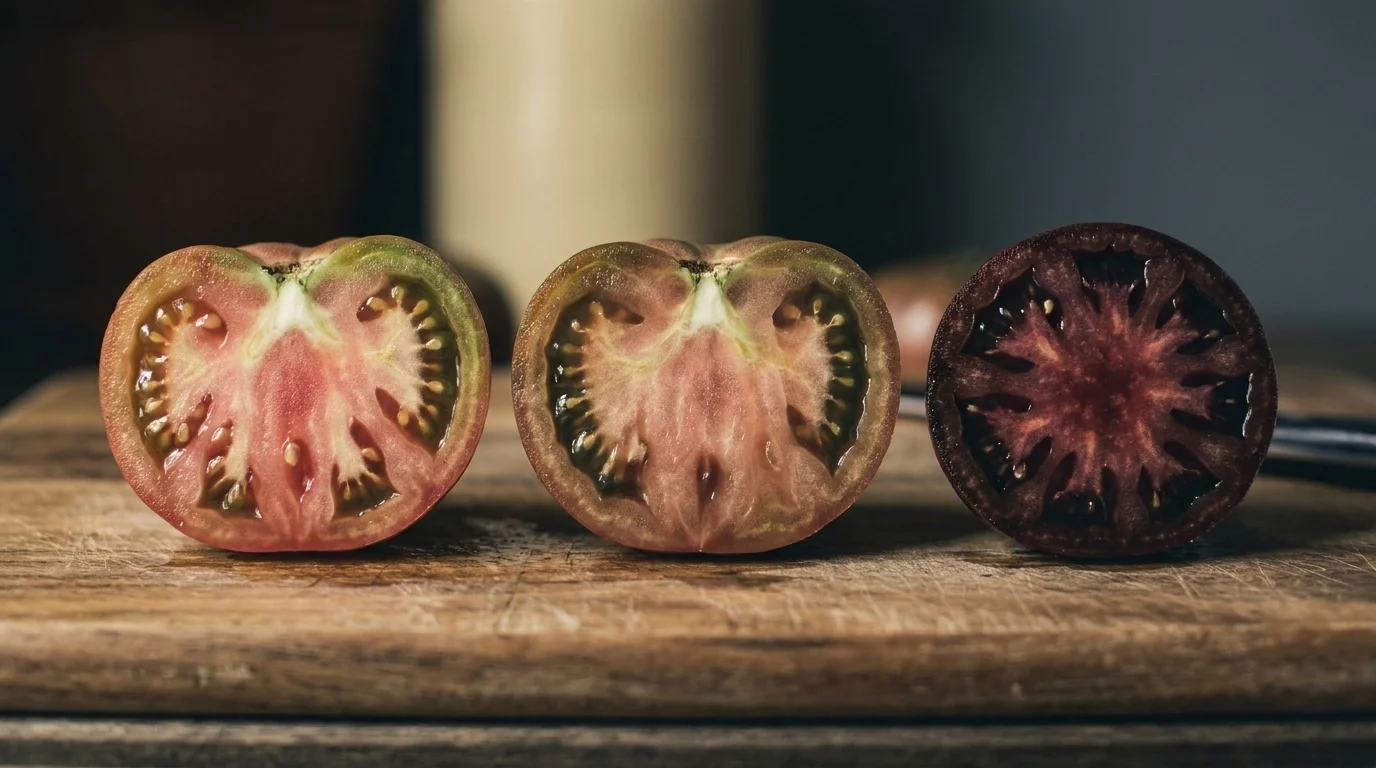
The 2026 nuance the older explainers do not yet address is the Purple Tomato. In February 2024, Norfolk Plant Sciences, working through its consumer arm Norfolk Healthy Produce, launched the first GMO seed sold directly to home gardeners. The Purple Tomato is engineered with two snapdragon genes that produce anthocyanin pigment throughout the fruit flesh — the same class of antioxidant compound that gives blueberries their colour. NPR's February 2024 launch coverage and the Synbiobeta launch write-up cover the development story; Norfolk's own FAQ page covers the part the older explainers miss.
The part the older explainers miss is this: the Purple Tomato is inbred. The seeds you save from a Purple Tomato fruit will, with reasonable consistency, produce another Purple Tomato. The plant behaves, in every observable way except the regulatory classification, like an heirloom — open growth habit, true-to-seed, saveable across generations. Norfolk's own framing positions it as the first member of a new category they describe as the "heirlooms of tomorrow." It is still, by the classification the FDA and the seed industry use, a GMO; an heirloom by definition cannot be. But the long-standing assumption that GMO equals not-saveable, the assumption that anchored every comparison explainer of the last decade, no longer holds for this one product.
The practical reading of this for the home gardener thinking about buying a Purple Tomato in 2026 is that the trade-off has moved. The historical objection to GMO at the home-garden scale — that you buy the seed once and the engineered traits collapse in the F2 generation, so you cannot save your own line — does not apply here. The choice is now closer to the choice between a heritage open-pollinated line and a modern open-pollinated line, with a regulatory layer on top. Whether you make it is a question for your own values; my job in this piece is only to note that the question has changed shape since the older explainers were written.
Loading image...
Two heirlooms and a GMO, side by side. The Norfolk Purple is engineered — yet inbred and saveable, behaving like an heirloom in everything but its regulatory label.
Five heirloom cultivars worth growing, and what each one is
The educational explainers I have read are strangely shy about naming the plants themselves. The five below are the cultivars I have either grown personally on the balcony, killed on the balcony, or watched a more competent gardener pull off in a friend's plot. The dates are the historical origins; the seed-saving difficulty is a one-line note for the home grower thinking about saving generation two.
Brandywine tomato (Pennsylvania, 1880s) — large pink beefsteak, intensely flavoured, low yield, prone to cracking. Self-pollinating; easy seed-saving. The poster-child heirloom and not the easiest one.
Cherokee Purple tomato (Tennessee, late 1800s) — dusky purple-pink, smoky flavour, more reliable yield than Brandywine in marginal conditions. Self-pollinating; easy seed-saving. Beginner-friendly.
Mortgage Lifter tomato (West Virginia, 1930s) — very large pink slicing tomato, named after the Depression-era story of a gardener who paid off his mortgage selling seedlings of it. Self-pollinating; easy seed-saving.
Moon and Stars watermelon (Tennessee, 1920s) — deep green rind speckled with yellow dots; thirsty plant, needs space, magnificent in flower as well as in fruit. Insect-cross-pollinated; isolation distance matters for seed-saving.
Cherokee Trail of Tears bean (Cherokee Nation, pre-1839) — climbing dry bean, productive, drought-tolerant, the name a reference to the bean's preservation through the forced 1838–1839 removal. Self-pollinating; easy seed-saving.
The pattern in the list is worth pointing out: the four tomatoes and the bean are all self-pollinating, which means saving seed is straightforward. The watermelon is insect-cross-pollinated, which means saving a true-to-type seed line requires either an isolation distance from any other variety in flower at the same time, or hand-pollinating individual blossoms and bagging them. The same pattern holds across most heirloom vegetables: tomatoes, beans, peppers, lettuce, and eggplant are forgiving; squash, corn, brassicas, cucurbits, and most root vegetables are not.
Saving heirloom seeds: the actual how-to
The strongest argument against the older heirloom explainers is that they treat seed-saving as a virtue without telling you how to do it. The actual process, for a beginner working with self-pollinating crops, is a four-step routine you can run on a kitchen table.
Step one: pick the right plant. Save from the plant in your patch that did best — biggest fruit, healthiest leaves, earliest set. You are selecting for the next generation. This is the part most home gardeners get backwards, saving from the leftovers; over five generations of doing it that way you will breed an heirloom into mediocrity.
Step two: let the seed mature past eating-ripe. Tomato seeds need to be removed from a fully ripe (verging on over-ripe) fruit; bean seeds need to dry on the vine until the pod rattles; lettuce needs to be allowed to bolt and the flower heads to dry on the stalk. A tomato picked for eating is not a tomato picked for seed.
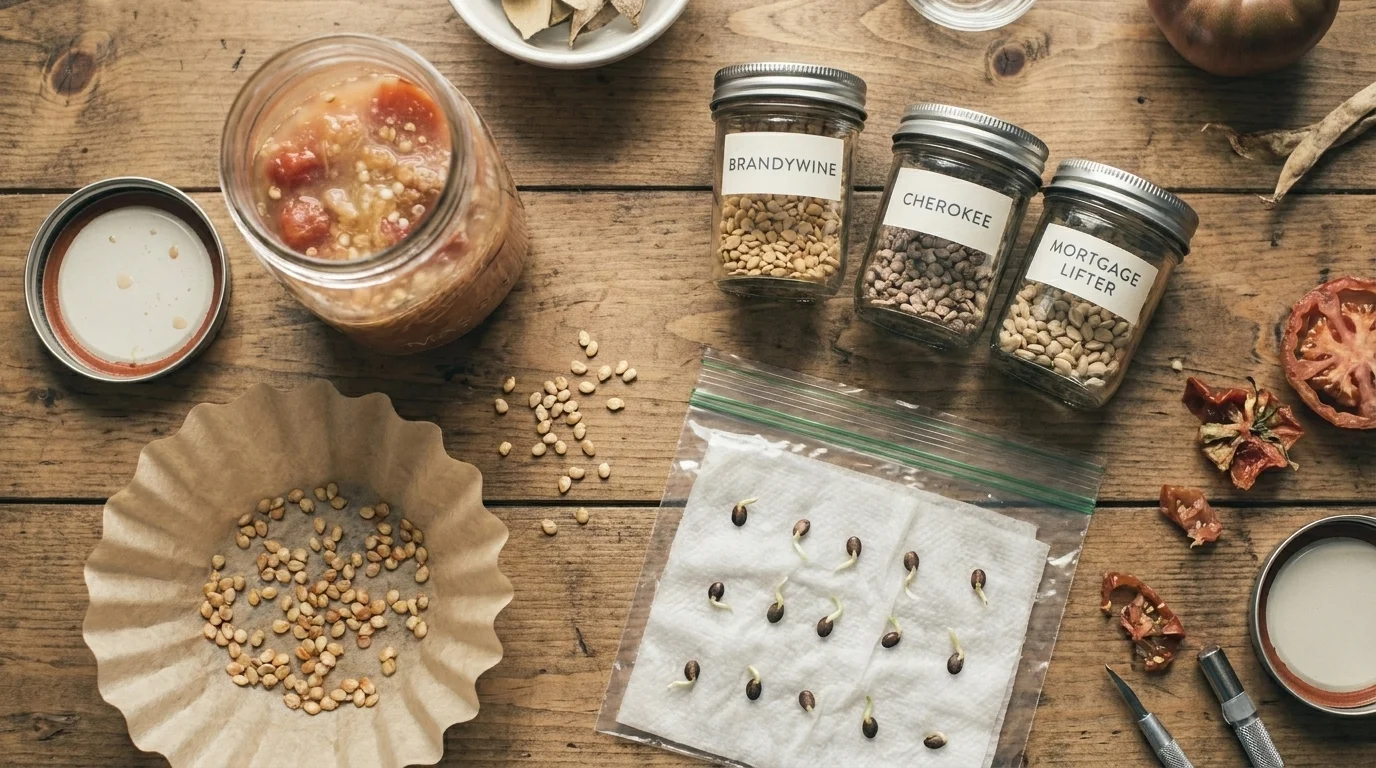
Step three: process and dry. For tomatoes, scoop the seeds and pulp into a jar with water and let it ferment for two or three days; the viable seeds sink, the unviable seeds and pulp float and can be poured off. Rinse, spread on a coffee filter or paper plate (not paper towel — the seeds will stick), and dry at room temperature for one to two weeks. For beans and peas, shell after the pods rattle; for lettuce, rub the dry heads over a fine sieve. The seeds are dry enough to store when you can snap a representative seed cleanly between your teeth (yes, really — soft seeds bend, dry seeds snap).
Step four: store cool, dry, and labelled. Airtight container, ideally with a silica desiccant packet. The benchmark storage condition that Valley Food Storage's seed-storage primer cites is 32–41°F and below 40% relative humidity — refrigerator or freezer territory. The label needs the variety name, the year, and one note on the parent plant (which row, which season).
The viability test, when you come back to a saved batch later, is the 10-seed paper-towel routine: ten seeds on a damp paper towel, sealed in a plastic bag, kept at room temperature for the variety's normal germination window. Five or more sprouts and the batch is usable; fewer than five and the batch goes in the compost. Total cost: nothing more than one paper towel and ten seeds you were going to plant anyway.
Loading image...
Saving tomato seed is a kitchen-table routine: ferment three days, dry on a filter, store cool and labelled. The 10-seed germination test costs one paper towel.
How long do heirloom seeds last? A shelf-life table
The shelf-life answer the explainers give in prose is easy to forget in spring when you are sorting through three years of envelopes. The table is easier to keep. The figures are drawn from Gardener's Basics and St. Clare Heirloom Seeds' lifespan FAQ, with the refrigerated column approximately doubling room-temperature viability per the same sources.
Crop
Room temp (years)
Refrigerated (years)
Tomato
4–6
8–10
Bean / pea
3–5
6–10
Lettuce
3
5–6
Pepper
2–3
5
Eggplant
4
7–8
Cucumber, squash, melon (cucurbits)
4–5
8–10
Brassicas (cabbage, kale, broccoli)
3–4
6–8
Carrot, parsnip
1–2
3–4
Onion, leek
1
2
Corn (sweet)
1–2
3
Onion seed at one year of room-temperature viability is the number worth circling. The pattern in the table is that the seeds that take the most patience to grow (cucurbits, brassicas, tomatoes) are also the ones that store the longest, which is the inverse of how my first season's spreadsheet had it set up.
What about the institutional safety net
I mentioned the USDA National Laboratory for Genetic Resources Preservation (around 250,000 samples distributed per year) and Seed Savers Exchange (20,000-plus active varieties since 1975) earlier. Two other organisations worth knowing about: Native Seeds/SEARCH, which preserves crops adapted to the arid Southwest, and Southern Exposure Seed Exchange, which focuses on heritage crops adapted to the Mid-Atlantic and Southeast. The catalogue work these groups do is the reason a balcony grower in Toronto can buy a Cherokee Trail of Tears bean seed at all. They are worth ordering from once a season even if you already save your own; it keeps them solvent.
A weekend modification
The one thing worth doing this Saturday, if you have any saved seed in an envelope older than two years, is the 10-seed paper-towel viability test. Ten seeds, one damp paper towel, a plastic sandwich bag, the variety's normal germination window. Five or more sprouts and your saved heirloom is still good — you have a generation of distributed crop-diversity backup on a shelf in your kitchen. Fewer than five and you compost the batch and order fresh, ideally from one of the four organisations above. Total cost: nothing, if you do it with seeds you already own — one paper towel, one Saturday morning. The dignity of the plot, in 2026, includes the work of knowing whether the seed in the envelope still wants to be a plant.
No. By definition, heirloom seeds are open-pollinated varieties that have not been genetically modified in a laboratory. The only GMO seed currently available to home gardeners is the Purple Tomato (Norfolk Plant Sciences, 2024), which is engineered with snapdragon genes for purple anthocyanin pigment. The Purple Tomato is inbred and produces saveable, true-to-seed offspring like an heirloom, but it is still classified as GMO and is not considered an heirloom variety.
What's the difference between heirloom and hybrid seeds?
Heirloom seeds are open-pollinated, at least 50 years old, and produce offspring true to the parent plant — so you can save and replant them year after year. Hybrid (F1) seeds come from controlled crosses between two parent varieties, typically deliver higher yields and disease resistance, but their seeds will not reliably reproduce the same plant, so you have to buy fresh seed each season.
How long do heirloom seeds last?
Most heirloom seeds stay viable 2–5 years when stored cool, dry, and airtight at room temperature. Tomato and bean seeds can last 4–10 years; onion seeds typically only 1 year. Refrigerated storage (32–41°F, <40% humidity) roughly doubles those numbers. A quick viability test: place 10 seeds on a damp paper towel, seal in a bag, and after the variety's normal germination window count sprouts — five or more means the batch is still good.
Can you save seeds from heirloom plants?
Yes — that's the defining feature of heirlooms. Because they are open-pollinated, their seeds reliably produce plants like the parent. Self-pollinating crops like tomatoes, beans, peppers, and lettuce are the easiest starting point. Cross-pollinating crops like squash, corn, and brassicas require isolation distance or hand-pollination to keep the variety pure across generations.
Are heirloom seeds better than hybrids?
Better at different things. Heirlooms win on flavor, genetic diversity, regional adaptation, and seed-saving — you only buy them once. Hybrids win on yield, uniformity, and built-in disease resistance, but you have to repurchase every year. A productive home garden often grows both: heirlooms for the harvest you'll remember, hybrids for the harvest you can count on.
What are open-pollinated seeds?
Open-pollinated seeds are pollinated naturally — by insects, wind, or the plant's own structure — rather than in a controlled laboratory cross. All heirloom seeds are open-pollinated, but not all open-pollinated seeds are heirlooms; modern non-hybrid breeding produces open-pollinated lines that haven't yet reached the 50-year threshold most seed organisations use to define an heirloom.
Which heirloom vegetables are easiest for beginners to save seeds from?
Self-pollinating crops — tomatoes (Brandywine, Cherokee Purple, Mortgage Lifter), beans (Cherokee Trail of Tears), peppers, and lettuce — are the easiest. The flower self-fertilises before opening, so the saved seed reliably produces the same variety without any isolation distance from other plants. Cross-pollinating crops like squash, corn, melons, and brassicas are harder; they require isolation distance or hand-pollination to keep the line pure.
Hydroponics versus Soil Gardening: The Future of Home Cultivation Debated
Join
Loading...
Our Green Community!
Loading...
VerdeNook is more than just a source of gardening wisdom; it’s a platform for sharing, learning, and growing together. We invite you to join our community, share your stories, and spread the joy of gardening. Let’s sow the seeds for a greener, healthier, and more sustainable future, one garden at a time.