Ethical Reflections in Home Gardening: Balancing Environmental Responsibility with Personal Rights
Share this article:
Sustainable gardening isn't a manifesto; it's a recipe that finally works — leave the soil alone, mulch it thick, feed it from the compost you already have.
What sustainable gardening actually asks of an ethical garden
The question I have stopped trying to answer at the gate of the community plot is whether home gardening is, in itself, an ethical act. The honest answer is: usually not, and that is the wrong question. A garden can be tended in a way that strips topsoil, kills bees, and props up a horticultural supply chain that pays its pickers nothing, and it can be tended in a way that does none of those things. The plot is morally neutral; the choices the gardener makes inside it are not. Sustainable gardening, framed in any way that matters, is the work of taking those choices seriously enough to notice the trade-offs — because there are always trade-offs, and the prose that pretends otherwise is the prose I would like the next decade of garden writing to drop.
The community plot I help run sits on a strip of council land behind a train line in Brunswick, and on the Saturday I am thinking of, eleven of us were turning a bed and arguing about pea varieties before nine in the morning. The conversation drifted, the way it always does, to whether the new compost shipment was actually peat-free, and whether the seedling punnets from the wholesale nursery had been treated with anything we should be worried about, and whose responsibility it was to find out. These are the conversations that sustainability lives inside. They are not large; they are not heroic. They are the small, repeated decisions about provenance and labour and consequence that, taken together, distinguish a plot that is part of an ecology from one that is merely picturesque on it.
What follows is an honest map of those decisions — the practical ones first, then the harder, more philosophical ones. The two cannot really be separated, but for the reader's sake I will pretend they can.
Sustainable gardening practices: the soil, the mulch, the water
The practical core of sustainable gardening practices has settled, in the last five years, around a small set of methods that the extension services no longer disagree about. They are not interesting in the way a manifesto is interesting; they are interesting in the way a recipe that finally works is interesting. They are, broadly: leave the soil alone, mulch it thickly, water it sparingly, and feed it from the compost you already have.
No-till, or no-dig, gardening. The University of Minnesota Extension's 2026 trend brief now treats no-dig as the recommended default for vegetable and perennial beds. The reason is biological rather than ergonomic: a single deep tilling shears the mycorrhizal fungi and earthworm tunnels that a season's worth of below-ground community has built. The compost goes on top, in a layer thick enough to plant into, and the soil structure below it is left where it has settled itself. This is unglamorous work — there is nothing photogenic about a tarp on a bed in February — and it is the single highest-leverage thing a gardener can do for the ground.
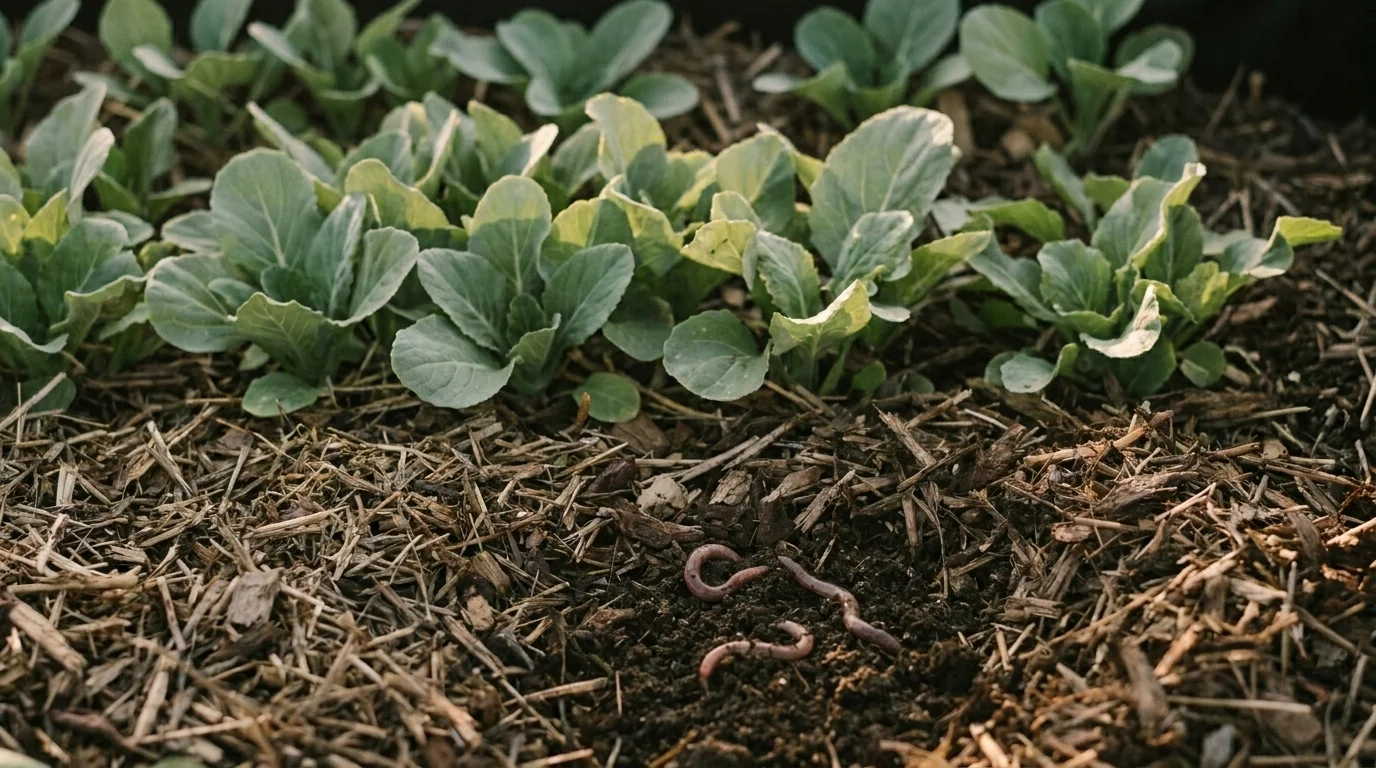
Mulch, three to four inches. UMN gives the depth, and the extension consensus has lined up behind it: three to four inches of organic mulch — wood chip, shredded leaf, straw — suppresses most weed germination, halves evaporative water loss, and feeds the soil as it breaks down. Thinner is decorative; thicker chokes the crown of young perennials. Three to four inches is the operative figure, and it is the number to write on the bag you take home.
Compost and the C:N ratio. A working compost heap runs hot at the centre, cools at the edges, and finishes when it falls apart cleanly in the hand and smells of leaf litter, not ammonia. The ratio that gets it there is roughly thirty parts brown (leaves, straw, cardboard) to one part green (kitchen scraps, fresh prunings, coffee grounds) — by volume, not weight, and not so precisely measured as the textbooks suggest. The community plot's heap runs on whatever the plot-holders bring in their kitchen buckets and whatever leaf-fall the council's autumn sweep deposits at the gate; we do not weigh it, and the heap does not seem to mind.
Integrated pest management, in plain English. Organic gardening practices in 2026 are no longer the binary they were a decade ago — you do not have to choose between toxic broad-spectrum pesticide and waving a hand at the aphids. The middle path that the eco friendly gardening literature has converged on is IPM: identify the pest, tolerate low populations, encourage the predators (ladybird beetles, parasitic wasps, the song birds that come for the caterpillars), and intervene only when the threshold is crossed. The intervention, when it comes, is selective — insecticidal soap for soft-bodied insects, a row cover at the right week, hand-picking on a Saturday morning. The garden looks slightly less tidy. The food web does not collapse.
Loading image...
Three to four inches is the number to write on the bag. Thinner is decorative; thicker chokes the crown. At that depth, mulch halves evaporation and feeds the soil as it goes.
Biodiversity, native plants, and the seventy-per-cent line
For a long time the ethical question about a garden's plant list was treated as a matter of taste — exotic-and-showy on one side, native-and-virtuous on the other, with most domestic gardens stretched somewhere uncomfortable between. The research that has accumulated through the last decade has made the question quieter and harder to argue with. The National Wildlife Federation now cites a research-backed threshold of about seventy per cent native plant biomass for measurable wildlife and food-web benefit in a residential garden (NWF — Plant 70% Native, Benefit More Wildlife). Below that, the insects that the local songbirds need to feed their young are not present in sufficient numbers to support the birds. Above it, they are. Seventy per cent is the figure to keep in mind.
The household behaviour data has moved with the research. Twenty-five per cent of US adults now specifically buy native plants, up from seventeen per cent in 2020; twenty-eight per cent — roughly 73 million people — are purchasing plants beneficial for native bees, butterflies, and birds; twelve per cent are converting some portion of their lawn to natives, with stated intent-to-convert doubling from nine per cent in 2019 to nineteen per cent in 2021 (NWF — Sustainable Gardening Trends). The trend is rising and not, on present evidence, fashion-driven. It is rising because the case for it has become harder to refuse.
The practical question, in a biodiversity garden sense, is which natives, and for whom. The species-level work — what grows in your USDA zone, what feeds your local moth caterpillars, what blooms in the hungry weeks between the last willow catkins and the first asters — is properly done against a regional list. The Missouri Botanical Garden's plant index, organised by wildlife purpose (birds, bees, butterflies) and USDA zone, is the place I send most readers; their work is better than mine on this and there is no point duplicating it. The principle to carry to that work is the seventy-per-cent line, and the ethical proposition behind it: a garden that does not feed the insects that feed everything else is a garden in name only.
This is the section where the older essay's word "ethical gardening" earns its mention — but not as the head term. The honest framing is that an ethical garden is one whose biology survives the week the gardener is away.
The decision the home gardener actually faces: GMOs at the seed packet
For most of the last twenty years the genetic-engineering question in horticulture was a question about commercial agriculture. Home gardeners argued about it in the abstract, signed the petitions, and bought their seed from a heritage catalogue. That changed in 2023 and 2024, when the FDA-reviewed purple tomato — engineered for high anthocyanin levels — became the first GMO seed marketed directly to US home gardeners, with home-scale availability and consumer-grade packaging (Homesteading Family — GMO Seeds: What the Home Gardener Needs to Know). The decision is now concrete in a way it has never been before. The packet is, or shortly will be, on a rack near the heirloom Brandywines.
The voice in my head when I look at the rack is not the voice that wants to issue a verdict. It is the voice that wants the gardener to ask three questions before reaching for the packet.
The first is about the licence. Many GMO seed lines, in commercial agriculture, are sold under patent agreements that prohibit saving seed for the next season. The home-garden GMO market is too new to know how the licensing will settle, but the question to ask the supplier is whether the seed is yours to save or whether you are buying a season of plants. The whole tradition of the seed-saver, from the Diggers' library to the small operators trading varieties at a kitchen-table swap, sits inside that question.
The second is about cross-pollination. A tomato is mostly self-pollinating, which makes the purple tomato a relatively low-stakes example. Other crops — squash, corn, brassicas — are heavily insect- or wind-pollinated, and a GMO variety in a backyard plot can drift into a neighbour's plot at distances measured in dozens of metres. If your neighbour has been saving seed from heritage stock for a decade, the courteous question is whether they would like to know about the new packet before you plant it.
The third is about what problem the modification actually solves. A purple tomato engineered for more anthocyanin is a nutritional novelty; that is not a criticism, but it is worth naming clearly. A modification that addresses a real local pest pressure or disease, in a way conventional breeding cannot, is a different proposition from a modification that produces a more photogenic salad. The reader's own values do the final sorting; the questions are a way of making sure the values get a chance to.
The framing that competitors miss is that this is not a binary about whether GMOs are good or bad. It is a question about provenance, licensing, and consequence — and those are questions the home gardener is, for the first time, genuinely being asked to answer.
Consumer rights at the garden centre: neonics and the question to ask
The most damaging single purchase a well-intentioned gardener can make in 2026 is a pollinator-friendly plant that has been pre-treated with neonicotinoid pesticides at the nursery. Neonicotinoids are systemic — the plant takes the chemical up through its tissue, so the nectar and pollen of a treated milkweed or aster carry the pesticide along with everything else. A pollinator garden planted from pre-treated nursery stock is, in the worst case, a slow-acting poison delivery system for the species the gardener thought they were helping.
The policy is shifting. Vermont became the first US state to pioneer outdoor-use bans on key neonicotinoid pesticides in 2025, and the EPA is finalising its review at the federal level (Bright Lane Gardens — Neonicotinoids in 2025). University of Florida researchers, in a June 2025 ornamental-horticulture pesticide study, have been documenting exactly the contamination pathway above — measuring pesticide residues in nectar and pollen and behavioural effects on bees, butterflies, and hummingbirds including disorientation, tremors, and reduced reproduction (News4Jax — UF researchers study pesticide impact on pollinators). The evidence is no longer in dispute.
The consumer-rights answer in the meantime is the one the older essay gestured at and never quite reached: ask. Ask the garden centre, in plain words, whether the plant on the rack has been pre-treated with neonicotinoids. A growing number of reputable centres now label "neonic-free" stock; the ones that cannot or will not answer the question are the ones to walk past. This is the small, quiet political work that sustainable gardening at the household scale most consists of: telling a horticultural supply chain, transaction by transaction, what you will and will not pay for.
The same logic extends backward through the chain. Where did the seed come from. Who picked the bulbs that are sold here. What labour standard does this nursery hold its workers to. Whether the answer is satisfactory in any given case is a private judgement; that the question gets asked, at all, is the practical content of the word "ethics" that competitors leave standing as a slogan.
Water, rainwater, and the laws you may not know about
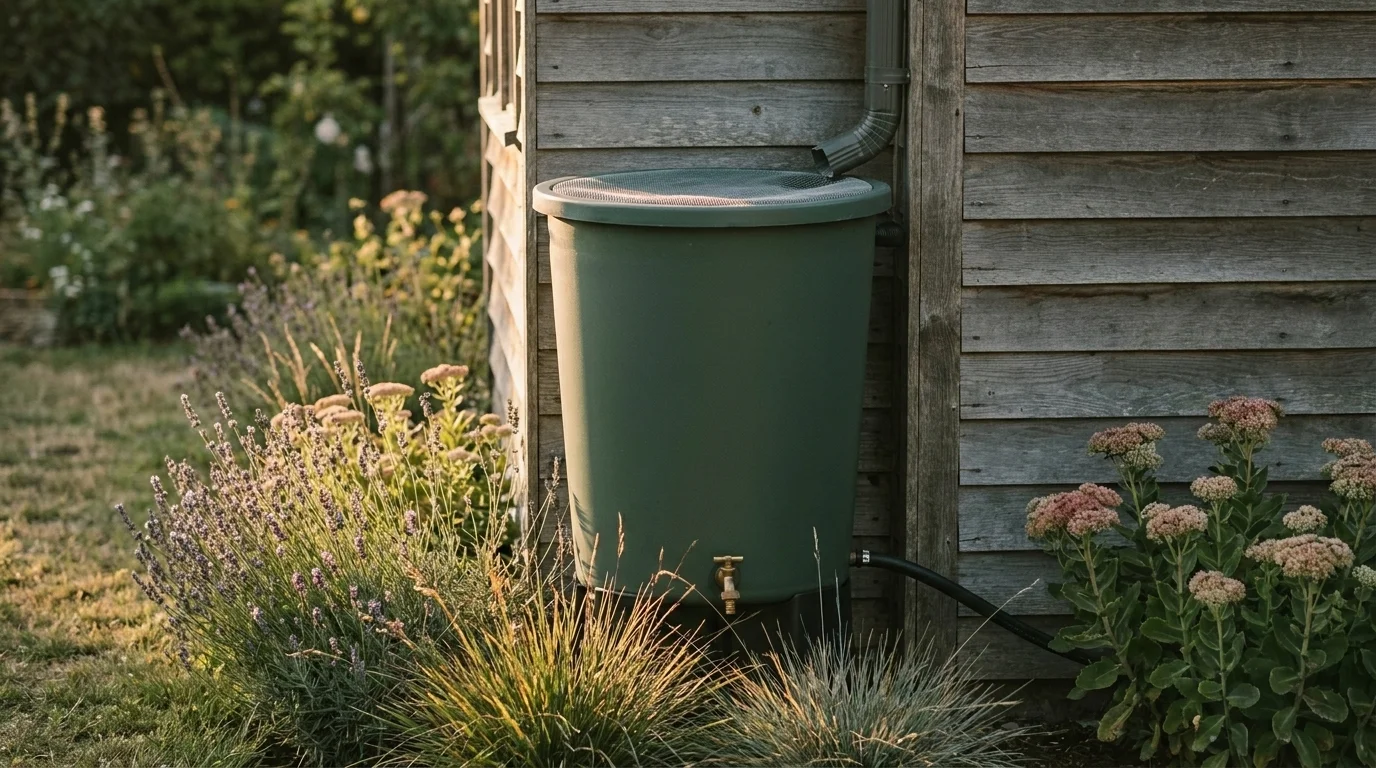
A water conservation garden in 2026 is not, in most temperate climates, an exotic project; it is the default the next decade will require. Rain barrels at the downpipe, drip irrigation on a timer, and a planting palette weighted toward drought-tolerant natives are the trio that the Homes & Gardens 2026 water-wise feature and most extension-service briefs now treat as standard practice.
The piece of this that surprises readers — and that the competitor essays leave entirely unsaid — is that rainwater collection in the United States is regulated, sometimes restrictively, at state level. Colorado limits residential rainwater collection by household; a handful of Western states regulate it as part of older water-rights doctrine; most Eastern states treat it as straightforwardly permitted. The consumer-rights point is that the regulation is local, and worth a five-minute check before installing a system. The principle is permitted; the cistern at the downpipe is, in most places, the gardener's to fill.
Loading image...
The cistern at the downpipe is yours to fill in most states — but Colorado and a few Western ones regulate rainwater. Worth a five-minute check before you install.
From sustainable to regenerative
The vocabulary is shifting. The trend briefs from the UMN Extension, J Walsh Gardens, and Amateur Gardening through 2025 and 2026 all observe the same progression: sustainable gardening as the older word for "doing no harm" is being joined, and in some quarters replaced, by regenerative gardening — the older word's stricter cousin, in which the garden is asked not only to leave the soil and the food web undamaged but actually to leave them measurably healthier each season.
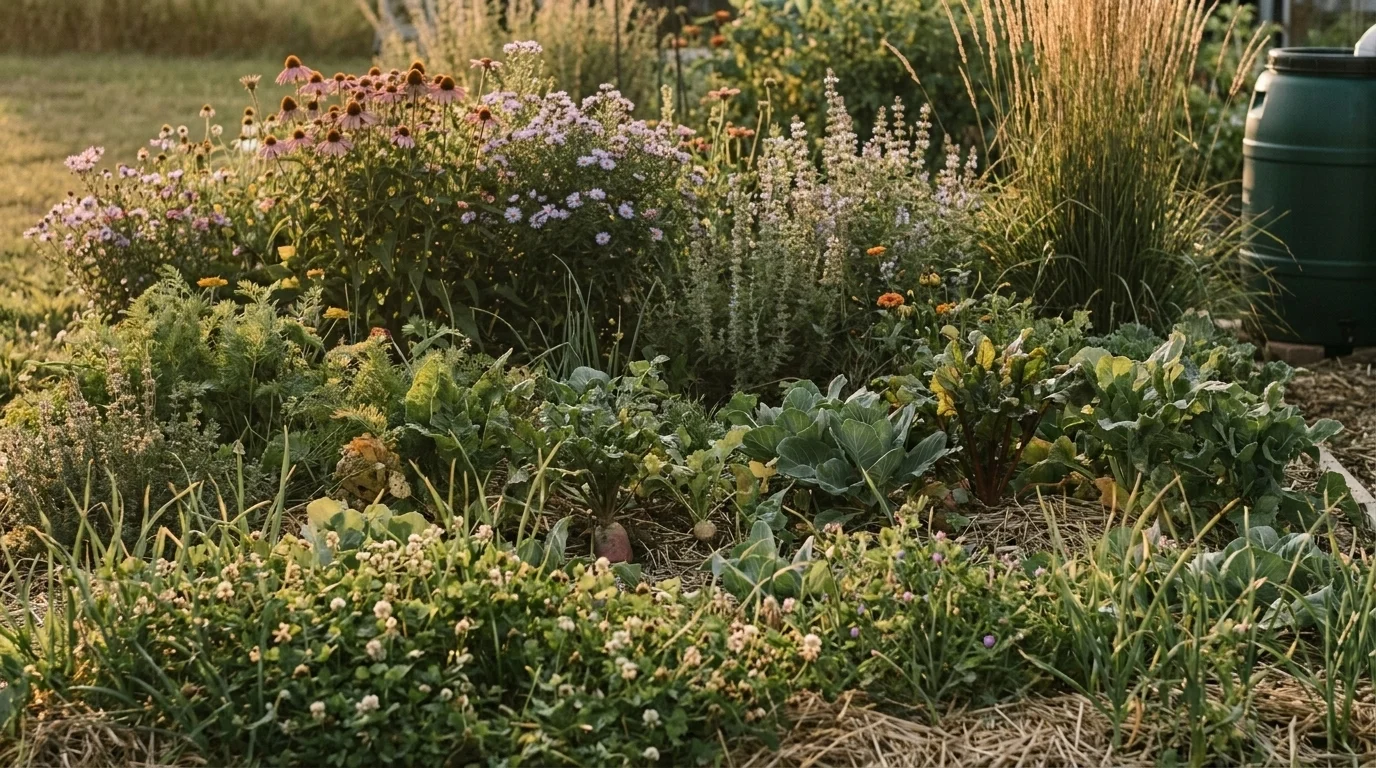
In practice the difference is small at the margin and large at the spine. A sustainable garden minimises chemical inputs; a regenerative one builds the soil's organic matter year on year. A sustainable garden tolerates pollinators; a regenerative one is planted to support them. A sustainable garden conserves water; a regenerative one captures and slows it on site. The line is not bright, and I have not yet decided whether the new word is doing useful work or whether it is a marketing layer on top of practices the older word already covered. I notice that the practices it names — no-till layering, cover cropping, the seventy-per-cent native floor, the rain garden as runoff sink — are practices the more thoughtful sustainable gardeners were already doing. The new word may be doing the political work of distinguishing them from the gardener who has bought a packet of wildflower mix and called it a meadow.
Loading image...
A sustainable bed minimises harm; a regenerative one leaves the soil measurably better each season. Same Saturday, stricter standard — and mostly the same practices.
The work the receipts do not measure
The case for sustainable gardening does not, when you set it down honestly, rest on the spreadsheet. The kilogram of tomatoes from a no-dig bed costs more in hours than the supermarket charges per kilogram; the rain barrel takes a season or two to pay back its install; the heritage seed line that has not been licensed away is more expensive than the patented one. The plot is uneconomic. It has always been uneconomic. What the receipts cannot measure is the slower thing the plot is actually doing: rebuilding a soil that was depleted, feeding a moth community that the wider landscape has thinned, holding a small piece of land outside the reach of the chemical industry that the supermarket lettuce belongs to. The dignity of the plot, in 2026, is something close to an ecological refusal.
That is the ethical case, and it is the case the older perfume-language version of this essay was reaching for and could not quite name. There is no clean conclusion to it — only a Saturday in front of a bed, a bag of mulch, a packet of seed you have looked at carefully, and the small, repeated decision to take provenance seriously enough that the receipts cannot do all of the moral work. That decision, made often enough, is what a sustainable garden actually is.
What's the difference between sustainable and regenerative gardening?
Sustainable gardening aims to do no harm — minimize chemical inputs, conserve water, preserve biodiversity. Regenerative gardening goes further: it actively rebuilds soil health and ecosystem function over time. Practices like no-till layering, cover cropping, and 70%+ native plant cover are regenerative because they leave the garden measurably healthier each season, not merely undamaged.
How much of my garden should be native plants?
The National Wildlife Federation cites about 70% native plant biomass as the threshold for measurable wildlife and food-web benefit in a residential garden. Below that, insect populations are too low to support local songbirds raising young; above it, they reliably are. Use a regional native plant list (your state native plant society or a botanical garden index) to choose species suited to your USDA zone.
Should home gardeners plant GMO seeds?
As of the FDA-reviewed purple tomato in 2023, GMOs are newly available to US home gardeners. The decision is personal but informed by three questions: (1) Is the seed under a patent license that restricts saving seed for next season? (2) What's the cross-pollination distance to neighboring gardens that may not want GMO genetics? (3) Does the modification address a real garden problem, or just a novelty trait? Organic certification standards prohibit GMO seed.
How can I tell if a nursery plant is treated with neonicotinoids?
Ask directly — most reputable garden centers can confirm pre-treatment status, and a growing number now label neonic-free plants. Neonicotinoid-treated nursery plants release pesticide systemically into nectar and pollen, which means even pollinator-friendly species like milkweed can harm bees if pre-treated. State policy is shifting (Vermont banned outdoor neonic use in 2025; EPA review ongoing), but the consumer-rights answer in the meantime is to ask before buying.
What's the right mulch depth for a sustainable garden?
Three to four inches of organic mulch — wood chip, shredded leaf, or straw — is the consensus depth across extension services. It suppresses most weed germination, halves evaporative water loss, and feeds the soil as it decomposes. Thinner is decorative only; thicker can choke the crown of young perennials and limit gas exchange to the soil.
Why is sustainable waste management important in home gardening?
Sustainable waste management reduces organic waste sent to landfill and enriches soil health through composting. Layering compost on top of a no-dig bed preserves soil structure and microbial life; community composting extends the benefit across a neighborhood; avoiding broad-spectrum pesticides and opting for integrated pest management keeps beneficial insects and pollinators in the system that the garden depends on.
How can consumers ensure ethical practices in the green industry?
Prioritize provenance transparency — ask suppliers where seed and bulbs come from, what labor standards their nurseries hold, and whether plants are pre-treated with neonicotinoids. Look for organic certifications, neonic-free labeling, and seed lines that permit seed-saving (not patent-licensed for a single season). Supporting suppliers who answer these questions clearly is the practical content of an ethical gardening choice.
Navigating the Gray Zones: Ethical Dilemmas in Modern Home Gardening
Join
Loading...
Our Green Community!
Loading...
VerdeNook is more than just a source of gardening wisdom; it’s a platform for sharing, learning, and growing together. We invite you to join our community, share your stories, and spread the joy of gardening. Let’s sow the seeds for a greener, healthier, and more sustainable future, one garden at a time.