Green Threads: The Influence of Home Gardening on the Fashion Industry
Share this article:
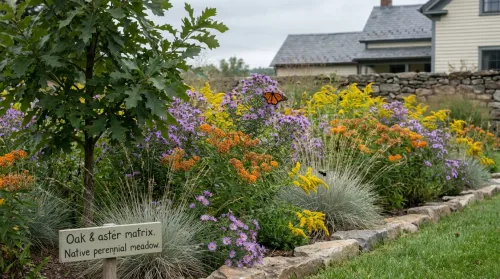
Every colour here came out of the bed: marigold gold, coreopsis rust, indigo blue. Grow the dyes and you feed the pollinators twice — for nectar, then for colour.
Natural dye plants: a dyer's coreopsis at the edge of the milkweed bed
At the edge of the pollinator refuge I run in Ulster County, on the warm side of a hedgerow that catches the morning sun, there is a row of Coreopsis tinctoria — dyer's coreopsis — that I planted three seasons ago for two reasons at once. The miner bees work the flowers in late June; my workshop students take the same flowers home in a paper bag at the end of August and come back the following month with a skein of merino wool the colour of marigold paint. The plant is doing two jobs. The ecological logic and the dye logic are not in tension here; they are the same logic, which is that a garden full of useful flowers is also a garden full of insects, and the gardener who learns to look at a plant for what it does in both registers is the gardener who ends up with a richer garden.
This piece is a list of eighteen natural dye plants worth growing at home, with the Latin names, USDA zones, dye colours, and growing notes that the older gardening literature on this topic consistently skips. The botanical literature counts somewhere between 555 documented dye-producing species (Springer, 2025 African systematic review) and roughly a thousand species with documented textile-dye potential (Heliyon / PMC 9587285, 2022), of which only about ten dominate commercial use. The eighteen below are the ones a home gardener in temperate North America can actually grow, harvest, and use in the same season — or, in two cases, with a patience the rest of the list does not require.
The 4×4 dye-garden blueprint
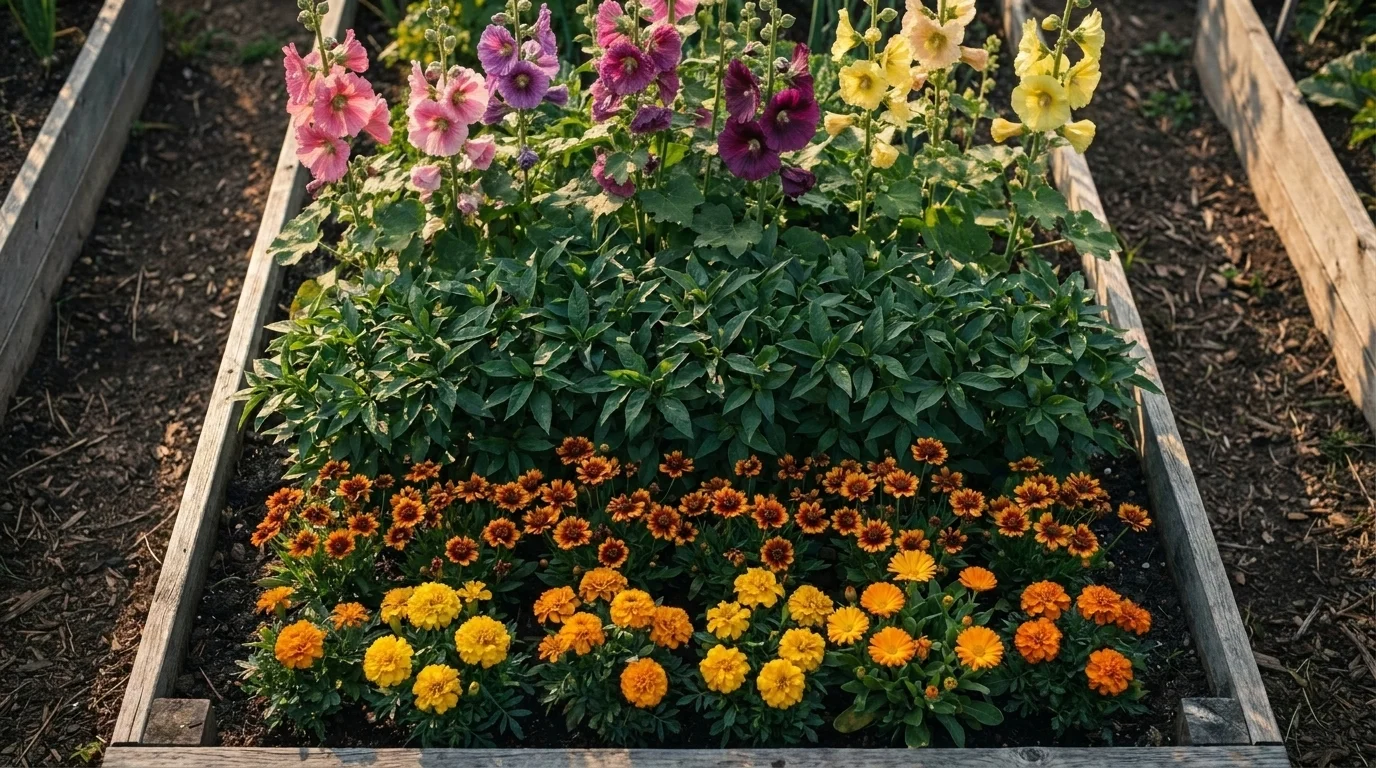
If you have one raised bed to give over to colour, the layout below works in USDA zones 4–9 with adjustments at the margins. The arrangement runs from tallest at the back of the bed to shortest at the front, with one perennial corner allowing for the multi-year plants.
BACK row — 4–6 ft    Hollyhock (Alcea rosea)    Japanese indigo (Persicaria tinctoria)
MIDDLE row — 2–3 ft  Madder (Rubia tinctorum, perennial corner) | Weld (Reseda luteola)
FRONT row — 1–2 ft   Marigold (Tagetes erecta)   Dyer's coreopsis (Coreopsis tinctoria)   Calendula (Calendula officinalis)
Two notes on the layout. Madder (Rubia tinctorum) needs three years of root growth before harvest — plant it once in the corner you can leave undisturbed; harvest in year three. Weld (Reseda luteola) is biennial — sow this year, harvest the second year. Everything else is an annual you can sow and harvest in the same season. The blueprint accommodates the long-game plants in their own corner and runs the fast colours through the open ground.
The list: eighteen natural dye plants
Each entry gives the plant's common and Latin name, the dye colour, USDA zone range, light and soil preference, harvest timing, and a beginner-difficulty rating from 1 (planted-and-forgot) to 5 (long-game patience).
Annuals — same-season colour
1. Marigold (Tagetes erecta or Tagetes patula) — golden yellow to deep orange. Zones 2–11 as annual; full sun, well-drained soil, 12–18" spacing. Harvest flowers from July until frost. Beginner difficulty: 1. Marigold is the easiest beginner dye plant — it self-seeds, tolerates poor soil, and flowers continuously from late spring through frost. The colour holds well on wool with a simple alum mordant.
2. Dyer's coreopsis (Coreopsis tinctoria) — rust orange to deep red. Zones 2–11 as annual; full sun, average soil, 12" spacing. Harvest flower heads through August. Beginner difficulty: 1.
3. Calendula (Calendula officinalis) — yellow to soft orange. Zones 2–11 as annual; full sun to part shade, average soil, 12" spacing. Harvest flowers June–September. Beginner difficulty: 1.
4. Sulphur cosmos (Cosmos sulphureus) — yellow to orange. Zones 2–11 as annual; full sun, well-drained soil, 18" spacing. Harvest flowers July–September. Beginner difficulty: 1.
5. Japanese indigo (Persicaria tinctoria) — blue. Zones 2–11 as annual (zones 8+ may overwinter); full sun, rich moist soil, 8–10" spacing. Harvest entire plant just before flowering, July–August. Beginner difficulty: 2. Japanese indigo is the better starter blue than its older European cousin — it yields a more vibrant indigo and the leaves are easier to process at home-garden scale.
6. Dyer's chamomile (Anthemis tinctoria) — bright yellow. Zones 3–7; full sun, well-drained alkaline soil, 12–18" spacing. Harvest flowers June–August. Beginner difficulty: 2. Among the most lightfast natural dyes.
7. Black-eyed Susan (Rudbeckia hirta) — golden yellow to greenish yellow. Zones 3–8; full sun, average soil, 12–18" spacing. Harvest flowers July–September. Beginner difficulty: 1. Native through much of the Northeast and Midwest.
8. Safflower (Carthamus tinctorius) — yellow from the outer florets, pink-red from the inner florets (with extraction). Zones 2–11 as annual; full sun, dry soil, 8–12" spacing. Harvest flowers July–August. Beginner difficulty: 3 (the two-colour extraction is trickier than single-colour plants).
9. Madder (Rubia tinctorum) — deep red from the third-year roots. Zones 5–9 perennial; full sun, deep loose soil, 24" spacing. Harvest roots in autumn of year three. Beginner difficulty: 4. The patience plant — plant once, leave undisturbed, harvest in three years per Mother Earth News's mature-root guidance.
10. Weld (Reseda luteola) — clear bright yellow from the leaves and stems. Zones 3–9 biennial; full sun, alkaline well-drained soil, 12–18" spacing. Sow year one; harvest plant tops in year two before seed set. Beginner difficulty: 3. One of the most lightfast natural yellow dyes recorded in the textile literature.
Loading image...
Lay a dye bed tall-to-short: hollyhock and indigo at the back, coreopsis in the middle, marigold and calendula at the front. Every row also feeds the bees.
Perennials, herbs, and trees — multi-year colour
11. Woad (Isatis tinctoria) — pale to mid-blue from leaves. Zones 4–9 biennial; full sun, well-drained alkaline soil, 12–15" spacing. Harvest first-year leaves through summer. Beginner difficulty: 3. The European indigo before Japanese indigo arrived; gives softer, paler blues than its modern cousin.
12. Hollyhock (Alcea rosea, dark varieties) — soft green to mauve from the dark-purple-flowered cultivars. Zones 3–8 biennial/short-lived perennial; full sun, average soil, 18–24" spacing. Harvest flowers through summer. Beginner difficulty: 2.
13. Wild bergamot (Monarda fistulosa) — soft yellow to peach. Zones 3–9 perennial native; full sun to part shade, average soil, 18" spacing. Harvest flowers July–August. Beginner difficulty: 1. Important pollinator plant — Monarda is the larval host for the hermit sphinx moth and a key nectar source for native bees. Choose this row carefully if your dye-plant patch is also doing pollinator work.
14. Yarrow (Achillea millefolium) — yellow to gold. Zones 3–9 perennial; full sun, drought-tolerant, 18" spacing. Harvest flowers June–August. Beginner difficulty: 1.
15. Goldenrod (Solidago spp.) — clear yellow to olive. Zones 3–9 native perennial; full sun, average soil, naturalises freely. Harvest flowering stems August–September. Beginner difficulty: 1. Native through most of North America and a keystone late-season pollinator plant — the bumblebees on goldenrod in September are doing the late-year provisioning the garden's food web depends on.
16. Black walnut (Juglans nigra) hulls — deep brown to nearly black. Zones 4–9 native tree (you grow it for the tree, not for the dye; the hulls are a windfall). Harvest the green hulls in autumn before they blacken on the ground. Beginner difficulty: 2. The juglone in the walnut roots inhibits many garden plants — plant the tree where it will not interfere with vegetables or sensitive perennials.
Kitchen-scrap dyes — no garden required
For the reader without garden space, several dyes come free with normal cooking. The colour-to-source map below is drawn from wildhearthlife's documented home palette:
17. Yellow onion skins — deep orange to rust. Save the papery outer skins from cooking; a quart bag's worth dyes half a pound of wool a strong orange.
18. Red onion skins — soft olive green. Save the outer skins of red onions for an olive that is hard to get from any other home source.
19. Avocado pits and skins — dusty pink. Six avocado pits and skins, simmered for an hour and strained, dye wool a soft, surprising pink.
20. Black walnut hulls (windfall) — deep brown.
21. Turmeric powder — bright yellow. The same turmeric in your spice rack. Lightfast is modest; the colour is striking.
That brings the plant list past eighteen if you count the kitchen scraps as dye sources; the gardening list proper is the sixteen named through entry 16.
USDA zone × harvest calendar at a glance
The table below summarises the planting and harvest windows for the major garden-grown dye plants. Zones extend at the warm end for annuals (anywhere they will frost-free for the season) and contract at the cold end for perennials.
Plant
Zone range
Sow
Harvest
Type
Marigold
2–11 annual
Indoors Mar; out May
Jul–frost
Flowers
Dyer's coreopsis
2–11 annual
Direct sow May
Jul–Aug
Flowers
Calendula
2–11 annual
Direct sow Apr–May
Jun–Sep
Flowers
Sulphur cosmos
2–11 annual
Direct sow May
Jul–Sep
Flowers
Japanese indigo
2–11 annual
Indoors Mar; out Jun
Jul–Aug
Leaves
Dyer's chamomile
3–7 perennial
Indoors Mar; out May
Jun–Aug
Flowers
Black-eyed Susan
3–8 perennial
Direct sow May
Jul–Sep
Flowers
Safflower
2–11 annual
Direct sow May
Jul–Aug
Flowers
Madder
5–9 perennial
Year 1 transplant Apr
Year 3 autumn
Roots
Weld
3–9 biennial
Direct sow May Y1
Year 2 Jun–Jul
Tops
Woad
4–9 biennial
Direct sow Apr Y1
Year 1 Jun–Aug leaves
Leaves
Hollyhock (dark)
3–8 biennial
Direct sow Jul Y1
Year 2 Jun–Aug
Flowers
Wild bergamot
3–9 perennial
Spring transplant
Jul–Aug
Flowers
Yarrow
3–9 perennial
Spring transplant
Jun–Aug
Flowers
Goldenrod
3–9 native perennial
Existing stand or seed
Aug–Sep
Flowering tops
Three things to read from this table. The annuals are forgiving — sow in May, harvest by August. The perennials reward patience — establish in year one, harvest fully from year two or three. The biennials are the trap most beginners fall into — they think year one is the dye year and miss the harvest entirely; weld and woad both give their colour in year two.
Mordants: kitchen-safe first, advanced never
A mordant is the metallic salt or natural compound that binds the dye to the fibre. Without one, most natural colours wash out fast. With one, they hold for years. The honest beginner answer, drawing on Morning Chores' mordant comparison, is to use the kitchen-safe natural mordants exclusively and skip the heavy-metal alternatives entirely.
Alum (potassium aluminum sulphate) is the standard starter mordant. Available from any dyeing supply shop or pharmacy under "pickling alum." Use roughly 12% of fibre weight (i.e., 12 g alum per 100 g of wool). Soak the fibre in dissolved alum and water at low simmer for an hour; remove, rinse, then dye. Alum is the mordant for almost every natural dye in this list.
Salt acts as a fixative for cellulose fibres (cotton, linen) and as a colour-modifier. A quarter cup of salt per gallon of water is a common cotton pre-soak.
Vinegar is a fixative for protein fibres (wool, silk) and a mild modifier for berry dyes. One part white vinegar to four parts water for a pre-soak; not strong enough to act as a full mordant.
Sumac (Rhus typhina or Rhus glabra) leaves — high in tannin, function as a botanical mordant. Boil the leaves for an hour; strain; use the tannin water as a pre-soak.
What to avoid: chrome (potassium dichromate) and tin (stannous chloride). Both produce vivid colours and are both toxic — they belong in a textile-artist's studio, not on a home stove. The colour gain over alum is small. The risk is not worth it for a hobby dyer working in a kitchen.
One useful rule from the textile literature: protein fibres (wool, silk) hold natural dye dramatically better than cellulosic fibres (cotton, linen). The Heliyon review cites K/S colour-strength values above 10.0 for wool and silk with minimal mordants, well above the values for cotton and linen at the same mordant ratios. If you are starting out and want the strongest colour for the least effort, start with wool.
A marigold extraction, end to end
The complete extraction below uses marigold dye — the simplest first project, drawn from the easiest plant on the list. The yields scale linearly; double the materials for double the fibre weight.
Harvest roughly 100 g of marigold flower heads, fresh or freshly dried. (A 1:1 weight ratio of fresh plant material to dry fibre is a good beginner default per the standard dyeing literature.) Cut the heads with kitchen scissors; remove green sepals where you can.
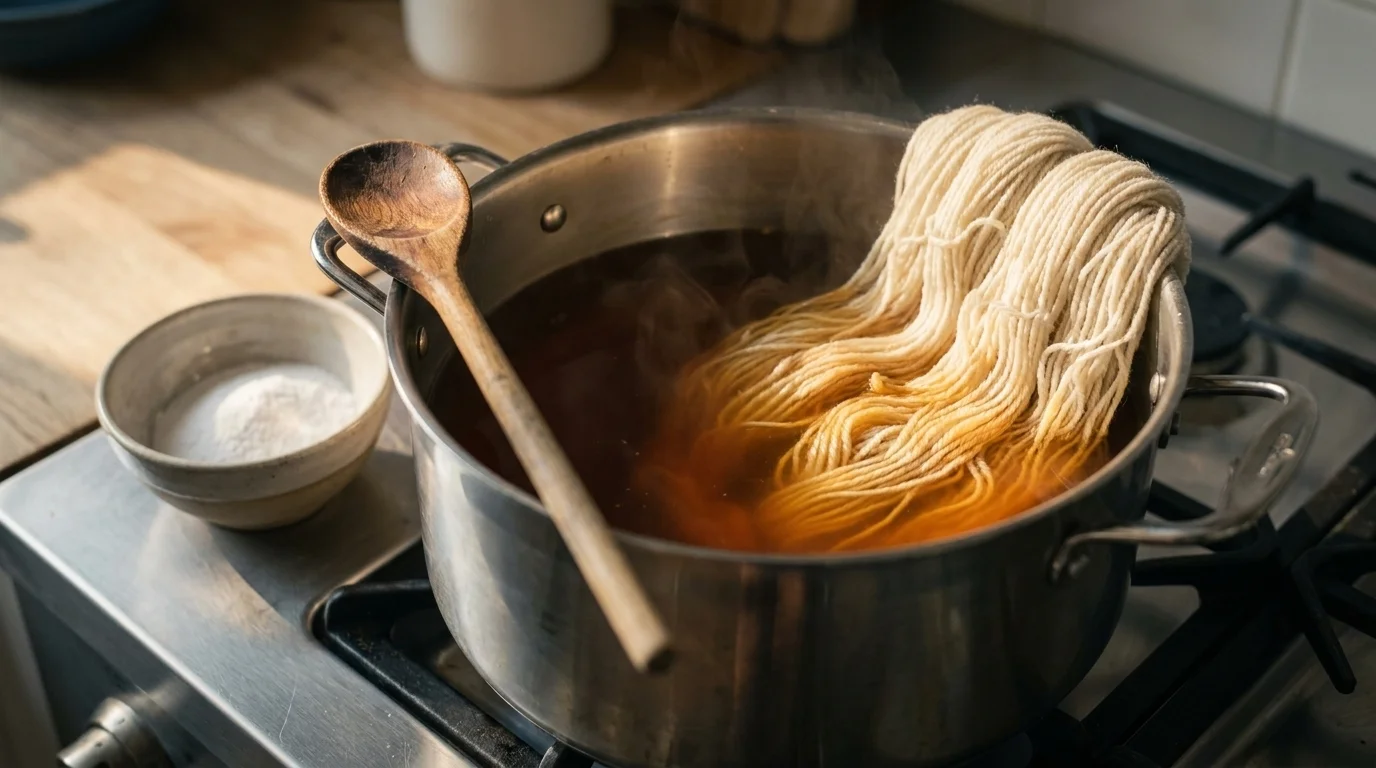
Pre-mordant 100 g of dry wool yarn or fabric in 12 g of alum dissolved in roughly 4 litres of warm water. Simmer 1 hour at 80°C; remove, rinse cool.
Extract the dye by simmering the marigold flowers in roughly 4 litres of water for 60 to 90 minutes, until the liquid is deeply amber. Strain through a sieve into a separate dye pot.
Dye the pre-mordanted wool by placing it in the strained dye bath. Heat to 80°C; hold 1 hour. Turn the fibre occasionally for even uptake.
Cool and rinse. Allow the fibre to cool in the dye bath overnight for deepest colour. Rinse in cool water until the water runs clear. Air-dry out of direct sunlight.
Total time: roughly 4 hours active work, plus the overnight cool. Total cost beyond materials you already grow: a small amount of pickling alum, one pot you keep dedicated to dyeing (don't share it with food preparation), one pair of rubber gloves. The wool yarn or skein you start with becomes a yellow you cannot buy.
Loading image...
Mordant the wool in alum first, then simmer it in the marigold bath — the mordant is what makes the gold stay gold after the first wash.
Beyond colour: the antimicrobial and UV-protective benefit
A part of the natural-dye story missing from every consumer-facing competitor: plant dyes carry functional properties beyond the colour they put on the fibre. The Heliyon 2022 review on sustainable textile coloration using natural plant resources documents antimicrobial, UV-protective, and antioxidant activity in dyed fibres alongside the colour effect. The same tannins and flavonoids that bond the dye to the fibre also inhibit microbial growth on the cloth and absorb a portion of UV light. A wool jumper dyed with weld carries a measurable UV-protection factor that the same wool jumper undyed does not. A linen tea towel dyed with walnut hulls develops modest natural antimicrobial properties that the bleached factory equivalent lacks. These effects are subtle, but they are documented in the peer-reviewed literature, and they mean a hand-dyed garment is doing one or two pieces of work the synthetic-dyed equivalent simply does not.
The implication for the home gardener: a dye plant is not only an aesthetic plant. It is also, in a small way, a textile-treatment plant. The food web and the fibre web are not really separate systems.
What this is and is not — and a word on the fashion question
The legacy framing of this article was that home gardening influences the fashion industry. The honest reading of the 2026 market is that the influence is, increasingly, going the other way: the global natural-dyes market reached approximately USD 4.8B in 2026 and is projected to grow at roughly 5.7% CAGR through 2033, with plant-based dyes holding more than two-thirds of the segment (Verified Market Reports, 2026). The brands writing this market are sourcing the same plants the home gardener can grow. The connection between the plot and the wardrobe is real, but the direction of travel is from the garden out, not from the runway in.
That is the closing thought I wanted to leave the older essay with, and could not, because the older essay was trying to be a fashion essay. The eighteen plants above are the actual ground the conversation lives on. By the time the serviceberry flowers in your zone, you have about three weeks to think about what to sow; by the time the goldenrod blooms in September, the bumblebees and your dye pot are both ready for the harvest. The garden and the fibre, in the honest reading, are one set of decisions.
Marigold is the easiest beginner dye plant — it self-seeds, tolerates poor soil, flowers continuously from late spring through frost, and produces a rich golden-yellow dye with just an alum mordant. Calendula, dyer's chamomile, dyer's coreopsis, and Japanese indigo are similarly forgiving for first-time dye gardeners.
Do natural dyes fade over time?
Some natural dyes — like weld, dyer's chamomile, and madder — are exceptionally lightfast and hold colour for years. Others, especially berry- and red-cabbage-based dyes, fade faster. Using an alum mordant, washing in cold water, and avoiding direct sunlight on dyed garments dramatically extends colour life.
Can you make natural dye without a mordant?
Yes, but the colour will fade and wash out faster. Some plants — black walnut hulls, pomegranate, and onion skins — contain enough natural tannins to act as their own mordant. For most plants, a simple alum or salt pre-soak is enough to lock in colour without using harsh chemicals like chrome or tin.
How long does madder take before you can harvest the roots for red dye?
Madder (Rubia tinctorum) needs a minimum of three years in the ground before its roots develop enough alizarin to produce a strong red dye. First- and second-year plants will give weak pink to orange tones. Plant once in a corner you can leave undisturbed and harvest in year three for best results.
What's the difference between woad and Japanese indigo?
Both produce blue dye from the same pigment (indigotin), but Japanese indigo (Persicaria tinctoria) yields more vibrant blues and is easier to process at home-garden scale. Woad (Isatis tinctoria) is hardier in cooler climates but produces softer, paler blues. Japanese indigo is the better starter choice for most home gardeners.
How much plant material do I need to dye one pound of fabric?
A general beginner rule is a 1:1 ratio by weight — one pound of fresh plant material per pound of dry fabric — for medium-saturation colour. Doubling the plant material yields deeper shades; halving it gives pastels. Dried plant material is more concentrated, so use about half the weight of fresh.
Are natural dyes safe for kids' clothing?
Most natural dyes mordanted with alum are completely safe for children's clothing. Avoid chrome and tin mordants entirely, and skip dyes from plants with toxic constituents (yew, oleander, foxglove) for any garment that will be worn against the skin. The eighteen plants in this guide are all alum-compatible and skin-safe.
Landscaping with Natives: Designing Gardens to Celebrate Local Flora and Fauna
Join
Loading...
Our Green Community!
Loading...
VerdeNook is more than just a source of gardening wisdom; it’s a platform for sharing, learning, and growing together. We invite you to join our community, share your stories, and spread the joy of gardening. Let’s sow the seeds for a greener, healthier, and more sustainable future, one garden at a time.