Cultivating Community: The Story of Neighborly Garden Co-Ops Transforming Urban Spaces
Share this article:
Step 1 isn't buying seeds. It's organising the meeting, walking the site, and finding the four people who will actually sign the bylaws.
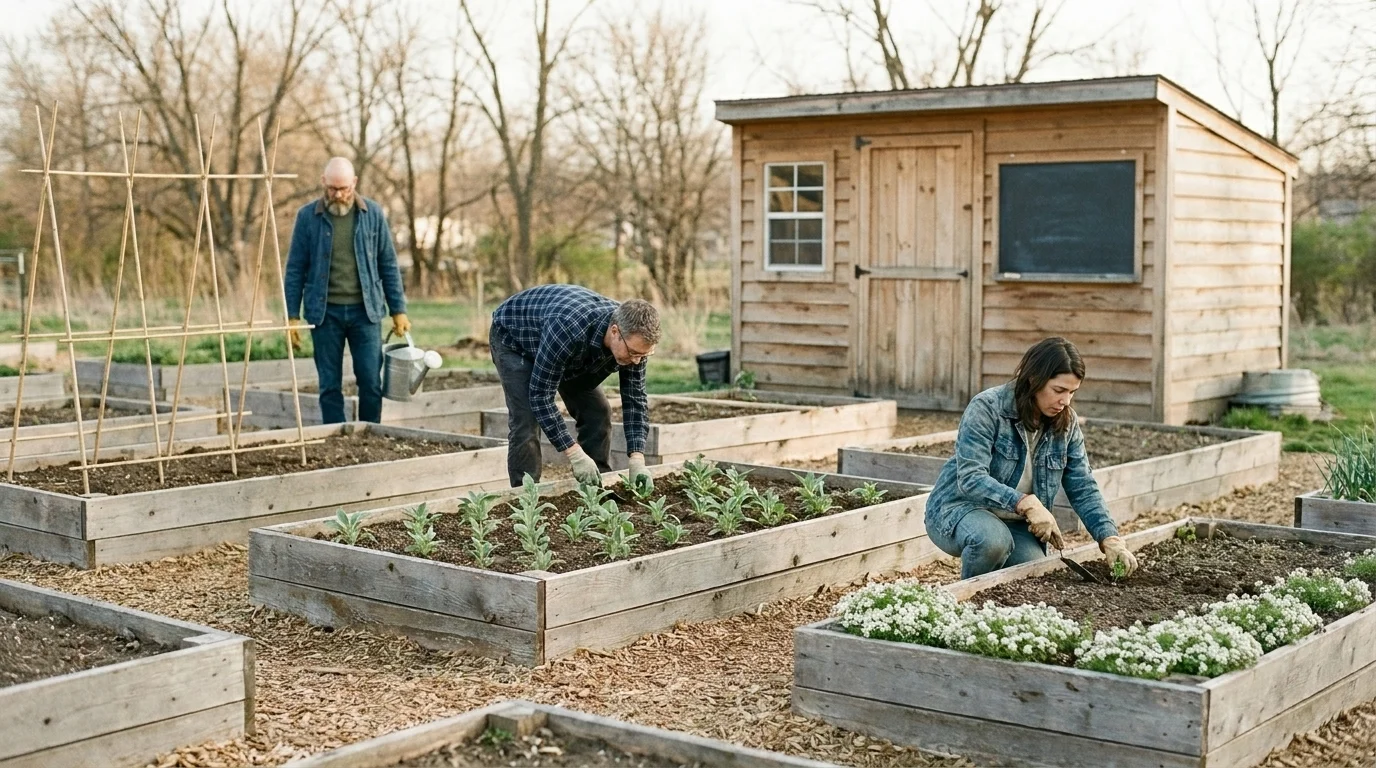
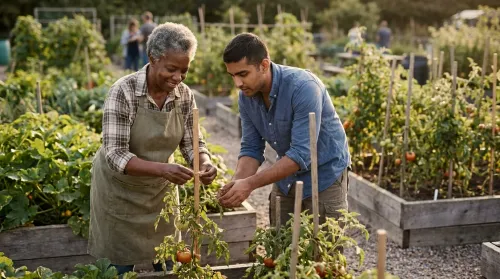
This is a practical guide on how to start a community garden, written from the inside. The community plot I help coordinate sits on a strip of council land behind a train line in Brunswick, and on the Saturday I am thinking of, there were eleven of us there by nine in the morning — a retired electrician, a woman from the Vietnamese grocer on Sydney Road, two exchange students from Chile, a nurse finishing a night shift, and the rest of us somewhere in between. We turned a bed, dug in two barrows of aged mushroom compost, and argued, in the best-humoured way, about whether the new pea variety was worth the seed price. At the end of four hours, we had roughly a square metre of newly planted ground each, and about three hundred and fifty collective dollars' worth of labour, if you were counting. We were not counting, and that is almost — but not quite — the whole point. The other part of the point is how the plot came to exist in the first place: who signed the lease, who paid for the soil test, which member of the planning committee wrote the bylaws, and which government grant covered the rain barrel. This is the guide I wish someone had handed me eight years ago when our committee first sat down. It is the practical answer to the question "how do we start a community garden?" — the operational layer underneath the romance.
Quick answer: what is a community garden, and how do you start one?
A community garden is a single piece of land — public, private, or institutional — gardened collectively by a group of people who share the work, the plots, and the produce. Starting one takes ten ordered steps, roughly $3,750 to $7,500 in startup costs at the University of Minnesota's benchmark, and a planning committee of three to five people willing to commit to a three-year minimum lease. The first step is not buying seeds; it is organising a meeting and asking who in your neighbourhood actually wants to do this.
A brief history of the community garden
The community garden, as we recognise it today, has roots in the kitchen gardens and allotments that emerged across industrialising Europe in the late nineteenth century — small plots leased to urban factory workers as a hedge against the food insecurity of the new wage economy. The American version comes in waves. The Victory Gardens of the Second World War (a 1943 Australian Department of Agriculture leaflet titled Dig for Victory: A Guide for the Home Gardener runs to sixteen pages, uses the word "duty" eleven times, and assumes the reader has access to a back yard, a spade, and a Saturday afternoon — three assumptions that are doing a lot of quiet work eighty years later) gave way after the war to suburban single-family lawns and the long quiet decade of the 1950s. The modern American community-garden movement is usually dated to the early 1970s, when a confluence of the OPEC oil crisis, urban fiscal collapse (most dramatically in New York), and an emerging environmentalism produced groups like the Green Guerillas — gardeners who claimed vacant lots without permission and turned them into productive plots. Seattle's P-Patch programme began in 1973 and now coordinates over 90 sites. New York's Green Thumb programme, founded in 1978, today supports more than 550 gardens. Detroit's 2013 agricultural-zoning amendment legitimised over 355 gardens that had been operating in legal grey area for decades.
The ACGA 10-step framework is the canonical skeleton — most extension guides rebuild from it because no one has improved on it in three decades of practice.
The 10-step framework for starting a community garden
The structural backbone here is the canonical 10-step framework published by the American Community Gardening Association (ACGA). Most of the operational guides I have read over the past several years — from Cornell Cooperative Extension's Beginning Farmers programme to the University of Minnesota's CCAPS short course — rebuild from the same skeleton, because no one has improved on it. The framework as published is structural; the version below adds the funding figures, plot dimensions, and legal-structure choices that the ACGA's resource page leaves to its members and partners.
Step 1: Organise a meeting
Before any decisions about plots, fees, or grants, you need to know whether the demand exists in the people who live within walking distance of the proposed site. Hold one public meeting. Post flyers within a 10-minute walk. Invite at least 15 to 20 people. If fewer than eight show up, the community is not ready and the garden will collapse in season two — better to know that now.
Step 3: Identify resources and define the legal structure
The legal-structure decision drives everything else. Three common paths:
Informal volunteer group under a fiscal sponsor. The simplest. Find an existing 501(c)(3) (a church, a school, a community development corporation) willing to be your fiscal sponsor — they handle tax-deductible donations, you keep the operational autonomy. Common terms: a small administrative percentage of donated funds goes to the sponsor for overhead. Best for gardens with modest annual budgets in years one and two.
Your own 501(c)(3) nonprofit. Independence and the ability to receive grants directly. The cost is real: incorporation and federal exemption application fees together typically run from several hundred to over a thousand dollars, plus ongoing compliance work (annual Form 990, state filings). Worth it for gardens running large annual budgets or planning multi-year capital projects.
Cooperative (LLC or cooperative association). Rare for traditional community gardens, common for urban-farm collectives that sell produce. The cooperative model is governance — one member, one vote — not a specific legal structure; you can do this inside any of the above forms.
Most US community gardens settle on fiscal sponsorship in years one and two and only file for their own 501(c)(3) once the annual budget and the legal-protection needs justify the overhead.
Site candidates to investigate: vacant municipal lots (in cities like Detroit, NYC, and increasingly Atlanta and Cleveland, dedicated programmes lease these to community groups for nominal annual fees, sometimes $1 a year as a symbolic lease); school grounds (after-hours weekend access); church land; cooperatively owned co-housing or apartment complex green space; and, increasingly, rooftops on commercial buildings whose owners are looking for green-roof tax credits.
Step 5: Test the soil
This is the step the romantic guides skip and the practical ones underline. Many urban vacant lots have residual lead, arsenic, petroleum hydrocarbons, or other contamination from prior industrial or residential use. University extension soil testing labs at UMass Amherst, Penn State, and Cornell typically charge $15 to $50 per sample for a heavy-metals and lead panel; turnaround is two to four weeks. If results come back clean, you can grow in the ground. If lead or arsenic levels exceed safe thresholds, the standard remediation is a raised-bed system with a woven geotextile barrier laid over the contaminated soil, filled with clean imported soil mix — and the EPA Brownfields Programme provides cleanup pathways for severely contaminated sites. Skipping this step risks the health of your most enthusiastic volunteers; the test is cheap.
Step 6: Prepare and develop the site
Standard preparation: clear debris and surface vegetation, install perimeter fencing (typically $8 to $15 a linear foot for chain-link), build a tool shed (a $400 to $900 build for a basic shed), install water infrastructure (a hose bib from a municipal source plus a manifold for drip-irrigation runs, $500 to $1,500 with a plumber), and lay out plots according to your chosen size standard (see Plot Mechanics below).
Step 7: Organise the garden — plot mechanics and shared infrastructure
The questions here decide the daily texture of the garden. How big is each plot? What is the annual fee? What is shared and what is private? The dimensions and fees vary by location and tradition, but the standards cluster around a few common formats:
Plot type / dimension
Typical annual fee
Best for
10×10 ft in-ground (Canadian/US standard)
$25 to $60
New community gardens with abundant land
20×20 ft in-ground (Canadian deep plot)
$50 to $100
Established gardens with serious gardeners
4×8 raised bed (cedar or galvanized)
$30 to $80
Urban sites with contaminated soil; rooftops
4×4 ADA-accessible raised bed (wheelchair-height)
$30 to $80
Inclusive gardens; mandatory under some grant programs
Maryland standard: 200-625 sq ft
$50 to $150
Mid-size suburban community gardens
UMN benchmark: 100-500 sq ft
$25 to $100
The reasonable middle for most new builds
Tokyo rooftop (~3m × 6m, ~200 sq ft)
~$980 / year (high)
Extremely dense urban contexts
Shared infrastructure pays back faster than private plots: a single $400 wheelbarrow, a $200 set of garden hand tools, a $150 set of long-handled tools, and a $250-$400 manual mower or string trimmer comprehensively equip a 20-plot garden. Add a $200 compost bin (or build a three-bin pallet system for $50 in scrap), a $150 rain barrel, and a $300 hose-reel cart, and the tool inventory is essentially complete. Total shared-infrastructure capital: $1,500 to $2,500 for a working 20-plot garden, which is well under the University of Minnesota benchmark startup-cost range of $3,750 to $7,500 once site prep is included.
Step 8: Plan for children
The ACGA framework treats this as its own step because gardens with children present run differently than gardens without. Practical implications: a fenced children's plot or two; clear rules about supervision; consideration of pesticide and tool storage (locked, out of reach); and ideally a planned weekly children's session led by a member who actually enjoys the work. Schools that partner with community gardens often run the children's programming on their own terms.
Step 9: Determine rules — bylaws and the Hold Harmless clause
Bylaws sound bureaucratic and they save the garden. Three things every set of bylaws should specify: how plots are allocated (waiting list rules, fee structure, what counts as forfeiture), how the committee makes decisions (consensus, vote, term limits), and how disputes are resolved (mediation by an uninvolved member, escalation, removal procedures). The conflict-resolution mechanism is the one most committees skip and most regret.
Liability is the other operational reality. A Hold Harmless clause in the member sign-up form — typically a single paragraph noting that the gardener acknowledges the inherent risks of gardening, releases the committee and landowner from liability, and agrees to follow posted safety rules — is paired with a liability insurance policy ($300 to $800 per year for a typical 20-plot garden through specialist providers like Nonprofits Insurance Alliance, ACGA-partnered insurers, or a state-level community-gardens insurance pool where one exists). This sounds like overkill until the first weekend a volunteer trips over a hose and breaks an ankle.
Step 10: Help members stay in touch
The last step is the soft one: build the social texture that holds the garden together between work parties. A monthly newsletter (a Mailchimp free tier handles this for under 500 subscribers), a private WhatsApp or Signal group, an annual harvest dinner, a tool-share Saturday in late winter. None of these things appear on a grant application but they decide whether the garden is alive in year five.
Loading image...
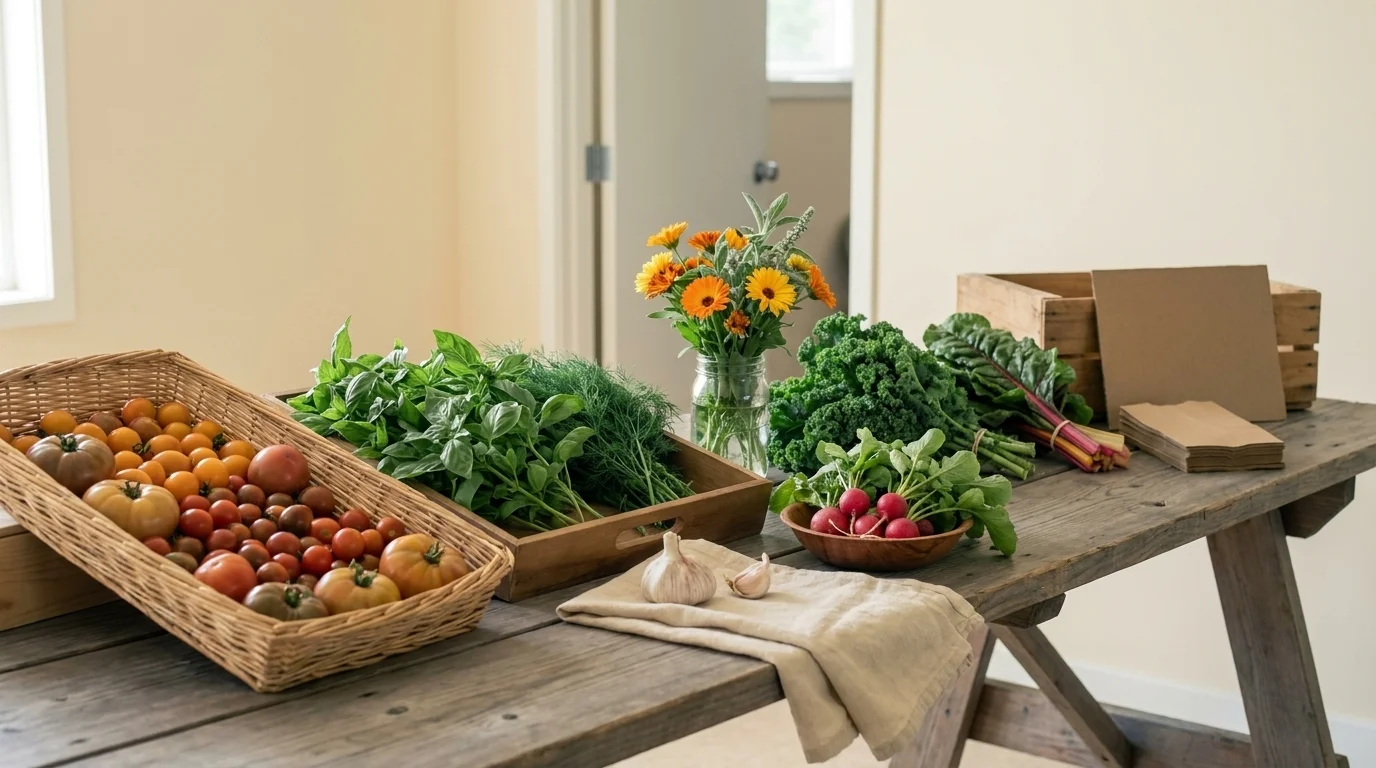
The harvest table is where the bureaucratic 10-step framework finally exhales — the part where the work becomes shared food, and the spreadsheet stops mattering.
The funding ladder (with no money is still possible)
The grant landscape has scaled materially since 2020. The order to climb the ladder, from easiest to hardest:
In-kind donations and local sponsorship. Hardware stores, garden centres, and lumber yards routinely donate seed, soil mix, and tools to community-garden start-ups in exchange for signage and tax-deductible receipts. The mid-sized hardware co-op in my Brunswick neighbourhood donates two cubic metres of mushroom compost a season in exchange for a small wooden plaque at the entrance. Worth asking directly.
Crowdfunding. A modest GoFundMe or Ioby campaign (Ioby specialises in neighbourhood projects and handles fiscal sponsorship for unincorporated groups) typically raises $1,500 to $5,000 for first-year operating costs. Pair with a single open-house event to drive contributions.
The full ladder rarely needs to be climbed in year one. Most new community gardens cover their startup costs through some combination of in-kind donations, a state-level grant of $5,000 to $25,000, and member plot fees. The federal-grant tier becomes relevant once the garden has two years of operating history and a 501(c)(3) or fiscal sponsor in place.
The benefits triad: why this work matters
The benefits literature on community gardens has grown substantially over the past decade. Three documented effects matter for both grant applications and member recruitment.
Social and economic.In food-desert neighbourhoods, community gardens increase access to fresh produce by approximately 30%. The intercultural exchange that happens at a working plot — Brunswick on a Saturday, the eleven of us — is harder to quantify but no less consequential. The dignity of the plot is the phrase I keep coming back to: a person who tends a 100-square-foot piece of ground is, in a small and stubborn way, a different kind of citizen.
Environmental. Urban gardens reduce stormwater runoff, modestly cool the urban heat-island effect via evapotranspiration, support pollinator populations (a fact the larger pollinator-decline literature now treats as significant), and divert organic waste from landfill via composting. The aggregate environmental impact of a single 20-plot garden is modest; the aggregate impact of 800 such gardens across a country, as in Australia, or 2,000 in Singapore, becomes structurally meaningful.
Urban context: zoning, vacant lots, and the modern toolkit
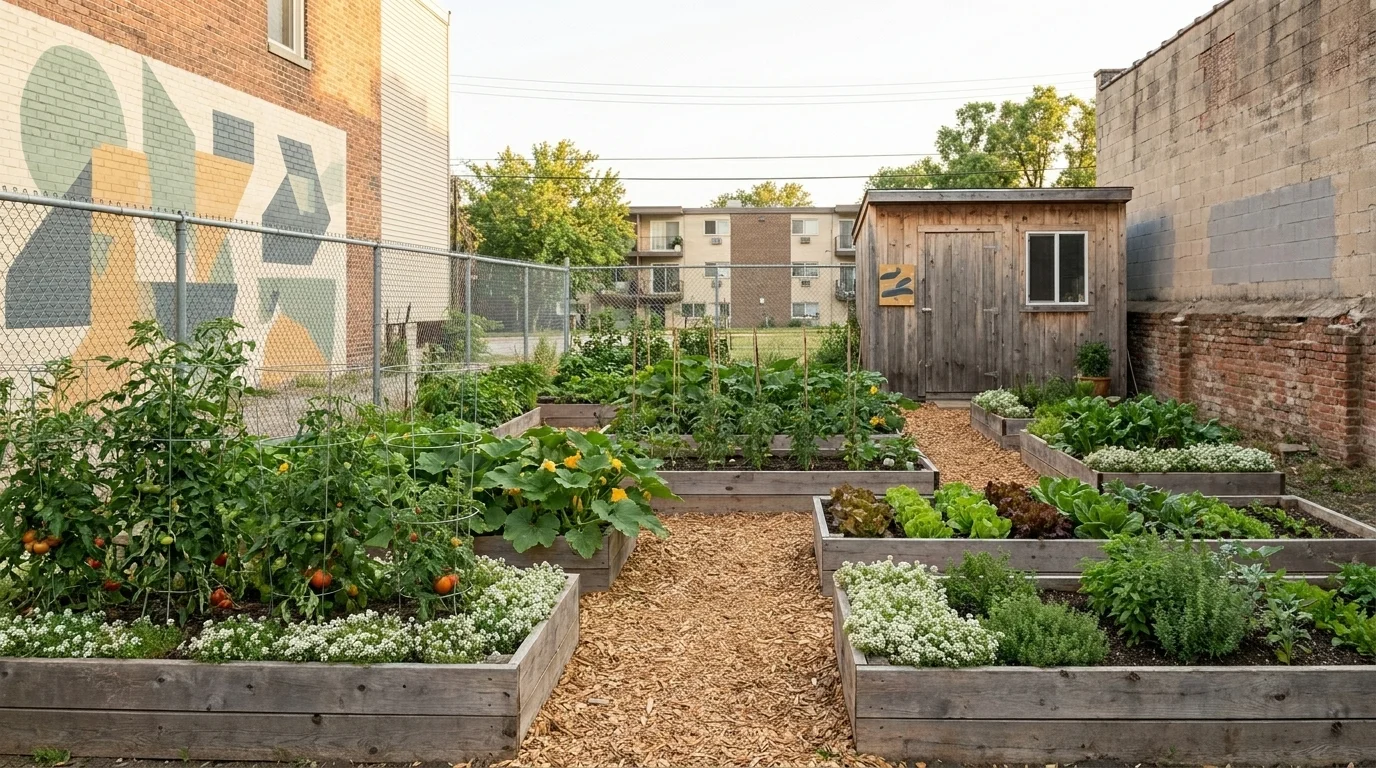
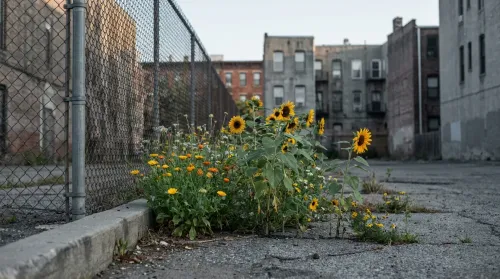
The hardest constraint on urban community gardens is not interest — it is land. The 1943 Dig for Victory leaflet assumed access to a back yard and a Saturday afternoon, two things steadily priced and subdivided out from under the people the leaflet was written for. The 2026 honest version of the same advice is: most urban gardeners do not have a back yard. The legal landscape has slowly accommodated this. Detroit's 2013 agricultural zoning amendment is the leading US model, formally legalising the ~355 gardens that had previously operated in administrative grey area. NYC's GreenThumb continues to lease vacant city lots to community groups for nominal annual fees. Cleveland, Atlanta, and Pittsburgh have followed with their own variants in the years since.
The modern operational toolkit is also worth a mention even if it is not where most new gardens should start. Smart irrigation controllers (the Rachio 3 at around $230, often eligible for $50-$150 utility rebates) can manage drip lines across multiple plots from a phone app. IoT soil-moisture sensors are affordable enough to deploy across a 20-plot garden. Composting can be modernised with bokashi systems or rotating drum composters for tighter urban spaces. None of these are necessary; all of them can extend what a small committee can manage.
Loading image...
Detroit's 2013 agricultural zoning amendment formally legalised over 355 gardens that had been operating in administrative grey area for decades.
A practical close
There is a question I have stopped trying to avoid, which is whether starting a community garden is the most rational use of a Saturday morning. The honest answer is the same one I give about market gardening: usually not, by the spreadsheet, and that is the wrong question. A 100-square-foot plot in Brunswick costs a modest annual fee and produces a season's worth of vegetables; the labour, priced at what the nurse on our committee earns for a shift, considerably exceeds either figure. If the case for community gardens rested on the spreadsheet, none of us would do it, and nobody ever did. The case rests elsewhere: on the dignity of the plot, on the patient repair of urban land that the planning regime had written off, on the small fact that an exchange student from Chile, a retired electrician, and a nurse on the way home from a night shift end up arguing about a pea variety on the same Saturday morning. The 10-step framework above is the bureaucratic infrastructure that lets that argument happen. The argument is what the framework is for. By the time you have walked through the meeting, the committee, the lease, the soil test, the plot allocations, and the first season's harvest, you will know whether your neighbourhood can sustain the conversation. The question worth carrying into next week is not whether you can start a community garden; it is whether you can find the four people who will sign the bylaws.
A community garden is a single piece of land — public, private, or institutional — gardened collectively by a group of people who share the work, the plots, and the produce. Most use a leased site (municipal, school, church, or private), allocate fixed plots of 100 to 500 square feet to individual gardeners or households for an annual fee, and govern by elected committee under written bylaws.
How much does it cost to start a community garden?
The University of Minnesota benchmark puts startup costs at $3,750 to $7,500 for a 20-plot community garden, covering site preparation, fencing, water infrastructure, shared tools, soil testing, and the first season of plot materials. Annual operating cost runs $1,500 to $3,500 thereafter, typically covered by plot fees of $25 to $100 per plot per year plus liability insurance of $300 to $800.
Do I need a 501(c)(3) to start a community garden?
No, not in year one. Most new community gardens operate under a fiscal sponsor — an existing 501(c)(3) like a church, school, or community development corporation that handles tax-deductible donations in exchange for 5-10% of donated funds in administrative overhead. File for your own 501(c)(3) only once your annual budget exceeds roughly $40,000 or you need to apply directly to multi-year federal grants like the USDA UAIP.
How do I test community garden soil for contamination?
Send a soil sample to a university extension lab — UMass Amherst, Penn State, and Cornell each run accessible programs charging $15 to $50 per sample for a heavy-metals and lead panel, with two to four week turnaround. If lead, arsenic, or petroleum residues come back above safe thresholds, build raised beds with a woven geotextile barrier over the contaminated soil and fill with clean imported soil mix. The EPA Brownfields Program provides cleanup pathways for severely contaminated sites.
What grants are available for community gardens?
The USDA Urban Agriculture and Innovative Production (UAIP) program offers Planning grants up to $50,000 and Implementation grants up to $250,000, having invested $53.7 million in urban agriculture since 2020. The USDA People's Garden Initiative provides approximately $1 million annually for school gardens, community gardens, and urban farms. Most US states with significant urban populations also run urban-agriculture grant programs — Minnesota's FY2026 pool is $1.93 million awarding $5,000 to $75,000 per project with a 25% cash match.
How big is a typical community garden plot?
Standard plot sizes cluster around three formats: 10x10 ft in-ground plots (Canadian and US standard, often $25-$60 per year); 4x8 raised beds (urban sites with soil contamination, $30-$80 per year); and 4x4 ADA-accessible raised beds for wheelchair height. Maryland community gardens commonly run 200-625 sq ft per plot; the University of Minnesota benchmark for new builds is 100-500 sq ft.
What is the difference between a community garden and a co-op?
A community garden is a shared piece of land worked collectively, usually with individual plots allocated to participating gardeners. A cooperative refers to a governance and ownership model — one member, one vote — which can be applied to many different organizations, including community gardens, food stores, or housing. Most community gardens are governed cooperatively without being legally incorporated as a cooperative; the distinction is about how decisions get made, not about who owns the land.
How long does it take to start a community garden?
From the first public meeting to the first planted bed, expect 6 to 12 months. The bottleneck is the site lease — most municipal and institutional landowners need 60 to 120 days to process a lease agreement, plus another 30 to 60 days for soil testing and grant cycles. Aim to hold your first organizing meeting in fall or winter to plant in the following spring.
Blossoms of Resistance: The Impactful Role of Gardening in Social Movements
Join
Loading...
Our Green Community!
Loading...
VerdeNook is more than just a source of gardening wisdom; it’s a platform for sharing, learning, and growing together. We invite you to join our community, share your stories, and spread the joy of gardening. Let’s sow the seeds for a greener, healthier, and more sustainable future, one garden at a time.